By Hugo Tortorissi – LIS
The 3rd Congress of the International Socialist League held in Istanbul has been a great step forward for the politics of continuing to regroup the revolutionaries of the world on the basis of key political agreements, an anti-capitalist and socialist program, a revolutionary strategy, with an indispensible method of placing these agreements above everything, respecting the origins and experiences of its members while also learning to coexist with nuances or partial differences, which can always arise in any living revolutionary. This method allowed a historic Congress to take place, which stands in contrast with the context of fragmentation and divisions of other forces. A Congress with delegates from 38 countries, with all continents represented, other invited organizations and the perspective of continuing to advance in the coming period, in the midst of the great challenges that the complex international situation places before us. The step we have taken in this 3rd Congress is significant, provides a contribution, and much remains to be done on the road toward build inga great international and a larger revolutionary regroupment. We will continue to do everything within our possibilities to contribute to this task.
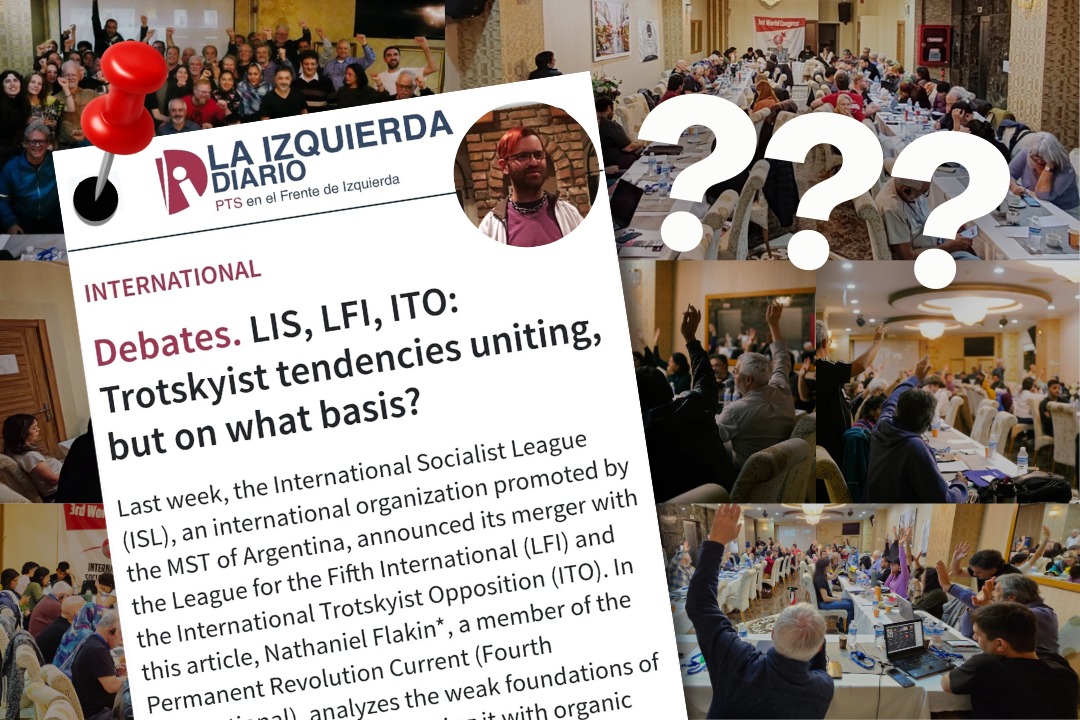
As we share the conclusions with thousands of workers and young activists around the world, it has become clear that the Congress and its dissemination has attracted the attention of other organizations. Unfortunately, in the case of the Trotskyist Fraction of the Argentine PTS, now rebranded as Permanent Revolution Current (CRP), our Congress provoked the need to hastily write a text signed by Nathaniel Flakin that we consider of a very low political level (1). It expresses a combination of political incomprehension of the tasks of the moment, falsehoods, some slander and a somewhat unusual method: the article is about the 3rd Congress of the ISL, but it makes no reference to any of its resolutions nor to the political and programmatic texts presented to the Congress, which are all available to the public and to the author, who did not even take the time to read them. Hence the shallowness and lack of seriousness of his comments and false accusations.
However, let us get to the main debates that the Trotskyist Fraction (CRP) text proposes to us. Starting from the title and the introduction, its incoherence is acute, asking on what basis different currents are uniting in the ISL? Then the author anticipates that he will explain the “flimsy” foundations of our new regroupment. Frankly, you must lack seriousness to begin an article speaking of weakness, when referring to a Congress that advanced in the international unity of revolutionaries on the basis of agreements on the main events of class struggle of recent times and on the basis of a comprehensive Programmatic Manifesto, which refers not only to the current international situation but to every political and programmatic point in the strategy of the world socialist revolution.
The author of the article had time to invent baseless historical and current debates, but he did not have time to read, seriously study, or at least provide a coherent or critical programmatic opinion on what our Congress discussed and resolved. The truth is that to write an assessment and unfounded opinions without referring to the actual documents and resolutions, is indeed a weak method, completely alien to revolutionary internationalism. That is why this article first shares the link to our programmatic manifesto and all our documents and opinions, for the knowledge of all the readers. And so that, if the FT (CRP) wants to make a have serious debate, it can begin by reading the texts and referring to their actual content. That would be a good method that would lead to a positive debate, something the ISL is always open to.
The FT (CRP) article attempts to question the progress achieved at the 3rd ISL Congress, but ends up providing its own confusions on the Ukrainian war. Without providing any evidence – because it does not exist – it accuses the ISL of pro-NATO positions and unclear texts on the subject. In this debate, the author and his international current simply abandon a key principle of the revolutionary movement during wars: the right of peoples to self-determination. It is not the ISL that is unclear, we always defended the right of the Ukrainian people to defend their territory, while always doing so independently and critically of the Zelenski government and denouncing all NATO plans and actions. The Trotskyist Faction (CRP), on the other hand, abandoned the Ukrainian workers from the beginning, denying them the right to defend themselves from an invasion by an imperialist power. On the contrary, the ISL always held the opinion that the character of this war is the following: “The war combines two processes. On the one hand, the invasion by an imperialist power of a semi-colonial or intermediate country that it has historically oppressed, and the just resistance of the Ukrainian people in defense of their self-determination and sovereignty. On the other hand, a concentrated intensification of the inter-imperialist struggle between NATO and Russia, which seek to promote their respective imperialist interests at the cost of the lives of the Ukrainian and Russian workers.” (2)
In this situation, the only correct and revolutionary policy is to respond to this combined and integral reality. The FT (CRP) does not have a correct policy in the face of this war. Furthermore, it does not have a single militant in Ukraine or the region. This is logical, taking into account that its position, though it pretends to conceal it, has always been one of capitulation to the Russian empire and Putin’s invasion.
A (fabricated) story to divide
The text of the Trotskyist Fraction that intends to assess the situation of the ISL, is also written with the self-perceived authority to judge the years-long history of the organizations of the ISL and those that joined in this 3rd Congress. We regret that, on this point as well, the TF’s method combines falsehoods with the refusal to engage in a serious debate.
To give an example, the article raises a series of slanders about our section in Ukraine, while completely ignoring what the Ukrainian Socialist League (ISL section) is, what politics is holds, who its members are and what activities they carry out. The FT (CRP) author’s comments amount to empty talk. He shamelessly echoes an old text by the Turkish SEP: “The biggest problem, as the SEP pointed out when splitting from the ISL in 2022, is that Vernik currently sits with extreme right-wing nationalists and even praises the Ukrainian fascist leader Stepan Banderas“. The least we can say is that one has to be completely irresponsible and dishonest to write such a barbarity and slander against a Ukrainian socialist militant currently active in an invaded country. These absolutely false accusations originate from pro-Putin groups that are financed by that apparatus to spread them. That is why it is scandalous that the FT author repeats them, quotes them and in fact makes them his own, evidencing an appalling method. Proudly, the Ukrainian section of the ISL is made up of honest workers and young socialists who have nothing to do with any extreme right-wing nationalism, a matter completely unworthy of explaining, given the ridiculousness of the accusation. The article also makes reference, by way of slander, to events that took place many years ago, with the intent of discrediting Ukrainian socialist militants. These events are long past and we have no objection to hold an independent tribunal, if necessary, to clarify everything and put things in their place.
To give another example, in the case of Argentina, the FT (CRP) author directly invents a completely baseless history, claiming that the MST joined the FIT-U in 2019 after years of promoting supposedly non-socialist agreements. In the first place, we remind him of the history that the 1st FIT in Argentina was formed by the MST in 1993, with the PO at that time. The FIT was then reborn in 2011 and, as its own members publicly recognize, it was founded solely to overcome the obstacles of a proscriptive electoral regime and has since been no more than that: an electoral front. We also remind him that the MST repeatedly sent them proposals from the following 2013 elections onward, in letters and requests for meetings to advance in the unity of the anti-capitalist and socialist left, and insisted in the 2015 and 2017 elections. In all cases, a childish sectarianism of the then FIT (PTS-PO-IS) rejected that unity that was necessary. When did it become possible to advance in forming the FIT Unity with the entry of the MST? After two significant provincial elections in Cordoba and Santa Fe, where the MST won a seat in the first one and practically equaled the FIT in votes in the second one. Only then, and only on the basis of electoral calculations, did the PTS (which leads the TF) look to the MST and open up to an agreement, which could have been made years earlier, had they not acted with such an electoralist and closed logic at the same time. We add that the author also misrepresents the past and present debate on the so-called broad parties. When he decides to actually debate the subject, he can start by reading the resolution of the 3rd Congress of the ISL on the subject.
We will not continue to respond to other past examples referred to in the article. Nor to the article’s very unserious version of the history of the ITO, which it casually accuses and minimizes by saying that “it has had sporadic international affiliations“. Or its reference to the L5I which he accuses of “slowly sliding towards social-chauvinist positions“. Nor to the utter ignorance it expresses about our comrades in The Struggle of Pakistan, of whom it claims that “before joining the ISL, the majority appears to have split again from the ISL in 2023, but we have not been able to find much information on this.” In other words, the TF author has no idea, but he speaks anyway, because speaking is free. There are already too many examples of such a mistaked and false method.
We are not going to delve further into historical questions so far away in time. We only place these examples as a response without making other references, because we do not share the method of relating between anti-capitalist and socialist currents on the basis of assessments of past decades. This is a road that leads nowhere and is only used by currents that do not seek to advance in any process of unity, but to put obstacles and excuses to not join any process of real and loyal unity, and to continue perceiving themselves as if they were the “only” revolutionary current, despite being a very limited and fragile force at the international level, with visible political and methodical errors in its path, as different currents have had, since no one was or is exempt from making mistakes. The problem is what conclusions are drawn from them and how to advance positively.
The underlying debate: the TF refuses to regroup the revolutionaries
Among the things of great importance that the article we refer to overlooks is our call to continue regrouping revolutionaries around the world. Our resolution of the 3rd Congress clearly states: “Direct this call for unity toward national organizations, parties, or groups that identify as anti-capitalist, socialist, and revolutionary, particularly at international forces within the Trotskyist camp open to this debate on an international regroupment. We propose to move forward with all those willing to converge based on present agreement on the main processes of the class struggle, a program for revolutionary action and the transition to socialism, and, fundamentally, on a healthy democratic centralism. This centralism should prioritize centralized political intervention with militant campaigns and the building of revolutionary parties in each country, while giving strong weight to the democratic pole, collective debate, tolerance for differences and nuances, and respect for national organizations, their rhythms, dynamics, and leadership.” (3).
Unfortunately, instead of proposing to make a profound exchange on this, the whole approach and structure of the article of the FT (CRP) and consequently its political position and method of international construction, is determined by a central problem: they reject the politics of regrouping revolutionaries in the world. They do not give any importance to something that is clearly a vital necessity; to make the greatest political and methodological efforts to unite anti-capitalist and socialist organizations on the basis of deep political and programmatic agreements.
The FT (CRP) thus repeats the methodology of other currents of Trotskyism that live from rupture to rupture and from crisis to crisis. Locking themselves in a method of construction around a somewhat more developed national party (in this case the PTS of Argentina) and pretending to build a 100% homogeneous international out of it, in the image and likeness of the central party, under the unusual name of “organic internationalism“, which is rather a euphemism for single thinking and monolithism. From this conception they live under the mistaken belief there are no other revolutionary currents apart from them or other valuable experiences coming from different traditions. From this method of construction, the rest of the currents are perceived as, in the best of cases, centrist, or even worse, tending towards reformism. Ultimately, this is the harmful thesis of believing to be the only revolutionaries.
Such is the case, that the FT article (CRP) arrives at an unusual definition, when it accuses the ISL of: “Such folkloric internationalism (based on “coexisting” on the basis “partial differences”) has nothing to do with the kind of united revolutionary struggle embodied by the Communist International founded in 1919 or the Fourth International from 1938.” It would be difficult to find a definition so alien to the history of true revolutionary internationalism. In the first place, because as we have already explained, the ISL is built on the basis of deep political, programmatic and strategic agreements. Whoever denies this, as in this case the FT, denies reality. And secondly, these agreements coexist with open debates, nuances or partial differences, as has always been the case in the revolutionary movement. We do not know where the author of the note gets a history of the internationals where there were no differences. In the Bolshevik Party, as in the Third, Lenin, Trotsky, Bukharin, Zinoviev, Kamenev, Rosa Luxemburg and other important leaders, lived debating and polemicizing, there were not unanimous votes, there were political and theoretical debates with different positions. Were they folkloric? No, they were revolutionaries doing real, living, open internationalism. The only method of international construction that can try to make a great organization and not be satisfied with building a small monolithic current.
This is the central debate that today a great part of the currents coming from Trotskyism including the FT (CRP) do not understand; the need to build an international revolutionary pole with weight in different countries, needs a method of regroupment of revolutionaries, with patience, with political and programmatic agreement, with respect to the different experiences and traditions. Focusing on the agreements of the present and the strategic projects for the future, and not on balances of past decades that are not common. In short, experience shows that the method of believing oneself to be “the revolutionary current” with revealed truths is outdated. That method only leads to the same problems that we have seen during the last decades and that are expressed, more and more often, in more fragmentation and divisions. Something that perhaps the FT itself (CRP) will not be exempt from suffering in the future, if it does not begin by understanding the depth of the debate and the reality of other recent experiences.
For all this, the ISL will continue advancing in a genuine process of internationalist construction and revolutionary regroupment with all those leaders and organizations that are willing to assume this challenge. For this reason, beyond this necessary response to an article that we consider deeply mistaken, politically and methodologically, we have no inconvenience in debating this issue with the FT (PRC) publicly, holding forums, meetings or talks on international politics and the different methods of construction. For which it would be good for them to contribute their program and texts on strategy, if they have them, since this long and mistaken article they have dedicated to us makes absolute reference to them. We can openly hold an enriching debate as many times as necessary. Although with all clarity the article expresses a rejection of such a decisive regroupment process, we call upon them to reflect on all this once again and at some point along the way to really open to a profound exchange and debate on all these issues, which make the perspectives and the future of the socialist revolution in the world.
1.- Debates. LIS, LFI, ITO: Trotskyist tendencies that unite, but on what basis?, published on LeftVoice
The war in Ukraine two years after the Russian invasion, published on lis-isl.org.
3.- III Congress of the LIS: International call to regroup more anti-capitalist, socialist and revolutionary forces, lis-isl.org