Automatically translated by AI.
In a situation of great international conflict and imperialist pressures, a series of cuts in social spending in the framework of the approval of the 2026 budget give a glimpse of periods of struggle to come in a convulsed France, in tune with the world.
Where we are, where we are going and how we organize ourselves to stop the bosses and their governments.
By Gustavo García
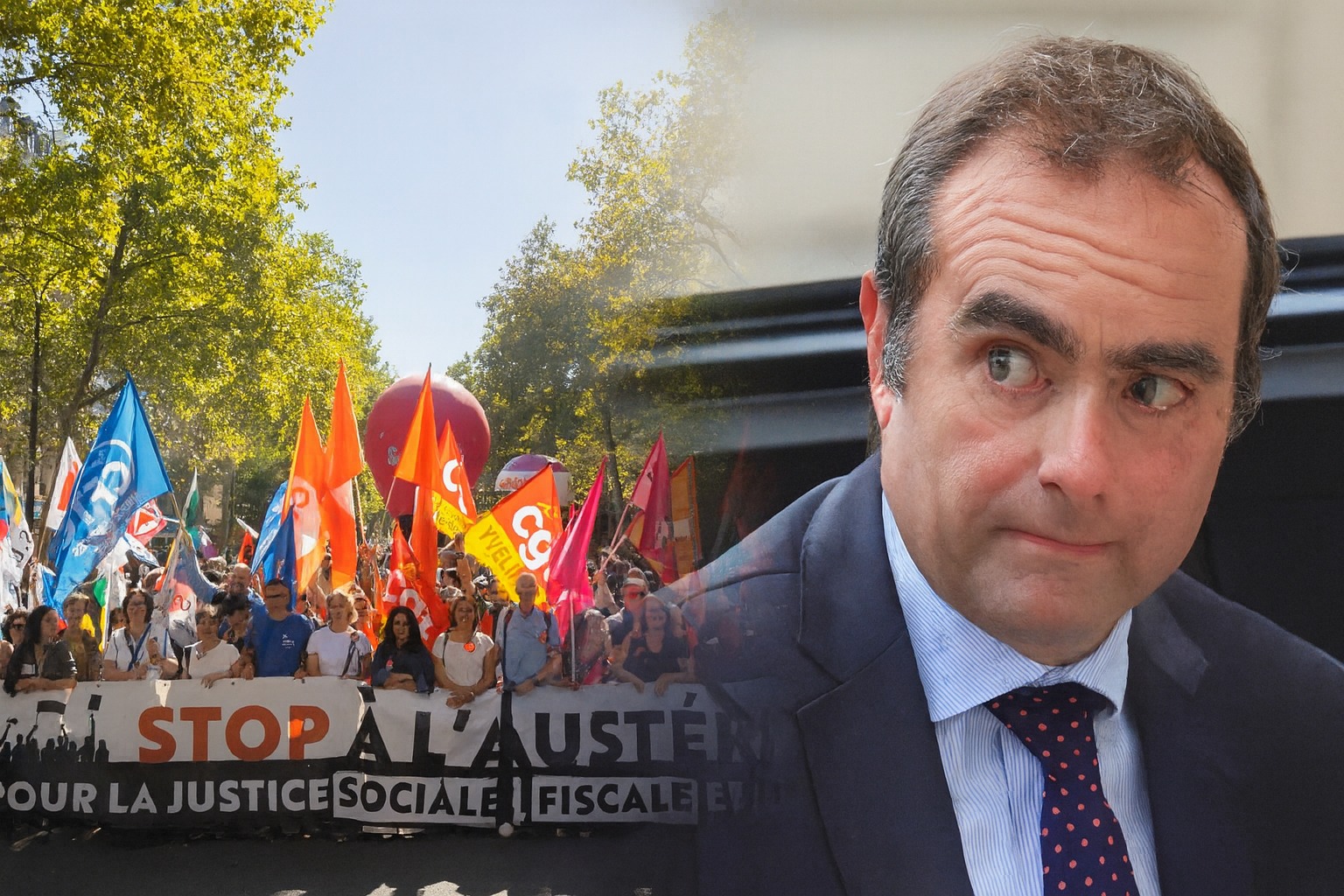
In the midst of a very unstable and chaotic world situation where US President Donald Trump is trying to reconfigure the global rules of the game established after World War II through his intervention in Venezuela and the kidnapping of Nicolas Maduro, in addition to his attempt to advance on Greenland with threats of attacks on Canada, Colombia and Mexico in between; and on the other hand with an EU accommodating itself to this new reality and trying to stop losing commercial ground by signing a treaty after years of negotiation with Mercosur causing huge protests from countrymen all over the continent; French Prime Minister Sébastien Lecornu, in line with Macron and counting on the complicity of the Socialist Party resorted to Article 49.3 of the French constitution to push through an austerity budget cutting back on social security, labor, education and health, in order to avoid both debate and parliamentary vote and thus dodge the possibility of censure of his budget which would have opened a new institutional crisis in the country.
It is a new chapter in a path of anti-popular authoritarianism in a crisis of the political regime that has been going on for years and that directly attacks the rights of the most unprotected social sectors without even making the simulation of discussion in the national assembly, something that would have completely exposed not only the bosses’ objective of the Macron and Lecornu government but also the nefarious role of the traditional parties that act as opposition but only seek to contain the anger of the people by entangling us in institutional maneuvers.
What this budget consists of
Under the pretext of reducing the deficit from 5.4% of gross domestic product to 5% due to France’s public debt problem and with the objective of reaching 3% in 2029, they will be applied:
- Cuts of 9 billion euros that will affect all ministries except Interior, Justice and Armed Forces. On the contrary, defense spending will be increased by 6.5 billion euros in relation to 2025 with the excuse of countering threats from Russia and other global conflicts.
- In Education, 4,000 jobs will be eliminated. Primary schools will lose 2,200 positions and secondary schools 1,800. This figure is higher than the one foreseen in the original version of the draft budget.
- More than 1,000 jobs are being cut at France Travail (formerly Pole Emploi), the office that helps and accompanies unemployed people to find a job. This reduction will make it more difficult to support and follow up thousands of unemployed people, whether natives or immigrants, in search of a formal job.
- The 500 euro grant for apprentices to finance the course for their driving license has been abolished on the grounds that it “generated inequalities for the rest of the students who did not receive it”.
- Dissolves the National Consumer Institute (INC), a public institution created in 1966 to inform consumers through the elaboration of technical studies and the development of information and prevention campaigns, leaving 60 people unemployed.
- The fees to be paid to obtain a regularization visa or a residence permit are increased. For permanent residence permits, it will increase from the current €200 to €300. The reduced fee for students, family reunification beneficiaries or temporary workers will also increase from €50 to €100. For renewals, the fee will be 200 €. The issuance, renewal, duplicate or modification of the residence permit is increased to 50 euros (compared to the current 25 euros), while the amount of the regularization visa increases from 200 to 300 euros. The application fee for access to French nationality will increase from €55 to €255. In addition, two new taxes will be created: A €100 fee for the issuance and renewal of a temporary residence permit and a €40 fee for the exchange of a foreign driver’s license for a French driver’s license.
- Subsidies for renting housing to foreign students will be eliminated.
- Driving license courses will no longer be financed through the Personal Training Account (CPF). This benefit, which thousands of workers used to learn to drive and which in many cases was used to change jobs and/or obtain a salary bonus based on this, will no longer be available, forcing them to pay for this extremely expensive course privately.
Contrary to all these reactionary measures that attack the interests of the population and many others that are being discussed and decided at the moment, some taxes on employers are kept the same and some are directly eliminated. The exceptional contribution to large companies, introduced in 2025, is maintained in 2026 with the same percentages: 20.6% for companies with an annual turnover of less than 3,000 million euros and 41.2% from 1,500 to 3,000 million euros. “Smaller” companies (with revenues between €1 billion and €1.5 billion) are excluded from the regime this year, bringing the number of companies subject to the tax in 2026 down to 300, compared to more than 440 in 2025. Expected revenues are also lower: they would be €7.3 billion, compared to €8 billion last year.
Cardboard socialists
All this could not be carried out without the rogue complicity of the Socialist Party which has negotiated with the governing party to support this pro-boss budget by refusing to present a motion of censure in parliament nor to support any other presented by La France Insoumise or Rassemblement Nationale in exchange for minimal concessions which it presents as great victories such as the increase in the budget.the government by refusing to present a motion of censure in parliament or to support any other motion of censure presented by La France Insoumise or Rassemblement Nationale in exchange for minimal concessions that it presents as great victories such as the increase of 50 euros to the activity bonus (state aid granted to workers with minimum wages) or lunch at with minimum wages) or the lunch at 1 euro in universities for students (still to be seen and that keeps the student unions expectant since although it responds to an important claim of the community it is not clear how it would be financed since in the budget 2026 no items are reflected for it).
Employers’ austerity, workers’ and people’s response
The concrete situation in the streets and in every workplace is one of anger, of thousands who see their purchasing power trampled every day, suffering daily labor pressures to “work more and better” while the unions negotiate salary readjustments that are totally insufficient in relation to the increase in the price of basic products consumed by the majority.
The approval of the “austerity” budget via the detested article 49.3, although it is a legal maneuver, it is no less anti-democratic and shows, just at the beginning of 2026, the panorama of confrontation that we will have and that challenges us to respond from the working class and the popular sectors. Since, although there is anger and daily pressures in the different workplaces, whether in private companies or state establishments, added to the fact that there are struggles for wage increases or better working conditions in several cities of the country, these are uncoordinated and without the strength they had in the struggle against the last pension reform that Macron applied in 2023 (also appealing to constitutional article 49.3).
Faced with the question that broad layers of society are asking themselves about how long the head of state and his prime minister will resist governing and applying their political plan based on anti-democratic austerity measures, the need to organize assemblies in our workplaces and strengthen the demand to the union leaderships to confront in the streets in a coordinated manner this policy of the bourgeoisie with the tool of the general strike, democratically debating a plan of struggle until defeating the objectives of the government and the bosses becomes more imperative.
That is why from the International Socialist League in France within the NPA-Revolutionaries and together with it we will continue to push forward this perspective not only to confront the bosses’ plans of Macron and Lecornu but to firmly express that once and for all we workers, those who produce and make society function, must be the ones to govern and decide on our own destinies. That is also why in these municipal elections we militate and call to support the NPA-R since it reflects the honest attempt to regroup the best of the revolutionary extreme left.
With this intention we build a party of our class to change in a revolutionary way this absolutely unjust society, promoting the regroupment of all those who also want to change it, here and around the world, to advance to something better where we can work to live and not live to work: for a life worthy of being lived.