By Permanent Revolutionary Congress
The youth uprisings of 2024 and 2025 mark a decisive turning point in Kenya’s political situation, as a new generation entered the streets with confidence, anger, and a growing sense of political direction. You can see a movement shaped by economic hardship, rising inequality, and a deep rejection of a system that offers education without opportunity. These uprisings did not appear suddenly, but developed from long-standing contradictions within Kenyan capitalism that have intensified over time.
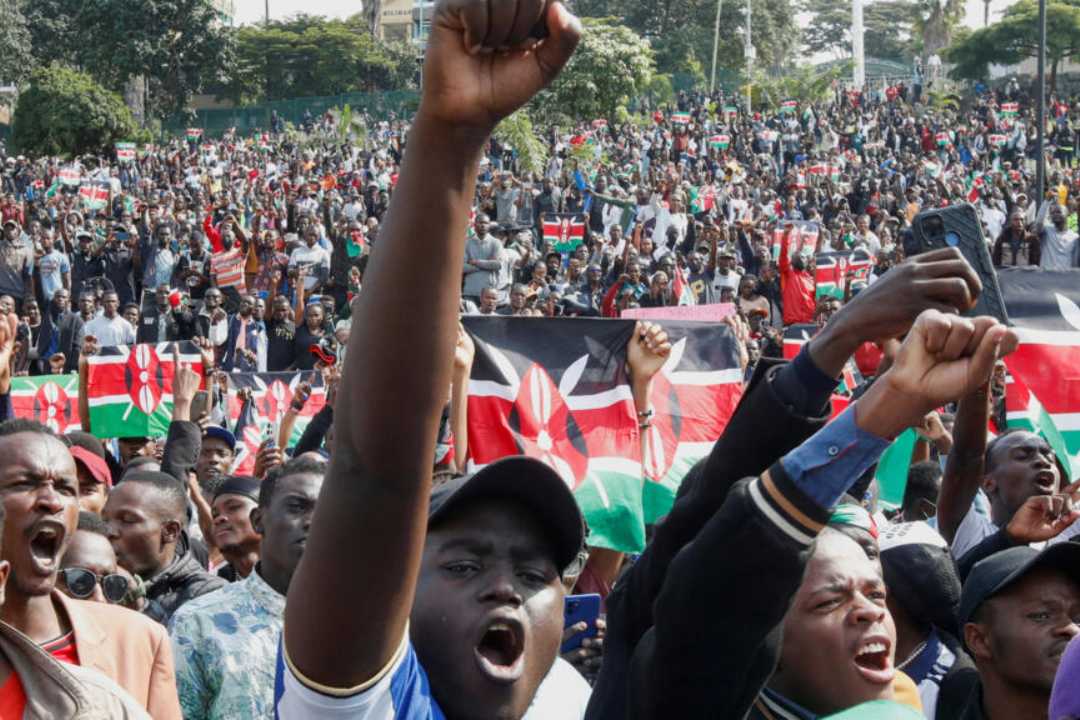
Gen Z stood at the center of this process and acted as the spearhead of the uprisings, using digital tools, decentralized coordination, and shared material struggles to mobilize at a national scale. The protests spread across major cities and smaller towns, with young people forming the bulk of demonstrators and driving the pace of escalation.
The immediate trigger of the 2024 uprising was the Finance Bill, which proposed tax increases on essential goods and services that directly affect daily survival. For many young people already facing unemployment and unstable income, this was not just another policy, but a direct attack on their ability to live. The protests quickly evolved from opposition to taxation into a broader rejection of corruption, inequality, and political exclusion.
The events of June 25, 2024, marked a historic escalation, as protesters stormed parliament in an unprecedented challenge to state authority, showing the depth of anger and the willingness to confront power directly. This moment revealed both the strength and limits of spontaneous mass action, as it forced immediate concessions while exposing the absence of long-term coordination.
By 2025, the movement returned with renewed force, marking the anniversary of the earlier uprising while expressing continued anger over economic conditions, corruption, and police violence. The protests again spread nationwide, with thousands mobilizing and confronting the state despite the risk of repression. The recurrence of protests shows that the underlying causes were not resolved, but deepened over time.
From a revolutionary marxist perspective, these developments reveal both revolutionary potential and political stagnation existing at the same time. On one hand, you see a mass movement capable of mobilizing across the country, cutting across ethnic divisions, and directly challenging state power. On the other hand, the movement remains disjointed, lacking a centralized revolutionary leadership capable of transforming protest into a struggle for power.
The scale of repression highlights the nature of the state as an instrument of class rule, defending elite interests through force when challenged by mass action. Multiple reports confirm deaths, injuries, and widespread police violence during the protests, showing how the ruling class responds when its authority is threatened. In 2025 alone, dozens were killed and hundreds injured, reinforcing the pattern of violent suppression.
At the same time, repression has not ended resistance, but has instead exposed the limits of state control when faced with a determined and politically awakening generation. Each cycle of protest and repression deepens political consciousness, as more young people begin to question not just policies, but the system itself. This process reflects a shift from immediate demands toward broader structural questions about power and ownership.
The political crisis also reflects the failure of traditional institutions to respond to mass demands, as parliament and established opposition forces struggle to maintain legitimacy. The withdrawal of the Finance Bill showed that mass action can force concessions, but it also showed that such victories remain partial and temporary without structural change. The system adapts, while the underlying conditions remain.
A key feature of the movement is its decentralized and leaderless character, which allows rapid mobilization but limits strategic direction. While this structure makes repression more difficult, it also prevents the consolidation of gains and the development of a clear political program. This contradiction lies at the heart of the current stagnation, where mass energy exists without organizational form.
From a revolutionary socialist standpoint, this reflects the absence of a revolutionary party rooted in the working class and youth, capable of linking immediate struggles to a broader socialist program. Without such leadership, movements can rise rapidly but struggle to sustain momentum or achieve lasting transformation. This gap allows the ruling class to regain control through repression, co-optation, or delay.
The uprisings also show the erosion of traditional political divisions, as youth mobilization cuts across ethnic and regional lines and begins to form a more unified social force based on shared material conditions. This shift opens the possibility for class-based politics to emerge more clearly, challenging the structures that have historically divided the population.
Economic conditions continue to drive instability, as high living costs, unemployment, and debt pressures remain unresolved. Kenya’s reliance on external financing and austerity policies limits the ability of the state to respond to social demands, pushing the burden onto ordinary people and intensifying discontent. This creates a cycle where economic pressure produces protest, and protest exposes the limits of the system.
The concept of permanent revolution helps explain how these struggles can develop beyond their initial demands, as opposition to taxation and repression evolves into questions about who controls resources and how society is organized. This transition is not automatic, but depends on political clarity and organization within the movement. The Permanent Revolution Congress has a duty to organize these masses towards class based politics for when a pre-revolutionary situation like this arises, it will find the people more prepared to take over power.
The role of digital platforms has been central, allowing rapid coordination and the emergence of a new form of political engagement that bypasses traditional structures. At the same time, the state has attempted to control information and restrict media coverage, showing that the struggle over communication is now a key part of political conflict.
The events of 2024 and 2025 reveal a situation where revolutionary potential exists in material form, through mass participation, militant action, and growing political awareness, but remains constrained by the absence of leadership and organization. This contradiction defines the current phase, where the possibility of transformation coexists with the risk of stagnation.
The path forward depends on whether the movement can move from spontaneous uprising to organized struggle, building structures that can sustain action, unify demands, and challenge state power more directly. Without this shift, the cycle of protest and repression is likely to continue without resolution.
The youth uprisings have already changed the political landscape, as a generation has entered politics through direct confrontation with the system, rather than through established channels. This has raised expectations, expanded political imagination, and created new possibilities for collective action.
The situation remains open, with no clear resolution, as the contradictions that produced the uprisings continue to shape the present. What emerges next will depend on the ability of the movement to transform its energy into organization, its demands into strategy, and its resistance into a coherent political force capable of reshaping society.