By KD Tait
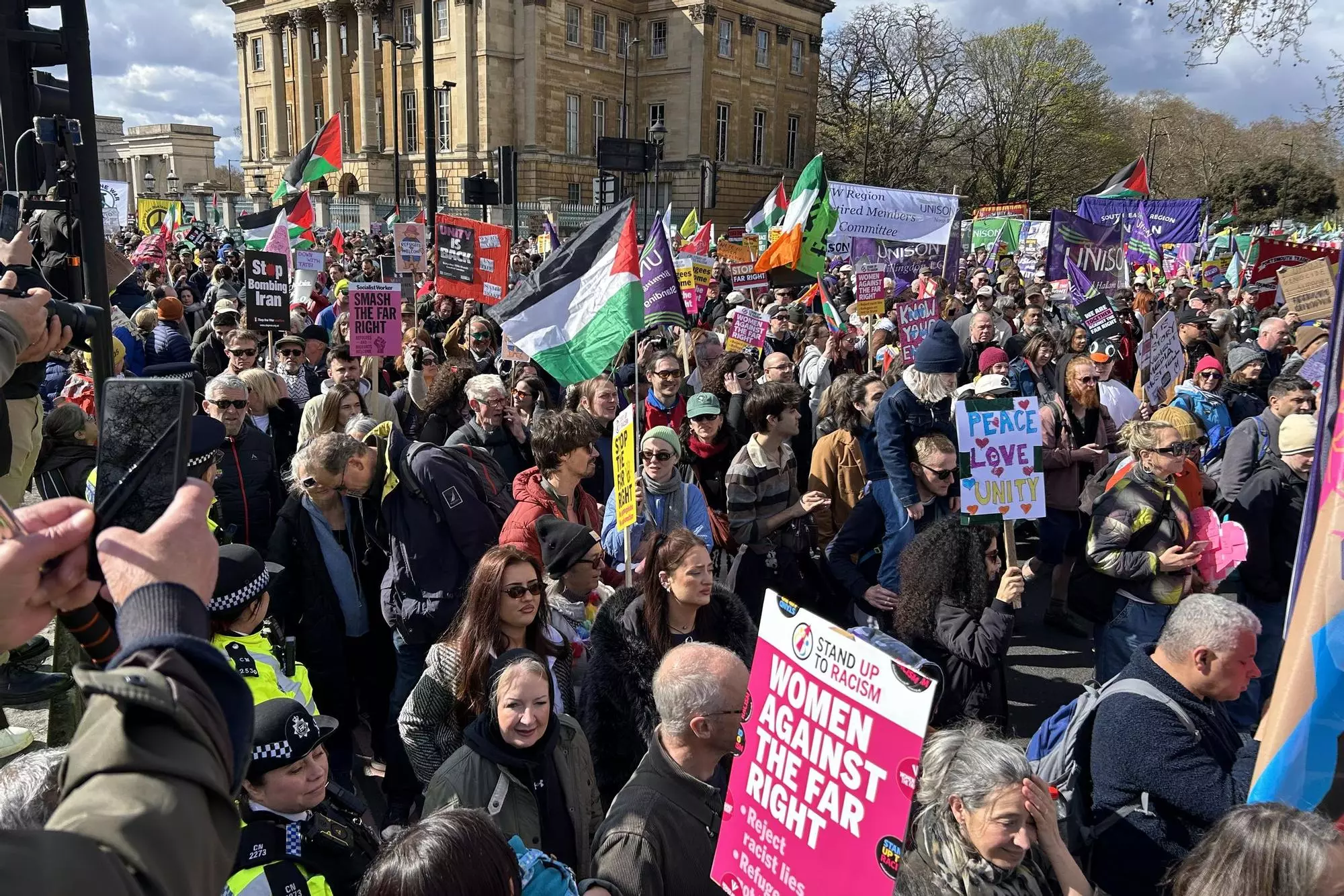
The Together Alliance — a broad coalition of trade unions, campaigns and anti-racist organisations — held its national demonstration on 28 March. Hundreds of thousands marched through central London in the biggest mobilisation against the far right in British history. After months in which Nigel Farage, his party Reform UK, and far-right street organiser Tommy Robinson (real name Stephen Yaxley-Lennon) have dominated the political agenda, the march showed that there is a mass audience for defending migrants’ rights, action against racism, and that the right does not speak for Britain.
The breadth of the demonstration was one of its strengths. Unions, campaigns, Palestine solidarity activists, charities and large numbers of people with no settled political home came onto the streets together. On the same day, activists in Croydon — a south London borough — disrupted Nigel Farage’s local election campaign launch there. People are not only registering their opposition — they want to stop the right advancing.
But a broad demonstration does not settle the political question. The Together Alliance’s message is built around hope, unity and resistance to division. That language can bring people onto the streets. It cannot get to grips with why the right has found such an opening, or what would close it. The far right has grown in the space left by the retreat of the labour movement. Where workers face insecurity, declining services and weakened collective organisation, the right offers reactionary answers: blame migrants, blame Muslims, blame the global elite. The grievances are real even when the explanations are false. Only a class politics that addresses the causes can cut across the scapegoating.
That weakness showed on the platform. The coalition gave the Green Party of England and Wales a high profile. Zack Polanski, the party’s recently elected leader, used the occasion as you would expect — pointing people toward the May local elections. It points to where this kind of politics tends to go: broad demonstrations at one end, electoral pressure at the other, with independent working-class politics absent from both. Reform UK is the radicalising right wing of Conservative Party politics, while Robinson is building a racist street movement with fascist backing. Neither will be stopped by better messaging or a ‘broader’ progressive alliance.
Socialists have a different answer: rebuild the workers’ movement. The trade unions are bureaucratic, cautious and shackled by Britain’s restrictive anti-union laws — among the tightest in Western Europe — and leave the most exploited workers, in the gig economy, in warehouses, in care work, largely unorganised. Tenants’ campaigns, migrant defence, youth organising — these exist but are fragmented. What connects them, develops their strategy and points toward a wider transformation is a mass workers’ party with an anti-capitalist programme: one that can rebuild working-class organisation in a rapidly changing economy and link immediate struggles to the question of who runs society.
The next test is already coming. On 16 May, Robinson plans another central London mobilisation. On the same day, the annual Nakba demonstration is due to take place — marking the expulsion of Palestinians during the founding of the Israeli state in 1948, an event Palestinians call the Nakba, or catastrophe. Palestine organisers say they notified police months in advance of their proposed route. The Metropolitan Police — responsible for policing London — has refused it. If Whitehall, Parliament Square and Trafalgar Square — the heart of the British government district — are handed to Robinson on that day, the state will have made a political choice, and the movement that marched on 28 March will run straight into the limits of its current strategy.
Hundreds joined the Your Party bloc in its first national mobilisation. Your Party is a new socialist party founded in July 2025 by former Labour leader Jeremy Corbyn and MP Zarah Sultana, which has attracted tens of thousands of members despite being marked since its launch by public disputes between its co-founders. That bloc points to something real: there are people looking for a new direction, and the present turbulence has opened political space that did not exist a few years ago. That space has to be organised.
The march on 28 March showed the depth of anti-racist feeling in this country. 16 May will show whether it can be turned into something capable of denying the far right the streets.