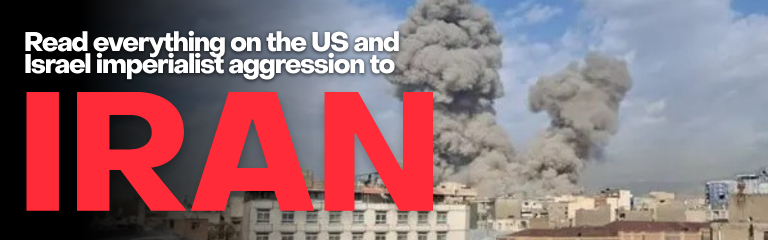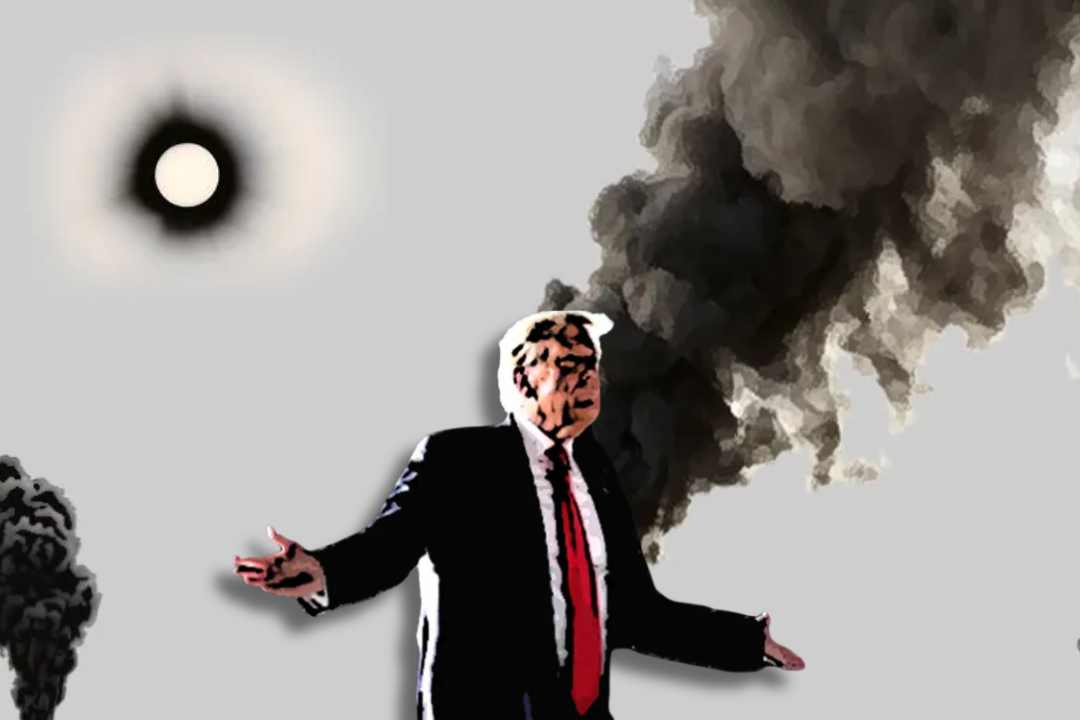
The US-Israeli war on Iran named “Epic Fury” is an imperialist war that is part of the larger US project to reposition itself as the sole dominant power in the Middle East. It aims to do this by remaking the region through war to topple rival and oppositional governments and replace them with client regimes and neo-colonies. To accomplish this goal, the US is working with and through its Israeli military proxy, and its political and military alignments with the authoritarian Monarchies of Saudi Arabia, United Arab Emirates, Qatar, Kuwait, Bahrain, Oman, and Jordan.
The current war is the inevitable result of a long term, bipartisan effort by the US state to topple the Islamic Republic of Iran, which came to power in 1979 after the overthrow of the US-installed dictatorship of Shah Mohammad Reza Pahlavi. War plans were ramped up after the attacks of 9/11, which saw the US ruling class declaring a generational “War on Terror” through both Democratic and Republican party administrations that began with the invasion and occupation in Afghanistan in 2001. This was followed by then President George W. Bush making a public declaration of war against what he called the “Axis of Evil” of Iraq, Iran, North Korea during his 2002 State of the Union address.
The Iraq Model
The US had originally begun a war on Iraq in 1991, following an Iraqi military invasion of Kuwait in 1990. But this war of regime change fell short of toppling the previously backed dictatorship of Saddam Hussein. Subsequently, successive US administrations imposed devastating sanctions on Iraq that collapsed whole parts of the economy and contributing directly to the deaths of over 1 million Iraqi people over the following decade.
The attacks of 9-11 were then used as a means to attack Iraq a second time in 2003, in what was promoted as a “pre-emptive” war to thwart the production of so-called “weapons of mass destruction” that Bush and his team declared would eventually be used against this US. This fabricated allegation was quickly followed by a massive “shock and awe” bombing campaign, with the US raining 30,000 missiles and bombs down on the Iraqi people in a matter of weeks. This was followed by a ground invasion, occupation, and war that raged at varying levels of intensity until 2011; and a continued military occupation that continues to the present. A 2006 Lancet study estimated that the US war on Iraq killed 654,965 Iraqi people—roughly 2.5% of the total population.
US military planners hoped for a quick victory in Iraq, much like Afghanistan, but became bogged down by the Iraqi resistance movements. This delayed the next invasion of either Iran or North Korea. Also, after watching US and aligned forces decimate Afghanistan and Iraq, both Iran and North Korea (who like Iraq and Afghanistan had no direct connection to the attacks of 9/11) scrambled to build a nuclear deterrent ahead of an eventual US attack.
Sanctions As a Weapon of War
Nevertheless, the US amassed 50,000 troops at 19 bases and military installations across the region during the War on Iraq and continued expanding the US military presence through the administrations of Barack Obama and Trump (2008-2020). This strategy was to effectively encircle Iran with US military assets in preparation for an eventual war on Iran. This war project was concurrently intensified through the imposition of a regime of economic sanctions beginning in the 1990s under then Democratic President Bill Clinton. This was followed with another round of sanctions by the Obama Administration in 2010-2012. Obama implemented executive orders to implement newer sanctions to exert “maximum pressure” on Iran to severely weaken its economy, squeeze the population, and force regime change. This type of imperial warfare tightened an economic noose by targeting Iran’s central bank and international oil sales. Oil exports make up 80% of Iran’s total export earnings and 50% to 60% of its government revenue, meaning the blockade of Iranian oil would have multiplier effects through the economy and not just weaken the government but also degrade the standard of living of the Iranian people. According to one report:
Iran’s gross domestic product (GDP) per capita fell from more than $8,000 in 2012 to about $6,000 by 2017, and to a little above $5,000 in 2024…The sharpest declines coincided with the reimposition and tightening of US sanctions under Trump’s campaign from 2018 onwards, which squeezed oil exports and access to global finance…Iran’s oil exports fell by 60-80 percent after US sanctions were reimposed, stripping the government of tens of billions of dollars in annual revenue. Iran was exporting about 2.2 million barrels per day (mbpd) of crude oil in 2011. The exports fell sharply after 2018, to an all-time low of just more than 400,000bpd in 2020…
The Iranian rial has collapsed in value. In the mid‑2010s, a dollar bought only a few tens of thousands of rials on the open market. However, by 2025, it bought several hundred thousand. Now, it can buy more than 1 million rials. A devalued currency can help a country in promoting its exports, but sanctions have long blocked a bulk of Iran’s exports. Meanwhile, the currency crisis has made imports costlier…
When the sanctions didn’t achieve their goal of bringing down the regime, the US tried another tack. Between 2016 and 2018, the Obama Administration signed a “nuclear arms deal” with Iran the loosened the sanctions in exchange for Iran’s suspension of its nuclear program. This agreement was torn up by Trump early into his first term, demonstrating his intention to continue with a belligerent approach in fomenting war on Iran.
Despite the sanction chokehold, the Iran regime re-routed state resources to building up its military capacity and expanded its regional influence through a network of political and military proxies that Iran deemed the “Axis of Resistance”. This alliance includes Hezbollah in Lebanon, the Houthi movement in Yemen, and several Shia militias in Iraq. This buildup took place to project Iranian influence across the region and as a counter to the US military presence. At the same time, Iran and its proxies have also moved closer into formal alignment with China and Russia—the two most prominent rivals of US imperialism.
Preemptive War on Iran
This next “pre-emptive” imperialist war began unfolding in stages in 2024, when the US and Israel began conducting bombings and airstrikes of civilian, military, and industrial infrastructures and carrying out targeted assassinations in Palestine, Lebanon, Syria, Yemen, and Iran, and against the “Axis of Resistance”. The current escalation of attacks by the US has provoked Iran to launch missiles and drones into Israel and against US military bases, infrastructure, and assets in the Gulf states. Iran has also closed the Strait of Hormuz to US-aligned states, blocking and estimated 20% of total oil and gas production from reaching international markets.
The expansion of a regional war with global economic implications is not only pushing a strained capitalist system toward a worldwide recession. It is also pressurizing a fragmenting US-centric imperialist order and threatening to increase the possibility of an inter-imperialist war, which can also be understood as “world war”. Inter-imperialist war refers to an enlarging conflict between powerful capitalist nations and aligned blocs fighting for global hegemony, markets, resources, and spheres of influence across the most strategically important regions of the global capitalist system. Wars for empire reach this scale when rising imperialist powers challenge the hegemony of the existing powers, and wars are then fought to redivide the world among the dominant imperialist powers and reorder the hierarchy internationally.
Trump’s New Architectures to Reassert Imperial Primacy
The US is a declining economic and political power in relation to emerging regional and global rivals—especially China—and is relying on brute military aggression and force to reassert its regionally fragmenting hegemonic status.
The US is not being “dragged” into this war by Israel. Rather, Israel is itself an extension of the US empire and exists primarily as its military proxy for imperialist purposes. Israel is the destructive spear tip that does the empire’s dirty work in the region in exchange for being armed to the teeth, enabled to conduct genocidal war against Palestinian and Lebanese people, and permitted to enlarge its settler-colonial territorial ambitions.
Both the US empire and its Zionist military-settler machine see the defeat of the Iranian regime and its aligned forces in the region as an opportunity, and as necessity, to advance their project. This is being carried out by attempting to topple and destroy rival governments and aligned forces across the region, reduce the influence of imperial rivals like China, and take control of as much of the oil resources as possible. The other goal is to fortify an alliance of reactionary states (Israel, Egypt, Jordan, and the Gulf Monarchies) aligned with the US empire and backed by US military forces in the region.
This aspirational alliance will advance through gaining more signatories to the Abraham Accords, which is an effort to “normalize” relations between Arab states and Israel, and pave the way for Israeli expansionism across Palestine and into Lebanon and Syria. It is also being proposed through Trump’s so-called “Board of Peace,” an imperialist front of US-aligned monarchies and authoritarian states willing to be junior partners in the US plan for a regional remake beginning with the complete colonization of Palestine.
Trump and a growing segment of capitalist oligarchs in the US hope to remake a new order, one that jettisons an enfeebled United Nations and recreates new US-centric international infrastructures at Trump’s whims to facilitate greater pillage and conduct further war against rivals and potential opponents. The segments of the capitalist class that operate through the Democratic Party have remained muted in the background during Trump’s military adventures because they too support the larger imperial objectives of conquering Iran and weakening Chinese influence—and are taking a “wait-and-see attitude” it the Trumpian strategy pans out.
Punching at China Through Iran
The “Trump Doctrine” of naked and aggressive US imperialism is largely conveyed through social media ramblings and rants. While his war rhetoric and logic can shift erratically or become less intelligible with each news cycle, has made clear that the oil is his primary concern, declaring that “we can easily open the Hormuz Strait, take the oil, and make a fortune”. What Trump blusters in an unfiltered way is both a combination of his personal and corrupted drive to accumulate vast fortunes for himself, his family, and his billionaire cronies in the capitalist class; while his war is in alignment with the larger imperialist consensus in US politics to topple the Iranian regime as a means to weaken and reduce Chinese influence in the region. US imperial placement in the region will give the US greater leverage against China’s dependency on oil from that region.
Even as Iran maintains the closure of the Hormuz Strait for most traffic, it is still permitting the transit of tankers moving oil through to China. The restrictions enforced by Iranian missiles and drones apply only to US and Israeli and aligned ships, and not to those from “non-hostile” nations.
Trump’s 2026 National Defense Strategy (NDS) designates China as the top long-term strategic threat, with a focus on preventing China from “dominating the US or its allies.” The NDS also focuses US military objectives on the systematic degradation and “obliteration” of Iran’s nuclear program, missile capabilities, and naval forces, as well as destroying Iran’s defense industrial base and to end its ability to support regional proxies. In other words, the Trump and the ruling oligarchs that back him are executing this war to complete two inter-twined imperialist objectives: to remove Iran and its aligned proxies as a strategic network of allies of China, and to consequently weaken Iran and its reach and influence in the region.
Trump’s war aims to reduce Chinese access to oil, its growing economic and financial role in the region, and establish greater control over oil and oil outflows to China. In 2020 for instance, China and Iran signed an agreement for $400 billion of Chinese investments over 25 years to be made in Iran, including in banking, telecommunications, ports, railways, health care and information technology in exchange for heavily discounted Iranian oil.
The agreement also called for increased military cooperation, joint training and exercises, joint research and weapons development, and intelligence sharing. China has reportedly supplied surveillance tech and provided dual-use technology for Iranian drones and missiles, while Iran’s military has been integrated with China’s BeiDou satellite system for more precise targeting of US bases and installations.
China has also become the largest trading partner for many countries in the Middle East and North African region, including with Saudi Arabia and the United Arab Emirates, both US-aligned, sub-imperialist regional powers. In 2024, China’s trade with the Gulf countries surpassed the combined trade of the U.S., UK, and the Eurozone. To stave off a rapidly rising global competitor in China—and inevitable military challenger—the US architects of the empire have to think and act in strategic terms and take aggressive measures to directly and indirectly attack and weaken its most pressing rivals by unleashing unparallelled scales of violence and destruction.
Bombing Iran “Back Into the Stone Age”
The war on Iran is not just an imperialist war of strategic positioning and control, but is taking on the forms of a “total war” to destroy the productive capacities to “bomb Iran back into the stone age” as Trump recently menaced. This coincides with the “Israeli method” of total war, which has amounted to a systematic genocide of the Palestinian people in Gaza over the last three years. The relentless airstrikes across Iran (and in Lebanon) show how this model of “total war” is now unfolding.
The Armed Conflict Location and Event Data (ACLED) has documented over 3,000 distinct strike events across 29 of Iran’s 31 provinces, with the heaviest bombardments occurring in Tehran. Over 3,500 people, including at least 1,607 civilians (including 244 children), 26,000 wounded, and 3.2 million people have been displaced. The Iranian government has documented that attacks have hit more than 100,000 sites of civilian infrastructure, including nuclear power plants, residential buildings, schools and universities, hospitals and medical facilities, water desalination plants, energy infrastructure, science research facilities, bridges, airports, and more.
Like with its war on Venezuela, the Trump regime is throwing out existing conventions on warfare. As the former Fox News host, Christian nationalist crusader in cosplay, and current “Secretary of War” Pete Hegseth asserted: “the US doesn’t fight with stupid rules of engagement.” Hegseth has also overseen a purge of top military figures who are not aligned with his vision for a holy war of conquest against Muslim nations.
A recent report published by more than 100 US experts in international law from universities including Harvard, Yale, Stanford and the University of California concluded that the conduct of US forces in Iran and statements by senior US officials “raise serious concerns about violations of international human rights law and international humanitarian law, including potential war crimes.”
Marx described the destruction of enemy productive capacity in war as a direct form of “capital destruction”. The US and Israel are destroying parts of the oil productive capacity of Iran, as well as its industrial productive base overall. According to a Marxist analysis, this scale of violence and destruction accomplishes three objectives for US imperialists. First, destroying the economic bases of Iran “removes it from the market” and decreases economic output and income, giving other producers (like the US) more market control to make greater profit. Trump recently responded to a question of the problem of rising gas prices in the US by proclaiming “we make a lot of money”. Here he is speaking on behalf of the oil and gas corporations taking control over a larger share of oil and gas production at home and abroad, including the recent invasion and overthrow of Venezuelan President Nicolas Maduro and the subsequent re-taking of that nation’s oil reserves.
Second, the destruction of Iranian oil-producing capacity addresses the problems of overproduction that has lowered prices internationally in previous years. A destructive war on Iran’s oil-producing infrastructure, clears out existing market capacity to allow for a new “cycle of investment” of capital through colonial re-installation under US control in the case of a US military victory.
The third aspect is how the most reactionary oil and gas capitalists empowered under Trump are in active opposition to the advancement of a transition away from oil and gas towards renewable alternatives. While Trump tears apart international and domestic climate agreements and shreds clean energy and environmental policies and practices, he and his war-mongering backers want to wage wars to control a greater share of existing oil resources on a global scale. While the invasion of Venezuela was accomplished with minimal loss in securing control over existing infrastructure, Iran represents a greater challenge that may require “destroying the oil infrastructure in order to save it”. This model of rebuilding the very oil infrastructure that they destroyed in war to take control and centralize the profit flows follows what happened after the US “bombed Iraq back into the stone age” in 2003.
In the immediate aftermath of the 2003 invasion and occupation of Iraq, the US colonial regime (Coalition Provisional Authority) took control over Iraq’s oil revenues by establishing the Development Fund for Iraq (DFI) which routes most revenues from Iraqi oil sales directly into the Federal Reserve Bank of New York. This arrangement is still in place 23 years after the US invasion.
An Unwinnable War—But One That Can Either Expand or Be Stopped
The hubris of Trump and the gamble being waged by the US ruling class in allowing this full-scale attack on Iran and its allies will not likely conclude any time soon or result in a decisive victory for any side. To overthrow the Iranian regime, Trump would need to invade with troops. The defeat of US forces in Afghanistan by Taliban forces followed by a humiliating retreat, and the inconclusive outcome of the occupation of Iraq and significant blows struck on US forces by the Iraqi resistance, have both added to the “Vietnam Syndrome” of reluctance of sending troops in for fear of significant casualties. Nevertheless, Trump may have no choice–or not care–and may plow ahead anyways into a greater debacle and quagmire.
If Trump sends in US troops, or if he and the Israelis escalate bombing campaigns against Iranian oil and industrial production facilities (with Iran responding in kind across the region), there will be a significant deepening of political and economic crises on a global scale. This form of total war will ultimately disrupt the global capitalist economy and lead to recession, potentailly expand the war across more borders and draw in more combatants, and accelerate the process towards a more expansive and dangerous conflict on a global scale.
The US gambit to topple the regimes in Venezuela and Iran, take their oil, and pull them away from China and Russia and back into the orbit of the US empire, are now in a similar motion as Russia’s invasion and expansion to take Ukraine, and China’s buildup and eventual invasion to acquire Taiwan. Each area of contention reflects the fault lines of an emerging inter-imperialist conflict that can draw the rival powers closer to direct war.
The contradictions emerging within the capitalist imperialist international order at a time of conflict and fracture, and the exposing faultlines of global inter-imperial rivalry and redivision means that the imperialists cannot suspend or stop their impulses towards total war. They will have to be stopped.
To stop the march towards spiraling war will take a massive effort by those who have the interest and power to do so. Like those that stopped previous imperialist wars, it will take organized opposition from within the military ranks. Soldiers’ and sailors’ rebellions were key to ending World War I in Russia and Germany, and pivotal to bringing an end to the Vietnam War.
It will also take the building of mass anti-war movements inside the United States, the principal aggressor and instigator of the war on Iran and provocateur of a potentially much larger war that could expand from it. Mass antiwar movements will have to be urgently built from the ground up on a solid foundation of anti-imperialism, anti-campism, and principled defeatism. Only through a growing anti-war movement that combines strategies and tactics that can disrupt war-making capacities, with military forces refusing and resisting orders, and international solidarity with the people in the targeted nations can we stop this war and prevent its spread.