By Martin Suchanek
On 30 April, US President Donald Trump and Secretary of War Pete Hegseth announced the withdrawal of 5,000 US troops from Germany. Although some German imperialists, led by German Defence Minister Boris Pistorius, are putting on a calm front and claiming that this move had been on the cards for some time, it has once again shaken the US’s transatlantic partners.
On the surface
On the surface, the move was triggered by a rather undiplomatic remark from the German Chancellor, who until recently had boasted of a good relationship with Trump. Speaking to a school class on 27 April, he stated that the US had no ‘exit strategy’ for the war in Iran. In this way, Iran would be making a mockery of and humiliating an entire nation, namely the US.
Undoubtedly, that is not a very diplomatic way of putting it. But Friedrich Merz was merely voicing what all German centre-right politicians actually think. He had already pointed out that the US had “quite obviously gone into this war without any strategy whatsoever”. Therefore, according to the German government, the campaign is not our war, but rather endangers the global economy.
No question about it. Trump and his administration were furious at these remarks, even though, in essence, they merely stated what everyone already knows. Merz, according to Trump, was merely demonstrating once again that he had ‘no idea what he was talking about’. Instead of taking the mickey out of the greatest president of all time, the failure Merz should rather focus on his own ‘broken’ country. After all, the US was on the verge of great successes.
In doing so, Trump fails to recognise that his counterfactual worldview is forcing even his allies and staunch transatlanticists in Western Europe – and Merz is certainly one of them – to distance themselves, at least verbally, from the US. Only politicians of the calibre of NATO Secretary-General Mark Rutte can get away with spinning the greatest nonsense as a brilliant strategy and expressing sympathy for the “US disappointment” with other Western states over the Iran war. After all, his job depends at least as much on the US government as it does on the other NATO states.
That aside, even bourgeois politicians cannot simply ignore the devastating consequences of the US strategy, which is as barbaric as it is reckless. The European capitalist classes, already under pressure from the crisis and competition from China and the US, fear the economic repercussions. Unless there is a ceasefire and a negotiated settlement with Iran, and soon, recession and inflation loom. The masses fear these consequences just as much, as well as massive social deterioration, redundancies and cuts to social services—in short, the costs of the US war. In all European countries, a large majority has rejected the reactionary war against Iran from the outset, and support for Israel, which has always been unpopular, is now rejected by even more people.
Deeper causes
Undoubtedly, Merz’s remarks—but certainly no less so the Spanish government’s refusal to allow the use of US military bases for the war against Iran—have exacerbated the conflict between the US on the one hand and the EU and its leading powers on the other. None of this is new, however.
In the National Security Strategy published in December 2025, the US identifies the EU and its current policies as a fundamental problem that must be tackled. Even before that, Trump declared a tariff war against the EU, which initially ended in a partial victory for the US government. The first Trump administration also pursued plans to withdraw US troops from Europe. However, those were scrapped by Joe Biden.
Even if the withdrawal of 5,000 US troops from Germany appears, on the surface, to be a “punitive measure” for an insubordinate remark by a clueless individual, it has much deeper causes and should not be misunderstood as a “spontaneous” reaction.
The relationship between the US and the EU, or Western Europe, had already been permanently fractured before April. The “transatlantic partnership” is a political shell; the US and the EU regard each other more as adversaries than as allies. As Trump’s threat of further tariff increases – which would hit the German car industry particularly hard – shows, the growing rift is by no means confined to the military sphere, but encompasses all aspects of the transatlantic relationship.
Under Trump, the still largest and strongest imperialist power is attempting to secure its waning hegemony by other means – through “unilateralism” – including military adventures and direct interventions in Latin America (the blockade of Cuba, the abduction of Maduro). However, the war against Iran also shows that the US administration’s policy is reaching its limits, that the imperialist attack on Iran could lead to a political defeat for the US, to the collapse of its alliance system and to a further deepening of the rift with the EU powers.
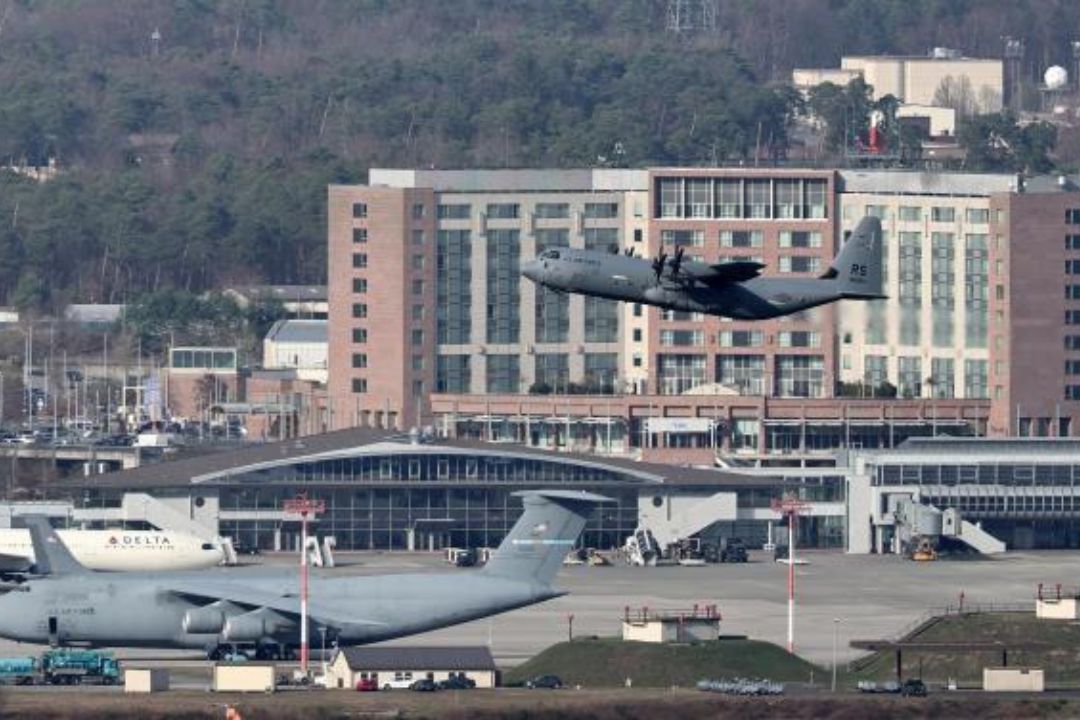
The withdrawal of 5,000 or more troops is an expression of this. After several days of speculation as to which bases they would be withdrawn from, the situation is now clear. 5,000 soldiers from the Stryker Brigade are to be withdrawn from the Upper Palatinate region of Bavaria. These are units that use the Grafenwöhr military training area alongside other NATO soldiers and Ukrainian forces. These exercises are primarily aimed at strengthening NATO’s eastern flank, that is, at building up forces for imperialist rearmament against the main enemy, Russia. These forces are the ones the US can most easily do without among those in Germany and Europe, now that the US under Trump has fundamentally changed its strategy towards Russia and Ukraine and is now acting as a ‘mediator’ for an imperialist peace at Ukraine’s expense.
Bases of far greater strategic importance to US warfare, such as Ramstein – the largest US base in Europe, from which the attacks on Iran were also coordinated – remain untouched. No wonder: a US withdrawal from Ramstein or even from Stuttgart, where the US European Command (EUCOM) and Africa Command (AFRICOM) are based, would only be shooting itself in the foot. So, when Trump speaks of further withdrawals from Germany, but also from Italy, this will probably mainly concern units or mixed formations oriented towards Eastern Europe.
Militarily more significant for NATO and the European imperialist powers than the withdrawal of 5,000 troops is the fact that Trump has halted the deployment of US Tomahawk medium-range missiles, which had been agreed under Biden for 2026. According to the CDU’s leading ‘defence politician’ and militarist, Roderich Kiesewetter, this is the ‘truly difficult signal’. Consequently, the production of Germany’s own medium-range missiles—the ‘European Long-Range Strike Approach’ (ELSA) project involving Germany, Britain, France, Italy, Poland and Sweden—must now be pushed forward.
It is to be expected that sooner or later not only will the debate on the expansion of the French nuclear umbrella in Europe be pushed forward, but the question of a German nuclear force of its own will also come to the fore. After all, German imperialism aims to build up the largest conventional military force in Europe. However, for this force to be fully effective as a means of power for its own ends – whether within the framework of the EU or beyond – and for Germany to play a leading role in the struggle for the redivision of the world, it will sooner or later need its own nuclear weapons.
In plain language: the withdrawal of US troops does not mean disarmament, but German and European ‘sovereign’ rearmament.
The struggle for the closure of all US military bases, the withdrawal of all US soldiers, and the dissolution of NATO and all other imperialist alliances in Germany and across Europe must be linked to the struggle against any European rearmament of its own. Until now, this has primarily been justified by the alleged ‘Russian threat’; now it is also being sold as an act of European ‘independence’ from Trump and the US. In reality, Germany, France, Italy and all the other smaller imperialist states, as well as the other EU countries, are primarily concerned with having a say in the redivision of the world. When they talk of European “independence”, they basically mean only the ability of the imperialist EU alliance, of capitalist Europe, to secure its political, geostrategic and economic interests by military means as well.
Just as we need a movement in the US against Trump, US wars and interventions—a mass anti-war movement—so, too, do we need one in Europe: against our “own” governments, against our “own” ruling classes and capital, against the European imperialist powers, their militarism and their arms build-up. In Germany and the EU, too, the main enemy is not in Moscow, Washington or Beijing, but in our own countries.