A desperate attempt to avoid Putin’s savage missile attacks.
By Oleg Vernik, Chairman of the Independent Trade Union of Ukraine “Zakhist Pratsi” – Socialist League of Ukraine
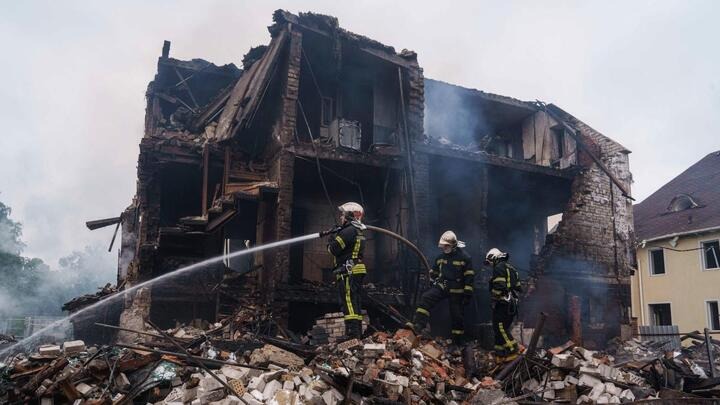
Since the start of the Russian-Ukrainian negotiations in Istanbul, which began on March 29, 2025, analysts have noted a marked intensification of Russian missile and drone shelling of major Ukrainian cities. At the end of May, i.e. on the eve of a new round of talks, the highest level of such attacks on the Ukrainian capital Kiev was recorded. On the night of May 24-25, 2025, Russia launched the most massive combined attack on Kiev, firing 9 ballistic missiles and several dozens of attack drones from different directions. Sources report 4 people killed and 23 wounded in Kiev, including several children. In total, 12 people were killed and 79 injured across Ukraine that horrific night. The victims of the missile and drone attacks died mainly in their apartments and homes.
Already on June 5 and 6, 2025, Russia carried out two of the largest attacks on Ukraine since the beginning of the war, launching more than 450 Iranian “Shahed” type drones and about 40 ballistic (Iskander-M) and cruise missiles. The attack affected practically the entire Ukrainian territory, including Kiev, Lviv, Ternopolis, Ternopil, Khmelnitsky, Chernobyl and other cities. As a result, up to 15 people were killed and about 100 were seriously injured.
The international agenda
The recent trend of intensified Russian missile and drone strikes is not only related to the stalled negotiation process in Istanbul. Russia is using such negotiations to buy time as it continues to advance on the front lines. Although that advance is not rapid, it is fairly steady. It is already completely evident that Ukraine suffers from a catastrophic shortage of Western air defense systems and missiles. Of course, Putin knows this and deliberately increases the number of missile and drone strikes against Ukrainian cities.
US President Donald Trump, acting quite in sync and in collusion with his new imperialist partner Putin, has safely blocked any new military aid package for Ukraine, and is gradually distancing himself from the Russian-Ukrainian negotiation process. By now everyone understands that his campaign promises to end the war “in 24 hours” were nonsense and a sign of incomprehension of the causes and development of the war itself. At the same time, his administration is doing everything possible to delay as much as possible the application of economic sanctions against Russia, related to a 500% increase in tariffs on countries trading with the Russian Federation.
However, in the U.S. Congress and Senate, an anti-Russian lobby of a bipartisan nature is growing stronger, evidently beyond Trump’s will. Republican Senator Lindsey Graham has announced his anti-Russia sanctions bill several times. One of the main stated objectives of such sanctions is to encourage various countries to support Ukraine without losing their economic ties with Russia. In particular, he proposes to establish exceptions to the 500 % tariffs on trade with Russia for those countries that provide military or humanitarian aid to Ukraine. This bill also involves obvious pressure on China. Graham intends to use economic leverage to force China to change its position on the war in Ukraine.
By June 2025 it also became completely clear that the European countries of the so-called “Coalition of the Determined”, led by the UK and France, despite numerous high-sounding declarations of “support for Ukraine”, proved absolutely incapable of meeting their armament supply needs. The few F-16 aircraft of very old versions that some EU countries delivered to Ukraine did not remotely represent a “game changer” in this war. As already mentioned, Ukraine exhausted its air defense systems, including the U.S. “Patriot” systems. And its European partners cannot deliver equivalent systems to it, due to their extreme scarcity and the fear of risking these unique units.
Operation “Spider’s Web”.
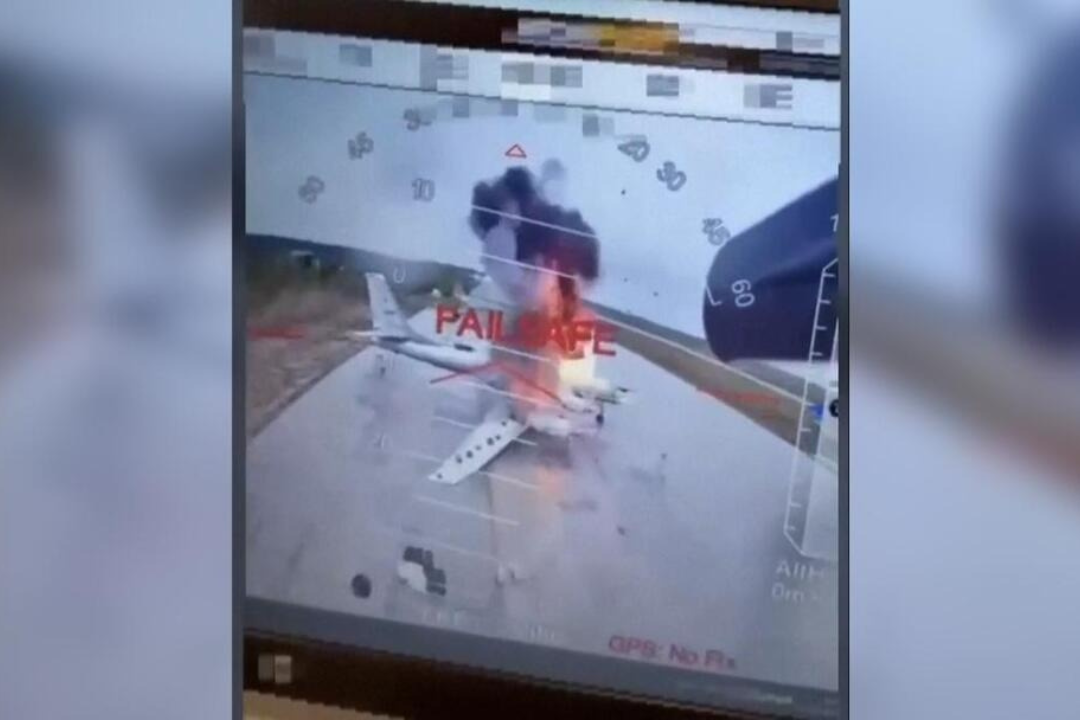
Be that as it may, Ukraine faced the difficult task of at least reducing the number of Russian missile attacks on its cities. Operation “Spider’s web”, which attracted worldwide attention and was carried out by Ukraine on June 1, 2025 with the aim of destroying several Russian strategic bombers from which Ukrainian cities were being bombed, turned out to be one of the most prominent and successful Ukrainian events during the war in 2025. The aim of the operation was to attack Russian military airfields using Ukrainian attack drones.
At least four Russian strategic air bases were attacked: Olenya (Murmansk region), Belaya (Irkutsk region), Diagilevo (Ryazan region) and Ivanovo (Ivanovo region). Only Ukrainian-made drones, including FPV drones, were used. President Zelensky stressed that no allied weaponry was used in this operation.
Ukrainian drones were secretly moved to the Russian territory. For this purpose, cargo trucks carrying wooden huts or homes, under the roofs of which the drones were hidden, were used. At the right moment, the roofs were opened remotely and the drones were launched. It is reported that the drivers of the trucks did not know what kind of cargo they were carrying. According to the Ukrainian side, 117 drones were used, with which 41 Russian strategic aviation aircraft were attacked. Among the damaged aircraft were A-50, Tu-95, Tu-22, Tu-160, as well as An-12 and Il-78.
Ukrainian authorities stated that a significant part of the aircraft was irreversibly destroyed and others will need lengthy repairs. Some international military experts believe that Ukraine may have damaged up to 10% of Russian strategic aviation. The experts emphasized the high technological level of the “Spider’s web” operation. Moreover, it was the first time Russian military targets were attacked in Siberia.
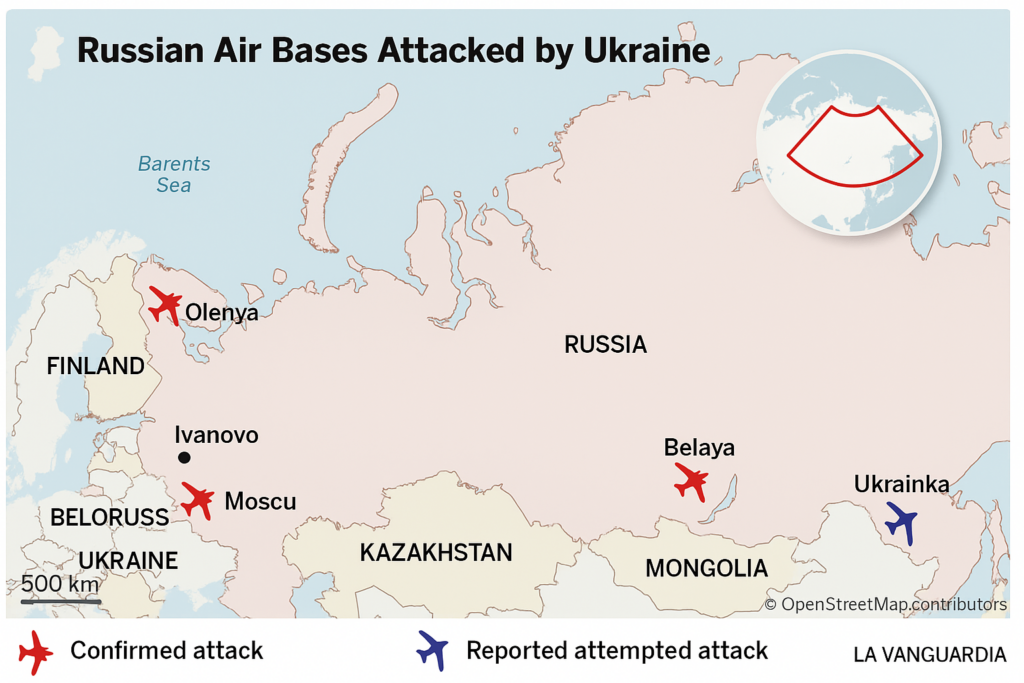
This operation demonstrated Ukraine’s ability to strike the enemy’s deep rear using innovative and asymmetric methods. At the same time, Donald Trump was outraged by such a special military operation of Ukraine and stated that it gave Putin a free hand to continue bombing it.
These losses of Russian strategic aviation are irreparable. These aircraft are of Soviet manufacture and their production no longer exists on Russian territory. Ironically, those aircraft were handed over by Ukraine to Russia after the signing, in December 1994, of the so-called “Budapest Memorandum”. Under this document, Ukraine gave up its nuclear weapons and strategic bombers as their carriers, handing over all its reserves to Russia. And the “guarantors of Ukraine’s security” were Russia, the United States and the United Kingdom. Of course, it turned out to be an imperialist hoax. Russia launched an armed aggression against Ukraine, while the U.S. and the U.K. gave up their role as “guarantors of Ukraine’s security”, limiting themselves to endless praise and completely insufficient and minimal supplies of armaments.
In the fourth year of war, Ukrainians automatically run to air-raid shelters at nighttime air raid alarms. Tens of thousands of Kiev citizens escape nightly missile and drone attacks at the same metro stations. There is war weariness, but there is no discouragement or apathy. There is faith in one’s own strength and luck, and hope that it will not abandon us. Our struggle continues, no matter what…