Automatically translated by AI.
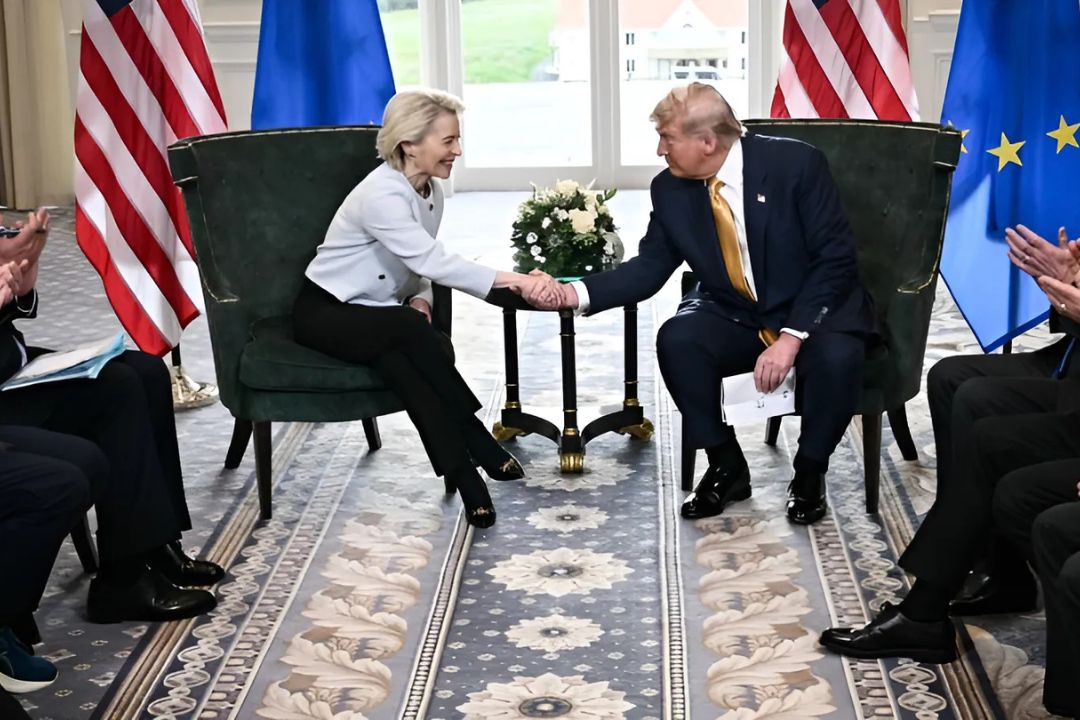
Meaning and consequences of the tariff agreement between the USA and USA. and the EU. For an international alliance of the wage earners against all imperialisms. Only a socialist revolution can give Europe a new historical perspective.
By: Communist Workers’ Party (CPL)
US imperialism offloads its decline on rival imperialisms, starting with the “allies”. The tariff agreement between Trump and Von der Leyen is part of this general framework.
The relaunch of protectionism on a large scale by the new American administration aims at combined objectives: to raise new resources with which to defray the American capitalists; and above all to repatriate to the USA. USA. the manufacturing industry that migrated in the golden years of globalization.
It is a plan to reactivate the material bases of US imperialism in the face of the rise of imperialist competition from China. “Make America great again” has protectionism as its credo.
The US protectionist policy is deployed all over the globe under an unscrupulous negotiating logic. It extends not only to America — through Canada and Mexico, in the name of the old slogan “America for Americans” — but also to Asia, where even the traditional allies of the USA are not spared. USA., like Japan and South Korea, despite the US strategic interest in containing China (which raises still unresolved questions about Trumpism’s hierarchy of priorities).
It is evident, however, that on the planetary board the Union of European imperialisms has received, so to speak, special treatment from Trump. Similar to the one reserved for Japanese imperialism. More burdensome than that offered to the old British imperialism.
The agreement is still subject to fluctuating interpretations, but its nature is obvious at a glance: a scandalously unbalanced agreement in favor of the American capitalists and the US government. USA.
The 15% reference tariff will affect 70% of European goods exported to the USA. USA. (which amount in total to 531,000 million euros), and is added to the “informal tariff” of the devaluation of the dollar by 15%.
At the same time, the EU commits itself during the remaining three years of Trump’s term to buy American energy products for 750,000 million dollars (basically gas and oil), to invest in the USA, and to invest in the United States. USA. 600,000 million dollars by European companies, and to increase military supplies from the American war industry, whose stock market shares have soared.
The only consideration for the EU is the (temporary) resignation of the USA. USA. to raise the tariffs to 30%.
A large part of the European bourgeois press is demoralized: “In order to avoid war, we have accepted surrender.” In particular, the submissive position exhibited by the President of the European Commission during the negotiation has been the frequent object of criticism and ridicule. Understandable. But beyond the scenic surface, it is necessary to go to the bottom of what happened.
THE CRISIS OF THE EUROPEAN UNION
The European Union’s negotiating weakness reflects its material basis. There is an American imperialism, a Chinese imperialism, a Russian imperialism. There is no European imperialism. There is a union of national imperialist states, of various sizes, long penalized in global competition, divided by divergent and conflicting interests. National imperialisms that compete for foreign investments through a race to the bottom in the taxation of profits; that have different energy systems; that the steel markets, the pharmaceutical industry, the continental military industry are contending; that they are bitterly competing for European funds for agriculture and industry; that they are competing for areas of influence in Europe, the Balkans, North Africa and the Middle East, as well as for market projections in China, India and Latin America.
The fall of the Berlin Wall, then the great crisis of 2008, and finally the combined and aggressive competition of other imperialist powers (mainly the USA, the United States, and the United States). USA. and China) led European imperialisms first to create and then to preserve their union. But never before have the different national interests turned out to be so conflicting.
The dispute between Germany and France for primacy in Europe, the latent conflict between France and Italy in North Africa, the competition between Italy and Germany in the Balkans, the endless disputes over budgetary policies (both national and Community) are a reflection of this. The so-called ”federal construction” of the EU has not exceeded the threshold of the common currency (2000) and has been stagnant for more than twenty years.
The exceptional recourse to common indebtedness in response to the pandemic (2020) has not had continuity. The same rearmament plan recently approved responds above all, and not by chance, to the budgetary capacities of the different national states, which sharpens their differences (starting with the Franco-German one).
EUROPEAN NEGOTIATED, NATIONAL INTERESTS
The trade agreement between the EU and the USA. USA., and its result, cannot be understood apart from this general context. Formally, the European Union, through its Commission, was and is the holder of trade negotiations. But behind the curtain of the continental negotiations, different national pressures are stirring.
Berlin tried above all to protect its automotive industry. Rome tried to defend its agri-food and pharmaceutical industry. Paris feels threatened by an agreement that harms it in key sectors of its military and energy industry, and protests (“the dark hour of submission”).
Von der Leyen negotiated for everyone and for no one. Thus, now all the different national and/or sectoral chains regret the gap between the results and their expectations. Between the result and his ”mandate”, mostly national.
On the other hand, a commercial negotiation is never only commercial, even less in the current context. The general relations of force weigh on the level of imperialist power.
In recent months, US imperialism has put on the table its unquestionable military primacy (NATO), the strength of its energy sector, the weight of its large technological monopolies.
European commitments to buy arms, gas and oil from the US USA. and massively investing in US territory are the product of the material pressure of US imperialism, and today in particular of the nationalist turn of its new political leadership.
It is striking the European “commitment” to spend 750,000 million on American gas and oil when all the US export is spent on oil and gas. USA. in that sector it amounts to 141,000 million; as well as surprising the commitment to invest in the USA. USA. 600,000 million by European companies, when it comes to private investments, hardly predictable or quantifiable.
It is possible that the figure actually includes the purchase of US Treasury bonds, currently in difficulties, among other things due to the threat of partial disinvestment from China. But beyond the unknowns and contradictions, the essential fact remains: the union of European imperialisms has bowed to the pressure of American imperialism.
FOR THE CLASS INDEPENDENCE OF EUROPEAN WAGE EARNERS
Now all the bourgeoisies of the continent are demanding “compensation”. In other words, a new mountain of billions to compensate the European capitalists for the American tariffs.
The same capitalists who, in response to these tariffs, are considering moving their production to the United States. USA.
On the one hand, the employers’ organizations claim money from their respective governments, presenting the invoice for the damage suffered (22,600 million, according to the Italian Confindustria alone), and invoking exceptions to European rules on state aid. On the other hand, they are going directly to the EU, demanding the suspension of the Stability Pact and even a new recourse to Community indebtedness (to which Germany continues to oppose).
In all cases, the flag of common interest between employers and workers is raised.
Whether with the nationalist discourse of the “national interest“ against a ”stepmother“ Europe, or with the liberal-Europeanist narrative of the ”European interest” in the face of Trump’s arrogance.
This fraudulent operation should be rejected. It should not be the wage earners who pay the cost of the competition between capitalists, their states and their unions.
Faced with the announced relocations, the nationalization of the affected companies should be demanded without compensation and under workers’ control. In the face of new debt transactions, it is necessary to demand an extraordinary and progressive taxation on large profits and assets, along with the cancellation of the public debt with the banks.
In the face of new cuts in social spending (perhaps to finance arms spending, whether European or American), a great plan of public investments in health, education, social services, environmental restoration and energy conversion is imposed — the latter even formally betrayed through the commitment to purchase American gas and oil — all at the expense of the capitalists.
In the face of any pretense of a common interest between classes, it is necessary to demand and build an international alliance of European wage earners, and of these with the American proletariat, equally hit by the deadly combination of inflation and social cuts.
FOR A EUROPEAN SOCIALIST FEDERATION
What has happened also requires a broader strategic reflection on the future of Europe and its role in the world.
Today the historical decline of the United States is being discharged on Europe, more and more an earthen vessel between the great global powers.
The liberal bourgeois circles that clamor for a European unity on a federal basis, in the name of a replica of the old American federation, ignore the insurmountable national contradictions between the various imperialist states of the old continent: their union was not only built against the European workers, but represents a stalled and failed project.
The sovereigntist sectors that call to dissolve the European Union and/or to ally with Russian or Chinese imperialism are in fact proposing a new subordination of Europe, although in a different direction, towards other emerging imperialist powers. Nothing that corresponds to the interests of European employees.
Only a socialist revolution can unify Europe on a progressive basis. Only a workers’ government, in each country and on a continental scale, can give Europe a new historical perspective.
For a European socialist federation! For the Socialist United States of Europe!
This is the slogan of the International Socialist League, of which the PCL is its Italian section.