By César Latorre
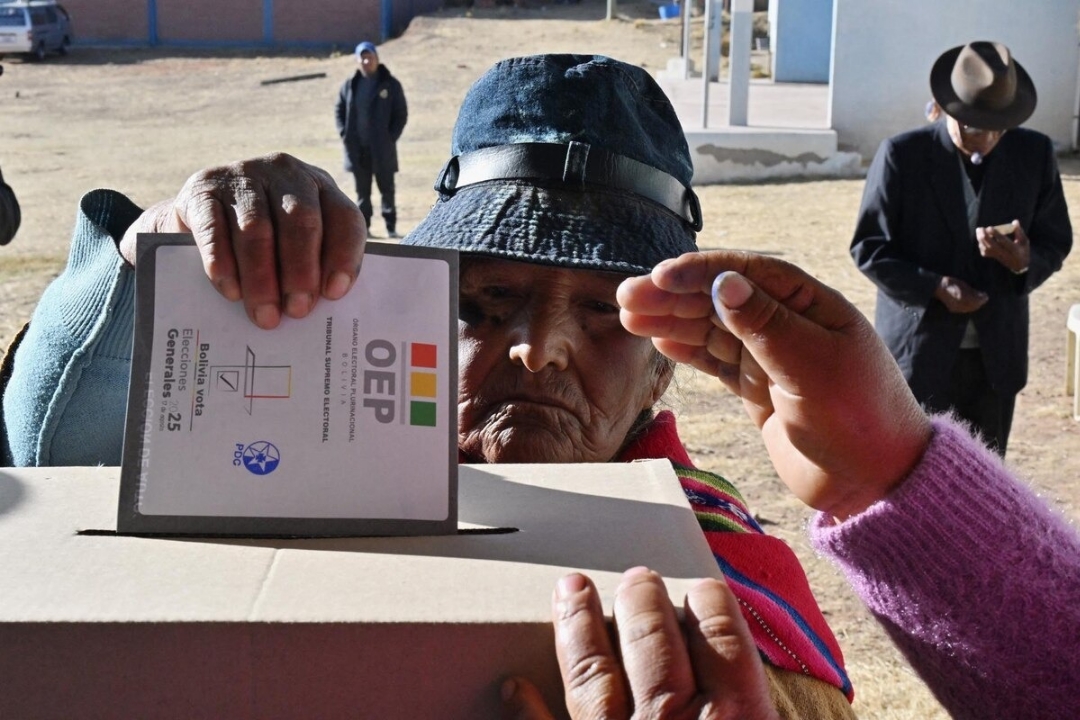
On Sunday August 17, national elections were held in Bolivia. The results offer a clear x-ray of the political situation of the country. After one of the longest cycles of the so-called populist governments in the region, there was an electoral shift to the right: the first three candidates accounted for 54% of the electorate. MAS, which had governed for almost two decades, collapsed. And almost 20 % of the vote was null and void.
This shift to the right is not an unexpected fact in the context of global social and political polarization, nor in the face of the deep erosion of MAS and Evo Morales. We have been analyzing this process in several articles on this website and in our magazine Permanent Revolution.
MAS started eroding when the exceptional cycle of high commodity prices came to an end, and the party became the administrator of economic austerity. As long as Bolivian business and associated capitalists (with some occasional contradictions) were expanding, there was room for social concessions. But when the economic cycle began to contract and austerity knocked on the door, MAS -like all its counterparts- opted to defend the interests of capital.
That is the determining factor, although not the only one. Other elements are consequences or expressions of this decision.
Bolivia is yet another example of the drift of progressivism. Although in this case, perhaps, MAS and Evo Morales embody one of the most extreme examples of political decomposition.
Election results
With 32% of the valid votes, the Christian Democratic Party (PDC), headed by the Paz-Lara duo -who were not among the favorites according to the polls- won with a “capitalism for all” approach: loans, cuts in state budget and fight against corruption. A center-right program in disguise, but clearly defending the capitalist system.
In second place, with 26% of the valid votes, was Alianza Libre, headed by Jorge “Tuto” Quiroga, former vice-president of dictator Banzer, who became president after his death.
The second round in October will be defined between these two candidates.
In third place, with 19%, was Samuel Doria Medina, businessman and key public figure of the privatizations of the 90’s, trained by economic imperialism. He competed with Quiroga for who could push the agenda more to the right, but he was left out of the second round and quickly expressed his support to Paz.
The center-left collapsed
MAS, weakened by internal disputes, ended up presenting two candidates from its ranks, while Evo Morales called for blank or null vote. The pro-government candidate, Castillo -supported by President Arce- barely reached 3%.
The other MAS candidate was Andrónico Rodríguez, who exceeded 8% of the valid votes and came in fourth place, far from third.
The null vote had a high rate as well: more than 1.3 million. This figure should be carefully analyzed. Although it partly reflects Morales’ call, it also expresses a more general trend: the rejection of traditional political alternatives and, in many cases, of the electoral mechanism itself.
From progressive model to decay
Beyond these preliminary considerations, there is an overwhelming political fact: a force that had emerged by eliminating the two-party system electorally collapsed. The question -wrongly answered in many analyses- is how a party that was a referent of Latin American populism, that implemented measures such as the partial recovery of the hydrocarbon rent or the inclusion of oppressed nationalities, ended up barely reaching the legal threshold to keep its legal status.
Product of the circumstances
As we pointed out above, the material basis of MAS and Evo Morales process was the high prices of commodities. The Latin American populist cycle was sustained by this extraordinary income: Venezuelan oil, Bolivian gas or Argentine soy, to take a few examples.
This favorable context was combined with:
- popular rejection of neoliberal policies and their social consequences;
- a rise in the class struggle that pushed the two-party regimes into a corner;
- and the absence of a structural defeat of capitalism.
Thus, center-left projects emerged -some of them based on traditional parties, as in Argentina- that took advantage of the trade surplus and the increase in reserves to offer minimal concessions, accompanied by a discourse overloaded with symbolism.
A wasted opportunity
In the case of Bolivia, these conditions made it possible to recover part of the national income from hydrocarbons. The fact that an indigenous leader -the first to become president- took power symbolically reinforced the legitimacy of the process and earned him massive support among the exploited and oppressed majorities.
With that political capital, we could have gone much further. For that, it was necessary to affect the interests of imperialism and the national bourgeoisie: to nationalize in a real and integral way the fundamental springs of the economy; to stop paying the foreign debt; to plan an autonomous development; to coordinate policies of economic and political independence with the countries of the region; to reform the Constitution to abolish the sacrosanct capitalist private property as well as to recognize the native peoples constitutionally.
But none of that happened. It was neither the orientation of MAS, nor that of Evo Morales, nor that of his vice-president, Alvaro Garcia Linera, who was referenced as one of the main intellectuals of the process. At that time, Linera warned against “turning too far to the left” in order not to frighten the electorate and prevent the process from going backwards.
Right wing emerges from the rotten fruit of progressivism
In addition to economic austerity, the decomposition of MAS was particularly serious. Not only was MAS involved in corruption scandals, but Evo Morales tried to modify the Constitution that he had promoted in order to perpetuate himself in power. That fact gave the right wing a powerful political weapon, which it used after the events of November 2019.
In 2020, the MAS chose Arce as presidential candidate, in an operation reminiscent of other Latin American examples, Arce became a “traitor” and an enemy of Morales. He was implicated in the coup attempt and ended up dividing the party. Perhaps the most telling image of this decomposition is that of Evo Morales hiding, on the run, calling for a blank or null vote.
Beyond this personal drift, the root of the collapse is clear: the inability of MAS to offer real economic solutions to the great majorities.
Even García Linera himself admits it:
“A progressive or left-wing government loses in elections because of its political mistakes. And these mistakes can be several. But there is one fault that unifies the others: the mistakes in economic management by making decisions that affect the great majority of its followers…. Progressivism and the left are condemned to move forward if they want to remain in power. To stand still is to lose.“[1]
Progressivism is a utopia. And in order not to “stand still”, the only way out is to move forward against the interests of capital. That is the truth that is proven, again and again, with painful clarity. There can no longer be any doubt, it is a law: progressivism does not give way to progress, but to a right wing movement that feeds on the disappointment and frustration of betrayed expectations.
[1] https://www.jornada.com.mx/noticia/2025/08/16/mundo/por-que-la-izquierda-y-el-progresismo-pierden-elecciones. The article was also published by the Argetinian newspaper Página 12.