March 24, 50 Years: More than an Anniversary, a Class War Trench
By Mariano Rosa
The new political stage of Milei’s government has a special field of dispute in Human Rights. To implement its program of restructuring capitalism, the government needs to restore the social legitimacy of the repressive forces. And to acheive that, it needs to suppress the historical memory of the genocide in Argentina. It is a line of ideological accumulation of the capitalistfraction represented by Milei’s far right party La Libertad Avanza (Liberty Advances). Next March 24 will be the 50th anniversary of the 1976 military coup and and its extermination plan. It will much more than a new anniversary: it will be a test of the relations of force between the anti-worker plan which is in command of the country and the social forces which oppose it. That is the scale of the challenge that is posed.
The interpretation of the past is a terrain of political struggle for the hegemony of the official narrative. In this way, the dominant social class builds collective identity, imposes it and gives meaning to things. This is what is called common sense. Then the ruling minority uses various devices to disseminate and institutionalize this narrative of the past: the media it finances, its paid spokespersons, the social networks in full force today, the books that continue to be produced, and even public education, promoting some discourses and stigmatizing others.
The current libertarian government set itself the task of reimposing a version of the last military dictatorship in line with how the coup has previously been justified: subversive and anti-national violent and criminal organizations tried to take power to impose communism, killing, stealing and leading the nation into the worst nightmare. The armed forces intervened to save the country from that nightmare. It was not genocide. There were not 30,000 people killed or dissappeared. That is a leftist story, manipulation and an invention protected by the cowardice of the complicit political caste. This is how denialists explain it.
As can be seen, it is a narrative to the right of the “two demons” theory and its interpretation that there were two opposing minorities on the left and right that both committed excesses: the political-military organizations and the repressive forces of the State. Denialism is something else. It defends the genocide by denying it, it exalts a messianic and salvior role of state repression. Evidently, the far-right acts politically on a terrain of ideological confusion fed by the disappointment with so-called progressive governments that ended in economic-social disaster. This material experience delegitimizes, in the conscience of a large segment of the people, everything that this progressivism used and abused, like its attempt to appropriate Human Rights as the exclusive patrimony of its political tendendy. The fall in disgrace of progressivism dragged into the discredit of the collective experience everything that it touched, including Human Rights. Incidentally, the far-right’s cultural operation takes advantage of this with ulterior motives, amalgamating all that social frustration with the left in general as a political identity, as if progressivism represented the left. The first two years of Milei’s government did not manage to bury the historical memory of the genocide, although he continues to fight it and to configure his own social base in negationism. This March 24, on the 50th anniversary of the genocidal coup, we have the responsibility to contribute in flooding the streets of Argentina with a historic mass action that will be a trench of resistance against the ruling nightmare.
They didn’t leave, we kicked them out revolutionarily
Capitalists as a ruling class do not exercise their power directly, but through the mediation of institutions and ideologies. In Argentina, during part of the 20th century, the bourgeoisie controlled the situation by appealing to two dialectically related regimes. That is, two combined systems of institutions. On the one hand, the two-party system with the UCR (Radical Civic Union) and the PJ (Peronist Justice Party). The alternation of one or the other was the mainstay for decades of false illusions among workers and even among the youth and the middle sectors. When struggles, revolts and rising mobilization became uncontrollable, before the masses could sweep away a government of the radical-peronist alternation, the armed forces would carry out a coup d’état. The coup, though formally striking against a Radical or Peronist government, was actually inteded to save one or the other from the population, from the mass movement completing its revolutionary experience. The military government that took over always had an economic objective of cutting rights, guaranteeing the transfer of resources and more capitalist profitability. Politically it[s mission was to give time to Radicals and Peronists to recover in order to restart the cycle of alternation, once the path militant, left and working class organization had been cleared.
But what happened in 1982 with the last Argentine dictatorship was entirely different. For the first time since 1930, a military government did not step down when it agreed to do so with the national capitalists and the dominant imperialism, It was driven out by the independent and revolutionary mobilization of the masses. The fall of the genocidal dictatorship in Argentina was not the result of capitalist planning: it was an imposition forced by the massive workers and popular mobilization. The discredit, the total political bankruptcy of the Armed Forces as an option or resource of power for the bourgeoisie left the latter with only one way out: to make do with the radical-peronist alternation, no longer able to appeal to a coup as a way of salvation.
The failure of capitalist democracy
The impressive effect of that revolution against the dictatorship was so strong that it even forced a government like that of Alfonsín (1983-1989), of the reactionary UCR, to judge the commanders of the Armed Forces responsible for the repression. The Nunca Más (Never Again) report, prepared by a commission of “notables” chaired by the author Ernesto Sábato, was the state’s account of the genocide that attributed the social tragedy to the existence of “Two Demons” -guerrilla and military-. It was the first attempt to cover up, to construct meaning with a false ideology. At the same time, this attempt was the way to try to close the process of permanent revolution by channeling illusions in Radical and Peronist democracy. They managed to temper the rise, to divert it, but the struggle continued. Then came the Holy Week of 1987, the Carapintada extortion (an uprising of officers who demanded impunity for their crimes) and the complete capitulation of Alfonsinism with the laws of Due Obedience (impunity for all who were “following orders”) and Full Stop (deadline for presenting lawsuits against the dicratorship’s crimes). March 24 became, little by little, the most attended mass action of each year. Incredible but true. The date of a counterrevolution, of a defeat, has become the most mobilizing day of the whole calendar of struggles. Menemism (1989-1999) was a leap forward in impunity. Menem pardoned all the genocides, leaving them free. This decision, far from demobilizing, drove the strengthening of human rights organizations and the democratic struggle of other political, social and student organizations.
The social crisis of neoliberal capitalism in the ’90s dragged millions into poverty. They are the ones who exploded in December 2001, who threw out 5 presidents in a few weeks and liquidated the two party system as we knew it. What had happened? The impossibility of staging a coup and preventing the disillusionment with the two major capitalist parties ended provided an in-depth experience and led to a collective majority conclusion: they all have to go, they are the same, without them we will live better. That simple (but very profound) lesson drove the Argentinazo. Now it was the two party system that was flying through the air, one of the last bullets of the corporations to control the country.
The wasted decade, the revenge of the defeated
Our Marxist current in Argentina elaborated a global approach placing the meaning of the dictatorship and its fall in the context of Plan Condor and South America. On the one hand, the revolutionary fall of the genocidal plan in our country, unlike the continuity negotiated in Chile with Pinochet, in Paraguay with Stroessner or in Brazil in the 80’s with its own dictatorship, disqualified any coup or authoritarian solution to the recurrent capitalist crises. At the same time, the process of austerity and reconversion of the following decades liquefied any illusion in the traditional parties, all of them anti-popular in the end. That explains 2001.
From then on, the political regime adopted a new form anchored first in Kirchnerism, which as a variant of progressivism in this part of the continent was a project that tried to recompose bourgeois normality from a narrative or discourse that combined anti-imperialist cosmetics, partial economic concessions and at the same time a commitment with the corporations not to provoke structural anti-capitalist changes. Hence its limit and ultimate failure: the exhaustion of the cycle of high commodity prices, the suffocating indebtedness and the adjustment by inflation, ended up evaporating the expectations accumulated in the first years. The faction of the most concentrated capital raised a center-right coalition, which tried the formula of gradual adjustment in economic matters and a conservative ideological narrative without reaching the fascistoid character of the current government. Everything failed, especially progressivism, as explained above. Now, the “red circle” of corporations and the ultra-right government supported by Trumpism is attempting a complete break with the past and a reactionary reconversion of capitalism . To achieve this, it requires two things:
- Defeating the resisting social pole in the streets
- Building its own ideologically homogeneous social base in conditions of being dominant and majority as common sense.
- For this reason, burying March 24 as an emblem of the struggle for Memory, Truth and Justice is as important for them as it is for us.
A trench
For all the above, much is at stake next March 24. The date will be marked by a hot February with a parliamentary offensive of the ruling party trying to impose the legalization of labor slavery and to erase with one stroke of the pen the conquests of decades of the workers’ movement crystallized in laws that we still preserve. They are making the attempt. They aim to reverse the Glaciers Law and enable the unhindered plundering by the mega-mining companies, even of the few water reserves that we still have left in this time of climate change and global warming. They aim for a Penal Reform that removes inhibitions from police brutality and the repression of protests. They aim to impose the Retirement Reform and Fiscal Innocence: legalizing the extension of labor exploitation until almost the end of life and tax exemption (of the very few that pay) for the big bosses. It is a right-wing remodeling of the economy, social relations and politics. This includes burying the historical memory of our people. All of this is at stake this March 24. For that reason, our challenge is to build a massive unforgettable action. To be unitary without diluting the identities, nuances or differences that we have had and have. But as in 2025, to give a strong message to the far-right and also, an enormous incentive of militant morale and struggle to all those who do not give up. There is no margin for sectarianism, pettiness or parasitical impositions. The left has to be the protagonist of this unity in diversity. To cry out that we do not forget, nor do we forgive. That we want the opening of the archives of the dictatorship. That we want them all in effective and common prison. That in the present we reject the co-government of Milei, Trump and the IMF. That we say that we cannot wait for 2027 because our rights know no electoral calendars. That we need a general strike and a plan of struggle now until we win. That it is necessary to say with force now that we do not want imperialist interference in Venezuela or Latin America. That there are 30 thousand dissappeared. That it was genocide. That we are going to organize, to fight and fight to build the world we deserve. Without capitalism. Without exploitation. Without oppression. Real socialism and democracy of those from below, of the workers and the people.
A unitary Plaza without losing diversity
This time it will be more special than ever. Because it can be transformed into a massive expression against the libertarian government. Because it is the 50th anniversary of the genocidal coup and the cultural battle against negationism is more intense than ever. Because we held a massive unitary rally last year, after almost 20 years of separate rallies, and it was an enormous political victory of the majority of the organizations of the Encuentro Memoria Verdad y Justicia – EMVyJ (coalition of left wing human rights organizations) and the Board of Human Rights Organizations (Peronist dominated coalition of human rights organizations) that made it possible. Because the far-right is in power and emboldened, and we have the obligation to try to repeat that feat. For all that, against all sectarianism and, at the same time, without losing our political independence, as (Mother of Plaza de Mayo) Norita used to say: let us march united, but not mixed up. The MST in the EMVyJ raises this orientation together with dozens of human rights organizations. The FITU is once again facing the same challenge. The debate is ongoing.
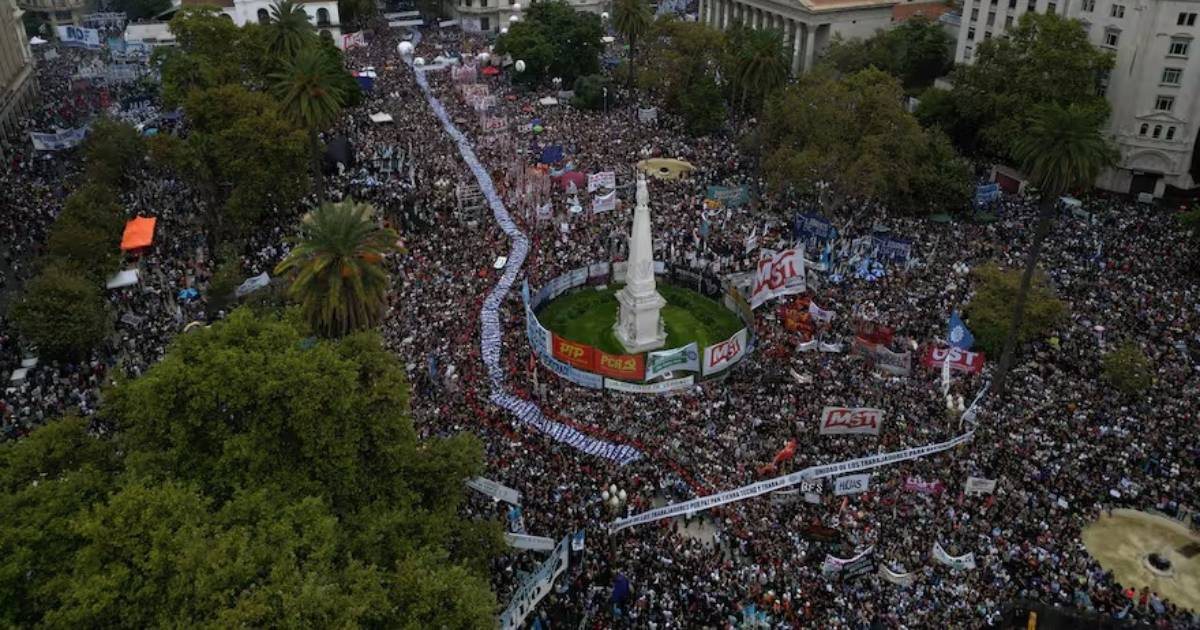
Last year the Plaza del 24 was impressive. But not by inertia: there was political will, determination, debates and a very hard struggle of ideas to make it possible. This particular date shows year after year the temperature of our people. It measures the active degree of consciousness in relation to a crucial issue: the genocide, the 30 thousand and the economic continuity of the dictatorship. It is a street response throughout the country that displays the accumulated democratic reserves that exist. T,his 2026 we need to give a strong signal to the ultra-reactionary project with fascist vocation of Milei-Bullrich. And also because the massive mobilizations do not act exclusively as a message to the opposing pole, they also act as a stimulus to the will to fight of those who participate. They are a powerful balm of self-confidence, of strength, of forward thrust. Those of us who participated in last year’s unitary rally in Buenos Aires came out of it with renewed energy, contagious joy both below the stage and on it with (Nobel Peace Laurate) Adolfo Perez Ezquivel, Elia, Estela, Taty and all the Mothers and Grandmothers of Plaza de Mayo. The organizations of the EMVyJ and the Board of Organizations, and all of us who were active in building the massive and historic action of 2025 came out of it highly invigorated. Thus, we have the obligation to repeat and multiply this year what we built just a few months ago.
The Plaza of 2025 must be the political, programmatic and organizational starting point
For almost 20 years, the united front of human rights in the country was divided in the face of the national government’s attempt to co-opt it. The EMVyJ was a positive regrouping to defend the independent character of the mobilization and the demands against the state. However, the division that repeated every March 24 was not positive. At least, we in the MST never celebrated it and we believe that many, many more saw it in the same way: as a setback. Precisely because of that, we consider having achieved in 2025 a massive and also diverse Plaza, in which nobody lost their identity while expressing a powerful and correct common message. The assessment was overwhelmingly positive. The agreements made were 100% fulfilled during the event: the representatives of the EMVyJ and the Board of Organizations acted as a team to guarantee what was agreed. There were no maneuvers or disloyalty. A message was read with positive and correct points, some of which were 1:
- Milei and Bullrich have to go.
- The opening of files since 1974, ergo, including the Triple A stage.
- Denounciation of the IMF and the debt.
- Rejection of DNU 70, the RIGI and the extractivist model.
- Demand to all labor federations for a strike and a plan of struggle.
- Solidarity with the Palestinian people.
These and other very correct definitions, which are part of the identity banners of the EMVyJ outlined a political message totally and completely compatible with what we have been raising in the last two decades. Our MST and other forces debated with the organizations of the EMVyJ for this orientation and we also achieved a majority of the Board of Organizations to act in unity in a rally that was independent of the PJ, the trade union bureaucracy and had a clearly militant profile.
Will Bregman’s PTS, PO and IS revise their policies and act differently this 24th?
Last year the FITU as a political coalition was unfortunately unable to intervene as a whole in the unitary Plaza. Except for our party and forces sympathetic to the FITU, like Vientos del Pueblo, the PTS-PO-IS and the NMAS with Altamira’s group excluded themselves from the powerful and correct mass rally to end up in a marginal action at the end of the day. We polemicized in advance with them within the EMVyJ 2, in the subsequent assessment 3 and especially with the party of Bregman and Del Caño in depth in a long pamphlet that we published and is still available for all activists and militants 4. What matters now is to know if they will change this year and collaborate together with us and the majority of the human rights organizations to improve what we did in 2025. We proposed to discuss this issue as a priority in the National Board of the FITU but it has not yet been possible. We ratify the basic reasons to insist again with the same orientation:
Because the far-right is in power and it is key to contribute to the broadest unity of action in the streets.
Because, taking as a reference what was built last year, there is a political, programmatic and organizational base of unity in diversity that guarantees that no one must resign their banneers.
Because if there is a way to strengthen the authority of the anti-capitalist and socialist left as an alternative to a resigned Peronism in crisis in the eyes of thousands and thousands who look at us with sympathy, it is by being protagonists of a massive and united March 24 with our own identity.
There is still time. The coin is in the air. Let us hope that sectarianism, dogmatic closed-mindedness and lack of courage do not prevail in order to challenge the leadership of a progressive movement in retreat in what could possibly be the greatest demonstration of forces against the far-right of the whole year.
1 https://periodismodeizquierda.com/24m-documento-leido-en-la-marcha-unitaria-a-en-plaza-de-mayo/
2. https://periodismodeizquierda.com/24-de-marzo-marchamos-al-acto-unitario-en-plaza-de-mayo-con-mas-de-40- organizations-of-emvyj/
3. https://periodismodeizquierda.com/24-de-marzo-multitud-historica-novedades-y-debates/#_ftn1
4. https://periodismodeizquierda.com/polemica-con-el-pts-dos-concepciones-en-la-izquierda-frente-a-la-etapa-mile i/#:~:text=24%20from%20March%20and%20that%20places%20the%20date%20and%20acting%20on%20the%20conduct%20of%20this%20conduct%20of%20March%203%B3%B3n 3 https://periodismodeizquierda.com/24-de-marzo-multitud-historica-novedades-y-debates/#_ftn1 2 https://periodismodeizquierda.com/24-de-marzo-marchamos-al-acto-unitario-en-plaza-de-mayo-con-mas-de-40- organizations-emvyj/ 1 https://periodismodeizquierda.com/24m-documento-leido-en-la-marcha-unitaria-a-en-plaza-de-mayo/