By Imran Kamyana
The U.S. and Israeli aggression against Iran has shaken the entire world within a matter of days. On the one hand, there is the issue of the United States’ military embarrassment, and the heavy financial and strategic losses it has incurred within just a few weeks through the indiscriminate use of extremely expensive weaponry. This has dealt yet another serious blow to the image of the United States as the sole ‘superpower.’
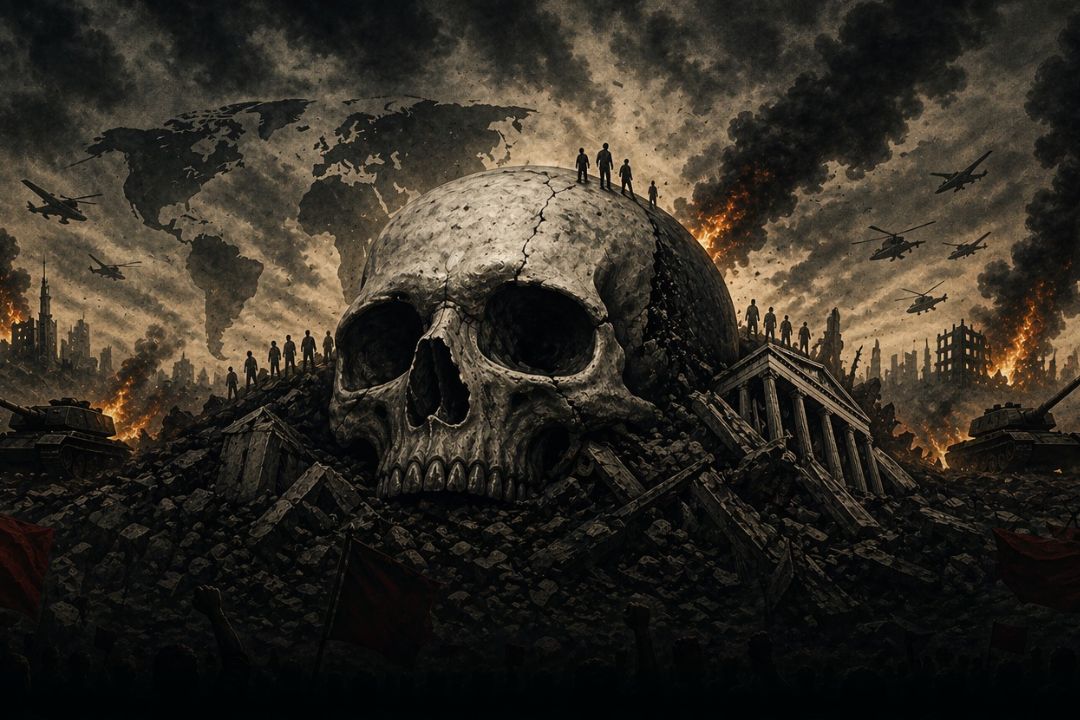
It is true that wars are highly profitable for the arms industry and for other sectors and contractors linked to militarism. However, war is not a constructive or productive process. It is outright devastation, in which resources are diverted from construction to destruction. But the matter does not end there. In this very process of destruction, the productive forces are further ruined and undermined.
Thus, war functions as a double-edged sword: as long as it continues, it not only results in mass killing but also impoverishes humanity. Scarcity, deprivation, and inflation rise. To finance war expenditures, states are compelled to rely on deficits and debt. But who ultimately bears these deficits, and who repays these debts? From the production of weapons to the destruction caused by their use, the cost is ultimately borne by the working class.
It is argued, in relation to wars and military industries, that they drive advances in science and technology, which are later utilized for peaceful purposes or human welfare. In this way, new sectors and industries emerge, carrying far-reaching economic benefits. A similar argument is often made in favor of capitalism itself: although it is a system of coercion and exploitation, it fosters innovation in science and technology and, over the long term, raises living standards (even though the capitalist criteria of “living standards” are themselves debatable).
Interestingly, there is an element of truth in this. Many modern inventions—including numerous items of everyday use—have emerged from wars or military industries. These range from modern rockets, radar, GPS, and jet engines to the internet, computers, microwave ovens, duct tape, synthetic rubber, wristwatches, sanitary pads, and aerosol sprays.
However, the crucial point is this: if such large-scale destruction and desolation can, indirectly, give rise to so many inventions, then to what heights could humanity be elevated through direct efforts of innovation, development and construction? In other words, is war a necessary condition for innovation? Why not redirect these enormous resources, along with creative and productive capacities, toward human development and well-being from the outset?
The same reasoning applies to the so-called ‘development’ or economic growth that results from war (through which capitalism attempts to emerge from crises). In reality, this amounts to destroying what already exists only to rebuild it (“broken window fallacy”), rather than creating additional or new wealth. But the same applies to the broader nature of the capitalist system itself. For a certain historical period, despite all its oppression and exploitation, it was an objective necessity, fulfilling a progressive role in advancing and expanding the productive forces. Today, however, its oppression and exploitation—indeed its very existence—are not only unnecessary but historically reactionary. It has become an obstacle to the development of productive forces and a grave threat to human civilization.
At present, humanity has reached a level of consciousness and organizational capacity where the bourgeoisie is no longer required for the organization and expansion of production. By breaking the constraints and barriers imposed by capital, it would be possible to achieve a pace of creative development far beyond anything conceivable under capitalism.
The issue of the current war is not confined to the United States, Iran, or the Middle East alone; it is proving extremely costly and damaging for the entire world. Even in recent history—including the wars in Afghanistan and Iraq—such a grave situation has not emerged. If the conflict escalates further in scale or intensity, not only will the Middle East face catastrophic devastation (including the possible use of nuclear weapons), but an energy and food crisis will engulf the entire world.
The problem is not merely one of disruptions in oil supply or immediate price increases. An economy cannot function under conditions of prolonged uncertainty. Each day brings contradictory reports regarding ceasefire, negotiations, and the resumption of hostilities. As a result, markets fluctuate sharply—rising one moment and falling the next. Under such conditions, investment ceases to be investment and turns into speculation, which is precisely what is occurring.
The key reason for this uncertainty lies in the chaos within the U.S. state and the ongoing disintegration of the Western imperialist bloc following the return of Donald Trump to power. This gang of reckless, unreliable and insane people, now in control of the most powerful military machinery in the world, has initiated the war in a state of frenzy. Yet, lacking any clear objective or coherent strategy, they now find themselves unable to chart a way out.
The elimination of Iran’s top political leadership has further complicated the situation rather than resolving it. However, in a state of mounting frustration, figures such as Donald Trump and Benjamin Netanyahu—marked by narcissism and viciousness—may be expected to go to any extreme. In response, Iran, too, is unlikely to hold back.
Global capitalism is already mired in a prolonged crisis. The onslaught of neoliberal policies has not only inflicted economic damage on societies across the world but has also left them culturally and politically scarred. Over the past few decades, lumpen tendencies have grown rapidly, while capacities for intelligence and observation (often measured in terms of “IQ”) have declined.
This condition finds expression in the rise of populist and hard-right politics, as well as in the proliferation of new forms of vulgarity in social media and everyday life. At its core, this is a crisis of the existing social order—one that is not temporary or accidental, but historical and structural in nature, and which manifests itself across all spheres, including the economy and politics.
Figures such as Donald Trump are not the cause of this crisis, but rather its symptoms.
The dialectics of the role of the individual in history is highly intriguing. The immediate and clearest expression of a system’s historical condition is found in its prominent or ruling personalities. According to Leon Trotsky, in most cases, people’s “individual” and “distinctive” traits are themselves imprints of the given time and circumstances. Different people may react differently to being tickled. But when touched with red-hot iron, everyone reacts in the same way. “As a steam-hammer converts a sphere and a cube alike into sheet metal, so under the blow of too great and inexorable events resistances are smashed and the boundaries of ‘individuality’ lost.”
This does not imply a negation of the role of the individual in history, which at times can be exaggeratedly large and decisive. However, as the pressure of circumstances intensifies, the scope for individual agency and choice diminishes. The terminal condition of a system typically generates precisely such circumstances. In such a situation, even if a highly intelligent and capable individual were to come to power, they could only delay the dictates of “fate” temporarily (conversely, if an exceptionally incompetent individual assumes power, the process of decline may accelerate).
Moreover, every epoch elevates personalities in accordance with its own character—indeed, one might say it “finds” the kind of individuals it requires. Thus, the issue is not merely that the crisis of U.S. imperialism (or of the imperialist order as a whole) has brought to power an ill-mannered, deceitful, blunt, and unreliable figure like Donald Trump. Rather, such conduct— obnoxiousness, falsehood, vulgarity, and deceit—also becomes a necessity for him. When a system itself becomes irrational, how can its representatives remain civil and rational?
However, there is another dimension to this entire situation. It may be surprising to much of the world, yet few have examined it in depth: the key mediator in this conflict is Pakistan. In other words, the world’s largest economic and military power—long claiming the role of resolving global disputes—now finds its own crisis being resolved by Pakistan!
Put differently (irrespective of the behind-the-scenes role of China or other powers), the aspirations for peace and survival in the world appear, at this moment, to be centered on Pakistan—a country whose own history is marked by state repression, violence, and proxy wars, and which itself has long struggled for peace and stability.
Were the situation not so grave, it would indeed appear almost ironic.
It is true that, following the Pakistan–India confrontation in May last year, Pakistan has gained a certain degree of stature at the international level. At the same time, it has marked the beginning of an ongoing process of humiliation and decline for the government of Narendra Modi—which also reveals how hollow, internally fragile, and dark the reality of Modi’s ‘Shining India’ truly is. Pakistan’s rulers have sought to capitalize fully on this situation, and at least in the short term, they have achieved a measure of success.
However, this is only a partial background to the broader situation. Pakistan has not really become a major power overnight. Rather, it is the relative decline of U.S. imperialism that is creating conditions in which many subordinate or satellite states are able to assert themselves with relative independence or adopt a more autonomous posture. In this broader context of uncertainty and instability, there is also a growing discourse around new defense arrangements. States with comparatively stronger military capabilities and nuclear status are gaining importance, and they are attempting to capitalize on these opportunities.
As with time, the temperament of Donald Trump can shift rapidly. Yet, since returning to power for a second term, he has repeatedly praised Pakistan’s rulers, particularly its powerful ‘Field Marshal.’ This once again indicates Trump’s willingness to engage opportunistically with, and to take “favors” from, any actor wherever possible. Indeed, it is difficult to find a clearer example of how things can turn into their opposites.
However, the urgency on the part of Pakistani authorities is also driven by the fact that they genuinely do not want a major catastrophe in the region. If the situation deteriorates further, not only would another of Pakistan’s borders become insecure, but the resulting economic devastation would be beyond what Pakistan can withstand.
Nevertheless, regardless of how much Pakistan’s importance may have increased under current conditions, without a developed and durable economy it should be regarded as a fragile and transient phenomenon. Indeed, these new defense arrangements and mediation efforts could also backfire. A glimpse of this has already been seen, as one “brotherly” country, having taken offense, demanded the return of its funds—forcing Pakistan to secure resources from another “brotherly” state.
Even beyond this episode, the Pakistani state appears to be walking a tightrope, attempting to maintain an extremely delicate and precarious balance under highly challenging conditions.
In the aftermath of the war, a new wave of inflation, lockdowns, and power outages has further worsened the internal situation. Economic growth has already been effectively stagnant for several years. If the war continues, the economic crisis could deepen and ignite widespread public anger. The rulers are aware of this as well. However, they are trapped in a dead end of their own system.
It is a historical and scientific fact that underdeveloped economies such as Pakistan cannot achieve long-term and sustainable development through capitalism. Showcase projects and initiatives may continue, but even a minimal, qualitatively meaningful improvement in the lives of the masses in such countries is not possible without violating the very norms of capitalism. Yet such ‘disrespect’ cannot be expected from obedient rulers installed and conditioned by imperialism.
The situation could develop in any direction from here. An extension of the ceasefire and a temporary accommodation are possible. However, if the war resumes, it is likely to be far more severe and unrestrained. It is doubtful that even Donald Trump himself knows what he will say or do the next day.
The future of humanity, in any case, is surrounded by perils. The intervals of “peace” between wars are becoming shorter, while the instability and insanity of ruling elites continues to intensify. The disintegration of U.S. imperialist dominance, and of the imperialist order associated with it, may take several decades to fully unfold. During this period, there may be phases of fluctuation and partial recovery. However, contrary to the illusions of certain naïve (or stupid) tendencies on the left, the so-called “multipolar” world that is emerging is likely to be more unstable and disorderly.
Capitalism is a horror without end, and the survival and prosperity of humanity ultimately depend on its revolutionary overthrow.