By Martin Suchanek
In recent weeks and months, the political situation in Argentina has changed significantly in several respects.
Firstly, the Milei government finds itself in a difficult position – in many respects the most difficult since it came to power two and a half years ago. It is entering the coming confrontations in a weakened state – due to internal conflicts and scandals, due to the economic and social crisis, and finally due also to the growing, albeit still largely sectoral, resistance.
Secondly, Peronism is being shaken by a deep internal crisis. It is increasingly fracturing into rival factions, with no ‘unifying’ figure in sight, who could stand above them. This paralyses it as a national force and thus also weakens its influence among the masses, even though the leadership of the major trade union confederation CGT—and thus the policy of the umbrella organisation—remains under Peronist control.
The rise of the FIT-U
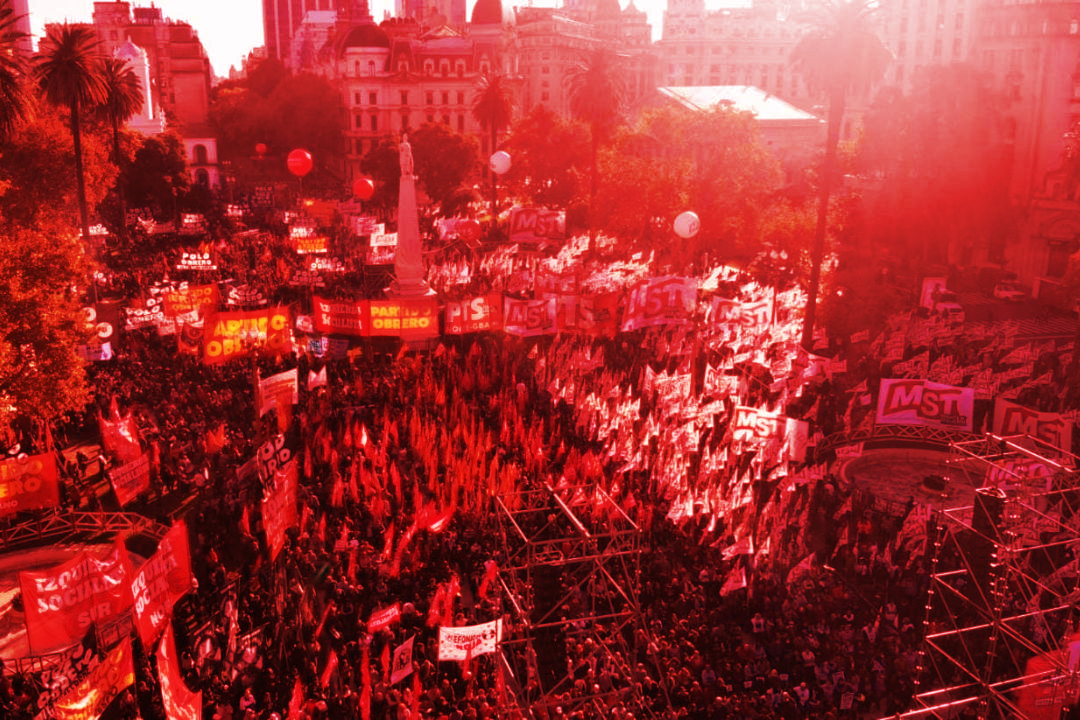
The third factor is the rise of the FIT-U in the polls and in its public role as the “third force” in the country. The FIT-U, an electoral alliance of four Trotskyist organisations, received between 2.5 and 5.5 per cent of the vote in national elections following its formation in 2011. In the by-elections in autumn 2025, it received 3.9% of the vote. Now, the FIT-U stands at between 10 and 15% in presidential polls (compared to 2.7% in 2023). Myriam Bregman, its candidate is now regarded as the most popular politician in the country.
The FIT-U itself also stands at 10%, and the trend is upwards. In the working-class suburbs of Buenos Aires and among young people, projections point to 25% or more support for the FIT-U.
The electoral alliance currently occupies the same position on the political spectrum as Die Linke in Germany or La France Insoumise in France. But with two key differences: Firstly, Argentina is in a far deeper political, social and economic crisis. The Milei government’s declaration of war on the working class, but also the objective economic situation, ultimately force a decisive political confrontation that can only end with the victory of the bourgeoisie and imperialism or the working class—with counter-revolution or revolution.
Even if the current situation is not (pre-)revolutionary, an escalation is ultimately inevitable. However, its pace, its ups and downs, cannot be precisely predicted, as it depends on the course of both national and international class struggle.
The second difference is that the FIT-U, unlike the reformist or populist left-wing parties, does not promise a parliamentary solution to the crisis. Rather, it advocates the necessity of overcoming capitalism and the formation of a workers’ government, to be achieved through the mobilisation of the exploited and oppressed.
Yet at the same time, before we turn to the tasks, challenges and problems facing the FIT-U, we wish to outline the first two aspects of the changed situation and political dynamics in Argentina. In doing so, we draw on documents and discussions from our sister organisation, the MST in Argentina, which has just held its national congress.
The situation of the Milei government
Milei took office as president in 2023 with the promise of overcoming the country’s crisis by wielding a chainsaw to Argentina’s ossified structures, among which he counted the Peronist apparatus, the trade unions, and the alleged ‘privileges’ of the regularly employed, students and the unemployed. This assault was coupled with right-wing attacks on democratic rights, on “wokeness”, “gender madness”, on the indigenous population, and with attempts to rehabilitate the military dictatorship of the 1970s-80s. Milei stood—and stands—firmly for subordination to US imperialism and Trumpism.
In recent years, Milei—who, due to the weakness of his own ultra-liberal party, La Libertad Avanza, could not rely on a stable parliamentary majority—has certainly achieved a great deal and pushed through massive cutbacks. Moreover, inflation has further impoverished the country’s working class and the poor.
But, contrary to his promises, he has failed to stabilise the economy. His successes have turned out to be short-lived flashes in the pan. The inflation rate still stands at 30% a year. However, this is by no means the only problem. Consumer spending is generally declining. Production capacity is utilised at only around 50%. It is not only wage earners who are becoming impoverished; numerous companies are also being forced to close down. Consequently, the economy is in decline, tax revenues are falling and debt is rising. Added to this is the fact that the IMF is demanding further ‘structural adjustments’ from the neoliberal ‘sawmaster’ in Argentina in exchange for further loans.
On a political level, the government is being rocked by financial and corruption scandals. These had previously always been blamed by the right-wing populist and ultra-liberal Milei on the Peronist “caste” and “elite”; now the reality of state bureaucracy and a more parasitic form of capitalism has caught up with him. In 2025, the focus was on his own sister, who had enriched herself through bribes for state contracts awarded to major drugstores. Memes (media content) with the title “Karina, alta Coimera” (Karina, the top corrupt official) went viral. Milei himself was at the centre of the $LIBRA scandal. The president himself promoted this cryptocurrency, which plummeted rapidly after a massive price surge, dragging down some 40,000 Argentine retail investors. These scandals not only expose the hypocrisy of Milei’s tirades against the “caste” whose corruption he claims to be rooting out. They also directly affect core sections of his own support base from the petty bourgeoisie and the middle classes.
The economic situation and the scandals have also shaken the unity of the government camp, at least in part.
Added to all this is a series of mobilisations by wage earners and students. For almost two months, teachers in key provinces such as Santa Fe and Córdoba have been organising regular protests. These combined large-scale mobilisations with significant rallies and posed problems for the trade union bureaucracy and the provincial governments. In some cases, the actions were self-organised or linked up with other struggles.
This development is directly linked to the deepening economic crisis and the increasingly acute loss of purchasing power. In the coming weeks, these are likely to lead to an upsurge in struggles and further outbreaks of unrest – often in the form of wage demands, resistance to redundancies, new company closures or more sweeping budget cuts, as in the case of the universities, where several strikes have already taken place and which have just organised a massive ‘March of the Federal Universities’, in which 1.5 million people took part nationwide and 600,000 in Buenos Aires alone.
This resurgence of class struggle is a key aspect of the current situation, even if it has not yet been centralised. Furthermore, whilst Milei has been weakened, he is by no means going to back down. Rather, the government is preparing new attacks, such as cuts totalling 2.5 trillion pesos (approx. 1.5 billion euros) in the sectors of education, health, culture, science, gender policy, housing and social services. Whether the defensive struggles can be generalised and coordinated is a key question for the coming period.
The crisis of Peronism
The most important and dynamic aspect of this new situation is the remarkable gain in political space for the left and the working class, and the beginning of a shift to the left.
This phenomenon must in turn be understood as the result of the deep crisis of the Milei government, indeed of the entire regime, but particularly of Peronism. As a cross-class, populist party, it managed for decades to bind the working class to the bourgeoisie. The Peronist party, the Partido Justicialista (PJ = Justice Party), represents, as Trotsky analysed in relation to the left-nationalist, populist parties of his time, a popular front in the form of a party. It is therefore no coincidence that these parties rely on a ‘strong leader’ who appears to stand above the various factions and class forces.
Today, Peronism is unable to present a unified project or a common perspective, but instead manifests itself in competing factions and currents. Naturally, there are also attempts to overcome this crisis and reorganise the party. For instance, the left-wing Peronist and Governor of Buenos Aires Province, Axel Kicillof, organised a tour across the whole country, whilst the conservative Peronist Pichetto is striving to establish internal order. But so far they have been unable to gain any significant support, as a significant section of the population does not wish to return to the past.
Rather, Peronism is in a deep crisis within its own mass base. Disappointment, mistrust and a rift within parts of its social base prevail. This is evident in workplaces, schools and working-class neighbourhoods, where, precisely because of this historic crisis of Peronism, there is greater scope for the Left. This is the key factor explaining why, for the first time, a larger proportion of workers and young people are looking to the left and feeling politically drawn to the possibility of voting for and supporting the FIT-U. The massive gains made by the FIT-U in opinion polls within just six months reflect this crisis. Significant sections of Peronism’s supporters no longer wish to repeat the experiences of the past that have disappointed them, especially as the various wings of the Peronist party are not even capable of acting as a united front, but are pulling in different directions. Consequently, there are greater political opportunities, and chances may also arise to gain a foothold in trade union and student circles. This shift away from the status quo will certainly continue for some time, and indeed, it may deepen. But it will not last forever. It is therefore crucial that the radical left finds a way to become the leading force in the struggle against Milei, and to advance this struggle—not merely through propaganda, but in reality—as a fight to establish workers’ power and a workers’ government.
Problems and possibilities of the FIT-U
The rise in popularity of the FIT-U and Myriam Bregman reflects, overall, a shift in the balance of power that raises the question of how the FIT-U can become a political, revolutionary force of the working class. Unlike all currents of Trotskyism in Europe, the FIT-U already represents an important part of the vanguard of the working class and the youth. But it does not open its doors to these sections of society.
The current state of the FIT-U as a mere electoral alliance of four organisations (MST, PTS, PO, IS) reveals itself in this situation as a massive obstacle to further development. At present, the alliance consists solely of the four member organisations. Workers, young people and other forces (social movements, organisations for the unemployed, trade union branches, human rights organisations) moving towards the left can vote for and support the FIT-U, but they cannot join it. There is no individual membership, so that militant workers and young people are faced with the choice of either joining one of the existing four groups, which together organise around 10,000 comrades, or supporting the FIT-U only from the outside.
The alliance essentially exists only as a united force during elections. In workplaces, trade unions or universities, the four groups often stand separately or directly against one another in elections. This also applies to street mobilisations. For instance, on this year’s May Day, the PTS organised its own rallies, whilst the other organisations held joint demonstrations.
The MST has been criticising the electoral limitations of the FIT-U for years, particularly since Milei’s election victory, and has proposed transforming the FIT-U into a party in which the four organisations (and possibly others) can operate as tendencies or factions, competing for majorities for their proposals and demands.
Finally, no one should be under any illusion that the four organisations are also divided by fundamental methodological and programmatic differences on international issues, as well as regarding the national class struggle.
For instance, the PTS and PO assume that China and Russia are not imperialist great powers, and both fail to recognise the dual character of the war in Ukraine (a war of national defence on the one hand, and its embedding in the struggle for the redivision of the world on the other).
There are also significant differences regarding the programme and the class struggle in Argentina. For instance, PO holds the view that a constituent assembly could form the basis for a revolutionary workers’ government. This is reflected in the founding programme of the FIT-U, in which councils and workers’ militias are not explicitly mentioned.
No less important is the question of how to assess the dynamics and prospects of the revolution in Argentina. The MST assumes that the crisis of capitalism and the Milei regime will force a confrontation between the classes, which will put the alternative victory of the neoliberal counter-revolution or victory of the working class through the establishment of a workers’ government that expropriates imperialist and national capital, implements a democratic plan, smashes the bourgeois state apparatus and relies on councils and militias.
The PTS does not assume that such an escalation lies ahead in the coming period, i.e. in the coming years, but rather a longer “process” in which the main task would be to win “footholds” among the masses and in public discourse. This is also why the PTS refused to make the FIT-U anything more than a mere electoral front.
But the changed situation has also forced the PTS to modify its position to some extent. It now advocates the creation of a workers’ party, even if it remains unclear what concrete steps are to be taken beyond support committees for Myriam Bregman in the next presidential elections.
This shift in position—at least in words—which we welcome, also reflects the pressure being exerted by FIT-U voters and supporters. For instance, four prominent intellectuals addressed the FIT-U in an open letter, calling on it to live up to its historical responsibility and opportunity and to politically unite a growing, significant sector of society seeking a revolutionary solution within a party that fights for a workers’ government.
In short, we are facing a situation that could make it possible to overcome the limitations of the FIT-U, opening it up to all those who agree with its existing programme. At the same time, such an opening would signify a transformation and would also be synonymous with an open discussion about the programme—its improvement and concretisation—and about the strategy and tactics of the Argentine revolution.
Undoubtedly, the current situation enables all groups within the FIT-U and the radical left in general to grow significantly and gain influence. Naturally, every current will do so, be it the MST, PTS, PO or others. And they would, of course, do so as tendencies even if the FIT-U were to be transformed into a new workers’ party.
What is crucial, however, is that such a party presents itself as a unified force not only in elections, but at all levels of the class struggle. It would have to wage a coordinated struggle within the trade unions to wrest them, step by step, from the control of the Peronist apparatus (including making use of divisions within Peronism in the process).
Above all, however, it would have to present a perspective of the working class seizing power through the struggle against Milei. Even if it is rather unlikely that Bregman will win the next presidential election, she could achieve a very strong result and, should the crisis within Peronism deepen further, well and truly make it into the run-off. In that case, the election would have to be fought primarily on the basis of a programme for a workers’ government.
However, it is by no means out of the question that the situation could escalate dramatically in the run-up to the upcoming elections. Milei’s current attacks, involving budget cuts running into the billions, demand a broadening of the resistance, a united response from the working class – ranging from a mass political strike to an indefinite general strike. This would even raise the question of political power in the workplaces and on the streets. The current situation could thus develop into a pre-revolutionary situation.
Finally, the situation could also come to a head if the FIT-U wins a majority in a province, which would put the formation of a workers’ government and its defence against the inevitable attacks by the national government and the reactionaries on the agenda there.
The MST Congress, which took place in Buenos Aires from 22 to 25 May and whose documents will be published in the coming weeks, has decided to set up support committees for Myriam Bregman for the upcoming presidential elections and to place these within the framework of the struggle for a political force that advocates a revolutionary programme. This is stated in a resolution of the MST Congress:
“We will take part in this and contribute to its organisation by bringing our ideas, opinions and our fighting spirit to bear across the country. The same applies to the organisation of the thematic and programmatic forums proposed in the call, as well as to other initiatives that may emerge and be advanced collectively.
We are convinced that this is the moment to make the greatest joint efforts to try to build a powerful political force of workers and youth which, under an anti-imperialist, anti-capitalist and socialist programme, will seek to attract millions and overcome the failure of all the bosses’ options, including the defeat of Peronism, which has disappointed millions. For this reason, we are facing the greatest opportunity to build an independent and left-wing force that reaches the masses and works to open up a perspective centred on seizing political power in the country.”