By Frederik Haber / Martin Suchanek
For days now, mass protests against a planned luxury tourism resort worth billions have been coalescing into a movement against the government and corruption in the country.
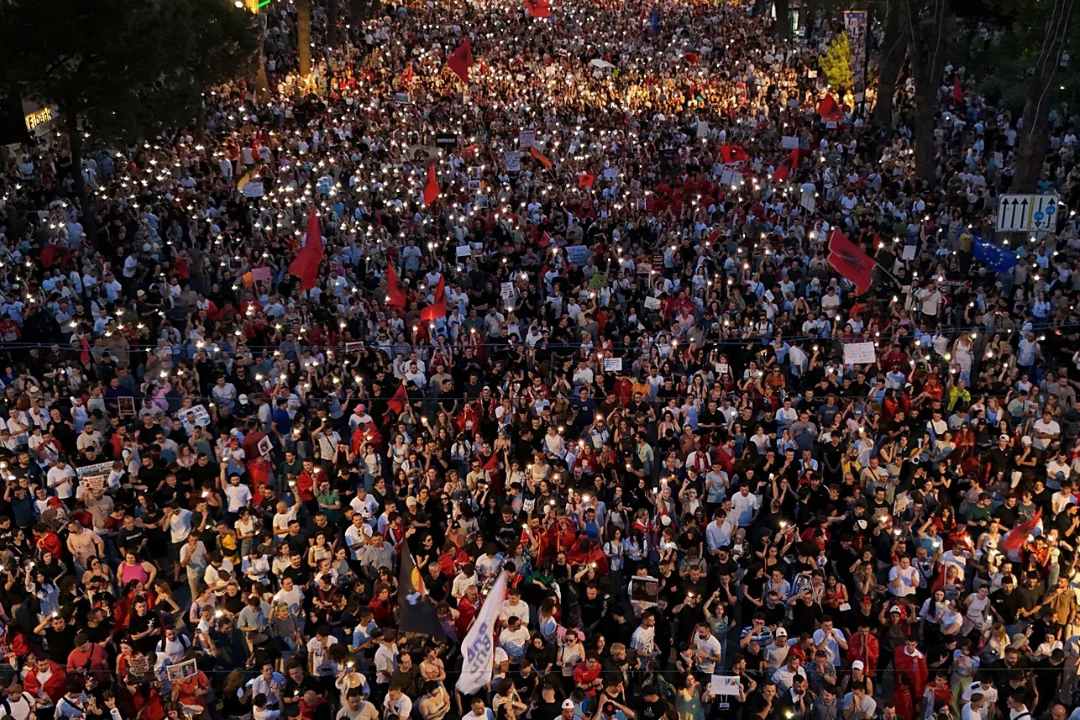
Since 5 June, thousands, and at times tens of thousands, have been demonstrating daily in Tirana and other cities across the country. The Rama government initially responded to the protests by dismissing them as the actions of a small, confused minority; now, alongside lies and defamation, it is resorting to repression. Water cannons and tear gas have been deployed in recent days.
The trigger for the protests and relations with the US
The protests have long been directed not only against the four-billion-euro luxury resort owned by Jared Kushner and Ivanka Trump, in which investors from Qatar and a local oligarch also have a stake. Their investment firm, Affinity Partners, plans to build hotels with 10,000 rooms, villas and a marina for wealthy tourists on the island of Sazan. They also intend to develop the beach on the mainland opposite. Unfortunately, this borders the Vjosa-Narta nature reserve on the Adriatic coast, with the Narta lagoon lying directly between them. This ecologically sensitive area is home to rare species such as flamingos, seals and sea turtles. The Vjosa River is known as one of Europe’s last unspoilt rivers and has been successfully defended against damming for hydroelectric power. It was only in 2023 that the entire course of the river within Albania was declared a national park. In fact, the environmental impact assessment for the construction project is still ongoing, yet construction work has nevertheless begun since May. With the kind assistance of the Rama government, legal regulations were amended as early as 2025 to favour Affinity Partners.
The fact that Kushner and Trump can push through their project so easily also highlights the close ties between the Albanian government and US imperialism. The country belongs to the illustrious circle of full members of Trump’s “Board of Peace”. A billion-dollar investment is not going to be derailed by a few environmental regulations, especially as the US President’s son-in-law is promising Albania a completely new city on the lagoon.
No to corruption and sell-outs!
The project and the government’s favouring of it are also emblematic of the rampant corruption in the country. The Minister for Infrastructure and Deputy Prime Minister, Belinda Balluku, is also alleged to have given preferential treatment to companies in major contracts. Yet despite demands from the Anti-Corruption Authority and protests in February 2026, the ruling Socialist Party refused to lift her immunity. Although Balluku stepped down at the end of February due to pressure from the government, parliament continued to refuse to authorise her arrest.
In recent years, leading members of the Socialist Party – which has been in power since 2013, emerged from the former Stalinist ‘Party of Labour’ and is now a member of the Socialist International – have repeatedly been accused of corruption and, in some cases, charged. Just like its conservative predecessors from the Democratic Party, which is closely linked to the European People’s Party, Rama’s Socialist Party also promised to “finally” root out corruption.
The fact that this has not succeeded is not solely due to the close ties both parties have with the state apparatus, the business world and US and European imperialism. Corruption is ultimately itself an expression of the capitalist restoration following the overthrow of Stalinism in its Hoxhaist variant. The capitalist restoration was necessarily accompanied by criminal forms of privatisation and the plundering of former state property. Only in this way could a new capitalist class, dependent on Western imperialism, be created.
It is therefore, of course, pure demagogy when the Democratic Party, which ruled until 2013, and the parliamentary opposition it dominates, seek to present themselves as an anti-corruption force. They were voted out of office 13 years ago precisely because of their corruption. They support the controversial investment project anyway. Nor is it only the US that makes use of this network of nepotism. Although the EU is demanding that Albania finally tackle corruption as a condition for accession, the country’s economic dependence on the EU perpetuates it time and again. Albania exports mainly agricultural goods and raw materials, primarily to the EU and, within that, mainly to Italy. Added to this are hundreds of thousands of migrant workers who remit around €100 million a month to their home country. The banking sector is dominated by the Austrian Raiffeisen Bank. The country is attempting to compensate for its lack of an industrial base and infrastructure through the tourism industry, which has indeed grown massively in recent decades and is primarily responsible for the country’s economic growth. The number of overnight stays rose from 588,000 in 2004 to 5.5 million in 2021, with over 4 million of these coming from other European countries.
Protest movement and its prospects
The protests in the country are rightly directed against corruption and mismanagement. The Kushner/Trump luxury resort starkly symbolises the deep social divide that also runs through Albanian society. The government’s actions, as well as the brutality of the security forces on the construction site, were the proverbial straw that broke the camel’s back. Against a backdrop of low wages and a lack of prospects for young people, who are forced to seek work in Europe and around the world, the corrupt deals struck by billionaires seem particularly obscene and provocative. The demand “Rama must go” has long been echoing through Tirana and other cities. It remains unclear, however, who is to replace him.
Alongside the Socialist Party and the Democratic Party, Levizja Bashke (LB; The Together Movement) has attempted to establish itself in recent years and is currently represented by one member each in Parliament and the Tirana City Assembly. Due to the very strong anti-communism in Albania – a legacy of the Enver Hoxha area – LB is making great efforts to project a non-communist image; for example, it very opportunistically refrains from publicly expressing solidarity with Palestine and concentrates on economic and democratic demands. Although LB could benefit from the mass demonstrations, it is not yet apparent that it is sharpening its left-wing profile, for example by linking solidarity with Palestine to the struggle against Rama and the Trump clan. Thus, whilst LB also calls for the overthrow of Rama and for daily actions across the country, it has not yet established a strategy for how this struggle can be given a political perspective.
As in other Balkan countries – e.g. Serbia and Bulgaria – a protest movement is also emerging in Albania directed against corruption and the regime’s growing authoritarianism.
Politically, it remains diffuse and relies, at least in part, on pressure from the EU to take action against the government. These illusions by no means mean that revolutionaries and socialists should turn their backs on the protest movement, but they must resolutely warn against these illusions. Unlike the protests in Serbia and Bulgaria, the protests in Albania can not only shake the country out of its political passivity but also link up with movements in other countries. From the very outset, this struggle has had a significantly more international dimension than the struggles in Serbia or Bulgaria.
It is also up to the international Left to show that Albania’s future does not lie in whether the country submits to US imperialism or the EU, but in the joint struggle against all wings of the ruling class and their imperialist allies. For the struggle against corruption, against nepotism, against authoritarianism can ultimately only succeed if it also turns against the system that necessarily produces them: against capitalism!