Carlos Ernesto Guevara Villar
Attorney
Panamanian Section of the International Socialist League
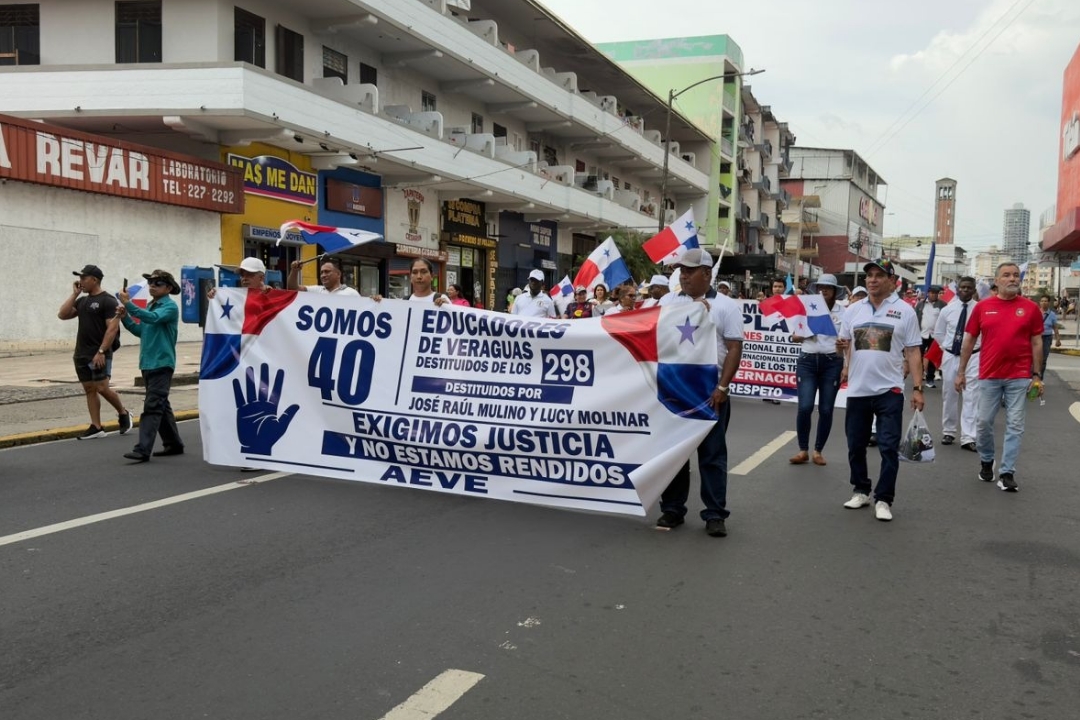
On Monday, June 22, 2026, various social organizations organized a march that set out from Porras Park toward the Chamber of Deputies. The march aimed, on the one hand, to oppose the Mulino dictatorship’s plans to reopen the mine, and, on the other hand, to speak out about the situation of the 298 educators who had been removed from their positions for participating in the strike against the reform of social security and the pension system, as well as the Río Indio reservoir project.
The march, though not very well attended, proceeded peacefully until it reached the area around 5 de Mayo Avenue, where the Chamber of Deputies is located. There, several dozen riot police—nearly a quarter of the march’s participants—awaited the peaceful demonstrators with a belligerent, arrogant, and aggressive attitude, as if we were in a period of pre-revolutionary social upheaval heralding the fall of the dictatorial regime. This is strikingly noteworthy, as it reveals the current government’s fear of the very real possibility that, despite its defeat on Law 462, the mining issue could once again awaken the consciousness of those young people and other sectors who fought against the ultimately defeated mining contract—without any apparent organizational leadership.
Regardless of the above, we must commend the unity shown by the various sectors that, rallying behind the slogans raised, marched together to oppose the possible reopening of the mine and to show support for the 298 educators who have been removed from their positions.
Notwithstanding the above, even though several lawyers representing the dismissed teachers from Panamá Centro and Colón were present at the demonstration, they were not given the courtesy of being allowed to speak to take stock of the situation and assess the current stage of this crucial struggle, which today—along with the persecution of SUNTRACS, its cooperative, and its historic leaders—represents one of the most critical points in the class struggle in Panama, as it reveals Mulino’s vengeance and warning against anyone who fights back: that opposing the regime’s policies has consequences, and precisely one of these is dismissal, exile, imprisonment, or criminal prosecution, at the very least.
An Assessment of the Current Phase
This leads us to—and compels us to—take stock, through this statement, of the current status of the administrative and judicial proceedings that the regime, through its Opus Dei minister, is conducting against the 298 educators who have been removed from their positions without the right to a salary.
On the administrative front, warnings of illegality have been rejected—in violation of the general administrative procedure set forth in Law 38 of 2000—based on a prior review that is not legally defined. The legal consequence of the alleged conduct of abandonment of office has been changed from dismissal to dismissal for lack of grounds, without access to legal remedies, which violates constitutional guarantees such as due process and the principle of strict legality, paving the way to justify before the Third Chamber of the Supreme Court the regime’s arbitrary and illegal actions carried out through its Minister of Education, implying that those affected are subject to discretionary removal rather than public servants who obtained their positions through merit-based competitive examinations.
On the legal front—a mistake many leaders made by promoting the idea that this was where the conflict should be taken—things are already starting to look fishy due to the decisions that have been made. For example, in Veraguas, 39 constitutional protection petitions were admitted and granted; however, upon appeal by MEDUCA, the regional Superior Court ultimately revoked them without further explanation and in a contradictory manner, once again leaving that group of dismissed educators defenseless, prioritizing jurisprudential requirements—which violate and render a mockery of the effective judicial protection that the administration of justice is obligated to provide to those affected—over the serious and imminent harm caused by the defendant’s actions.
The same has been true for cases pending in the civil circuit courts in Panama, where, depending on which court is assigned the amparo petition, the action may or may not be admitted—a sort of Russian roulette when it comes to obtaining protection from the Panamanian judicial system.
Neither Washington, nor Beijing, nor Ottawa: the struggle is against transnational capital as a system
As revolutionary Marxists, we categorically reject any attempt to reduce the struggle against the surrender of our natural resources to a dispute between nationalities of capital. The fundamental issue is not whether the exploiter holds a U.S., Canadian, or Chinese passport: the issue is imperialism as a global system of economic domination, which subordinates the wealth of dependent countries to the accumulation of capital by the central powers, regardless of their flag or internal political regime.
It is an opportunistic fallacy to portray this conflict as a struggle between power blocs, when behind First Quantum Minerals Ltd. there are capital interests from various sources, including a stake held by the Chinese state-owned enterprise Jiangxi Copper Company Limited, which owns approximately 18.5% of the Canadian company. This demonstrates, once again, that transnational capital has no homeland: it mixes, forms partnerships, and divides the spoils across national borders, all while trying to make us believe that the choice is between one form of imperialism and another.
We do not fall into the trap of so-called “anti-imperialism” that only points the finger at Washington in order to remain silent about Beijing, nor into the opposite rhetoric that denounces China in order to whitewash Western imperialism. The Panamanian working class does not have to choose between foreign administrators: it must fight against transnational capital as a whole and against the local bourgeoisie that acts as its intermediary and profits from the surrender of our wealth.
Therefore, any new contract or mechanism that seeks to resume mining operations must be denounced not only on economic grounds, but also on constitutional and class grounds, as it entails surrendering strategic national resources and compromising our sovereignty to the interests of international finance capital. Panama cannot simply replace one foreign master with another: our natural resources are not commodities to be traded by any empire, economic power, or transnational corporation, whether from the West or the East. Only the nationalization of strategic resources under the control of workers and the organized people can guarantee that these riches serve the needs of the people and not private profit—whether that profit comes from the United States, Canada, China, or any other power.
Conclusion
All of the above indicates that the dictatorial, pro-business, pro-U.S., and pro-Zionist regime is fulfilling its role: not only to set a precedent, but also, in doing so, to send the message that anyone who fights against the austerity plan and the handing over of resources to transnational mining companies will face exemplary punishment.
Given this situation, it is clear that the regime has its hands in the judiciary—and from the very beginning, we have had no doubt about the role it is playing and has always played. One need only look at the judicial persecution of SUNTRACS, educators, and other social activists.
This leads us to warn those affected that the only way out of the regime’s repressive policies is, on the one hand, unity in action, and, on the other hand, constant struggle and mobilization against the current austerity measures and the surrender of our resources to the imperialist powers involved—powers that, in the name of their own development, divide up the mineral resources of the rest of the world among themselves, resources that never even reach the people but instead remain in the hands of the local bourgeoisie.
June 22, 2026
Immediate reinstatement of the 298 dismissed educators!
No to the reopening of the mine! Out with the transnational mining companies from Panama!
Stop the judicial and criminal persecution of SUNTRACS and social activists!
Unity in action among all sectors in the struggle!
Not a step back: Mobilization and the people’s struggle are the only guarantee!
Our natural resources are not up for negotiation or surrender!