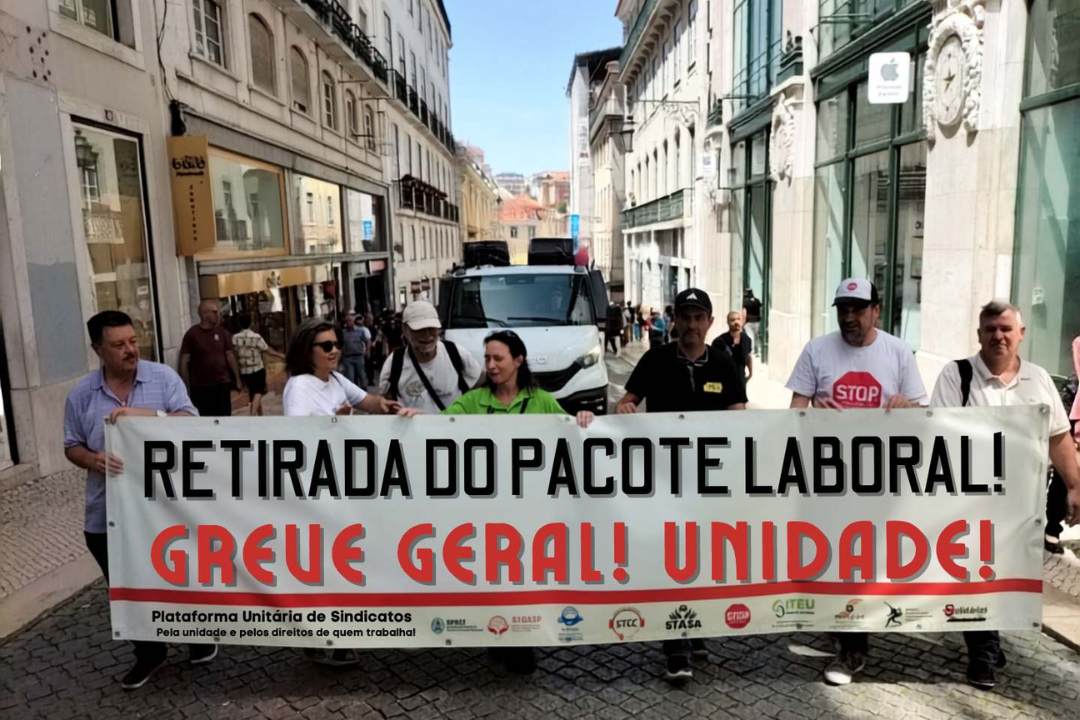
“No one wanted Luís’s package…”. Two general strikes, opposition from the majority of the population to the proposed labor law amendments, demonstrations, and new nationwide strikes created the conditions to divide the parliamentary right wing and prevent the Montenegro/AD government’s proposed labor package from being approved.
This is a major defeat for this government and a victory for the working class and its struggles.
The intensity of the struggle divided the right wing
The government tried by every means possible to unite the right-wing parties and make concessions to the far right in order to secure support for this deeply unpopular law that undermines labor rights. With 70% of the population opposed, anyone who sided with the government to help carry out this attack would inevitably be “burned,” so the far right put forward several “demands” as “compensation” in order to present them as “victories” for the people.
The ploy was exposed, the scheme was laid bare, and Chega had to present concrete results regarding the new and much-publicized demand (which is demagogic coming from Chega) to lower the retirement age—something that, as is well known, this government never intended to do—and which a right-wing government with the far right would not do either. In fact, reducing the retirement age by one month when it already stands at the absurd 66 years and 9 months—and Chega’s advocacy for lowering it to 65 as a condition for voting in favor of the labor package—was equally just empty rhetoric to justify the demagogue Ventura’s eventual vote in favor.
Faced with widespread public opposition, and to avoid future electoral setbacks, Ventura’s position shifted once again, and he opportunistically chose to vote against the government’s bill, fearing he would lose votes and seats in future elections. It is worth noting that Chega’s current 60 lawmakers represent, each year and at the expense of our tax dollars, nearly 5 million euros for the party. Thus, he chose to vote against the bill alongside the PS and the entire parliamentary left.
The workers’ victory could have been overwhelming
Despite the strong turnout at the general strike on December 11, 2025, and the large demonstrations that took place that day—with the participation of many thousands of young workers who were not organized either through unions or political parties—this mobilization did not continue. A three-month “truce” by the CGTP and the UGT’s withdrawal influenced a second general strike called for June 3, although the reason for choosing that date was not entirely clear. This second general strike saw less street mobilization and was met with provocation from the government, which took the opportunity to announce that the bill would be debated on June 18.
A direct link between the struggle and mobilization and the defeat of the labor package would have required that the date of the general strike coincide with the debate on the bill in the Assembly of the Republic, which would also have strengthened the level of mobilization and militancy of the strike, as well as the confrontation with the positions of the deputies during this debate and vote.
However, only one union called for a national strike—decided at a union assembly—for June 18. It was the STOP union in the education sector, despite the challenge that it was the fourth day of a strike in just two weeks. Given the gravity of the situation, and to continue affirming the need for struggle at this decisive moment, reality demanded that strike as a form of resistance. That is what should have been demanded of the entire labor movement, particularly those unions that claim to be militant.
Unfortunately, neither the CGTP nor other unions issued such a call to action or organized a mobilization, leaving the far right to take the limelight in this parliamentary outcome. And the victory could have been overwhelming and decisive, leaving no room for doubt, as a result of the workers’ mobilization.
A victory that encourages us to continue the struggle
The government’s overall policy undermines workers’ rights, citizens’ democratic rights, the rights of immigrant populations, and the entire public services sector (education, health care, transportation), and seeks to divert our money to the arms and war industries.
To prevent these destructive policies, the labor movement must discuss a plan of action in assemblies with the rank-and-file workers and present a set of demands that are necessary and felt by all, such as:
- An immediate pay raise of 200 euros to offset the losses caused by the sharp rise in food, fuel, and housing prices.
- Retirement pensions equivalent to the minimum wage.
- Lower the retirement age to 62 or to 40 years of contributions, so that people can enjoy retirement “before they die.”
- Money for public services and not a single euro for weapons.
To develop new policies that benefit workers, a debate is needed within the working class and on the left to build an anti-systemic political alternative.
The MAS salutes all those in the labor movement and in politics who are committed to building these paths.