By Haris Qadeer and Umair Khurshid
This translation reflects the situation as it stood during the height of the crackdown. Since 15th July, negotiations involving representatives of the movement and government intermediaries have been underway. While the outcome remains uncertain, the commencement of talks marks a new phase in the political crisis and should be kept in mind when reading the analysis.
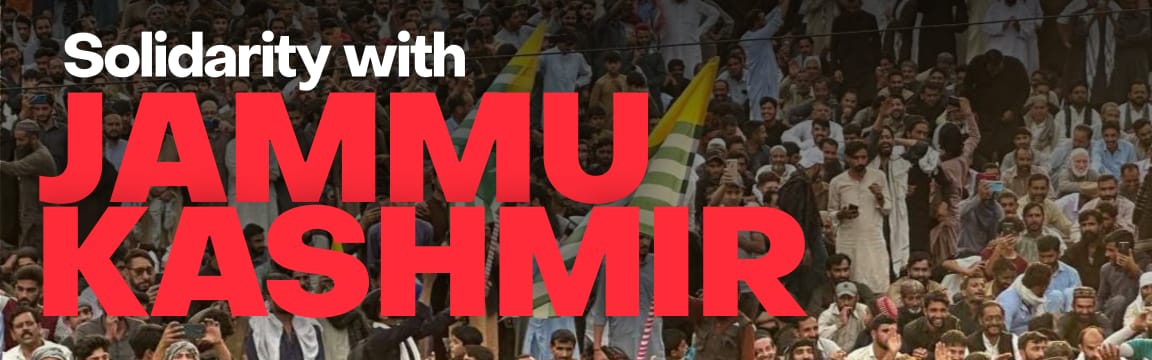
For more than three years, the popular rights movement in Pakistani administered Jammu Kashmir (PAJK) has sustained a continuous cycle of mass mobilization. During the past month alone, the movement has entered an unprecedented phase.
As of 14 July, the lockdown in Rawalakot has completed 38 days, while the lockdown has entered its 34th day. Operations carried out by security forces during this period have claimed the lives of at least 50 people. Hundreds have sustained injuries, and hundreds more have been taken into custody.
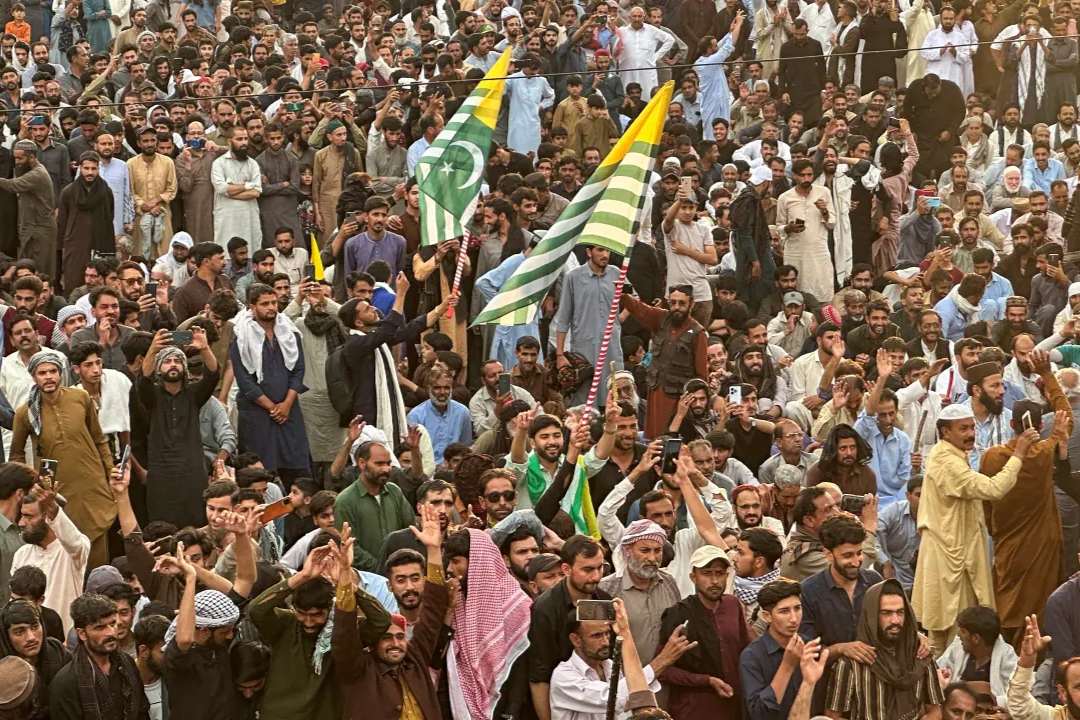
The long march that began in Bhimber on 9th June has remained camped only a few kilometers outside Rawalakot for the past 34 days. Alongside this central sit-in, five additional protest camps have been established around the city.
One sit-in blocks the main highway linking Poonch with Islamabad at the Bus Terminal on the Gowain Nullah Road. Another has been established on the Singola Road connecting Poonch with Bagh. Two more camps stand at Mujahidabad and Paniola on the highway leading from Poonch to Muzaffarabad1. A fifth protest camp has been set up near Potthi Makwalan High School on the Shujaabad Road between Rawalakot and Bagh.
The movement’s leadership has announced that a long march will begin on 15th July if its demands remain unresolved. State authorities have prepared extensive measures to stop the march regardless of developments in the negotiations.
On the morning of 14th July, security forces launched an operation against the Bus Terminal sit-in. Also, a large contingent was moving through Baloch in an attempt to seal off the central protest camp from the rear. Protesters first blocked their advance in Baloch and later stopped them again at Baithak Awanabad. These confrontations left at least eight people dead, while many others sustained injuries.
The State’s Decision and the Crackdown
The state resolved to suppress the movement and began its crackdown on 5th June, four days before the scheduled start of the long march. Several rounds of negotiations had taken place beforehand. The final formal talks were held on 30th May in Muzaffarabad with representatives of Pakistan’s federal government. After those discussions failed to produce an agreement, the movement’s leadership confirmed that the long march would proceed. The state then began preparations for a decisive security operation.
On 5th June, authorities first announced the election schedule. This was followed by an official notification declaring the Joint Awami Action Committee (JAAC) and affiliated Awami Action Committees (AACs)2 to be terrorist organizations and banning their activities.
At the same time, the Government of Pakistan deployed 14,000 security personnel to PAJK. A further contingent of more than 8,000 personnel arrived in the following days.
Internet services were suspended on the night of 5th June, marking the beginning of the crackdown. Raids were carried out across several towns, resulting in numerous arrests. Checkpoints were established as part of efforts to detain 27 members of the movement’s central leadership.
During these operations, security forces acted on intelligence reports concerning the convoy of senior movement leader Umar Nazir Kashmiri. Security personnel opened fire on the convoy, killing prominent activist Shazeb Habib, who was struck in the head and died at the scene. Umar Nazir Kashmiri suffered serious gunshot wounds to his ear and face.
The shooting triggered an immediate response across Rawalakot. A lockdown began on 6th June, while protesters placed Shazeb Habib’s body outside the Combined Military Hospital (CMH) and established a sit-in.
On the night of 7th June, Rangers3 dispersed the protest through a security operation. According to available reports, at least 24 civilians and seven members of the security forces lost their lives during these events. Establishing the final death toll has remained difficult because police took custody of the bodies, including that of Shazeb Habib, and buried them before they were returned to their families. A full account of the casualties will depend upon conditions that allow independent verification.
Curfew, Arrests, and Collective Punishment
Following the operation in Rawalakot, the authorities adopted what they described as a “zero tolerance” policy and imposed a curfew across the city. Security operations also continued in other towns throughout PAJK.
Homes belonging to movement activists were raided and damaged. Offices of Action Committees and political organizations were sealed, while furniture, records, and equipment inside many of these premises were destroyed. Private vehicles, motorcycles, and other personal property belonging to residents also became targets during the operations.
In Rawalakot, security personnel forced entry into at least 7 shops by breaking their shutters before carrying out looting inside the premises. A petrol station was also looted during the operation.
Across Rawalakot, checkpoints operated by Islamabad Police have become a permanent feature of daily life. People entering or leaving the city are required to undergo identity checks, while officers routinely inspect mobile phones. Any photograph or video related to the protests is treated as grounds for detention. Many detainees report severe physical abuse before being transferred to police stations.
Hundreds of people have been arrested across different towns, including a significant number of minors. Reports from detainees indicate that physical abuse has become routine inside police stations. Local police have largely been assigned surveillance duties, while Rangers are responsible for dispersing demonstrations and sit-ins. Islamabad Police continue to conduct searches, make arrests, and oversee interrogations at checkpoints throughout the region.
Taken together, these measures amount to a system of collective punishment directed at people participating in, or associated with, the protest movement. Official figures state that 425 people have been placed on the Fourth Schedule4 under Pakistan’s counterterrorism framework, more than 194 criminal cases have been registered, and over 450 people have been arrested.
Participants in the movement maintain that the actual number of arrests extends well beyond the official figures. Numerous accounts also describe local police officers demanding payments ranging from thousands to hundreds of thousands of rupees in exchange for releasing detainees. Families have increasingly viewed these payments as the only practical route to securing the freedom of relatives held in custody. For many officers within the police and security establishment, the crackdown has become an additional source of income.
Retaliatory Measures
Alongside arrests and security operations, authorities have pursued a broad campaign of retaliation intended to discourage further participation in the protests. Business owners have faced the freezing of bank accounts and the confiscation of property. Dozens of properties have already been seized, while hundreds of accounts remain inaccessible.
Individuals placed on the Fourth Schedule have also had all mobile phone numbers registered in their names blocked under Pakistan’s counterterrorism regulations. More than 100 government employees, including school teachers, have been suspended on suspicion of attending protest sit-ins.
Authorities have also suspended the pensions of more than 90 retired military personnel, while disciplinary proceedings have reportedly been initiated against at least seven serving members of the armed forces.
Private educational institutions have received formal instructions requiring them to prevent students from participating in demonstrations. School administrations have been warned that failure to comply could result in the cancellation of their registration.
Another feature of the crackdown has been the use of public disavowal videos. Following their arrest, several movement leaders and supporters have reportedly been pressured to record statements renouncing the JAAC as a condition for release.
Roads connecting Islamabad with Jammu Kashmir remain under heavy surveillance by Punjab Police. Freight transport has effectively been halted. Private vehicles carrying food supplies or essential household goods also face repeated inspections. In many cases, security personnel confiscate food and necessities before allowing travelers to continue their journey. These restrictions have contributed to growing shortages of food, medicine, and other essential supplies across large parts of PAJK.
The Negotiation Process
Since the decision to launch the security crackdown, the authorities have not extended any formal invitation for direct negotiations with the movement’s leadership. Several mediation efforts have nevertheless taken place.
Among those attempting to facilitate dialogue have been Maulana Fazlur Rehman, representatives claiming to speak on behalf of the Gujranwala Corps Commander, delegations from the Bar Council, a delegation led by the Mayor of Rawalakot, the Chairman of the District Council and the President of the Bar Association, the Commissioner of Poonch, and a prominent businessman who has received one of Pakistan’s highest civilian honours.
These intermediaries have held multiple rounds of discussions with members of the movement’s available leadership. Throughout these efforts, the government’s position has remained largely unchanged, although it has been presented in different forms. Authorities have offered relief measures on the condition that the long march and all protest sit-ins are ended unconditionally.
The movement has continued to maintain its own conditions for entering formal negotiations. These include withdrawing the notification that banned the Joint Awami Action Committee, cancelling the bounties placed on movement leaders, withdrawing criminal cases, releasing all detainees, returning the bodies of those killed to their families, and addressing the remaining demands raised by the movement before substantive negotiations begin.
Media, Public Discourse, and State Narrative
Coverage of the movement in Pakistan’s mainstream media has closely reflected the state’s official narrative. Instead of examining the demands raised by the movement or the position of its leadership, much of the coverage has portrayed the wider “Kashmiri” population through a colonial lens. Kashmiris have frequently been described as disloyal or rebellious, while public commentary has promoted hostility and ridicule directed at the people of Jammu Kashmir. This campaign has unfolded with official encouragement and institutional backing.
The same centralized political outlook has shaped media coverage as well as state policy. Demands for rights within Jammu Kashmir have often been framed as acts of rebellion against Pakistan, creating the impression that only political interpretations endorsed by politicians, commentators, and television personalities based in the federal center carry legitimacy. This discourse has also reinforced the perception that the state’s primary concern lies with the territory, its land, and its resources, while the people living there occupy a secondary place.
This narrative has influenced the conduct of security forces deployed from outside the region. Protest itself has increasingly been treated as an offense committed by an entire political community, encouraging a framework of collective punishment. Sections of the intellectual establishment have also contributed to this environment by branding an entire political community as traitors while publicly defending the use of overwhelming force against the movement.
Despite the scale of these developments inside Jammu Kashmir and despite the large demonstrations organized by overseas Kashmiris across several countries, international media has devoted only limited attention to the crisis.
A Remarkable Story of Public Sacrifice
Since 5th June, this part of Jammu Kashmir has witnessed an extraordinary display of public solidarity, collective organization, and social cooperation. More than a month of uninterrupted strikes and protest camps has created a sustained movement that stands out for both its duration and its scale. Throughout the protest, participants demonstrated an exceptional level of unity and coordination.
When the march unexpectedly halted at Darek, organizers and local residents transformed the temporary stop into a fully functioning protest camp within a matter of hours. Facilities capable of sustaining the camp for months were assembled through voluntary public effort. Similar arrangements were established at each of the other five protest sites.
Residents also developed their own locally organized security arrangements around the camps and neighboring communities. Volunteers assumed responsibility for safeguarding both the protest sites and the movement’s leadership through an organized system that reflected a high degree of public participation and discipline.
The logistics of supplying food have been equally significant. Despite lockdowns across multiple towns and extensive security checkpoints on surrounding roads, communities organized food distribution with remarkable speed. Essential supplies reached the protest camps through networks built almost entirely by local residents.
Women have emerged as one of the defining forces of the movement. When the crisis deepened, women entered demonstrations and protest camps in unprecedented numbers despite the risks created by armed deployments and live fire. Many have traveled several miles on foot to attend demonstrations. Others have remained at protest sites until late at night, often accompanied by their children.
Their participation has reshaped established social expectations within Jammu Kashmir. It has also prompted repeated reactions from state officials, who have used official press conferences to criticize women’s presence at demonstrations. Those statements have themselves reflected the degree to which women’s visible role in the movement has challenged long-standing assumptions about political participation in the region.
Leadership and Strategic Direction
The present leadership of the movement and its strategic outlook cannot be understood simply as the product of decisions made by a handful of individuals. They emerged through the movement’s own social and political development.
Progressive and nationalist political organizations played a central role during the early formation of the movement. Over time, however, traders’ unions assumed a more prominent position within its leadership.
These unions have long occupied an influential place in the politics of the region because they possess the practical capacity to organize shutter-down strikes and transport shutdowns capable of disrupting commercial activity and everyday life. Their growing influence also reflected the political background of many union leaders, several of whom already maintained links with progressive and nationalist circles before the movement expanded. These connections made it easier for them to acquire leading positions as the movement evolved.
This development strengthened the movement in important ways while also shaping its political limits. Trade union politics traditionally seeks to secure concessions from the state or from economic elites by organizing sustained public pressure. Within this framework, strikes, commercial shutdowns, sit-ins, and economic disruption serve as the principal instruments of mobilization.
Those methods proved highly effective during the movement’s early stages. Exceptional public participation, sustained resistance, and considerable sacrifice compelled the authorities to accept several demands. Those achievements reinforced the belief that each subsequent phase could produce similar results through larger demonstrations, longer sit-ins, and increasing public pressure.
As the political situation evolved, however, the movement entered a more complex phase. A strategy that succeeds under one set of circumstances eventually encounters new political realities requiring different forms of organization and planning. Sustained pressure remained the movement’s central approach, while discussion of the political direction that would follow successful mobilization received much less attention.
Throughout this period, negotiations remained focused on discussions with influential sections of the state. Details of those negotiations, differences within the political leadership, and competing views on future strategy rarely became subjects of wider public debate.
At the same time, the movement provided limited space for voices advocating a broader political program, organizational expansion, or new forms of struggle. A common argument held that the movement should remain “non-political.” In practice, every major confrontation with the state expanded its political character. History repeatedly shows that large popular movements acquire a political dimension through the state’s response as much as through their original demands.
Another shift gradually influenced the movement’s direction. As progressive currents lost influence, nationalist tendencies occupied a larger political space. Within this outlook, greater emphasis was placed on creating pressure during elections, administrative processes, and symbolic political crises. This approach encouraged demands such as projecting an election boycott, seeking the repeal of specific constitutional provisions, and incorporating additional constitutional questions into the movement’s agenda.
The political rationale behind these demands, their practical implications, and the strategy required to achieve them were never fully explained in public. This produced an internal contradiction. The movement adopted slogans carrying significant political implications, yet when the state used those slogans to shape its own propaganda, repeated explanations and qualifications followed. Political clarity remains essential for every mass movement; a demand that deserves public support should also receive a full political explanation. Demands that cannot sustain public defense require careful reconsideration before becoming part of a movement’s strategy. Political uncertainty rarely remains empty for long, and states possess considerable capacity to fill that space with their own narrative.
The same question arises in relation to elections. There is broad agreement that elections conducted under the present constitutional framework do not provide a fully free or equal expression of popular sovereignty. Administrative influence, intervention by state institutions, and unequal political conditions remain built into the existing system.
That assessment, however, does not automatically establish that the electoral arena holds no value for a popular movement. Mass movements reshape political conditions as well as respond to them. Large-scale public mobilization creates opportunities unavailable during ordinary periods. When hundreds of thousands of people remain politically active, when public pressure shapes the political climate, and when the state devotes substantial resources to containing that pressure, elections themselves become another arena of political struggle.
This does not require confidence in parliamentary politics as the principal route to change. It suggests that every political space opened by the state can also become a space for public intervention. Had the movement entered the electoral process while preserving its organizational strength, maintaining continuous public mobilization, and encouraging citizens to defend their own vote and political mandate, it could have expanded pressure around constitutional reforms and other demands that the movement itself regarded as achievable within the existing constitutional framework.
At the same time, the leadership continued to concentrate much of the movement’s energy on the same set of tactics: long marches, shutter-down strikes, and extended sit-ins. These methods possess considerable political value. Every strategy, however, reaches a stage where it requires adaptation. When each new political crisis receives the same organizational response, the opposing side gains time to study previous confrontations, improve preparation, and develop more sophisticated methods of repression.
States learn from every conflict. Intelligence networks expand, administrative structures adapt, security planning becomes more coordinated, and new techniques of repression emerge through experience.
A movement that does not revise its own strategy at a similar pace gradually discovers that its political possibilities narrow, even while public commitment and sacrifice remain strong. The enduring strength of a popular movement therefore rests on more than courage and sacrifice. It also depends upon the capacity to reassess changing political conditions and reshape strategy accordingly. At the present stage, this question deserves careful and sustained consideration.
International Strategy, the United Nations, and the Question of Power
Within the movement, some political circles have proposed the creation of a local authority under United Nations supervision or have argued that international intervention could provide a political settlement.
These proposals appear to offer a path beyond the present impasse. Their practical value, however, requires assessment through the existing balance of international power rather than through political aspirations alone.
A common argument points to the presence of the Jammu Kashmir dispute on the United Nations agenda and concludes that international institutions may eventually facilitate the establishment of a local administration or transitional political arrangement.
This reasoning leaves several important questions unanswered. The influence of any international institution depends less upon its resolutions than upon the balance of power among the states that shape its decisions. Throughout its history, the United Nations has operated within the framework established by major powers. Where their strategic interests remain directly involved, its room for independent political action has always been limited.
The issue extends beyond the historical character of the United Nations, and the present international environment deserves equal attention. Despite prolonged public resistance, sustained repression, hundreds of arrests, restrictions on freedom of expression, and significant public sacrifice, this movement has received far less international media attention than movements of comparable scale usually attract.
Part of this outcome reflects the severe pressure placed upon local journalists and media organizations, conditions that have greatly restricted independent reporting from inside PAJK. Local censorship alone, however, cannot fully explain the absence of sustained international coverage5.
International media organizations also operate within a wider geopolitical environment. Their editorial priorities are shaped, in part, by existing diplomatic relationships, strategic alliances, and the global distribution of political and economic power.
At present, Pakistan occupies an important strategic position within the region for several major international powers. That position has strengthened its diplomatic standing internationally. Under such circumstances, many governments, international institutions, and media organizations avoid direct political confrontation with Pakistan.
This wider context helps explain why a crisis of such scale has generated neither sustained international pressure nor the type of diplomatic intervention upon which some sections of the movement have based their strategic expectations.
The first question, therefore, concerns the practical path through which such an authority could come into existence. Which political force possesses the capacity to persuade Pakistan to accept it? Which international coalition is prepared to advance such a proposal? Which government would invest the necessary diplomatic or political capital under the present international balance of power?
Without clear answers to these questions, proposals of this kind remain political aspirations rather than an operational strategy. An equally important question concerns the long-term viability of such an authority.
Even if an exceptional political situation resulted in the establishment of a local administration, its legal standing, international recognition, financial resources, and institutional survival would still depend upon broader political realities.
At present, no major state appears willing to recognize such an arrangement without Pakistan’s consent. Political institutions do not survive solely because they are declared into existence. Their durability depends upon recognition, diplomatic support, economic resources, and sustained political backing. Where those conditions are absent, such proposals risk directing the movement toward an objective without identifying the means required to achieve it.
Another current within the movement has advanced the slogan of taking state power. This question also deserves examination at the level of practical politics rather than political rhetoric.
The question of state power represents one of the most serious issues confronting any popular movement. It extends far beyond control of government buildings or administrative offices. Political power encompasses authority over resources, production, public finance, administration, legal legitimacy, public consent, and the institutions capable of exercising organized force.
Within PAJK, this discussion carries particular significance. The offices of President, Prime Minister, Legislative Assembly, and other public institutions create the appearance of an autonomous political system. The decisive centers of power, however, lie elsewhere6.
The constitutional framework, administrative authority, financial arrangements, and security architecture of the region remain concentrated within the Pakistani state. For that reason, the question of political power cannot be reduced to the administrative structure based in Muzaffarabad alone.
The region’s economic structure reinforces the same conclusion. Industrial production remains extremely limited. Employment depends heavily upon the earnings of migrant workers abroad. Local commerce, household incomes, and even public finances rely to a considerable extent on remittances.
Within an economy organized in this way, political power cannot be separated from the organization of economic resources. Any movement seeking political authority requires a clear program explaining how it intends to organize public finance, production, remittance flows, public institutions, and its future relationship with Pakistan. Without such a program, the question of political power loses its practical foundation.
Also, the movement that seeks to transform the question of state power into a practical political objective must therefore explain how it intends to confront the inevitable conflict that would emerge with the Pakistani state. That question demands an equally clear political, organizational, and social strategy.
Repeating slogans about capturing power cannot substitute for such a strategy. This discussion also connects with the broader political reality of Jammu Kashmir. Today, Jammu Kashmir exists as a territory divided between several administrative systems rather than as a single political unit.
Developments within one part of the region therefore cannot be understood in complete isolation from the others. This does not imply waiting until identical political conditions emerge across the entire region or within Pakistan before taking action. It does require that political strategy be grounded in the existing balance of forces rather than in abstract political formulas.
Women’s Participation in the Movement
As the internal balance of leadership shifted, the movement’s political priorities and social outlook also evolved. These changes reached beyond questions of strategy. They influenced how the movement understood the social groups that formed its active political base.
When progressive organizations exercised greater influence, conscious efforts were made to encourage women’s participation as an integral part of the movement. Women’s marches and other initiatives reflected the understanding that the struggle represented more than a campaign around specific demands. It also sought to widen political participation across society.
As progressive tendencies gradually lost ground and the argument for maintaining a “non-political” movement became more influential, conservative social attitudes and traditional nationalist perspectives gained greater prominence. Within these currents, women’s independent and visible participation increasingly came to be viewed as a matter of concern rather than as an important political development.
Some voices argued that women should occupy only limited roles within demonstrations, long marches, and protest camps. Others proposed that women remain absent from such gatherings altogether. Events on the ground, however, followed a different course. As repression intensified through arrests, sieges, and widespread violence, the movement itself generated new social roles.
Women entered public life through their own political agency rather than through symbolic representation or organizational concessions. They participated extensively in demonstrations, sit-ins, and public assemblies. At many locations, women also stood among the foremost participants confronting state repression.
This development deserves recognition as one of the movement’s most significant political and social achievements. A movement that has witnessed participation on this scale will inevitably confront serious political consequences if future efforts seek to confine women once again within traditional social boundaries.
Women’s participation also reflects deeper structural realities. The present economic, social, and political order imposes a particularly heavy burden upon women through unequal access to employment, education, healthcare, mobility, and broader social restrictions.
When widespread public resistance develops into a mass social movement, women’s participation therefore emerges as a natural consequence of those shared conditions. Even so, influential voices within the movement continue to favor limiting the prominent public role that women have assumed. This extends beyond the question of women’s rights alone.
A movement that restricts the political participation of half its population also narrows its own collective strength. By contrast, the free, organized, and equal participation of women broadens the movement’s social foundation while strengthening its democratic character, public legitimacy, and long-term resilience.
What Should Be Done?
At the present stage, the most practical course appears to be maintaining the protest camps with patience and discipline while continuing to seek an opening for meaningful negotiations. At the same time, those responsible for shaping the movement’s political direction, along with those who present that strategy to the public, should recognize an important reality. Repeated attempts to challenge the state through successive long marches and calls to seize political power have carried heavy costs. This approach has already claimed dozens of additional lives.
Politics develops in complexity as social movements expand. Trade union politics and sectarian politics generally operate within comparatively simple organizational frameworks. A mass popular movement follows a different path. Once large sections of society become active participants, political questions multiply, and the movement enters a far more complex stage.
For that reason, strategy must rest upon serious political analysis and coherent theoretical foundations. Political methods require careful selection. Major political crises cannot be resolved through demands alone. They require alternative political ideas supported by a comprehensive program capable of addressing the wider structure of power.
The movement would benefit from abandoning the perception that it seeks to boycott elections. A strategy centered on continual confrontation also deserves reconsideration. Greater priority should now be given to developing a long-term political strategy.
If the movement secures either a temporary victory or a negotiated settlement, that moment should become an opportunity for broad consultation among all political currents rather than an occasion for rivalry among existing political leaders.
Building an alternative political project demands sustained discussion, organizational planning, and practical preparation. Recent developments have also exposed important organizational weaknesses. Some core members have surrendered under pressure or agreed to cooperate with the authorities after their arrest. These experiences provide lessons for the future.
Political forces closely aligned with conservative interests, state institutions, or sections of the ruling elite should not occupy influential positions within the movement. Greater space should instead be created for organizations and individuals with a sustained commitment to resistance politics so that a more coherent and durable political strategy can emerge.
Immediate Demands
- The movement should advance the following immediate demands:
- All security forces deployed from Pakistan into PAJK should be withdrawn without delay.
- Every detained protester should be released.
- The bodies of those killed during the crackdown should be returned to their families.
- The official notification declaring the JAAC and other action committees terrorist organizations should be withdrawn immediately. A formal public apology should be issued to the people of Jammu Kashmir for that decision.
- Those responsible for the attack on Umar Nazir Kashmiri and the killing of Shazeb Habib should be identified and prosecuted.
- All officials responsible for killings, arrests, torture, looting, and abuses committed during the past month should face legal proceedings.
- The policy of placing bounties on political leaders should be revoked immediately. Such measures have no place in a democratic political process.
- Every criminal case registered against participants in the movement should be withdrawn.
- Compensation should be provided to everyone affected by the crackdown.
- The election schedule should be postponed until normal civic conditions have been restored. A new election timetable should then be announced, ensuring that every political organization and activist can participate on equal terms.
- Authorities should also implement, without further delay, the demands that have already been accepted in previous agreements.
Above all, the existing colonial constitutional framework should give way to a genuinely empowered constitutional government established through the democratic will of the people of Jammu Kashmir.
Such a political arrangement would enable elected representatives of the region to negotiate future administrative and financial relations with the Government of Pakistan until the broader Jammu Kashmir dispute reaches a final settlement.
The people of the region should possess the democratic authority to direct their own resources toward collective public welfare and to shape their political future with dignity and equal citizenship.
Translator Notes:
- Muzaffarabad serves as the administrative capital of PAJK.
- Alongside the Joint Awami Action Committee, district and town-level Action Committees operate across different parts of PAJK. These local committees organize demonstrations, strikes, logistics, and negotiations within their respective areas.
- Pakistan Rangers are federal paramilitary forces operating under the Ministry of Interior during peacetime. They frequently assist civilian authorities during security operations.
- The Fourth Schedule forms part of Pakistan’s Anti-Terrorism Act. Individuals placed on this list may face movement restrictions, mandatory reporting requirements, financial monitoring, and enhanced police surveillance. Placement does not itself constitute a criminal conviction.
- International media attention declined markedly after 11th June, despite the continuation of the movement and large demonstrations organized by overseas Kashmiris, including marches in London. Coverage remained limited for several weeks, even as protests, arrests, and sit-ins continued across PAJK. Reporting began to increase again after negotiations commenced on 15 July, when developments surrounding the talks renewed international interest.
- The reference is to the Azad Jammu and Kashmir Interim Constitution Act VIII of 1974, which established PAJK’s current constitutional structure, including the offices of President, Prime Minister, and Legislative Assembly. While these institutions administer many aspects of local governance, the constitutional framework places important powers relating to security, constitutional affairs, external relations, and significant financial matters under Pakistan’s authority.