By Camilo Parada Ortiz.
Automatic translation made by Artificial Intelligence.
The austerity measures implemented by the far-right Kast administration have directed part of their firepower against culture and the active exercise of cultural rights. It is no coincidence that one of the most high-profile frontal attacks carried out by the authoritarian political project of “creole capitalism” is directed against the cultural ecosystem, always under the guise of “fiscal adjustment” and the outdated slogan of necessary sacrifices to achieve a “more efficient state.” It is in this context that the Kast administration is implementing, without compromise, a 51.75% cut, which corresponds to 10% of this year’s budget.[i]
It is significant that the specific cut to the culture budget is three times the general cut applied to other departments; this is a statement of principles by the capitalist far right.
The Adjustment and Its Impacts
For revolutionary socialists, contrary to bourgeois morality, culture is neither an ornament nor a luxury; it is not limited to the body of knowledge, ideas, traditions, customs, and material or spiritual works; rather, it encompasses both material objects and values, art, morality, different peoples, and institutions. But culture, beyond artistic creation and its sociological definitions—and in an interrelated manner—is part of the ideological superstructure that reproduces the relations of production within the capitalist system in crisis. However, moving beyond an overly simplistic definition, we must recognize that cultures—in the plural—are the fertile ground where class consciousness and the will for emancipation, both individual and collective, can emerge. Therefore, the budget cut to culture implemented by the Kast administration is not merely a technical cut, as they seek to disguise it; it is a deeply political cut that runs parallel to tax cuts for large corporations and the wealthiest 1%, who concentrate the nation’s wealth, as well as the defunding of public education, healthcare, housing, reproductive rights, gender policies, public works, and so on. Thus, the classic political stance of neoliberalism is adopted: viewing culture through a commercial lens—as an expense—while disregarding the social investment it represents; we are facing capitalism’s classic economic reductionism, in its authoritarian form, which disregards cultures, artistic creation and practice, their relationship with audiences, and tangible and intangible heritage as fundamental components of social and human development.
The budget cut isn’t just an abstract figure to be posted on digital portals and in the mass media—which have bowed to the narrative of the capitalist far right—its consequences are palpable; they have faces, names, companies, communities, productions, spaces, and tangible hardships, even more so when the austerity measures target:
- Cultural Infrastructure: There has been a rollback in calls for proposals for the construction of cultural centers in municipalities with fewer than 50,000 residents, and construction of the Main Hall of the Gabriela Mistral Cultural Center (GAM) has been halted[ii], resulting in a massive compensation payment of over $6.2 billion due to the early cancellation of the construction project[iii]. All of this is accompanied by a drastic cut to the Public and Private Cultural Infrastructure Fund of nearly $15,000 million.[iv] The result of these infrastructure cuts is the suspension of major public works projects that could have created hundreds of jobs at a time when unemployment is on the rise.
- Museums and Heritage: A substantial reduction in the Fund for the Comprehensive Improvement of Museums, from $3,400 million to $643 million, directly affecting preservation efforts and the guarantee of historical memory as a right, at a time when fake news and media manipulation, through falsification, are taking center stage in the so-called “cultural battle” waged by the far right on an international level. As a result, dozens of sites of memory—including several that have been designated National Monuments—face threats to their operations, as do many of the jobs associated with them. This is all the more serious given that we are clearly dealing with a government that denies human rights.[v]
- Competitive Grants: The Cultural Infrastructure Financing Program ran out of the necessary and sufficient funds, as did the Somos Barrio program and the grant to the Artistas del Acero Cultural Corporation. Resources from the CORFO Fund to Support High-Impact Audiovisual Investments were cut in half. Furthermore, the criteria have been changed, leading to certain absurdities, as we can see at the end of the book, where a portfolio of previous work is required prior to the proposed project—in other words, this blocks the possibility for young people without prior publications, meaning that new creations are not being encouraged.
- Access and Participation: The Cultural Pass, the Public Library Network, and funding for regional governments and public universities are under attack. Iconic institutions such as the La Moneda Palace Cultural Center, the Teatro a Mil Foundation, the Museum of Memory and Human Rights, and the Violeta Parra Museum are also seeing their funding cut, forcing them to adjust their programming.
The real risk behind all of this is the dismantling of cultural institutions[vi], leading, thousands of cultural workers to face increasingly precarious living conditions in a cultural ecosystem that, even before the Kast administration, was already suffering the effects of this model—with poverty-level wages and a culture of competition for the few available funds.
Job Insecurity Among Cultural Workers
It is clear that the cuts do not only affect infrastructure and programs; the corollary of this terror is that it directly impacts workers in the sector—even more so, given that job insecurity in this productive sector is a structural phenomenon that has persisted since the return to democracy, and no successive government (adhering to the neoliberal model) has honestly and courageously addressed this problem, despite countless broken promises. This is a multidimensional and deeply entrenched phenomenon that affects stability, living conditions, social protection, health, and the conditions necessary for artistic creation. We cultural workers have been facing informality, lack of protection, and job instability for decades, and the labor reforms pushed by the government are worsening the already precarious situation. In light of this, it is essential for the sector to organize in order to mount a unified response, develop a plan of action, and go on the offensive against these attacks.
There is no room for naivety; it is something we must accept: this precariousness serves the interests of capital; it turns cultural workers into a flexible proletariat, stripped of labor rights, forced to compete in a sort of “Hunger Games” in a job market rife with insecurity, where creativity is exploited as a commodity. Government budget cuts take this logic to its extreme—a logic that has been imposed under the civil-military dictatorship and has continued to be enforced by every administration that has governed, by reducing public funding channels and pushing artists to rely on market logic, private sponsorships, and forced self-management.
The ruling party’s rhetoric defends the cuts as a measure of “efficiency” and “effective implementation”—it’s the typical siren song used when seeking to impose austerity on the people. However, this ultra-capitalist rhetoric masks a profound ideological offensive: culture is treated as a dispensable expense, not as a fundamental right. Minister Undurraga himself has described the Cultural Pass as “the most neoliberal policy,” a “voucher” that emphasizes demand and individual purchasing power,[vii] replicating the logic of education vouchers. This is the essence of cultural commodification—a project that seeks to restore Pinochetism—aiming to transform access to culture into an act of consumption rather than a social right.
Underlying this, then, the decadent logic of invisible market regulation—a private sector that invests in funding commercial distribution and festivals with commercial implications, while sidelining independent creation, dealing a blow to sectors that provide employment—such as Chilean cinema, the performing arts, and the book industry—and abandoning public cultural infrastructure. What they seek is a market that replaces the state in cultural funding—the bourgeoisie’s wet dream, a trap for fools—that only benefits big business, deepening inequality in access to and production of culture, and narrowing the creative field.
When expressed in figures, this contrast is stark: while the cultural sector contributes between 2.2% and 3.3% to the national GDP, it receives barely 0.5% of the public budget. This makes it clear that the state is not bankrupt; Kast’s policy is the corporate defense of capital’s interests over the rights of the people, and this extends to all areas of life.
In the face of this offensive, we—workers in the arts—face the challenge of defending the collective nature of culture and fighting to ensure that the State guarantees the right to culture in a pluralistic and democratic manner. Culture is neither a private good nor an elite luxury; it is a common good, a human right that the state has an obligation to guarantee.
Toward an Emancipatory Cultural Model
From the anti-capitalist and revolutionary left—from those of us who fight for a different organization of society—we should be clear that cultural hegemony is the arena where a society’s common sense is contested. The defunding of culture is not neutral; it seeks to depoliticize and demobilize, and it undermines society’s ability to engage in critical reflection. By reducing the spaces for creation, participation, and critical thinking, capitalism deepens its ideological dominance.
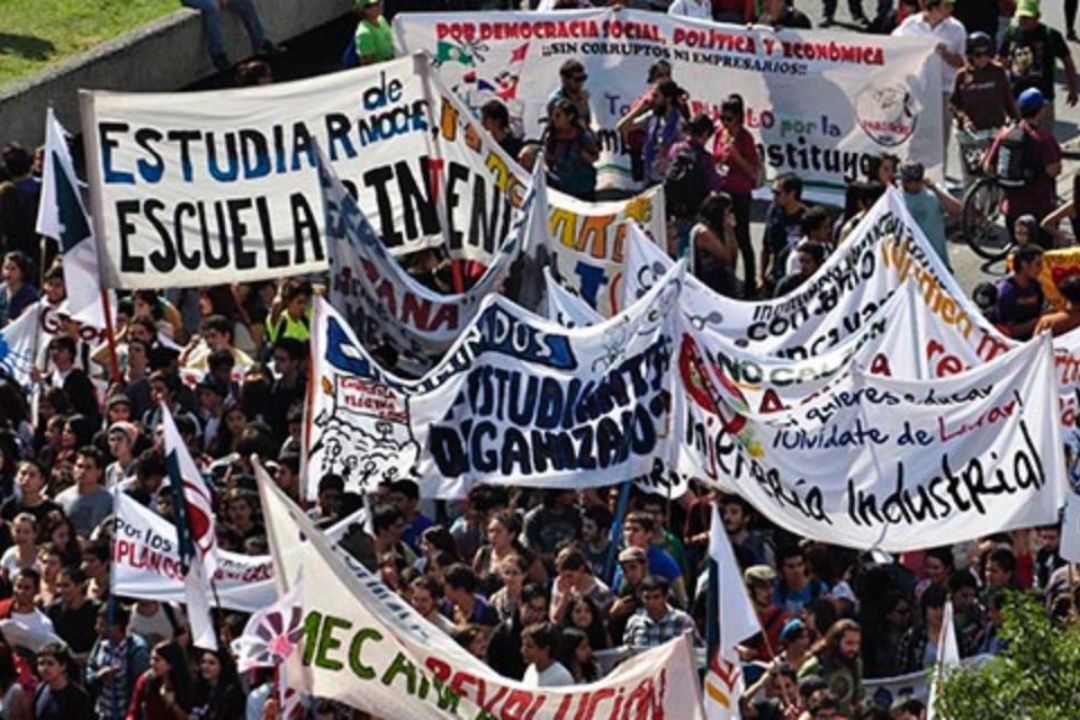
So far, the social movement and cultural workers have seen some signs of a response. Cultural, heritage, and human rights organizations have mobilized under the slogan #NoEsMetáfora, denouncing this as the most significant budget cut since the return to democracy. The events of November 2024 are still fresh in our minds, when a massive artistic and cultural demonstration in front of the National Congress[viii] warned that “culture and memory are in danger.” We must continue along these lines, work toward a nationwide mass movement, and radicalize our demands.
These protests reflect a certain awakening; cultural workers are recognizing themselves as part of a class exploited by a system that devalues their work and their tangible and symbolic output. However, the solution does not lie in patching up the capitalist-neoliberal model, but rather in building an alternative model that places culture at the service of human emancipation. From our socialist perspective, transitional measures are needed to defend workers, such as: an immediate increase in cultural budgets that genuinely recognizes the contribution of culture to human, social, and economic development; a state that ensures universal, pluralistic, and democratic access to culture, with stable funding not subject to the whims of the government in power or the fiscal cycle; the decommodification of cultural access, rooting out the logic of vouchers and the market in access to culture, guaranteeing that public cultural services and spaces are free and universally accessible; job stability for cultural workers, ensuring that cultural practice is recognized as dignified work, with full labor rights, social security, and conditions that allow for free creation, without the anxiety of subsistence; democratization of funding and participation, so that all communities and cultural workers can participate in defining cultural policies, moving beyond the logic of competitive grant programs that perpetuate individualistic competition; ongoing defense of memory and human rights, to guarantee the funding, independence, and autonomy of sites of memory, as a state obligation to ensure truth, justice, and measures of reparation.
Almost 100 years ago, in 1938, André Breton, Leon Trotsky, and Diego Rivera drafted the Manifesto for an Independent Revolutionary Art, a proclamation calling for the unlimited freedom of art from the state and political apparatuses. The manifesto called for an “anarchist regime of individual freedom” for intellectual creation, asserting that art could only be revolutionary if it were radically independent.
Today, in Chile in 2026, that manifesto takes on new relevance. It is not merely a matter of defending the artist’s individual freedom, but rather a collective demand: that is, the independence of art cannot exist within a system that renders artistic creation precarious, commodifies it, and deprives it of funding. The freedom of art is inseparable from social liberation.
The manifesto declared: “This is what we want: the independence of art—through revolution; revolution—for the definitive liberation of art.” In the current Chilean context, we could identify three points that can serve as our compass:
- The independence of art from capital—not just from the state. The enemy is not just the current government, but the system that reduces culture to a commodity.
- Revolution as a process of cultural and material emancipation. There can be no revolution without a transformation of the conditions of production and access to culture.
- The definitive liberation of art as the emancipation of humanity. Art is not an end in itself, but a practice that helps foster critical consciousness, emancipatory imagination, and class solidarity.
The cuts to cultural funding in Chile—implemented by the far-right government but supported by the entire right wing and centrist sectors—are neither a mere accident nor a technical measure. They are a class attack, an offensive against the potential for critical thinking, imagination, and collective creation. In the face of this, the response cannot be individualism or adaptation to the market. The response is collective organization, social mobilization, and the construction of an alternative cultural project to the hegemony of contemporary bourgeois culture and morality.
As revolutionary, socialist, anti-capitalist, Marxist, and anti-authoritarian cultural workers, as artists, as activists, we say: no to budget cuts, yes to culture as a right, yes to memory, yes to imagination in the service of social transformation. Culture cannot and must not be a luxury or a commercial fetish; culture is a tool for emancipation. And as the manifesto declares: “Transform the world, change life”—tasks that are one and the same in the struggle for truly free art and society.
[i] https://radio.uchile.cl/2026/05/11/quiere-ser-el-mejor-alumno-de-quiroz-the-controversial-decisions-that-are-straining-undurraga’s-visit-to-the-culture-committee/
[ii] https://gda.com/detalle-de-la-noticia/?article=6028310
[iii] https://radio.uchile.cl/2026/05/11/quiere-ser-el-mejor-alumno-de-quiroz-the-controversial-decisions-that-are-straining-undurraga’s-visit-to-the-culture-committee/
[iv] https://gda.com/detalle-de-la-noticia/?article=6028310
[v] https://www.ciperchile.cl/2026/05/29/dia-de-los-patrimonios-sitios-de-memoria-bajo-el-abandono-financiero-e-institucional-del-estado/
[vi] https://www.biobiochile.cl/noticias/artes-y-culture/cultural-news/2026/05/28/cultural-policy-expert-if-the-cuts-continue-the-institutional-framework-will-be-dismantled.shtml
[vii] https://www.biobiochile.cl/noticias/artes-y-culture/cultural-news/2026/04/01/minister-undurraga-announces-the-return-of-the-cultural-pass-and-further-budget-cuts-to-the-sector.shtml
[viii] https://radio.uchile.cl/2024/11/14/masiva-movilizacion-artistico-cultural-frente-a-congreso-nacional-por-presupuesto-2025-culture-and-memory-are-in-danger/