In just a few days, several disasters struck the Colombian people. The first was the inauguration of the far-right government led by Abelardo De la Espriella. The second was a devastating earthquake that struck the western part of the country, particularly Chocó, Colombia’s most impoverished region. The third is the wildfires spreading across various agricultural and forested areas, and the fourth—which is already underway—is the “Super-El Niño,” a heat wave that will destroy crops, kill thousands of animals, drive thousands of farmers into ruin, drain the reservoirs of hydroelectric plants, and force energy rationing. None of the social consequences of these catastrophes are “natural”: nature merely adjusts the tectonic plates of the Earth’s crust or alters its temperatures as a result of atmospheric changes, whether these are the product of nature’s own metabolism or caused by human activity.
Advances in scientific knowledge allow us to predict some of these natural phenomena. But above all, we have the ability to prevent their social consequences by rationally planning the places where we produce and live. It is no coincidence that, in relative terms, the greatest devastation from the earthquake occurred in Chocó. A region with a predominantly Afro-descendant population, historically segregated and mercilessly plundered since colonial times. Its ethnic identity is a product of slavery promoted by the colonizers to exploit the area’s mineral and agricultural resources. Numerous indigenous peoples live alongside them, some of whom were not yet contacted until recently. Many of their urban settlements have collapsed, and their communities are now isolated, without access to food or medicine.
For years, the traditional plundering of its resources and the political domination of its institutions by traditional political parties have been compounded by the constant interference of armed groups linked to political insurgencies and drug cartels, as well as the mass displacement of migrants toward the U.S. and human trafficking. Amid a natural paradise lies a social hell. San José del Palmar—a town unknown to most Colombians— that served as the epicenter of a 7.4-magnitude earthquake that sent a roar from the bowels of the earth—a roar heard as far away as the nation’s capital—and destabilized the newly inaugurated De la Espriella administration.
In media, the spotlight has been on Cali—the country’s third-largest city, which, in absolute terms, has reported the highest number of fatalities, injuries, and missing persons, as well as collapsed buildings—and Pereira, another severely affected urban center, along with Manizales. The difference with Chocó is that these are established urban centers, with access roads and resources for reconstruction. In other words, they are places of interest for capitalist investment. Because disasters also highlight social differences and the priorities of big business.
In the face of the aftermath of the earthquake—and now the fires—we have witnessed the new government’s improvised response, when it hasn’t been downright indifferent: a housing minister on vacation with his family in Santa Marta, or the president himself handing out soccer balls to the victims. Their contempt for the victims’ lives went so far as to reject urgent aid offered to rescue them during the critical first 72 hours after the buildings collapsed. It did so in order to prioritize intervention by governments politically aligned with the ultra-reactionary faction that has come to power—such as the U.S., El Salvador, Ecuador, or, even more outrageously, the State of Israel, which is responsible for the genocide of children and the barbaric demolition of thousands of homes in the Gaza Strip.
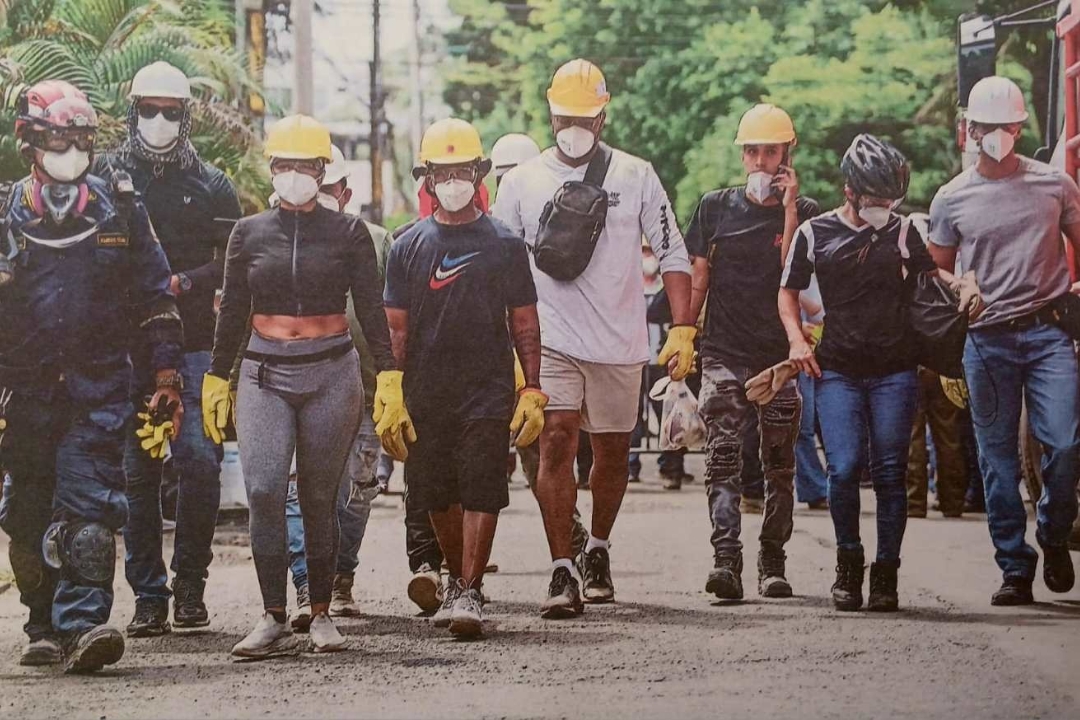
In contrast to the government’s irresponsibility, the population has channeled its energy into solidarity campaigns. Across the country, thousands of initiatives sprang up spontaneously to collect resources for those affected, striving to overcome logistical and distribution challenges in getting aid to them. We can affirm that, just as a few years ago the Colombian people led an outburst of outrage against Iván Duque’s government, today we are witnessing an outburst of social solidarity that overwhelms the far-right government. This is the best proof that what we need to pave the way for a new society that governs itself for the benefit of all lies in our hands. The front lines of social protest today have given way to the front lines of rescue and support for those affected by the disaster.
For large capitalist corporations, it’s business as usual. A preliminary estimate puts the cost of reconstruction at 30 trillion pesos. Multilateral banks have rushed to open lines of credit that will further indebt the country and will be a millstone around the neck of the drowning man for decades to come. We must reject these solutions that only benefit financial capital, big construction companies, or insurance firms. We must strengthen the solidarity movement with committees of disaster victims and coordinate them at the national level to demand that the government prioritize the reconstruction of homes and small and medium-sized businesses for those affected over mega-construction projects that serve to plunder our resources. Payments of interest and principal on the state’s fraudulent external and internal debt must be suspended immediately, so that those resources can be allocated to the emergency reconstruction plan and massive job creation in social projects such as housing, education, and health care. Instead of “donations” from big business or “tax-for-projects” schemes to privatize the reconstruction effort, extraordinary taxes must be imposed on large fortunes—or, better yet, they must be directly expropriated. These would be radical measures toward socializing the wealth we collectively produce.
The National Meeting of Social Organizations convened by the labor federations and other coordinating bodies for September 11 and 12—preceded by the National Board meeting of the CUT, the country’s main labor confederation, particularly those of public-sector workers—must be transformed into anEmergency Meeting of Earthquake Victims,where an initial assessment of the situation is conducted so that the demands of those affected by the earthquake are given priority in theNational List of Demands, the defense of our labor and social rights, and the struggle for full political freedoms in the face of De la Espriella’s escalating authoritarian measures and his antisocial reforms.
Workers’ and Socialist Unity – UNÍOS!
Section of the International Socialist League – ISL
Bogotá, Medellín, August 23, 2026