At the same time, the politicians who serve them are persecuting immigrants
By Gérard Florenson
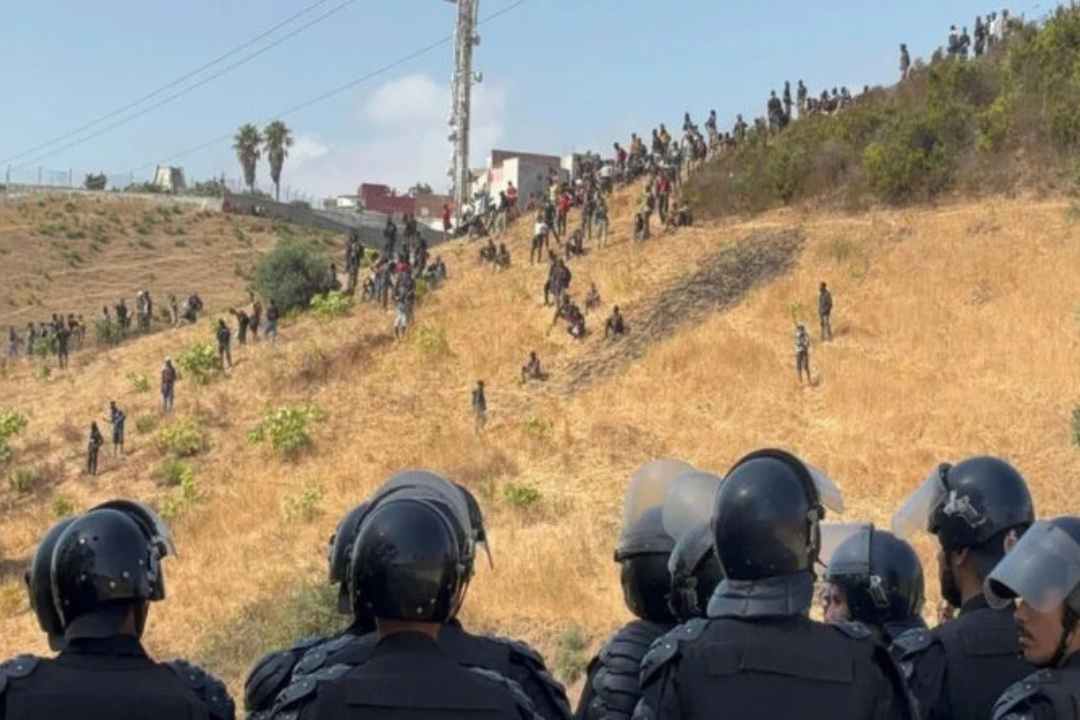
Unsurprisingly, the new invasion of Ceuta announced for August 15 did not take place. Instead, Moroccan police demonstrated their determination to defend Ceuta’s border by beating, tear-gassing, and imprisoning the 300 to 400 migrants who were hoping to cross. To ensure that their brutality went unobserved, the police expelled Spanish television crews.
This latest episode is dramatic because the vast majority of these migrants, who were violently repressed, came from sub-Saharan Africa—a region at war—and had traveled through Morocco, where they are not welcome, are mistreated, and are forced to live in hiding. There is great concern for their fate in a country that does not want them, but which prevented them from reaching the Spanish enclave of Ceuta, where they could have applied for political refugee status.
At least, in theory. Because not only the right wing and the unchecked far right, but also some “socialists,” are demanding the expulsion of all undocumented migrants still in Ceuta, regardless of nationality and including children and adolescents. The immediate task is to prevent this outrage. We revolutionaries stand with the organizations and volunteers who are helping migrants—in Ceuta, where the needs are immense, and everywhere else. We need a united front, a social and democratic emergency plan to defend our sisters and brothers who are under threat, to secure immediate aid and the recognition of their rights.
But at the same time, we must explain and show how the capitalists—through the media they control and the politicians of the true right and the false left—use racism to divide the working classes and divert their outrage.
Capitalist Europe is fortifying its borders
“More walls, fewer Moors.”VOX’s racist slogan is gaining traction across the Old Continent.The “immigration issue”became a“problem”and then a“risk”; after the tragedy in Ceuta,we are now supposedly facing an“invasion.”The barbarians are said to be at our gates. According to this rhetoric, we must fortify and control our borders even further. Meloni is taking measures to prevent migrants who have swum across the strait from setting foot in Italy, and the Danish Social Democrats are taking the same line.
But European leaders did not wait for Ceuta to build a “Fortress Europe,” to ban immigration, or to limit it to the needs of employers. They strengthened border police, created Frontex, and delegated the blocking of migrants to third countries considered “safe,” such as Morocco, or even to others considered less safe, such as Libya. This policy is responsible for thousands of deaths at sea, while some governments criminalize rescue teams and organizations that help migrants.
“La France ne peut pas accueillir toute la misère du monde”(“France cannot take in all the world’s misery”). The phrase was coined by Michel Rocard, Mitterrand’s Socialist prime minister. It became very popular. In European terms, it means: we know that misery exists, but we cannot do more to remedy it. And they cite unemployment, the housing crisis, and the strain on public services—all of which the arrival of migrants would exacerbate. These issues are discussed as if they were natural disasters and, above all, as if the leaders who advance these arguments bore no responsibility for the deterioration of the social and economic situation. This argument does not hold up: even within the current system, a larger population means greater needs and, therefore, increased production of goods and services, more jobs, and higher tax and social security revenues. But the goal is to portray migrants as a burden—as useless mouths that will reduce the slice of the pie that each person is entitled to.
Even more pernicious is the second argument, which is openly racist. It refers to migrants’ ability and willingness to integrate into the societies that receive them; to put it more bluntly, to the compatibility of their customs with “our values,” without specifying whether those values are those of the Enlightenment or those of VOX and Francoist National Catholicism—which is sexist and homophobic. You don’t have to look very hard to find barely concealed Islamophobia, fear of the “great replacement,” and fear of Islamist infiltration. What is most serious is that this rhetoric is not exclusive to the far right and that the so-called left echoes it in its own way in the name of secularism.
But returning to Ceuta, the Moroccan government is facing accusations. It is alleged that it failed to fulfill its role as the external guardian of Europe’s borders. Its border guards let tens of thousands of migrants through. Should they have fired on them? Was Morocco an accomplice—or even an instigator—of the invasion—which was, incidentally, peaceful—of the small colonial enclave of Ceuta? And if so, for what reason? It’s hard to see what more one could expect from Sánchez, who recognized Morocco’s “right” to occupy Western Sahara and abandoned the Polisario Front; and events have, if anything, undermined the credibility of the Moroccan state, its police, and its intelligence services. But denouncing Morocco and proposing to punish it by stripping it of the World Cup—a proposal shared by both VOX and SUMAR—allows one to cast it as one of the barbarians besieging civilization.
The European right and far right are targeting Sánchez. His government’s leniency toward undocumented immigrants—and, worse still, the ongoing regularization process—would weaken Europe. But wasn’t it Sánchez himself who endorsed this line of argument when he denounced an attack on the territorial integrity of Spain and Europe? And wasn’t his government’s first measure to send more police and military personnel to protect the enclaves of Ceuta and Melilla, in order to provide assurances to the European Union?
In this game of poker filled with lies, accusations, and false appearances, there is one notable absence: the migrants themselves—those men and women who, perhaps lured by false information about a safe route, attempted to flee Morocco and reach a European country. To dwell on their motivations could call into question their country’s good reputation and the economic ties that go along with it. Deaths have become commonplace: they join the long list of those who drowned because they could not reach “Fortress Europe” any other way than in precarious boats. As for the children, teenagers, and “unaccompanied minors”… they are not human beings; they are “problems.”
Racism and the persecution of migrants are not uniquely European phenomena. We immediately think of the sinister ICE (Immigration and Customs Enforcement), tasked by Trump with persecuting, detaining, and deporting undocumented foreigners. ICE’s ranks have been significantly bolstered, its powers expanded, and, in effect, it has become a militia with a license to kill. Beyond “undocumented” immigrants, its targets include all people of color—Black, Asian, Indigenous, or mixed-race. Trump’s delusional rhetoric—for example, against Haitians, whom he claims eat dogs and cats—serves to fuel this persecution, but all Latin American citizens are singled out: they are barred from entering the American fortress, and those who manage to cross the border must be deported.
In a world where migrants are portrayed as enemies
Fortunately, the atrocities committed by ICE—which even included murder—sparked major popular protests; migrants under threat were hidden and helped in their neighborhoods. Trump’s militiamen were at times pursued and barred from certain cities. This is part of the sharp social and political polarization: in the face of the ultra-reactionary, racist, sexist, and homophobic bloc that supports Trump, a force of radical resistance is emerging—in the streets and even at the polls.
Hostility toward migrants extends beyond Europe and the United States. Canada, Japan, and Australia have passed restrictive laws and are deporting “undocumented immigrants”—a term that includes foreigners who arrived legally but whose residence permits were not renewed—a situation also common in Spain, where Latin Americans account for two-thirds of those seeking legal status. But the reactionary rhetoric about the “great replacement” does not affect only imperialist countries. For example, the Tunisian government is attempting to divert popular discontent through a racist campaign against refugees from Libya and sub-Saharan Africa.
Other countries have pledged to close their own borders to migrants “in transit” to block their path to Fortress Europe or the United States, sometimes openly and in exchange for compensation, as is the case with Morocco, and other times in a shameful manner, such as the progressive government of Mexico, which does not want to alienate its powerful northern neighbor. The men and women who are trying to flee poverty, war, and the climate disasters caused by the capitalist system—who dream of a future for themselves and their children—are ordered to stay and die in their own countries. Those who disobey and survive the dangers of the journey are treated as criminals.
Capitalists have adopted different attitudes toward immigration depending on their economic interests at any given time. In the 1950s and 1960s, employers in the most developed European countries needed low-skilled workers in factories and on construction sites. The labor shortage was real, unemployment was at an all-time low, and in the absence of that “industrial reserve army”—those “ten who are willing to take your place”—workers could afford to be more demanding. Turning to migrant workers—who were underpaid, monitored by their home countries’ intelligence services, and kept on the periphery of labor unions—was therefore an opportunity for capitalists. Turks, Spaniards, Portuguese, and Africans—sometimes brought from their villages by recruitment agencies—set out for France, Germany, Switzerland, and the countries of Northern Europe. These young men, who sent money to their families and planned to return to their home countries after a few years with the savings they had accumulated through hardship, accepted precarious conditions so as not to lose their jobs.
Capitalists and Immigration: Divide and Conquer
But while capitalists were able to profit from immigration during certain periods, they were always aware that the proletariat could become their gravedigger. They know that while the strength of workers lies in their numbers, without unity those numbers are not a source of strength: “divide and conquer” has always been the method of the powerful. Racism has been an instrument of division, on both sides of the Atlantic and in the colonized countries as well. Unfortunately, the political and union leaderships of the labor movement did not combat this division and, at times, were even complicit in it, accusing immigrants and people of color of “coming to steal jobs” from native-born workers and holding them responsible for downward pressure on wages.
Times have changed. Capitalists in imperialist countries have offshored a significant portion of industrial production, as well as services such as call centers, in order to exploit a cheap workforce controlled by authoritarian governments on the ground. Open doors to mass immigration are no longer useful to them, but that doesn’t mean zero immigration. The trend is toward short-term residence permits, with equally short-term contracts and guarantees of return to countries of origin, for “hard-to-fill jobs” and seasonal work. “We need you, you can come, and when we no longer need you, we’ll kick you out; and if you’ve made demands or protested, there’s no need to reapply next year.” This doesn’t mean the classic mechanisms have disappeared: the exploitation of immigrants—with or without a residence permit, but always in precarious situations—remains the norm in the restaurant industry, on farms, in cleaning services, in construction, and in public works, either directly or through subcontracting firms.
The rhetoric of the far right—which is increasingly echoed by the traditional right—serves the interests of the capitalists. The rhetoric has shifted slightly: in addition to stealing our jobs, migrants are accused of coming to take advantage of our social benefits, of receiving priority for public housing… and their children are blamed for the worst crimes. Anti-Muslim racism has taken on great significance. These stigmatization campaigns always have the same goal: to pit the working classes against one another, to label the neighbor as the enemy, and to make us forget the responsibility of the exploiters for the deterioration of our living and working conditions. The “progressive” parties claim to oppose this, but while they distance themselves from the most caricatured expressions of it, they also position themselves within the framework of a supposed “national interest” that justifies the domination of imperialist countries over the rest of the world.
To gauge capitalism’s responsibility for misinformation, slander, and hate speech, one need only look at who owns the newspapers, radio stations, and television networks that eagerly spread them. The media coverage of the events in Ceuta reveals this clearly: the deaths and injuries are either ignored or blamed on Moroccan inaction, while children and teenagers are treated like vermin. The reasons why tens of thousands of people—mostly young—risk their lives to flee their countries are reduced to matters involving criminal gangs. The threat of an “invasion” dominates the front pages and pushes the daily hardships of the working classes into the background.
For a Social and Democratic Emergency Plan
Hundreds of sub-Saharan migrants were beaten and detained by Moroccan police, and we do not know their fate in a country where they are unwanted foreigners. Every true democrat must demand explanations from Morocco and take action to ensure these people receive material and legal assistance. Thousands are stranded in Ceuta, and the living conditions for most are similar to those of the Spanish refugees in 1939, crammed onto the beaches of southern France. The needs are immense, and the remarkable solidarity shown by Ceuta’s secular and religious organizations cannot be enough.
The Spanish government is providing aid in dribs and drabs when it should be sending shelters, food, clothing, and hygiene supplies, strengthening medical care, and making the safety of all minors its top priority. But the government fears being accused of laxity by the right and/or is speculating on new “voluntary” departures.
Child protection laws must be enforced
There should be no exceptions to the protection of asylum seekers. All migrants must be able to reach the Iberian Peninsula. More broadly, we revolutionaries fight for the free movement of men and women: no human being should be considered “illegal,” and borders must come down. We demand the abolition of all anti-immigrant laws, genuine regularization in all countries, and the same social and political rights for everyone. We must establish and enforce a social and democratic emergency plan to combat poverty and oppression. We fight against the rotten propaganda of the media in the service of capital and the politicians who serve them, who impose laws that roll back social progress. We are always ready to fight alongside those who mobilize for freedoms and social and democratic rights. From the flotilla to Gaza to the convoy currently being organized for the Ukrainian people, we are working toward this goal.
Of course, our program goes even further
We want to put an end to neocolonialism, the plundering of natural resources, the appropriation of land by imperialist powers, and the unequal exchange that benefits the latter; put an end to the blatant exploitation of the working class and small farmers who, especially in Asia and Africa, are subjected to unbearable living and working conditions in exchange for paltry wages. The large corporations that offshoring and outsourcing the production of goods—and even services, such as call centers—do so not to create jobs, but to increase their profits.
In a word, we fight against capitalism, which crushes peoples and destroys the planet. We fight for socialism on a global scale, for a world free from exploitation and all forms of oppression. While we are committed to the struggles of the day, we want to share our conviction that lasting victories cannot be achieved without putting an end to capitalism.
In the early 19th century, France witnessed a major workers’ uprising: that of the silk workers, known ascanuts. It was crushed by the monarchy, but a song remained from that time that ends like this: “We will weave the shroud of the old world, for the roar of the revolt can already be heard.” Thiswill be the conclusion of this article.