A diverse group—including comrades with whom we have been active in the movement for 40 years—sent a letter to the national executive committee ofthe FIT-U1. The Front had already met with most of them, and some of us held bilateral meetings with them; we shared some points of view, published their proposals, and carried out some joint activities.
We understand that most of you are motivated by a genuine concern about the Front’s situation at a time when there is a tremendous opportunity for the left in our country. In a spirit of solidarity, we would like to share our opinion with you—which, we should note up front, is critical of your most recent statement—since we do not believe it helps in finding common ground to move forward.
You are proposing Unitary Committees. We also proposed them at the time. The reality is that they didn’t happen, and it’s most likely they won’t happen. We need to ask ourselves why this is happening.
When we, as a resolution of a Congress, proposed joining the committees convened by the PTS alongside some of you, we took into account what Bregman’s party had hinted at and later made explicit: that these committees would serve to promote a new party with the goal of establishing a workers’ government. As you know, for years we had been proposing that the FIT-U evolve from a mere electoral front into a common movement or party with freedom of tendencies and a method for acting in unity in the class struggle. That is why we found it very interesting to open that debate with the PTS, which we consider strategic.
From the letter you have sent and the various activities you have carried out, we understand that you do not see—or downplay—the importance of taking steps to build a great revolutionary party in the struggle for government and power. Or at the very least, we do not see that you have any proposals regarding this issue.
For us, this is the most important challenge facing the revolutionary left if we truly want to seize the opportunity that has arisen. Because without a revolutionary party of tens of thousands of members, rooted in the working class and the youth, it is impossible to promote the self-organization of workers and to challenge for power with any chance of success. This is a possibility on the horizon in the not-too-distant future, given the ground the left in general—and Myriam in particular—is gaining, provided that those of us who agree on this work together to advance it. No single group can do it alone.
The PO and IS rejected the PTS’s proposal to build aparty of the new working classand all of our proposals on this issue. Instead, they propose maintaining the FIT-U exactly as it has been operating—that is, as an electoral agreement—without being open to discussing or changing anything at all. They then went ahead on their own to launch deceptive committees, supposedly representing the Left Front, which are not such, because neither the MST nor the PTS—and therefore not Bregman either—participate in them. The PTS, for its part, closed its committees off to its own members and the broader base—something we have criticized and continue to criticize. Our position is that they should have been open to unity with all those who see the need to build a new party that goes beyond the existing ones.
We believe that the proposals in your letter are also in line with those of PO and IS regarding these debates, in that they suggest that the committees should focus on the electoral process. This is what can be inferred from what you do not say and from your proposal to launch the campaign for Bregman as president.
Unfortunately, there are no joint committees today because there is no consensus on the magnitude of the opportunity, the need to move beyond the FIT-U’s electoral phase, and the objective those committees should have. This will not change unless agreements are reached on these issues.
Fate’s debate—which also places you in a position similar or comparable to that of the PO and IS—reflects the differences we also have regarding what the left should do in the class struggle. You downplay what has happened. But for those of us who want to see if the conditions exist for a common party—or at least an agreement that goes beyond elections and positions the left not only on that level, but primarily as an option for power and in the class struggle—how we act within the labor movement is no secondary matter. What kind of unity to contest the government can be achieved if we have enormous differences over the union model we are going to apply, and there are sectors of the left that reproduce the vices of the union bureaucracy or separate the union struggle from politics and refuse to discuss the orientation for the ongoing struggles? After all, they advocate for a Front that should only discuss candidate slates a few months before each election.
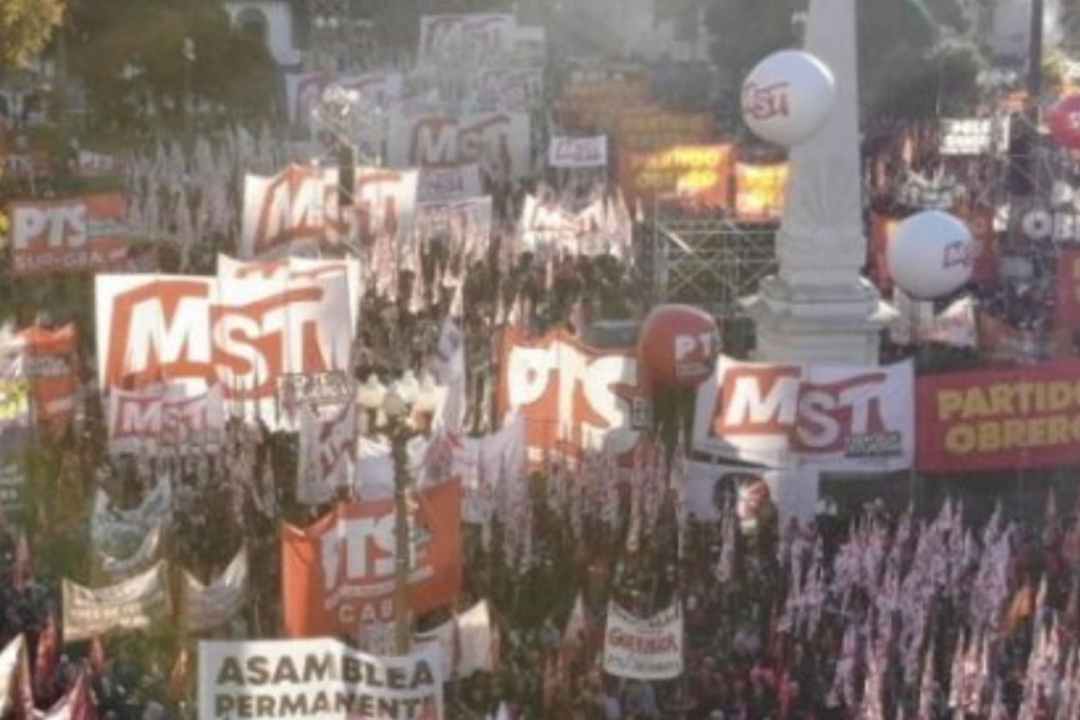
Nor do we see them assessing—even though they mention it—the significance of the initiative we launched to organize a “Great March of Anger” on September 19. This initiative, which is gaining more and more traction among activists every day, is an opportunity to begin working together on a broad scale, responding to the most pressing needs of the mass movement. It is no coincidence that the PTS and the MST launched it jointly. This, as well as the regional coordinating committees in support of and for the unity of the struggles, are proposals that would allow us to build unity from below and help resolve many of the current problems. The problem is that neither the PO nor the IS have joined the coordinating committees, and they opposed the September 19 March, attempting to alter itsagenda, until it became impossible for them to maintain their positions. They are opposed to any broad initiative that emerges outside the PSC—an organization that could have been very important for uniting the class-based movement had they not destroyed it by co-opting it to exert bureaucratic control and pitting it against important struggles where they are not the focal point.
On the issue of the election, we do not see the FIT-U’s future as being up for debate today. That is a false debate. In Bariloche, if there had been PASO primaries, as has happened several times before, a single slate would have been presented after the primaries. There was even a situation similar to Bariloche’s in 2025 in Salta, and that didn’t cause the FIT-U to split or anything of the sort.
To reiterate, today’s debate is not about the election; it goes beyond that. Just to be clear, we also want to make it known that we do not deny the importance of electoral battles—far from it.
We understand that the differences we have with you, as well as those we have been discussing with the PO and IS, are significant. We even have differences with the PTS, although we are taking some steps to clarify them with them, while we continue to work together on various united initiatives. We invite you to be part of these initiatives, while we continue to discuss whatever is necessary.
Let’s discuss the goals of the unity we need and how to achieve it: whether it is merely for electoral purposes or whether we must go much further to organize tens and hundreds of thousands of people, and what strategic agreements we need to establish in order to become a viable option for government and power. Until that is clarified, it is unrealistic to talk about united committees, not even at the electoral level. But we can take some very important steps.
With fraternal regards, MST Secretariat
1- Letter to the FIT-U National Executive Committeehere.This letter is signed by independent comrades along with members of organizations that are not part of the FIT-U.
2- The PO, along with IS, tried to make this a march called and controlled by the FIT-U rather than a self-organized rally in unity of action with all those who want to defeat Milei’s plans and agree with a document containing substantive proposals—as was proposed from the outset to make the demonstration as inclusive and as large as possible.