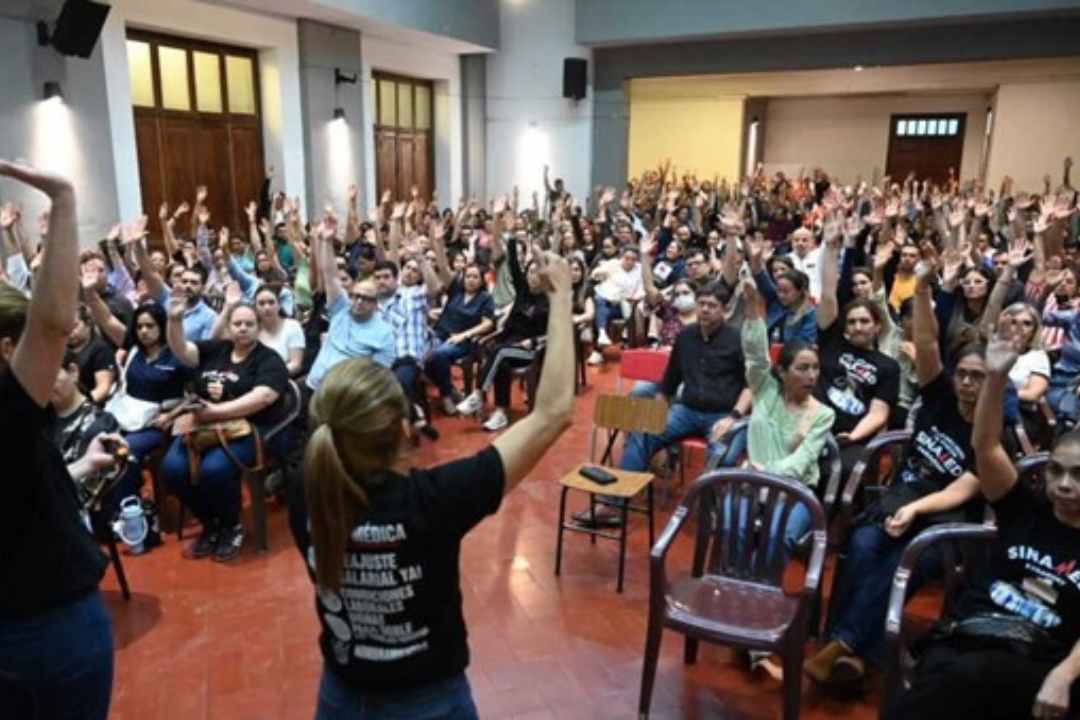
Following a five-day national strike in August, the National Doctors’ Union (Sinamed) unanimously rejected the wage proposal from Santiago Peña’s government and called for a new 48-hour strike on September 21 and 22. With wages frozen since 2012, shortages of supplies, and a wave of mass resignations, healthcare workers are now at the forefront of the country’s most significant class struggle. We at the International Socialist League in Paraguay call on all social, labor, and student organizations to actively support this struggle.
For the past fourteen years, doctors’ salaries in Paraguay have been frozen. While prices have risen, the purchasing power of medical staff has plummeted: from the equivalent of 2.8 minimum wages in 2012 to just 1.5 today. In concrete terms, doctors earn a base salary of around 5 million guaraníes and are demanding that it reach 8 million. The government offered them a raise of 400,000 guaraníes—less than $70—and the response at the Sinamed assembly was unanimous: the crumbs they’re proposing aren’t even enough to begin a discussion.
It’s not just a financial issue. There’s a shortage of medications, a shortage of supplies, and a shortage of permanent positions: thousands of professionals remain employed under precarious conditions, with no job security, while working shifts from dawn to dusk in overwhelmed hospitals. The pent-up anger has already manifested in a phenomenon that even the government cannot hide: the mass resignation of specialists, including dozens of pediatric therapists and neonatologists, precisely in the areas where a vacancy cannot be filled overnight. Sinamed put it bluntly: those who are resigning are irreplaceable. It is the public health system itself that is being hollowed out.
A government that has money, but not for healthcare
The Ministry of Economy was categorical: it is “impossible” to fund the wage adjustment demanded by doctors. The very same week this statement was made, the Peña administration welcomed elite troops from 21 countries to Asunción for Operation “Fuerzas Comando 2026” organized by the U.S. Southern Command, in the context of a year in which the SOFA agreement—granting diplomatic immunity to U.S. military personnel and contractors on Paraguayan soil—had already been signed. The state, which lacks an additional 3 million guaraníes per month to pay a doctor on call, does have the fiscal and political leeway for other priorities: supporting another country’s armed forces, financing its own election campaign, safeguarding the privileges of the political caste, waiving fees for agribusiness, and making timely payments to international banks. Let’s take it one step at a time.
And the money appears—and quickly—when it comes to maintaining the Colorado Party’s hold on power. With less than a month to go before the October 4 municipal elections, the National Republican Association (ANR) unanimously approved a bank loan of 25,000 million guaraníes to finance its campaign, to which it is adding another 5,000 million from the party’s own funds: 30 billion guaraníes (about USD 4.1 million) distributed among its electoral structures, just for the final stretch of the campaign. Added to this figure are the individual campaign contributions declared by dozens of Colorado Party candidates and a multimillion-guaraní contract for electoral advertising awarded by the Superior Court of Electoral Justice itself—a contract now being questioned due to the lack of transparency in the bidding process.
But that’s just the tip of the iceberg. Congress itself demonstrates, through its own privileges, that there is more than enough money: the 125 members of Congress receive a stipend that, together with representation expenses, totals nearly 33 million guaraníes per month for each member—almost 12 times the minimum wage—which amounts to nearly USD 6.9 million per year in stipends alone. In August of this year, in the midst of the health crisis, Congress also approved a privileged retirement plan that allows them to retire with 60% of their salary, and for the 2027 Budget, they voted themselves an allocation of USD 6.2 million for private health insurance—just as they are denying pay raises to doctors in the public system, leading nearly 300 medical professionals to resign. Combining per diems and private insurance, Congress’s perks cost the government about USD 13 million a year.
And yet, that figure—which is already outrageous—is a mere fraction compared to what follows. The government pays approximately USD 1.2 billion a year in debt interest alone to banks and international organizations—92 times more than all of Congress’s perks combined—without repaying a single guaraní of principal with that amount. And there’s more: agribusiness generates nearly 25% of the country’s GDP—about USD 15,000 million a year—but accounts for barely 2–3% of total tax revenue. If it were to contribute in proportion to its share of the economy—as is appropriate in any equitable tax system—the government would collect between USD 900 million and 1.1 billion more per year than it does today—a figure that, on its own, nearly equals what is paid in debt interest.
Therein lies the real answer to the “fiscal impossibility”: it’s not that there’s a lack of money. There’s plenty for political campaigns, VIP salaries, usurious debt, and untaxed agribusiness profits. The only thing missing is the political will to direct that money toward the people’s health. And instead, when the government finally offered something to the doctors, it did so in the form of a “merit-based pay scale”: paying more to those with more training and seniority, rather than a general base pay increase as demanded by the union. It’s the same old playbook: dividing the profession into “good” and “bad” professionals to lower the political and economic cost of a real and across-the-board raise, rather than acknowledging that healthcare workers as a whole have been propping up an underfunded system with their own bodies for fourteen years.
Repression as a Response
When doctors took their protest to the streets, the government responded with force. In Ciudad del Este, police fired into the air and fired rubber bullets at healthcare workers marching toward the Friendship Bridge. In Asunción, as the procession of doctors approached an international event in which Peña himself was participating, a police operation directly attempted to hide the union’s banners so that foreign delegations would not see the country’s real healthcare crisis. That alone is enough to show which side this government is on: repression in the streets and window dressing for the world, while public health is falling apart behind closed doors.
Solidarity and empathy that have already begun to take shape
The most important development in recent weeks is not just the resolve of Sinamed, which unanimously rejected the government’s “crumbs” and confirmed the strike for September 21 and 22. Rather, solidarity has already begun to spread beyond the medical union itself: scientific societies specializing in nephrology, hematology, and pediatric intensive care have come out in support of the strike; the IPS nursing staff expressed their support; and in Misiones, the Misiones Peasants’ Organization joined in with roadblocks denouncing the dismantling of regional hospitals. There, in that combination of healthcare workers and peasant organizations fighting side by side, lies the seed of something much greater than a sectoral wage dispute: the possibility of unity among the exploited and oppressed against a government that is implementing austerity at home while surrendering sovereignty abroad.
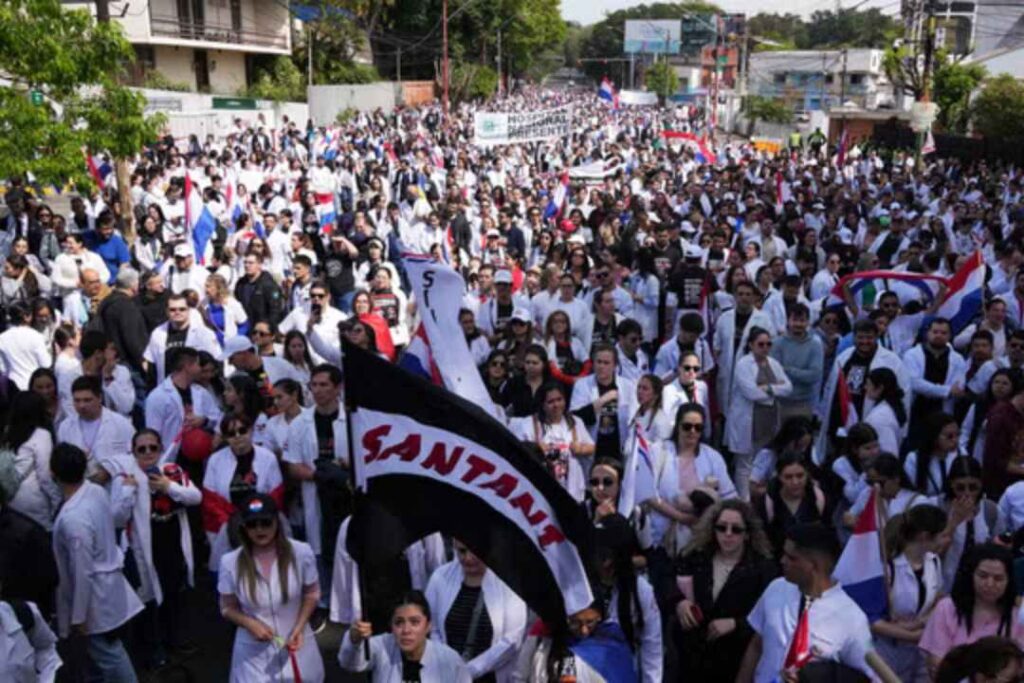
We must continue to unconditionally support the Sinamed strike and each of its demands: a salary increase to 8 million guaraníes, an end to job insecurity and permanent appointments for those still on contract, the actual provision of medications and supplies, and fair pay for on-call shifts on holidays. No “merit-based” pay raise is acceptable: public health care is sustained by decent wages for everyone, not by rewards for a minority while the rest are disciplined.
We call for the new strike on September 21 and 22 not to be an isolated event. We need the labor federations, peasant organizations, independent student groups, and every social organization that identifies with the popular movement to actively join in: by participating in the demonstrations, publicizing the demands, providing financial solidarity if necessary, and making the common demand that healthcare workers not be made to pay for these austerity measures. Sinamed’s struggle is not just another sectoral conflict: it is today the most advanced front in the class struggle in Paraguay, and we at the International Socialist League will stand with them until they win.