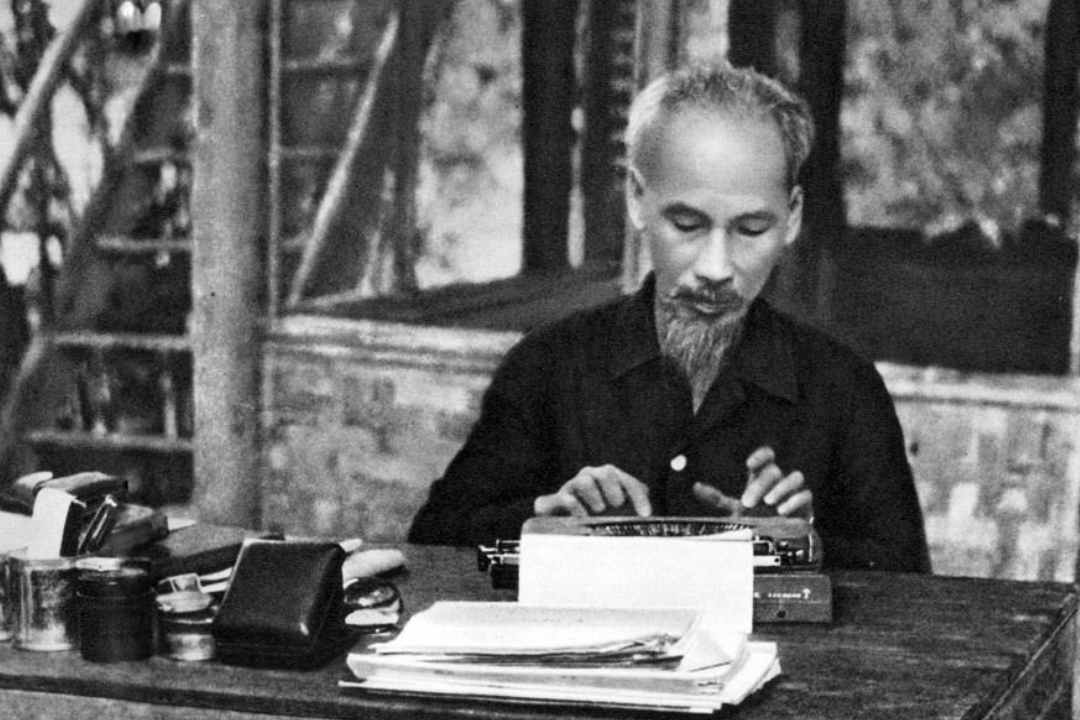
On September 2, 1969, Ho Chi Minh died in Vietnam during what was then the most influential war of national liberation. He was central to understanding the unfolding of that process, earning the prestige of any leader at the helm of a historic struggle that was only partially successful—a fact that often overshadowed his ties to the political movement that acted globally to halt revolutions and subsequently roll them back throughout the postwar era: Stalinism.
Automatic translation made by AI
By Manuel Velasco
Born in 1890 as Nguyễn Sinh Cung, Ho Chi Minh spent his early years in colonial Vietnam under French rule. Like many of his generation, he decided to move to France to further his education as a young man, where he came into contact with Indochinese nationalist groups and later joined the French Communist Party (PCF). From there, his ties to Stalinism grew stronger as he moved to the Soviet Union and later to China, where he founded the Communist Party of Vietnam (CPV) in 1927.
By that time, the weakened French empire was in retreat in the face of the rise of the powers that had banded together as the Axis, both with Japan’s advance on the Asian colonies beginning in 1931 and with the German occupation of France itself in 1940. The context of wars and occupations fueled the flames of revolution, as demonstrated by the Vietnamese who took up arms against the French administration and the Japanese occupiers in 1941. That same year, the Viet Minh (League for the Independence of Vietnam) was formed, comprising two nationalist parties made up of the petty bourgeoisie and the left wing of the liberal bourgeoisie, two communist parties—one Stalinist and the other Trotskyist—as well as organizations of women, workers, peasants, youth, and soldiers, immediately establishing itself as the leadership of the resistance movement.
The defeat of the Nazis in Europe and the fall of the Vichy regime in France shook the Japanese occupation in Vietnam, strengthening the people’s struggle and creating favorable conditions for the Viet Minh to declare independence in 1945, thereby setting the stage for a revolution. However, the revolutionaries’ control of the cities of Saigon and Hanoi did not last long, due to the Vietnamese Communist Party’s policy of yielding to pressure from the Soviet bureaucracy and its pre-Cold War diplomatic commitments to the Allies.
With the arrival of the Allied Commission on September 1, 1945, and the opening of the country to British troops, tensions within the Viet Minh intensified. The differences in orientation were encapsulated in the slogans “all power to the Viet Minh,” promoted by the Vietnamese Communist Party (VCP), and “all power to the People’s Committees,” backed by the local Trotskyists. It was a pivotal moment for the future of the socialist revolution in the country. At stake was whether the revolution would be diverted toward institutionalization—with fundamental decisions concentrated in the hands of a few—or whether the development of dual-power bodies—which took shape in the People’s Committees—would allow the social sectors involved to democratically assume governance and the self-defense of their hard-won gains.
Faced with this situation, Ho Chi Minh and the VCP resolved the disputes using the same tactics they had learned from Stalinism. Lacking significant influence in Saigon—the city where opposition to imperialist interference was strongest—the CPV ultimately imposed the Viet Minh’s hegemony by shutting down the People’s Committees and organizations opposed to capitulation. The persecution of activists and the assassination of dozens of leaders—many of them Trotskyists, such as Ta Thu Thau, who had previously opposed Stalinism from within the Left Opposition in France and later in the Communist International, challenging the “Third Period” policy and the capitulation in China.
Amid the tensions, occupation troops were deployed throughout Saigon, underscoring the urgency of strengthening and arming the popular organizations. But the Viet Minh authorities maintained their policy of dialogue with the French government by participating in the 1946 Fontainebleau Conference, where Ho Chi Minh met with French government officials. Ultimately, the people’s resistance through guerrilla warfare defeated the French forces in 1954, bringing the first stage of Vietnam’s path to independence to a close with a partial victory, as the country remained divided, with a clear division of spheres of influence between the bureaucracy in the East and the bourgeoisie in the West. This was yet another regrettable example of the criminal policy of peaceful coexistence with capitalism, directed from the USSR to sustain the privileges of the government elite and prevent the advance of revolutions around the world.
Faced with the establishment of the Democratic Republic of Vietnam in the south, the revolutionaries carried on their resistance in isolation, without any real support from the states that proclaimed themselves socialist. It was not until 1960, with the creation of the National Liberation Front and the Third Congress of the Vietnamese Communist Party—which Ho Chi Minh called the “Congress on Socialist Construction in the North and the Struggle for Peaceful National Reunification”— was a first step forward in sending material aid to the resistance in the South. However, the false illusion of coexisting with the enemy came to an end when President Johnson launched the U.S. offensive in 1965, creating an urgent need to send troops from the North to the South and unleashing the struggle that ultimately dealt the first decisive blow to the United States.
However, the man who had been the leading figure in the movement did not live to see the outcome, as he died of tuberculosis in 1969 at the age of 79. Even so, the momentum of the revolution was strong enough that on April 30, 1975, the Vietnamese people finally succeeded in driving out U.S. troops, proving to the whole world that the empire could be defeated, with Ho Chi Minh as one of the most prominent figures in this popular triumph.
Problems of the Past, Solutions of the Present
The Vietnamese people played a leading role in one of the most significant historical feats of the 20th century by demonstrating the unstoppable power of a people when they decide to put an end to subjugation. With their fighting spirit, they achieved a partial victory; however, the process failed to go further toward achieving definitive independence through the regional and international construction of socialism, because a leadership emerged that, far from pushing for the deepening of the revolution, led it into stagnation.
The anniversary of Ho Chi Minh’s death is an opportunity to reflect not only on the historical particularities of the period in which he was active, but also on those general trends that persist today and influence the struggles of our time. One of these is the immense weight of the anchor that Stalinism once represented, along with its allies—a force now overcome by the global activist struggle against all forms of bureaucracy. Today, in its place, there remain leaderships that share its counterrevolutionary policies, albeit with much less room for concessions due to the magnitude of capitalist decline.
On the other hand, although we are currently in a more favorable moment for the development of a movement genuinely committed to the democratic and internationalist organization of the peoples, without an organizational tool to confront the reformist apparatuses that seek to institutionalize the mobilization, these processes end up being thwarted time and time again. That is why, now more than ever, it is urgent to build a revolutionary party that brings together the best of activism, with the absolute clarity that the only solution to the crisis is the struggle for socialism.