Automatically translated by AI.
From September 22 to 26, New York once again served as the setting for the diplomatic ritual of the UN General Assembly. Eighty-one years after its creation, the red carpets and solemn speeches contrast with an undeniable reality: the institution is increasingly delegitimized, powerless, and incapable of intervening in the wars and crises plaguing the planet. But the UN’s crisis cannot be explained solely by the limitations of its institutional architecture: it is also a superstructural reflection of the crisis of the world order, of the new balance of power, and of the struggle over who defines the world’s course and how. Its very power structure reflects power dynamics that are now being challenged: the five permanent members of the Security Council—the U.S., Russia, France, the United Kingdom, and, later, China—are the only countries with veto power on the Security Council and can block any resolution that affects their interests. For this reason, an overwhelming majority may vote against the blockade of Cuba, call for a Palestinian state, or demand an end to a war, but these resolutions come up against the interests of the major powers when they affect their strategic positions. The UN’s paralysis thus reflects a deeper contradiction: an institution riddled with a power structure that can no longer contain the disputes, tensions, and shifts in the balance of power that characterize the international crisis—a crisis we must confront before it leads us into barbarism.
By Oda Cuentas
Trump: Threats and Imperialist Patronage
Donald Trump took the podium once again with his usual tone: threatening and bombastic. In his September 22 speech, he warned that he faces a major decision regarding Iran: either a deal that allows it to rebuild itself, or “annihilating the Islamic Republic.” This is not the first time he has threatened to plunge Iran into disaster if it does not submit to his conditions: for months, Trump has repeatedly returned to the idea that Tehran would be defeated and its nuclear program eliminated. But the course of events itself lays bare the gap between that rhetoric and reality. Trump arrives at this Assembly on the back foot; the war Washington has been waging against Iran since February has failed to achieve the objectives it had announced: neither the collapse of the Tehran regime, nor the definitive elimination of its nuclear program, nor the rapid reshaping of the Middle East that had been fantasized about. On the contrary, Iranian resistance has forced Washington to wage a protracted war and is already driving oil and gasoline prices to levels that Trump himself has had to justify to his electorate.
In Latin America, the immediate target of his speech was Cuba, against whose government he reaffirmed the explicit goal of bringing about “fundamental change” and asserted that the island “will fall,” in a context marked by the U.S. oil embargo and mounting economic pressure. The Venezuelan case reveals the other side of this strategy: Trump received Delcy Rodríguez in New York for their first in-person meeting since the U.S. intervention, just weeks after Washington and the Venezuelan government sealed another agreement on the transfer of resources, which grants U.S. capital substantial control over the country’s oil reserves. This is yet another form of imperialist tutelage and recolonization, in which Rodríguez’s government accepts economic and political subordination that turns Venezuela’s wealth into an object of imperialist appropriation.
At the same time, the domestic situation in the United States is adding pressure to Trump’s offensive: a September Reuters/Ipsos poll put his approval rating at 32 percent—the lowest of his career—with just 17 percent approval for his handling of the cost of living, while the war with Iran appears to be linked to rising fuel prices and economic hardship. Trump’s threats, while not to be downplayed (since U.S. imperialism retains enormous destructive military capacity), should not be confused with unchallenged domination: this is the attempt by an imperialist power facing external resistance, economic constraints, internal turmoil, and a growing struggle over the world order. It is more necessary than ever to denounce and confront all interference from Washington, reject the recolonization of Venezuela, defend Cuba against threats, oppose aggression against Iran, and build an internationalist response by the working class and the peoples, independent of both U.S. imperialism and the bureaucracies and governments that subordinate national sovereignty to their own interests of power.
A Devil Named Netanyahu
The other unavoidable protagonist of this session was the infamous Benjamin Netanyahu, who is being prosecuted by the International Criminal Court for war crimes and crimes against humanity. When he took the podium on September 24, dozens of delegations walked out en masse amid boos, leaving the Israeli prime minister speaking to a half-empty chamber. It was a scene of unprecedented international isolation, in the midst of an Israeli election campaign that will be decided on October 27.
But this symbolic condemnation is not backed up by any concrete action. None of those governments followed through: they did not sever diplomatic relations with Israel, none imposed effective economic sanctions, and none blocked the arms trade. Hypocrisy elevated to a method: they walk out of the room for the photo op, but maintain relations with a genocidal state. Meanwhile, according to a joint study by the UN, the European Union, and the World Bank released months ago, rebuilding the Gaza Strip will require some $71.4 billion over the next decade, of which more than a third is needed in the first eighteen months alone to restore essential services. This figure does not even take into account the ongoing occupation of the West Bank or Israel’s military escalation in Lebanon. Faced with such a massive scale of destruction, the “Peace Board” that Trump touts as the most important international body in history had raised, as of the beginning of the year, only a paltry fraction of what is needed. The Palestinian cause is once again taking center stage in international debates, but none of the powers that pay lip service to recognizing a Palestinian state is willing to lift a finger to dismantle the military and economic apparatus that sustains the occupation.
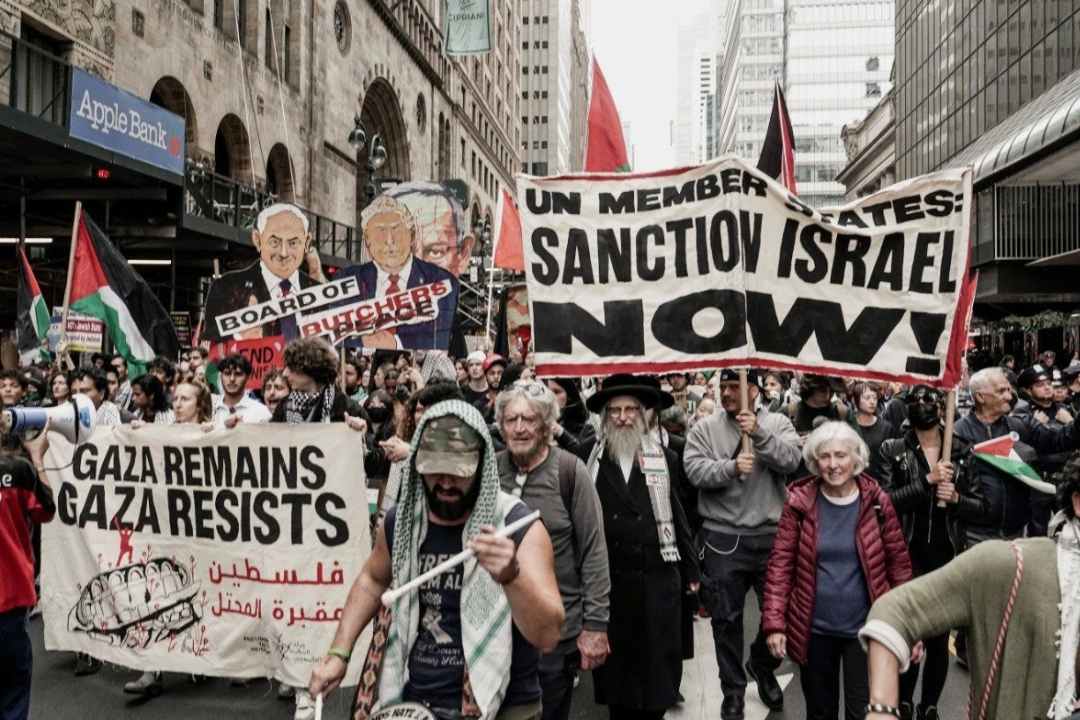
In contrast, hundreds upon hundreds protested in front of UN headquarters and marched through the surrounding area to condemn his presence and denounce the war in Gaza. More than a hundred people were arrested, including actress Susan Sarandon and other public figures. A stark contrast: while inside the UN Netanyahu boasted to justify the actions of the Zionist state, outside hundreds of people mobilized to reject him and denounce the genocide in Gaza and the advance into the West Bank and Lebanon. The day also showed that, despite the brutality of the offensive and the attempt to normalize it, solidarity with the Palestinian cause has not disappeared; rather, hundreds continue to take to the streets to express their rejection of Netanyahu and demand an end to the genocide against the Palestinian people.
Milei and the Art of Submission
If there is one prime example of subservience to imperialism, it is the one Javier Milei demonstrated in his third consecutive address to the Assembly. Rarely has such a level of open subservience been seen: he described Netanyahu as an “extraordinary” leader and went so far as to place him, alongside Trump, Marco Rubio, and Scott Bessent, as a sort of geopolitical beacon for the West. Milei’s meeting with Netanyahu completed the picture. While outside the UN hundreds of people were rallying to condemn the Israeli prime minister and denounce the massacre in Gaza, Milei chose to meet with him and reaffirm his support for the Israeli government, even as international condemnation grows. At the same time, he is offering Washington the so-called “Andes-Atlantic Corridor,” presented as an investment agreement but aimed at connecting Vaca Muerta and mining areas to Atlantic ports via pipelines, railroads, energy infrastructure, and telecommunications. It envisions no less than US$7 billion in potential financing, including a loan of up to US$6 billion for the Argentina LNG project, contingent on the purchase of U.S. goods and services. In other words: while Milei provides political support to Netanyahu, he is also placing the country’s strategic resources and infrastructure at the service of imperialist capital’s business interests.
The Falklands issue deserves a separate discussion; Milei brought it up again with unusual emphasis in this speech, calling the UN itself “useless” for failing to force London to negotiate. The opportunism is evident: this self-proclaimed admirer of Margaret Thatcher now waves the banner of the “national cause” while pushing through the Argentine Congress laws ostensibly aimed at “defending sovereignty” but which, at their core, seek to persecute and criminalize social and labor opposition. All of this is taking place amid a period of political weakness, with internal tensions within his own government and a growing backlash in the streets.
A subtle final irony: while Milei repeats ad nauseam his admiration for Trump, the U.S. president himself met that same week with British Prime Minister Andy Burnham, who even mentioned the Falklands in his own speech to the Assembly—an unprecedented event— and the much-anticipated photo Milei had hoped for never materialized. Once again, sycophancy offers no guarantees in return.
Take action seriously, without pretense
This year’s session has already come to a close. And, as always, thousands of words and promises were left to be carried away by the wind. No one—not even a shred of common sense—believes anymore that these summits generate real trust: the public imagination has been shaped by the image of leaders who speak of peace while managing, financing, and legitimizing war. The spectacle of Netanyahu speaking before an Assembly that claims to defend peace, while outside hundreds are mobilizing to condemn him, and the double-dealing of governments that applaud him, welcome him, and at the same time feign concern for the situation in Gaza, are just a glimpse of that hypocrisy. A rot that permeates the system and manifests itself in institutions incapable of resolving the contradictions they themselves purport to manage. It is the decay of a global capitalist system that needs to present itself as a guarantor of peace while perpetuating wars, plunder, exploitation, and oppression. The international stage is reduced to rituals of solemn speeches, where what is presented as the “international community” is in reality the management of the conflicting interests of the ruling classes and the imperialist powers.
To act without pretense means abandoning the illusion that those who rule the world will put an end to the injustices they need to maintain their power. It means organizing ourselves to confront them, to prevent them from leading us into barbarism.
Because if capital organizes exploitation on a global scale and imperialism coordinates its interests worldwide, those of us who are fighting to overcome this system must build a force capable of confronting it on that very same terrain: internationally, independent of the great powers and of any form of compromise with the established order. That is what building a revolutionary organization is all about: bringing together the struggles and forces of resistance, equipping them with a common program, and building an International capable of intervening in the class struggle, challenging for power, and opening up a socialist path forward. It is not a matter of waiting for the system to reform itself, but of organizing ourselves to transform the balance of power that sustains it.