Campouts in Porto and Lisbon.
By the Socialist Alternative Movement (MAS-Portugal)
Police violence is a structural function of modern states. The police originated in the 19th century, alongside modern states, in the service of the ruling class: the capitalists. Leaving behind militias, royal guards, and forces tasked with capturing runaway slaves, professional police forces emerged—not to fight crime, but to control the working class (today, the working classes) and protect industrial private property. In Portugal, it was established in 1867, in the context of the consolidation of bourgeois liberalism.
Thus, states establish themselves as the sole legitimate users of physical violence, with police forces serving as the instrument that carries out this repression. Police violence is not the antithesis of the state; it is the state—in its crudest form—acting in the interests of the wealthiest.
Police violence is a global phenomenon that constitutes a true repressive apparatus of the state. It tends to disproportionately affect three groups: by class (precarious workers, the unemployed, residents of outlying neighborhoods); by “race” (racialized bodies, a legacy of colonialism and, of course, slavery); and by territory (where the welfare state is diminished and only the penal state prevails).
Police violence is characteristic of both dictatorships and so-called bourgeois democracies. In dictatorial regimes, violence is explicitly political. During the Estado Novo, the International and State Defense Police / General Directorate of Security (PIDE/DGS) constituted the backbone of the regime. Torture, kidnappings, murders, and infiltration served primarily to defend the political order against communism, anarchism, and anticolonialist movements. In “parliamentary” democracy at the service of the wealthiest—the kind we experience in Portugal and in the vast majority of European countries—this violence merely changes form while retaining the same function. It is not presented as a “defense of the regime,” but rather as the “maintenance of public order.” Ultimately, the supposed defense of the individual citizen is nothing more than a marketing strategy; in reality, the state is sustained by force.
The main difference between police forces in dictatorships and those in parliamentary democracies lies in the following: in dictatorships, the goal is to eliminate politics; in bourgeois democracy, the goal is to prevent social issues from becoming political issues.
In this context—as has happened on other occasions in Portugal—there was yet another episode of police violence, ordered by the Social Democratic Party (PSD) government. The mayor of Porto declared that he would be “absolutely relentless” in the face of any attempt to set up tents—a stance supported and praised by Prime Minister Montenegro and his Minister of Internal Affairs.
In other words, given the incompetence of this government’s housing policies—as well as those of previous governments led by the Socialist Party (PS) and the Social Democratic Party/Democratic and Social Center (PSD/CDS)—, and given the ongoing administration by the PSD-led municipal governments (especially in Lisbon and Porto), the heavy police presence aims to prevent the government’s incompetence from becoming evident and to stop a social issue from turning into a political one. For this very reason, it is not surprising that the PS (and the President of the Republic, José Seguro) have not clearly condemned the police repression that took place in Porto.
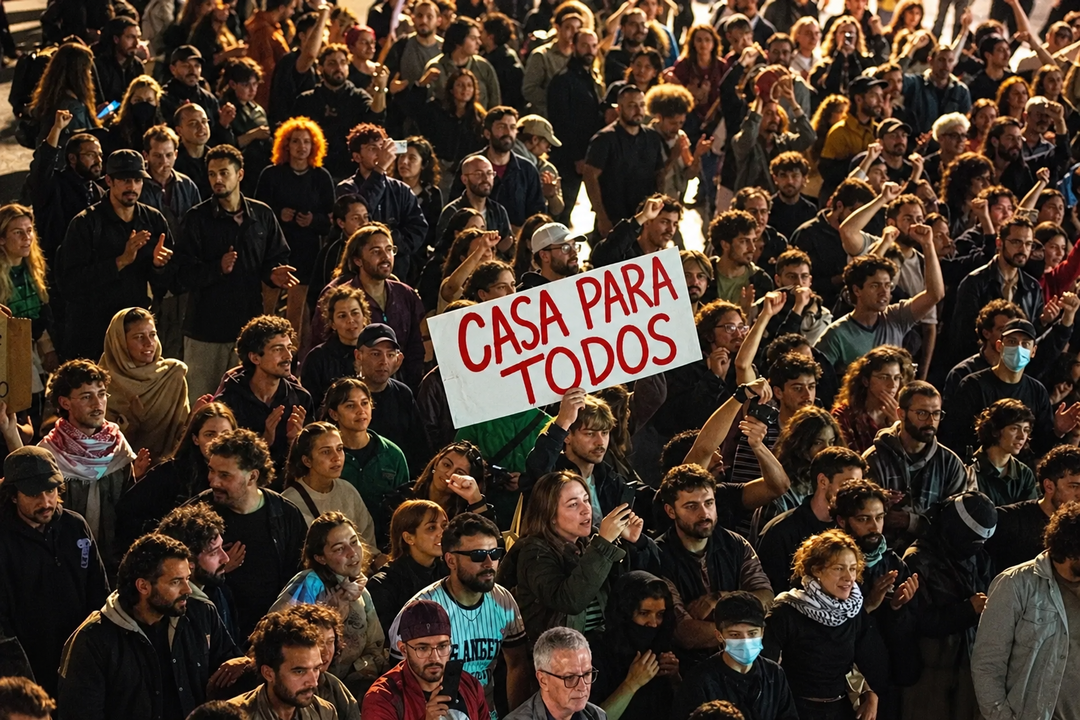
From the perspective of this established power, the police crackdown—which was violent, disproportionate, and entirely unjustified at a demonstration that remained peaceful throughout, leaving 37 people injured (two of them in serious condition) and including the cowardly attack on a person with a disability—is considered “legitimate” precisely because it exposes the government’s incompetence and its defense of corporate—and private—interests linked to the aberrant real estate speculation plaguing Portugal. The epitome of indecency is reflected in the Prime Minister’s paternalistic recommendation, in which he asks us not to be “selfish” while he and his family own a portfolio of 55 properties.
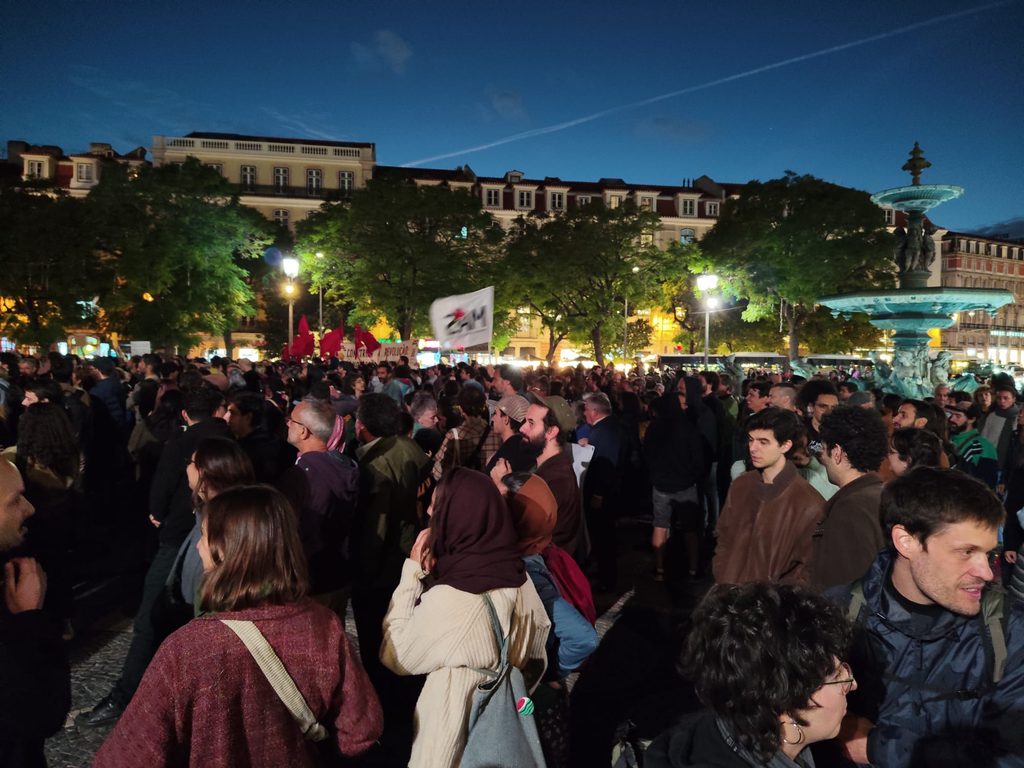
The Socialist Alternative Movement (MAS) stands in solidarity with all the encampments, whether in Portugal, Spain, France, or any other country where capitalism has stripped people of their right to housing, reserving it exclusively for the wealthiest members of society. The MAS also proposes that these encampments spread to all cities to force the repeal of the Rent Law, passed by the government with the vote in favor—or the acquiescence—of the IL and the demagogue Ventura and his party. Likewise, we propose that all independent unions pressure the General Confederation of Portuguese Workers (CGTP) and the General Union of Workers (UGT)—which should already have called for a GENERAL STRIKE— to organize, in coordination with the strike already scheduled in Spain for November 11, an Iberian general strike demanding caps on rent and fuel prices, as well as real increases in wages and pensions.
MAS statement distributed at the rally in Rossio regarding the police crackdown on the encampments in Lisbon and Porto:
“Montenegro Responds to the Housing Crisis with Police Repression”
“The current AD government, supported by the far right of the IL and Chega—with some voting in favor and the demagogue Ventura abstaining—has managed to pass the disastrous Rent Law, a law that fully favors…” ……especially the wealthiest members of our society.
They are the ones primarily responsible for the legitimate outrage that has driven thousands of young people and workers to take to the streets to fight for the repeal of the Rent Law. These young people are fighting for all of us: for the repeal of the Rent Law and for a cap on housing prices, since no one with limited resources or a minimum wage can rent or buy a home. And young people are the ones most affected.
In this current historical period, large-scale protests and protest camps have reemerged in Spain, but they have quickly spread to several countries across Europe.
The MAS (Socialist Alternative Movement) not only supports the camps but also demands an immediate end to the arrests and criminalization of social activists, who were cowardly attacked during the night.
Here we see the face of a possible future fascist regime. For now, it’s just a glimpse, but… Nothing stops Rita Matias—an avowed fascist and member of the Chega party—who bursts into a student association and stirs up trouble in the name of “freedom of expression”; yet she surely applauds the lack of freedom suffered by protesters during their just and peaceful demonstrations in the country’s public squares. In other words, the fascists, in order to seize power and begin imprisoning people (and, who knows, perhaps in the near future, banning left-wing parties), claim to be defending their own freedom of expression (obviously). But in reality, they seek to put an end—as we are now seeing in the protest camps—to the freedom of expression of those carrying out entirely just protests. And these protests are just because they challenge the injustice that prevents most working-class young people from even being able to rent or buy a home, given that prices are sky-high.
EVERYONE, SHOW YOUR SOLIDARITY WITH THE PROTEST CAMPS!
LET’S ALL STAND UP FOR THE FREEDOM TO HOLD PROTEST CAMPS! WE DEMAND FREEDOM AND THE DECRIMINALIZATION OF ALL THOSE DETAINED, AND THE WITHDRAWAL OF ANY CHARGES THAT MIGHT BE FILED IN COURT!
“FOR A GENERAL STRIKE, FOR AFFORDABLE HOUSING, FOR WAGES AND PENSIONS, AND TO STOP PRICE INFLATION!”