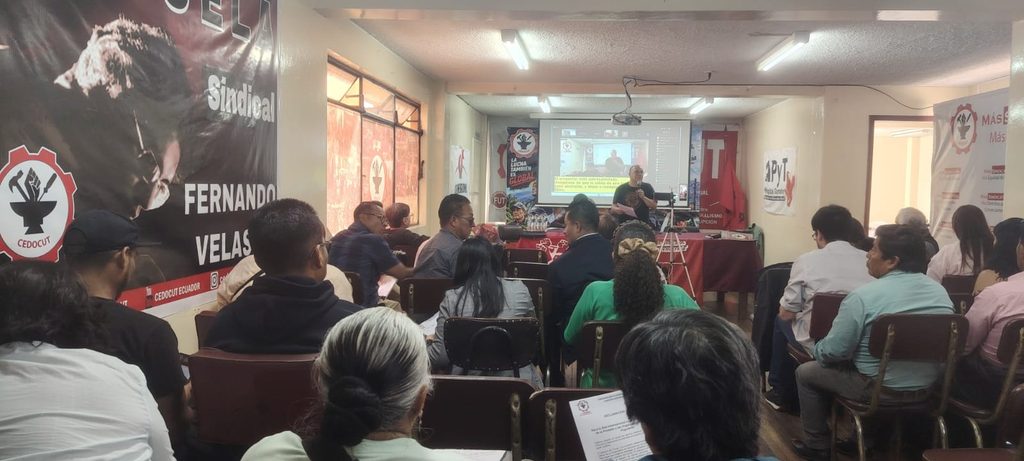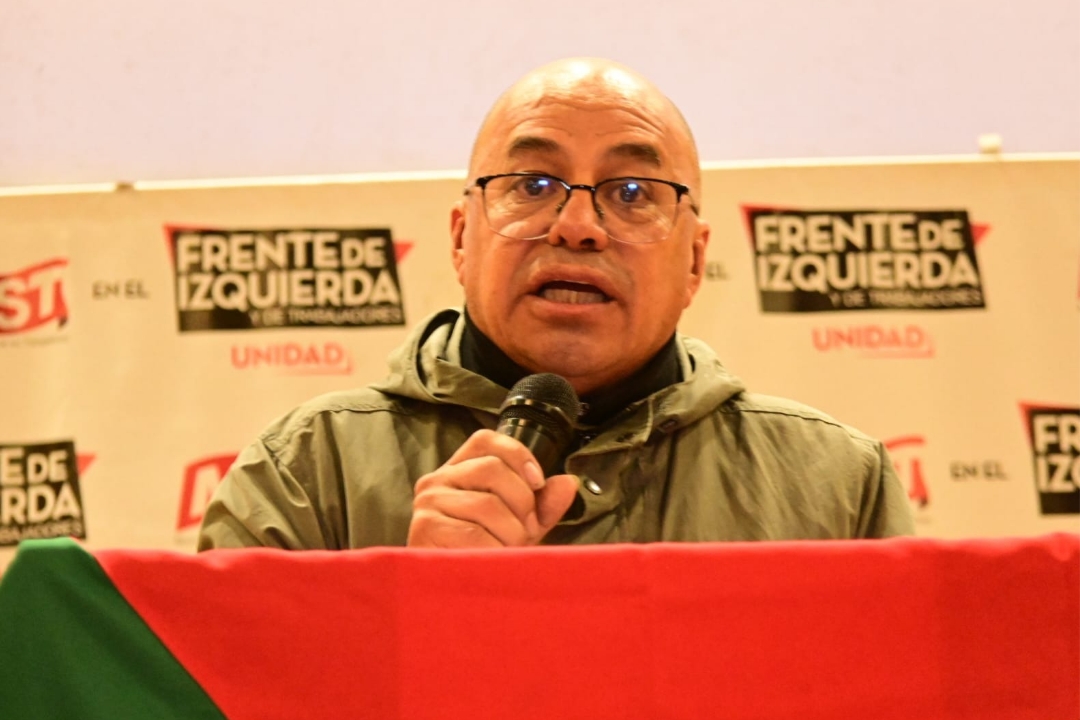
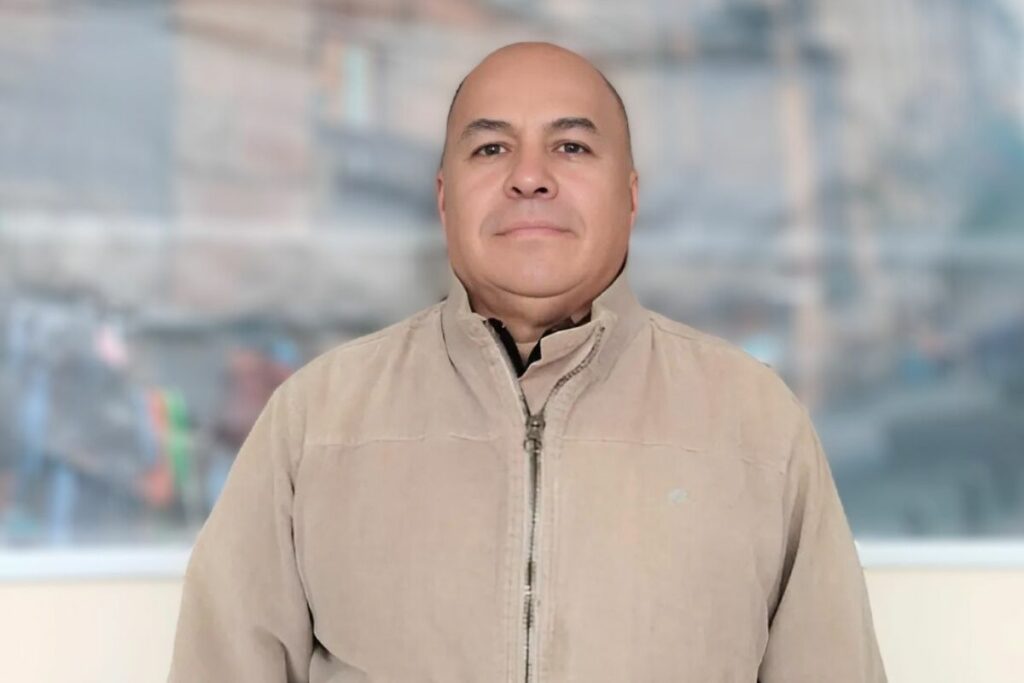
Edwin is the best-known labor leader and one of the most influential figures in Ecuador’s labor movement. He is president of the militant labor federation CEDOCUT and of the United Workers’ Front (FUT), which brings together the country’s main labor federations. He has roots in the metalworking and automotive industries, and is now a major actor alongside the country’s peasant and indigenous movements. He led the First International Meeting Against Criminalization in Quito, and in this conversation, he shared some important insights.
M.R., tell us about your social background first. You come from a working-class and popular tradition, right?
Edwin: Well, my experience with social organizing began with my introduction to culture, especially music. I’d been involved in theater and music since I was 14. I played several instruments, and we had a neighborhood organization, and we gradually became involved with the labor movement of that time. Whenever there was a strike, we’d go play for the striking workers. I come from a humble family—let’s say lower class, working class. My mom worked in a textile factory; my dad was a baker at first, then he started working in an auto factory; and even my grandfather worked as a grinder at the BOTAR factory, which later became the BOTAR assembly plant here in Quito. I became involved in the labor movement when I started working at the assembly plant where my dad and my grandfather had worked—the one that later became General Motors.
M.R., Your training in grassroots unionism reached its peak before CEDOCUT, in the automotive industry, right? Tell us about it.
I joined the labor movement while I was working at the factory, and right from the start—at age 22—I became a member of the first executive board. Then I severed the tips of my fingers in a metal-bending machine, but I continued my activism in the union. Later, I became Organizing Secretary, and eventually I was tasked with leading the rank-and-file union and the Works Council. I had the opportunity to meet several international allies in the industry, from the FITIN, and I met fellow auto workers from Argentina, who were the ones who brought us into the Federation of Metalworkers, both nationally and internationally, and that’s where I met workers from General Motors in Canada. In other words: it was in the auto workers’ union and grassroots unionism that I gained my most comprehensive training and experience, in a sector that, thanks to its historic struggles, had achieved significant victories.
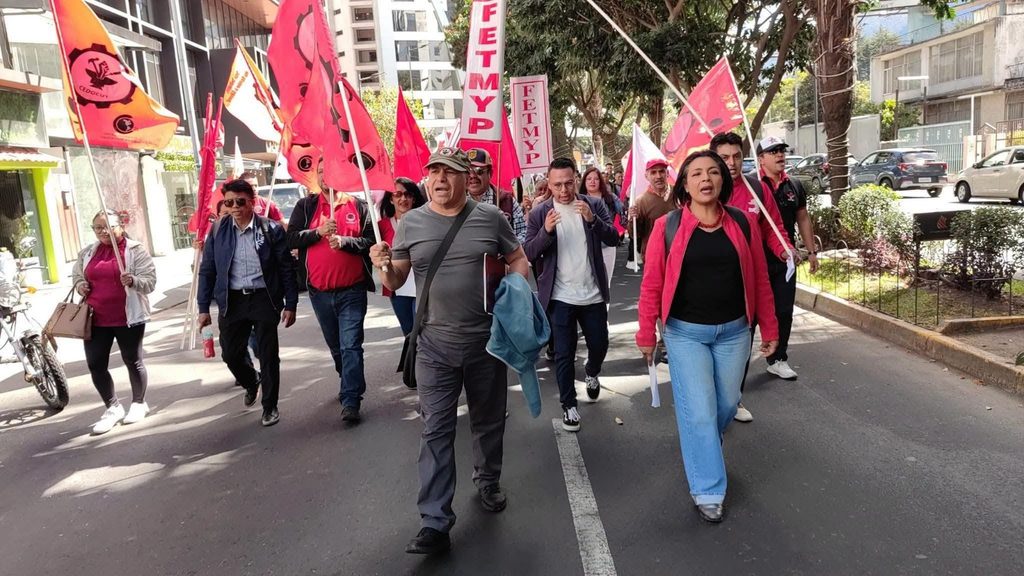
M.R. Could you share your perspective on the challenge that CEDOCUT faces with Noboa right now?
Edwin: Well, CEDOCUT and the Ecuadorian labor movement face a challenge at this time of expansion by the right wing, which had already been gaining ground in Ecuador—it’s not that it wasn’t already established; it was already gaining ground in Ecuador in an extreme way, and rights violations were already taking place. In the 2008 Constitution itself—which was enacted under a progressive government, that of Correa—a ban on unionization and collective bargaining in the public sector was established. In other words, many public-sector workers who had previously been unionized and engaged in collective bargaining no longer had those rights under the 2008 Constitution. It stated that they had the right to organize, but without any provision for collective bargaining.
M.R. The Central Bank also clashed with the Correa administration at the time and had a hard time maintaining its independence. Is that correct?
Edwin: Well, a process began early on under Correa’s administration, before the Constituent Assembly. Apparently, there was a feeling of well-being, and it seemed like some progress was going to be made, but after the Constituent Assembly—when collective bargaining and the right to organize in the public sector were eliminated— that’s when the problems began for workers, especially in the public sector. This also affected the private sector, because a series of attacks and acts of persecution began against social organizations, NGOs, and environmentalists. So, far from being a left-wing government—labeled as progressive—it gradually became clear that there was an alliance with private enterprise and transnational corporations, and the attack on labor unions began as well; Correa even divided the labor movement by promoting artificial pro-government organizations. In any case, the most serious issue was that strikes were criminalized in the COIP (Comprehensive Organic Criminal Code). The COIP did not previously include provisions for the criminalization of strikes. In other words, under so-called “progressivism,” strikes are penalized; one of the articles includes the prohibition on striking, with the threat that such industrial action—or the shutdown of public services—would result in criminal prosecution. Therefore, the criminalization of social struggle began, although under right-wing governments we had experienced also forms of persecution. But the criminalization of the labor movement was legalized under so-called “progressivism”. In addition, mechanisms for dismissals in the sector were established through Law 813, which allowed officials in the Correa administration to dismiss workers based on their ideological or political positions. Noboa is now utilizing and expanding upon this entire repressive framework, which was put in place under Correa.
That is why, when we are told that progressivism is “leftist,” we have a very clear experience of persecution, anti-worker measures, and even alliances with multinational corporations—such as Coca-Cola, which allied with Correa to use water that peoples and communities defend and demand it’s used for life, not for business. Under “progressivism,” we tried to organize a union at Coca-Cola, and Correa allowed management to carry out 200 layoffs in retaliation for our actions and because of his strategic agreements with that corporation. Our assessment of “progressivism” is based on facts and material experience—not on prejudices or dogmas.
M.R. How significant was the recent First Conference Against Criminalizatio for CEDOCUT?
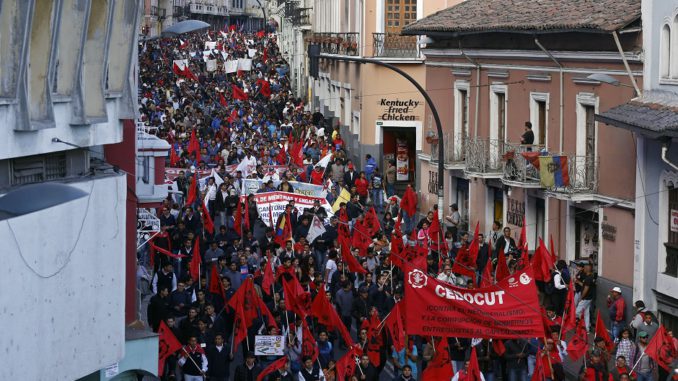
Edwin: It was a political and organizational success. We launched an International Network Against Criminalization, which was of particular interest to us. The international representation and the commitment of leaders from our CEDOCUT grassroots organizations were important. In Ecuador, Noboa’s administration is attacking collective organization; our unions and the Confederation itself are the targets of legal boycotts and economic strangulation, in collusion with big business, which is taking advantage of this reactionary policy of the national government. This event was a breath of fresh air; a valuable iniciative. We are now preparing to mobilize in Ecuador for the International Day of Action on December 10 that we have launched. It is a starting point for this effort we are beginning, and we recognize the ISL’s actions as a decisive point of support. We have much to do together in the next phase.
M.R. Over the course of the two days, the topic of political alternatives for Ecuador and on the international stage came up in the debate. Do you see a need to address that challenge? Is it a Workers’ Party in Ecuador?
Edwin: Regarding the Workers’ Party, I believe this debate is essential. I’d like to mention that the formation of the Workers’ Party has already been proposed at two CEDOCUT Congresses as a challenge we must take on. Our history as a labor federation over the past 50 years—marked by class-consciousness and autonomy—has allowed us to accumulate experience and insights that it is now time to transform into positive politics and proposals and to regain the initiative. In the union’s most recent period, there wasn’t quite enough political determination to move forward—a certain influence from Ecuadorian social democracy played a role. I am convinced, that we workers need our own political representation; we must stop delegating and build our own tool to fight for power. The idea of a Workers’ Party may bring to mind failed experiments in other parts of the world, but we will have to try it ourselves in Ecuador. And in any case, if we make mistakes, it will be us workers who make them—we will learn from them and try again and again. In this challenge, international organization and solidarity are crucial. We must also move forward with this strategy in the coming period—the time has come.
Interviewed by: Mariano Rosa