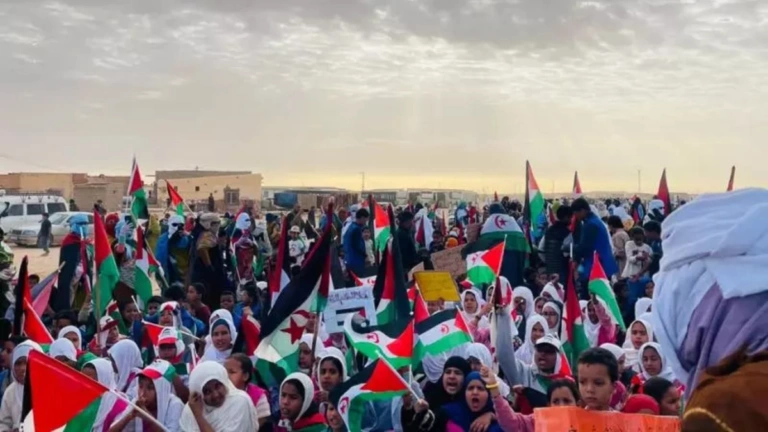
On October 30, the UN Security Council failed in its two attempts to pass a resolution on the continuation of the United Nations Mission for the Referendum in Western Sahara (MINURSO). The only way forward for the Sahrawi people is self-determination, which requires the mobilization and solidarity of all the peoples of the world.
By Chaiaa Ahmed Baba and Rubén Tzanoff
Automatic translation made by AI.
The vote in the UN Security Council
The U.S. imperialist plan proposed changing its name and political orientation. It sought to make Mohammed VI’s proposal for autonomy—always under Moroccan sovereignty—the exclusive basis for negotiations. This was not a neutral compromise among different alternatives: it ruled out the possibility of the Sahrawis choosing independence and sought to block the path to a referendum on self-determination.
There could be no real self-determination under the impositions of an imperialist power and an occupying monarchy, and without a referendum. The resolution was not approved, with 11 votes in favor, abstentions by China, Pakistan, and Somalia, and a veto by Russia.
Inter-imperialist Conflict in Africa
The Russian imperialist project, which opposed U.S. imperialism and sought to renew the mandate without accepting Morocco’s demands as the basis for negotiations, justified this stance by citing the need to preserve the decolonization process.
However, it would be a mistake to portray Russian policy as a selfless defense of oppressed peoples; rather, it is a defense of its own strategic interests in North Africa and its close relationship with Algeria.
The major powers blocked each other’s initiatives, since even in the Security Council, the interests of the permanent members take precedence over the needs of the people. This outcome does not remove the Sahrawi issue from the UN’s diplomatic agenda, but it does usher in a new phase of uncertainty.
The Mission, Its Origins, and Its Failure
MINURSO was established in 1991 to monitor the ceasefire and prepare for a referendum in which the population could decide on self-determination. Thirty-five years later, that referendum has never taken place. Now, instead of ensuring that it takes place, the U.S. sought to adapt the mission to a political solution that favors the occupation and the territorial claims of the Kingdom of Morocco.
The Sahrawi people have long since lost trust in MINURSO and are well aware of its failure to carry out the referendum on self-determination. Nor did it denounce human rights abuses in the occupied territories—including the mistreatment of political prisoners in jails, acts of torture, landmines in areas near the wall, or attacks by the invading army—which is why its presence was increasingly viewed with indifference.
Israel, an ally of Morocco and Trump
U.S. support for Rabat has specific precedents. In December 2020, Trump recognized Moroccan “sovereignty” over Western Sahara as part of the agreement under which Morocco normalized its relations with Israel. In July 2023, Benjamin Netanyahu’s Israeli government also formally recognized that false sovereignty.
In this way, Morocco is strengthening its ties with Washington and Tel Aviv, while the United States is solidifying an ally in the Maghreb and seeking to limit the influence of Algeria, which supports the Polisario Front.
The Sahrawi issue is increasingly becoming the focus of a dispute between imperialist powers and regional powers that act in their own interests rather than in the interests of the Sahrawi people.
Spain: Historical Responsibility and Political Subordination
Spain bears a special responsibility. It was the colonial power in Western Sahara and withdrew in 1975 without ensuring that the population could decide its own future. The Madrid Accords of November of that year facilitated Spain’s withdrawal and paved the way for the occupation of the territory by Morocco and Mauritania.
In March 2022, Pedro Sánchez’s government endorsed Morocco’s autonomy plan—a shift that marked a departure from its traditional public support for a process of self-determination under the United Nations framework and solidified its rapprochement with Rabat. Sánchez’s reprehensible betrayal aligns with the positions of European Union authorities, who have never fully and unconditionally defended the Sahrawi cause.
The Polisario Front: Satisfaction Over the Veto, Concern About the Future
The Polisario Front expressed its satisfaction with the rejection of the U.S. proposal. It believed that its approval would have seriously undermined the foundations of the peace process by making autonomy under Moroccan sovereignty the only path forward in the negotiations.
But the Polisario Front also expressed concern over the blockade on the renewal of MINURSO and its consequences, and once again called for the referendum on self-determination to be held.
For the Self-Determination of Western Sahara
At the International Socialist League (LIS), we defend the unconditional right of the Sahrawi people to determine their own destiny. This means demanding that a referendum on self-determination be held, free from interference by Morocco, the United States, or any other imperialist power, from which it is necessary to remain politically independent.
We stand in solidarity with the mass protests that continued for several days in the Tindouf camps.
We continue to reject the occupation and forced annexation, diplomatic pressure, and any attempt to impose a solution that disregards the will of the Sahrawi people. We recognize the right of the proclaimed Sahrawi Arab Democratic Republic (SADR) and the Polisario Front, the representative of the Sahrawi people, to defend themselves by all means at their disposal against the ongoing aggression by the Moroccan army.
We condemn repression and human rights violations. And we promote internationalist solidarity among workers, unions, youth organizations, and popular movements around the world. The Sahrawi cause is not a pawn on the chessboard of world powers but a struggle for freedom and the right of a people to decide the fate of their land and their future.
The Sahara Can’t Wait
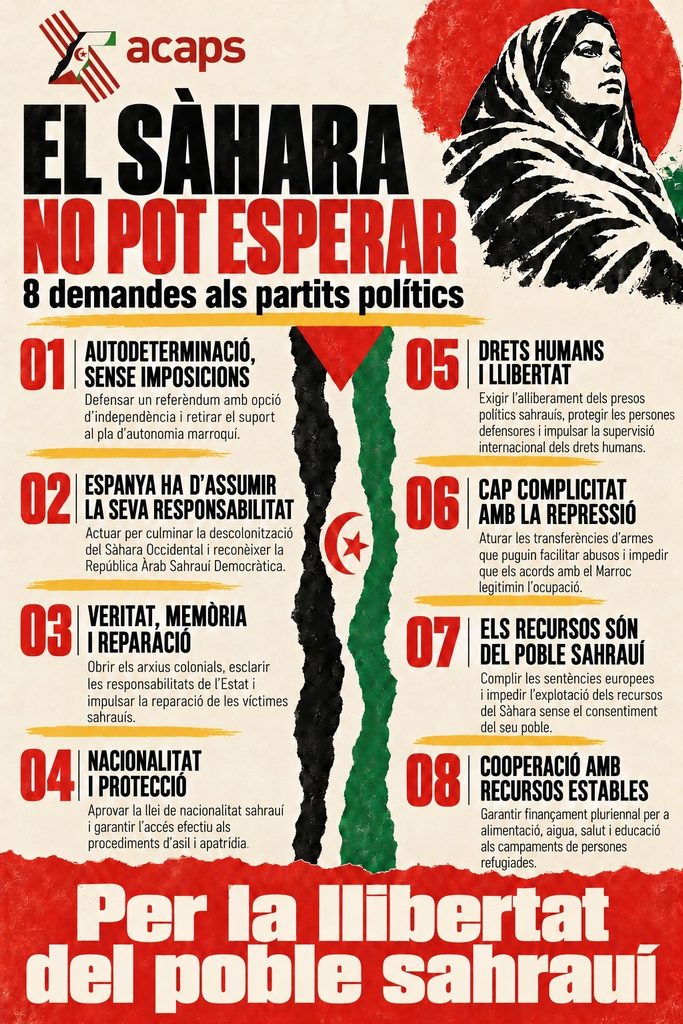
In Catalonia, we at Socialism and Freedom (SOL) support the demands of ACAPS (Catalan Association of Friends of the Sahrawi People) ahead of the early general elections on November 29. We will participate in the rally in front of the Spanish Government Delegation in Catalonia (278 Mallorca St.) on Tuesday, November 17, at 5:00 p.m., and we will organize the march that takes place every year to protest the Madrid Agreements.