By Ali Hammoud
Palestine:
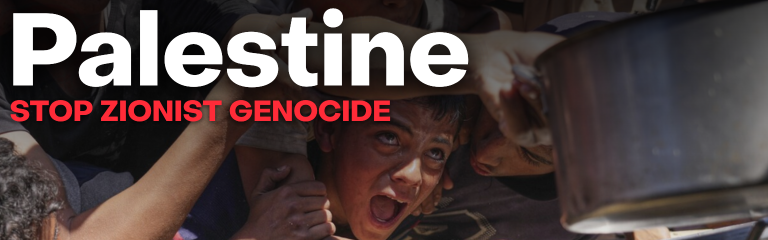
The Zionist enemy continues its war against the region and its peoples, waging a relentless attack on humanity, the environment and urban development. Its attacks are intensifying, reaching the point of genocide against the population of the Gaza Strip. Not content with bombarding refugee camps with tons of rockets, the enemy has moved on to the largest systematic famine operation in collaboration with the U.S. government. Palestinians are starving to death on a daily basis, and the Gaza Strip is now on the brink of catastrophic famine. This is a scene that epitomizes the humanitarian and moral failure of the world.
This is not a famine resulting from a natural disaster, but rather the direct result of Zionist blockade tightening policies and military operations. International reports from the World Food Program confirm this, warning that “Gaza faces catastrophic levels of hunger” and that “famine is inevitable if a large and sustained flow of food does not arrive.” The World Health Organization confirmed a sharp increase in malnutrition in children under five, and the United Nations Office for the Coordination of Humanitarian Affairs indicated that 100% of Gaza’s population (2.3 million people) suffer from varying degrees of food insecurity, and a large proportion of them are in emergency and famine situations.
The daily scenes we receive from the Gaza Strip are a horrifying testimony of indescribable human suffering. Famine creeps up on children and adults whose only crime is to live in a besieged and devastated land. Urgent and effective action is not an option; it is an urgent humanitarian and moral duty to save innocent lives. The world’s silence and reluctance to take decisive action will write dark chapters in the annals of history.
The enemy continues its genocidal war against the Palestinian people with political decisions approved by the Knesset, from the approval of the control of the West Bank to the decision of the enemy government to occupy the Gaza Strip and appoint a new ruler there. This confirms their intention to put an end to the Palestinian cause.
Syria:
The new regime in Syria remains mired in a deep crisis and is unable to reach an understanding with the active political and military forces in Syrian society. Following the massacres in the coastal area committed by the Syrian General Security Forces and foreign militias affiliated with Al Qaeda, it has become difficult to convince the Sweida and SDF military factions to lay down their arms or integrate into the new military and security institutions. The Israeli intervention further complicates the Syrian situation. The enemy invaded Syrian territory and established observation posts near Damascus (13 km away).
The new regime in Syria is based on a criminal takfiri ideology that rejects others and does not treat all components of the Syrian people as subjects. The sectarian violations taking place in Syrian cities and universities confirm that the mentality of the new regime rules the country as a sectarian militia.
Turkey, the United States and Saudi Arabia have attempted to lay the groundwork for the survival of this new regime by providing financial, economic and political support and establishing security arrangements with Israel. Several meetings have been held between representatives of the new regime and the Zionist state, most recently in Baku, Azerbaijan. Recent events in Sweida have had a significant impact on the Syrian reality. During the Syrian civil war, the people of Sweida distanced themselves from the conflict and did not participate in the sectarian massacre. After the fall of Assad, Druze forces were in Umayyad Square before the arrival of al-Julani forces. The Druze reached out to the new government, to the point that the Sweida factions reached a preliminary agreement with it. The isolationist Druze movement, supported by the Zionist enemy, was in the minority, and everyone expected a national conference and a clear political road map. However, the response of the new regime was to invade Sweida, humiliate and murder its people, kidnap their women and steal their property. This shows that the regime’s sectarian and criminal policies serve the Zionist project in the region. The new Islamic regime in Syria has pursued a project of normalization with the enemy and began its reign by betraying the causes of the Arab people. However, the Zionist state has its own project in the region. It does not seek weak and subservient states, but warring sectarian cantons that will divide Syria into four sectarian states and create what is known as David’s Corridor. There was, and is, hope that the Syrian people will rebel against the new government, reject the Afghanization of Syria, reject normalization with the enemy and begin the process of building a new Syria.
Lebanon:
More than eight months after the announcement of the fragile truce between Lebanon and the enemy, the political and military landscape is becoming increasingly complex. The enemy still refuses to implement the terms of the agreement and to withdraw from the territories it occupied. Its drones perpetrate assassinations on a daily basis and its warplanes launch weekly incursions into Lebanese territory, claiming to target military installations and missile launchers.
In recent weeks, the enemy has issued serious threats that it intends to resume war with Lebanon if the terms of the agreement signed in October are not fulfilled. The enemy, along with the Americans, claims that the agreement stipulates the withdrawal and destruction of all Hezbollah weapons, while Hezbollah stubbornly refuses to acknowledge defeat and insists that the agreement does not include the area north of the Litani River, but only the area to the south.
The Zionist threats have had a significant impact on political life in Lebanon, and the Americans took advantage of this by sending their envoy for the region, Tom Barak, with the text of a new agreement to the Lebanese state. The agreement includes several provisions, including the withdrawal of Hezbollah’s weapons, from ballistic missiles to drones, within six months; the imposition of controls at border crossings, ports and airports; the imposition of controls on the financial and banking sector; the demarcation of the border with the Zionist entity; the cession of land in the Shebaa Farms and the Kfar Shuba Hills; and the suspension of reconstruction projects.
Our position was clear from the beginning: Barak’s document was a declaration of total surrender to the enemy and an agreement between Lebanon and Israel under the auspices of the United States. The political authority should inform the Americans that the solution to the problem of Hezbollah’s weapons is an internal matter to be dealt with within the framework of the Lebanese state and framed within the defense strategy and national security plans. However, the Lebanese authorities made a serious mistake by deciding to discuss the U.S. document at a meeting of the Lebanese Council of Ministers with the aim of approving it. The Lebanese government met for two days and discussed it. Despite the heated debate and the withdrawal of the Shiite ministers from the session, the cabinet voted and approved the document, turning it into a new agreement between the state and the entity under the auspices of the United States. The state pledges to withdraw Hezbollah’s weapons within a specific timeframe, which has plunged the country into a new political crisis with sectarian and national dimensions. The Lebanese government has succumbed to Saudi and U.S. intimidation and pressure. This submission strips it of its national immunity and legitimacy. The motto of this stage is to force it to yield, to declare its decisions null and void or to overthrow it. The duty of any legitimate authority in Lebanon is to assert the right of the Lebanese people to resist the occupation.
The duty of any legitimate authority in Lebanon is to take advantage of Hezbollah’s existing capabilities and experience and develop a national defense strategy that takes advantage of them.
The duty of any legitimate authority in Lebanon is to support the steadfastness of the Palestinian people and to reject the normalization of relations with the enemy.