By Jean Mendoza and Gustavo Martínez Rubio
Translated by AI.
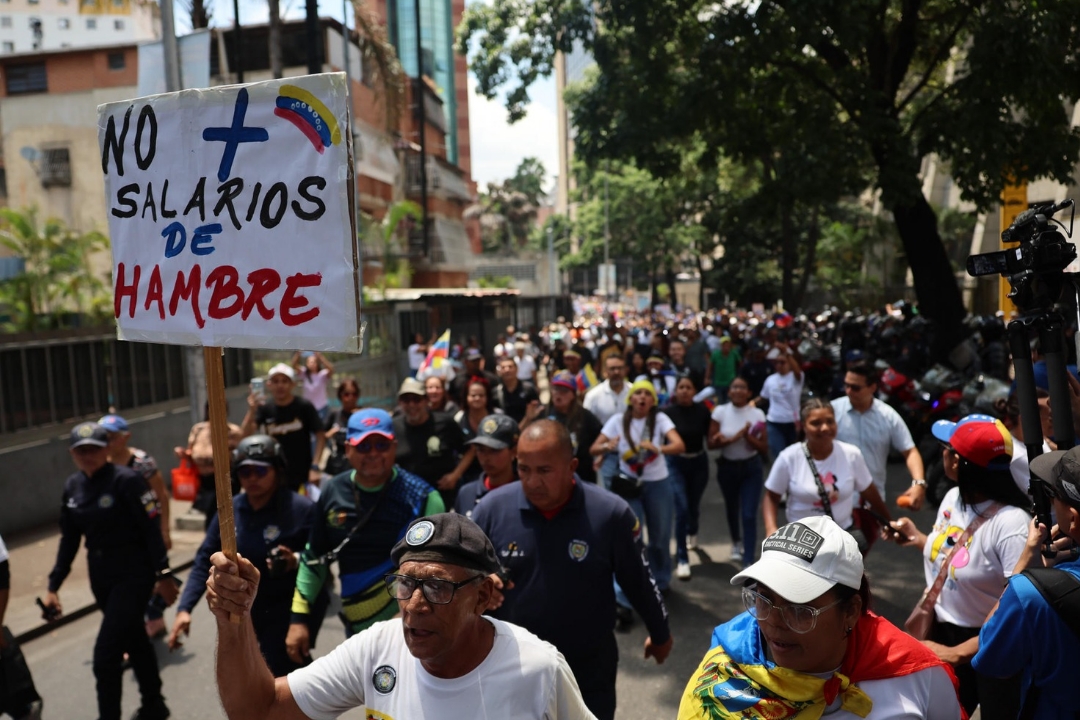
May Day left a positive balance for the Venezuelan workers’ movement. At the national level, the willingness to fight was felt and, in Caracas, the route from Chacaito to Plaza Morelos was completed. It was a demonstration that, in spite of everything, the workers’ muscle is still alive.
However, this scenario of progress is marred by a disturbing reality: the tactical and political division. While the bulk of the organizations mobilized on Labor Day, a union sector called for a parallel march on April 30 towards Miraflores -stopped by the government-. This lack of unity is not an accident; it is the symptom of a deep problem that afflicts, in general, the trade union leaderships.
The debacle of the trade union movement in Venezuela has a clear origin: the absence of a democratic and consultative exercise. The union leaderships have substituted the grassroots assembly for the understanding with the bosses and the blind application of partisan lines. We are talking about top-level parties, with interests alien to the welfare of the workers.
Added to this, of course, is the systematic repression by the Maduro (and now Delcy) government. Years of persecution, imprisonment and police harassment against those who demand rights have weakened the organizational capacity. The result is a fragmented union movement, with some bureaucratic leaders more concerned with politically capitalizing small spaces than with promoting a unitary mobilization to recover the wages and rights taken away.
Neither “Coalición Sindical” nor Patines: A bosses’ political line
In this troubled river appears the so-called “Union Coalition”, a group with a “rarely” wide media exposure in private sectors and social networks. Its spokesman, José Patines -presentedas a union leader of the Chancellery, although he is rarely seen with his base peers-, leads a clearly divisive work, as expressed by workers in some states.
Under a rhetoric of struggle, this group operates to impose the agenda of a specific political sector of the bosses: that of María Corina Machado. While Machado makes international tours, these groups move with a line that is basically demobilizing: they say that“it does not make much sense to fight for wages” because what is really important is the electoral calendar.
It is, in essence, asking the worker to choose another executioner. This work is the mirror of the work that the Central Bolivariana de Trabajadores (CBST) does for the government. If not, let them explain how Machado and the businessmen surrounding her have not benefited from the anti-worker policies of the current government.
The false dilemma and the agenda of the top management
It is not a matter of debating whether Venezuela needs elections; it is obvious that we are facing a de facto government, illegitimate and prostrate before international interests, especially after its subordination to policies that favor foreign capital and clearly Donald Trump. The point is that the “Trade Union Coalition” is pushing for an electoral exit where the figure of Machado represents the continuity of the adjustment. Machado’s economic plan, in essence, is already being executed by Delcy Rodriguez: that the crisis will continue to be paid by the workers without labor rights.
Despite her strong discourse of change, María Corina Machado has maintained a notable silence regarding the deep recovery of labor rights and the precarious situation that the working class is going through. While the elimination of these conquests has been executed mainly by the policies of the current government, this scenario of de facto deregulation and low operating costs is aligned with the interests of her business sector. By not deepening union or wage protection mechanisms, their proposal suggests a continuity in which corporate profit is prioritized over the restitution of historical guarantees taken away from workers.
Since this is a policy designed in the offices of the bosses’ leadership, the rank and file are never consulted. This is what divides, weakens and takes away the strength of the workers’ drive against the government and the bosses as a whole.
A call to conscience and the United Front
These notes are a warning to rank and file workers. Without political clarity, we will be “cannon fodder” for foreign interests. The desperation of the current crisis cannot allow us to be led, once again, to dead ends where only the faces in power change but exploitation remains intact.
To the sectors that marched with dignity this May 1, we extend a fraternal summons: it is time for an even more democratic and consultative attitude. We must forge a genuine plan of struggle, based on the demands of our class.
We need to put together a plan in the historic key of the “United Class Front”. Only unity from below, independently of all the bosses -whetherfrom the government or the business opposition-will give us the real possibility of defeating the plan of hunger that is being imposed on us today.