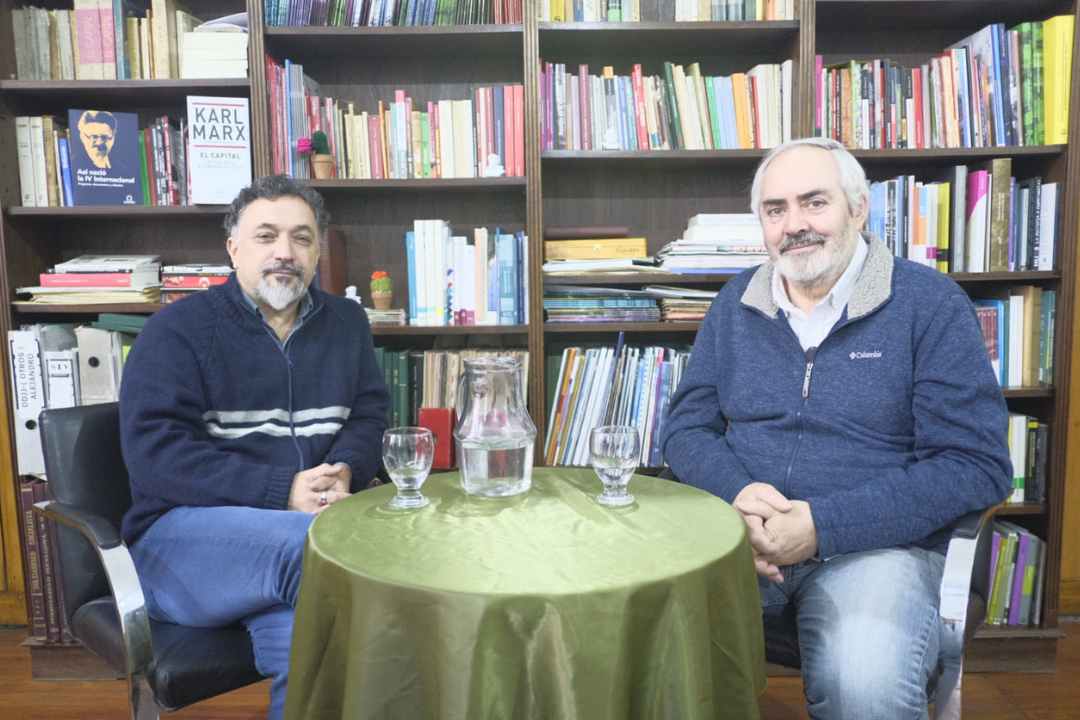
Sergio García: We’re here with Alejandro Bodart, General Secretary of the MST, a leading figure in the Left Front, and coordinator of the International Socialist League, because the country is experiencing a very particular situation: for some time now, the left has begun to show a political leap, becoming increasingly prominent, and Myriam Bregman’s figure is steadily gaining ground in the polls. Alejandro, we want your thoughts on these issues because it’s truly a debate that affects the entire country, thousands of workers, and young people. We want to ask you: hearing you speak at the Plaza de Mayo on May Day, or the MST rally Entre Ríos, or the recent MST Congress, you say in different ways that Argentina is facing an unprecedented situation and that the left has a historic challenge. Can you explain what you mean by that?
Alejandro Bodart: I think we’ve never seen a phenomenon in which the left begins to emerge as a real alternative for government and power in the country. Keeping in mind that journalists often use the term “left” in a general way that includes so many people who are not left-wing at all. We’ve seen the Peronist governments, for example, described as left-wing in various periods, when in general they pursued center-left or progressive policies in the context of being part of a bourgeois party.
What we’re talking about now is a class-conscious, anti-capitalist, Trotskyist left that is capitalizing on a situation that has a truly unprecedented combination of factors. The fact that this left is polling at 10-15% of the vote, that a candidate of the Left Front leads some opinion polls on positive image, surpassing figures like Cristina Kirchner, Buenos Aires Governor Kicillof, and even the Milei government, demonstrates an unprecedented situation that presents us with a tremendous challenge, an opportunity, and also a great responsibility. That’s why we’ve been discussing this for the past couple of months. Because, moreover, it has been a meteoric rise over just a few months. Beyond the fact that, with the Left Front, we have been growing year after year in political influence in unions, universities, and neighborhoods, this development is a turning point that presents us with a new opportunity because we have become one of the country’s central political actors.
There are no longer two spaces in this country—as many continue attempting to portray—but three, and the revolutionary left is one of them.
SG: Yes, that’s true. Because if you look at the debate in all the media, it’s already “well, the left is growing so much.” Now, if this is the case, if it’s a historic challenge, if it’s an unprecedented situation in the sense you’re describing it, then clearly what we have been doing until now can’t continue being the same. If there’s such a big change in reality, I assume that the left has to respond to a new phenomenon. What are the most important issues for the left, for the Left Front, to address? What’s the new message for disillusioned Peronists? Because it’s difficult to explain such a leap on the left if it’s not tied to a crisis of the traditional forces.
AB: To explain what’s happening, you have, on the one hand, the crisis of the government, of its moral discourse and of its culture war, which has been shown to be a complete fabrication. These days we have the Adorni case and how lucky that man was to find $200,000 on a flash drive, somehow make it grow to $500,000. It’s a complete fabrication that shows the decadence and that these people are more of the same, beyond the rhetoric. This unfolds as the desperate situation of the working class, of the popular sectors, is getting worse and worse while they watch the same old group feasting and getting richer. The government is politically in a very bad place, even though it tries to mask it with macroeconomic data, because everything it has done in terms of legislation will allow mining, the oil business, soy, etc., to grow. But not a single peso of that money will come this way; quite the opposite. It won’t even stay in the country, because they’ve allowed all the big corporations to take their money abroad, so the government is failing.
But there’s another phenomenon, which is Peronism, because our growth can’t be understood without the collapse of Peronism, which fails to capitalize on this crisis. Many people are disillusioned. We could explain Milei’s own rise at the time by that disillusionment. But that disillusionment has continued with Milei in power, because Peronism did not present an alternative to confront him. On the contrary, it has provided him with a Senator or a Representative whenever he’s needed one to pass terrible laws. And the union leaders not only haven’t opposed the changes, but have in a sense endorsed the brutal labor reform, and we could talk about many more things.
I just came back from Entre Ríos, where a pension reform is being debated to raise the retirement age in that province to 68 for both women and men. That means women who are currently 60 will suddenly have to wait eight more years. And mind you, that’s only for new retirees, because for older people, the retirement age is being raised to 65 for those already working. It’s a brutal situation when people are dying while working. Now, the governor, who was in the PRO, he’s a libertarian now, it’s not clear what he is, he doesn’t have the votes to pass the bill. But two or three Peronist senators have already been convinced and will give him their votes.
So we have been the only ones out on the streets. There’s a tremendous void in the union leadership, in Peronism itself; all of that has combined to cause a segment, even of Peronist workers and young people, to turn to the left, and I think it’s something very profound because it’s not a passing fad. I want to emphasize this again. For some time now, we have been seen as a significant force, a force to play a role in Congress, in the legislatures, to make a bit of a ruckus. A kind of counterweight to all the atrocities that happen there, and that people know are happening there, or for the demands that usually only the left raises to reach those places.
But now we find ourselves a leap ahead, because when people start seeing you as a presidential candidate, it means they start seeing you as a potential government. That’s the qualitative shift, and it naturally imposes a discussion on how to face this challenge, because we can’t face it with what we have been doing; we have to make changes.
The MST has long argued that the Left Front needs to evolve, to stop being just an electoral front and become a much stronger force. At that time, we said this in order to try to transform ourselves into a viable alternative for government. Now that we are beginning to become one, we have even more reason to discuss what changes we need to make so that we can achieve this. Because a historic opportunity has opened up for a revolutionary force to contest for power.
And I want to reiterate: we’re not talking about a Syriza, we’re not talking about forces that were never revolutionary, but rather center-left forces that quickly showed their true colors. They had a brief period of rise, but they disappointed because they didn’t want to break with capitalism, and never considered doing so. And there’s no way out if you don’t break with capitalism and take anti-capitalist and socialist measures. Without a workers’ government, there’s no way to solve the underlying problems. This would be the first time in many decades that an anti-capitalist force could contest for power, and it would create a tremendous situation not only in Argentina but around the world. It would have a tremendous impact globally.
SG: Of course, that’s true. I was listening to you, and it’s fascinating because those who have been activists for a long time have been waiting for a moment like this, and we’re starting to perceive it in workplaces, in schools, in neighborhoods—there’s a clearly growing sympathy for the left. Now, turning to a specific topic, Myriam, who is currently leading in the polls, is a member of the PTS, one of the parties in the Left Front. From our perspective, what do you think is important for PTS members to consider in this situation in the country in order to address this phenomenon in a way that can be capitalized?
AB: We are in talks with our PTS comrades and we will continue the discussion because we believe this is a time when it is important to debate, but also to listen to each other. We need to listen to them, and they need to listen to us.
I believe that in the current situation, and given the speed at which events are unfolding, for example, no one can rule out a very serious governance crisis erupting even before the elections, because we’re talking about elections that are still distant, at the end of next year, in a very turbulent country. Therefore, things could accelerate. Or the elections could arrive, and the Front could achieve a great electoral victory, which could also precipitate events. That’s why we believe that no single party can respond to this situation alone. That’s why we value the Left Front; I think it should be valued. But we also need to open a debate about how revolutionaries in this country can work with a common strategy to carry this experience through to the end and ensure a positive outcome, and not fail in the attempt, because I believe this is an opportunity that won’t come back around soon. So, we need to discuss this.
In fact, a debate has already been raised: what kind of organization is needed to face this situation? How do we get a portion of the millions who already support us, and whose numbers could grow in the coming period, to organize with us so we can fight for our rights? Because we’re not going to wait around; we’re not like the traditional parties that say, “vote for me sometime soon to solve your problems.” In other words, how do we organize the vast number of people who are supporting us so we can have more strength and make our struggles successful? Because we know the CGT (General Confederation of Labor) is corrupt, the traditional organizations are corrupt, and the Left Front is a fighting force. How do we organize this political influence into a militant force to contest union leaderships, to carry on environmental battles, to strengthen the struggle women are waging to continue winning rights and prevent them from being taken back? How do we build enough strength to confront the labor reform and the employers’ offensive? Because we are facing an opportunity: the Left Front currently has about 10,000 members. How do we transform those 10,000 into 100,000, 150,000 to have sufficient strength to fight for power? Because one thing is the transition of power between capitalist forces, which always have the backing of powerful sectors, of the power behind the scenes, of imperialism, etc., which always seek to alternate in power; and another thing entirely would be our government confronting all those powers. We need strength in the streets, strength in the unions, strength in the neighborhoods, among the youth, to support a project of this kind. That’s why the type of organization is so important. And there are all kinds of debates about this. The PTS comrades initially launched a proposal for a Workers’ Party and then shifted towards a New Party of the New Working Class, which they have explained at various events.
The Partido Obrero doesn’t have an organizational proposal beyond holding an assembly and a plenary session of the Left Front; they lack a policy for how we can organize as a whole.
We’ve put forward a proposal, which we’ve been adapting through discussions with our PTS comrades. We agree on creating a new party; that’s our initial decision. We believe that a purely electoral front is no longer sufficient, although we uphold and continue to uphold the Left Front, because it allowed us to unite the left, which is what brought us to this point. We’re in this situation because the Left Front has been gaining support due to the power of unity. Now we need to discuss how to transform that power into a common organization. And we believe that it is a very important debate. We have ideas. We have a program, which is crucial because no common organization can exist without one, and we need to discuss the methodology, because we are currently different parties. How do different parties fit together in a common process?
If we are different parties, it’s because we obviously have nuances and differences; otherwise, we would have been one long ago. But how do we make that fit into a single project? That’s one of the debates we’re having; there are issues to discuss. I understand that a series of talks and debates with other forces are going to be held for this purpose. But this is a strategic debate, of international importance. That’s why we, as part of the International Socialist League, which has a meeting coming up in a few days, are going to discuss this as well, because all revolutionaries have to put their heads together. And we’ve told the PTS: we have to take advantage of all the cadres that have been trained in recent decades in the various revolutionary organizations, because these cadres are crucial today to unite in a single project, because, I insist, there is no single party that can respond on its own, become hegemonic, or organize the hundreds of thousands that we could together.
Because, unfortunately there’s a tendency towards political sympathy, but actively organizing is more difficult, because it’s related to many recent events: there have been disappointments with everything that happened in the USSR, and that has had an impact. Within the working class, there are problems because neoliberalism managed to destabilize sectors of the working class. In other words, organizing has become more complicated, and to organize hundreds of thousands, it’s crucial to have a common project, because if someone thinks they can do this alone, they’re going to fail.
Separately, we can grow some; we’re all going to grow, organize a few thousand. But we’re not talking about gaining a few thousand for a self-proclaimed project, if you will. We’re discussing how to organize tens of thousands, how to transform this political sympathy into a militant force, and we’re only going to achieve that with a joint intelligence of the entire Front or a significant part of it. Because there are also those who want to and those who don’t. The Left Front will always be an option; the problem is whether we can build a militant force of tens or hundreds of thousands, which would make the struggle for power real. Because it’s not just about votes. In our case, since we’re not a force of the regime that will be aided by the capitalists, we will be fought, confronted, boycotted, and threatened. All the forces of capital will oppose us, and we can defeat them, but that’s why it’s important to discuss how and with what tools.
SG: You know I was in Colombia and Venezuela a few weeks ago, visiting anti-capitalist left-wing organizations. The minute you arrive, they ask you about Argentina, what’s happening with the left in Argentina, if it’s going to advance. It’s an international uproar. It’s in newspapers around the world. This party debate is a very strategic one, because we’re talking about what you explained so well: how to mobilize thousands of people into an organized force. This is discussed in various materials, articles, interviews, and videos, exploring the different possibilities. Examples are given of whether what we want to do is similar to other experiences around the world, such as the NPA. That’s not generally our proposal, but what is the distinction between a new revolutionary party and other, different experiences, which hasn’t been fully understood? What is our proposal for this convergence?
AB: What we’re proposing is novel and hasn’t been implemented anywhere in the world, partly because nowhere in the world has a revolutionary left force with an anti-capitalist program that aims to defeat capitalism and build a different kind of society gained traction. That’s the first point: none of the previous attempts, which have failed—Syriza, for example, or the NPA itself—have achieved that, but that’s because the left, and a left with these characteristics, never had the influence it has in our country. So we can’t compare them. Even programmatically, the NPA is different, for example.
Let’s take the NPA, which is currently under discussion, because, as we have long advocated for a unified left-wing party with various tendencies—to simplify it, I’ll elaborate later on what we believe this means—some ask, “Is it like the NPA, which was a party that unified and had tendencies (it even had about 13 tendencies, which was already very difficult)?” No, because that has nothing to do with what we propose. First, the NPA never had a revolutionary program, in the sense of fighting for power. It raised anti-capitalist measures, but it was essentially an electoral project. It emerged due to the rise of one figure, Besancenot, but as soon as it suffered an electoral defeat, it began to decline because it was united around that electoral project. Here we’re talking about something else; here we’re talking about how to build a project based on the political influence we have, where people are starting to see us as a potential governing force. At that time, the NPA wasn’t seen as a viable option for government; it was seen as something that could elect legislators. The whole expectation was to elect one representative. We’ve already passed that stage; we’ve already elected representatives, we’ve elected all kinds of representatives. So, our project isn’t solely focused on elections to bring about change. Of course, elections are important, and we don’t rule out the possibility that an election could empower us to such a degree that it opens a revolutionary situation and triggers a struggle for power. But what we’re talking about is a revolutionary process. We want a revolutionary party that fights in the streets. You could say that the NPA’s strategy was electoral, and ours is insurrectional, speaking in Marxist terms. It ends in a workers’ government. We fight for workers to rule, not to get one more vote or one more representative. We don’t even consider the struggle for power contained in this regime. The NPA did frame it that way. They also didn’t have a functioning mechanism for all the forces within the party to debate and then unify in action. That’s why everyone said different things during the protests.
We want to build a revolutionary party, with a revolutionary program. The base starts with the FITU program, but it continues and deepens until we discuss what our government would look like. We want to open that debate because we envision a government that draws on the experiences of Marxism but also takes reality into account, because we want workers to govern. I’d go further: we want to promote the self-organization of workers because we conceive our government as one built by the organizations that workers themselves build in the struggle for power. That’s why we believe it’s important to organize tens of thousands of people, because only with tens of thousands organized together will we be able to fight to unseat the union bureaucracy, to encourage the construction of the democratic, self-determination bodies that allow workers to become the force leading the process. And even though the working class is dispersed, we continue to believe that it is the fundamental force. Now, unfortunately, as we’re seeing in Bolivia, for example, the working class has tremendous strength, but without the organized force of a revolutionary party, no matter how strong the working class is, it has its limits. We want to build that strength. So we’re not talking about a broad anti-capitalist party, on which there is a debate about whether or not you can tactically participate in. Here in Argentina, the conditions are right to build a revolutionary party with mass support, with tens of thousands of members in the fundamental structures to fight for power, using a revolutionary method where we debate, but then act in a unified way in the struggles, in political events.
Now, since today we are different political organizations, we have to find ways for those organizations to coexist within this party. Not to carry out a fratricidal debate, but so that we can all collaborate based on our diverse experiences. And nuances will emerge, and well, there will be a vote, and a majority will emerge, and we will all have to commit to following it, because that’s what it’s all about. I always bring up the experience of the Bolsheviks, who had many debates, many discussions; they even debated whether or not to take power at one point. But then they united in the struggle. I believe there is no possibility of building any force if it is not democratic. Because even those thousands and thousands we want to organize come with their ideas; they have a general support for the program, but they have their own ideas. There are intellectuals who will surely contribute their perspectives, representatives of human rights organizations, there will be debates on how to address environmental problems, and the debates have to play out. After the debate, there has to be a majority conclusion, ideally a fully unified one, but the larger the organization, the more ideas there will surely be, and then we all have to act together. We have to act together in the unions; the party can’t present two lists in union elections, as often happens, which often results in the bureaucracy winning. There has to be one list, it will be discussed and voted on. Just like we do within our parties today, for example: we debate, we discuss, there can be two positions, and then we vote and implement it. We just had an International Congress of the ISL where there were debates about elections, about many issues, but then these converged into a common definition, a majority in some cases, and the rest committed to doing so.
We aspire for our government not to be a one-party government, where other parties can participate in the organizations of the working class and reflect a position, which in some cases may even become a majority, and that position must be respected. Because we conceive of society and organization differently. Here, you elect a president who does whatever he wants for four years. We need the workers, through their organizations, to be the ones deciding everything, and there will be debates about that—what’s wrong with that? Now, if we don’t form a unified party, the problem is that we won’t be able to organize tens of thousands. Each of us separately will organize a thousand here, a thousand there, but that won’t get us to fighting for power.
That’s why this is a strategic debate: how do we organize tens of thousands and listen to each other? How do we do it? I think it would have a tremendous impact if the various organizations within the Front issued a broad call, without any limitations other than the program and the method, to build this party. Because many more people would join than if we called for it separately. Right now, we’re all doing different activities: the PTS is forming some committees, but it’s doing so alone, with a few independent comrades. We would have liked to participate; in fact, at our Congress we voted to participate in those committees. Since our PTS comrades don’t see it that way yet and are somewhat focused on doing things on their own, we’ve organized events that are going incredibly well. In the first few days, three or four times more people came than previous events. We’ve seen this in several places; in San Juan, in Entre Ríos—an event that surprised our comrades—and Cele Fierro, who is touring the south, is experiencing the same thing. I think the PO is pursuing other initiatives. We believe we should all work together on one initiative. But, for example, the PO isn’t debating this; they don’t believe we need to form a new party, but the PTS is, and so are we. That’s why we need to deepen this debate, because, for example, if everyone launches initiatives on their own, all that will happen is that each group’s efforts will grow each party a little. But we won’t achieve what is needed, which is why this is a strategic debate.
Of course, we come from many years of being separate parties, and that creates understandable mistrust. We have it, the others have it, what would it be like? But well, when revolutionaries have these opportunities, they have to leave many things behind. The Bolsheviks, for example, if they hadn’t put aside their squabbles and the debates between Lenin and Trotsky, the October Revolution wouldn’t have happened. Now, Trotsky realized that Lenin was right about some things, and Lenin realized that Trotsky was right about others. They synthesized their views, and that allowed Lenin to say that “there is no better Bolshevik than Trotsky,” and Trotsky to say that “there was no better leader than Lenin,” even though they had been political opponents for all the previous years. But they understood the need to unite. Trotsky understood the need to join the Bolshevik Party, that this was the way forward.
We must have the maturity to understand that a historical opportunity has arisen, the possibility of workers taking power through this process that has begun, if we do things right. This warrants that we all rethink many things, that we leave behind our differences, and that we understand that revolutions can also unite what has been divided, if there is the will to do so, and to find a way to make it happen. This is a challenge for everyone. Logically, it’s more comfortable to be with people who share all your opinions, which happens to some extent in each party. Our parties have, over many years, brought together people with very similar views. Now, when you consider forming a party with people from another party, that’s when the doubts begin: What will it be like? What will happen? You step out of your comfort zone. Now, if we as revolutionaries aren’t capable of revolutionizing ourselves and finding a way to do something new and powerful that can challenge the current power structure—and this can’t be some kind of maneuver, it has to be serious—we’re going to miss our opportunity.
SG: You were telling me that there was a very important event in Entre Ríos with many independent people. Celeste is in Chubut and she told me that they also held an independent event there with some very good people, who will also be participating in the PTS Committees, because people are actively seeking to get involved in all these spaces. Surely there are thousands of workers and young people across the country discussing this. What final message do you want to give them?
AB: The message we’re giving them is three or four. First, a question arises: can we govern? And I think it’s important to answer this question: Do we have the capacity to govern? Do we have a program to pull the country out of the crisis? These are questions people are asking. I believe the first thing we need to do is say yes. We have a program, a program that offers a solution. In fact, it’s the only program that offers a solution, and we’ve been preparing and promoting it for a long time. Therefore, we are prepared to take the necessary measures. We can clearly explain how to solve the problems of wages, pensions, unemployment, work, health, education, housing, transportation, and so on. How to ensure that the money that currently goes abroad stays here. There is money to do this; there are resources in this country to do this. We have an international policy to overcome any blockades that might be imposed on us and to trade with other countries in a similar situation. And if we were to gain power, we would generate a wave of support that would surely lead to similar processes in other countries, and we would put everything we have here at the service of that, because we believe that capitalism must be defeated internationally. This is even an issue, because our PTS comrades and us belong to two international organizations. We’d have to find a way around that too, how to ensure freedom for everyone to join international groups as they wish. A unification process here could open the debate on the international stage as well.
I want to tell people that this isn’t just a task for the leaders; it’s everyone’s task. That’s why we’re calling for everyone to join us. Every weekend we’ll be holding open meetings so that anyone who wants to can come to our offices, to our meetings, because we need everyone to make this happen, to spread the word and multiply this message, to reach each of the millions who want to vote for us today. For example, one important point: Myriam isn’t a member of our party, but we defend her because we believe she’s a success we all achieved. Because she was our last presidential candidate, because it’s a success for all of us to have a comrade there. Knowing that what we have—and on this we agree with our comrades in the PTS and with everyone—is not a personal project, but a collective one, that today it might be Myriam’s turn, tomorrow it might be another comrade’s. We must defend the Front, because it allowed us to get this far, but now we need to take another step. And we need everyone for this, so come to our events to exchange ideas with us, come with your opinions, join the organization, because we are engaged in a struggle that can change Argentina and take the first step towards changing the world. We call on you to be active participants in this process, not just to vote for us or to act based on a poll.