By Tamara Madrid
Europe’s political barometer is once again showing temperatures of barbarism. After weeks of a heat wave that has turned France into an uninhabitable place, the official narrative of “green” capitalism and technocratic government management is falling apart in the face of the harsh reality. The publication of the official bulletin from Santé publique France on July 3, 2026, reveals a scenario of undeclared social war: during the critical week of June 22, deaths across the country rose by 29.1%, resulting in 2,025 additional deaths in just seven days. In the Île-de-France region (Paris and its suburbs), the figure is a clear sign of collapse: the death toll skyrocketed by 62.8%.
While SAMU emergency services were reporting fatal cardiac arrests in which victims’ internal body temperatures reached an unbelievable nearly 44 °C, President Emmanuel Macron took to his X account to post an example of institutional cynicism: “Face à la canicule, veillons les uns sur les autres” (“In the face of the heat wave, let’s look out for one another”), followed by childish advice such as “drink water” or “wet your body.”
This staging is not merely a failure to act. As Romaric Godin (2026) argues, the bourgeois state’s approach to ecological collapse seeks to isolate the causes, pin the blame on individuals, and turn a structural crisis of capitalist social organization into a matter of individual morality or mere technical resilience. But climate change is no longer just small talk in an elevator; it is a life-and-death struggle for control over our lives.
The Trap of “Adaptation Denial”
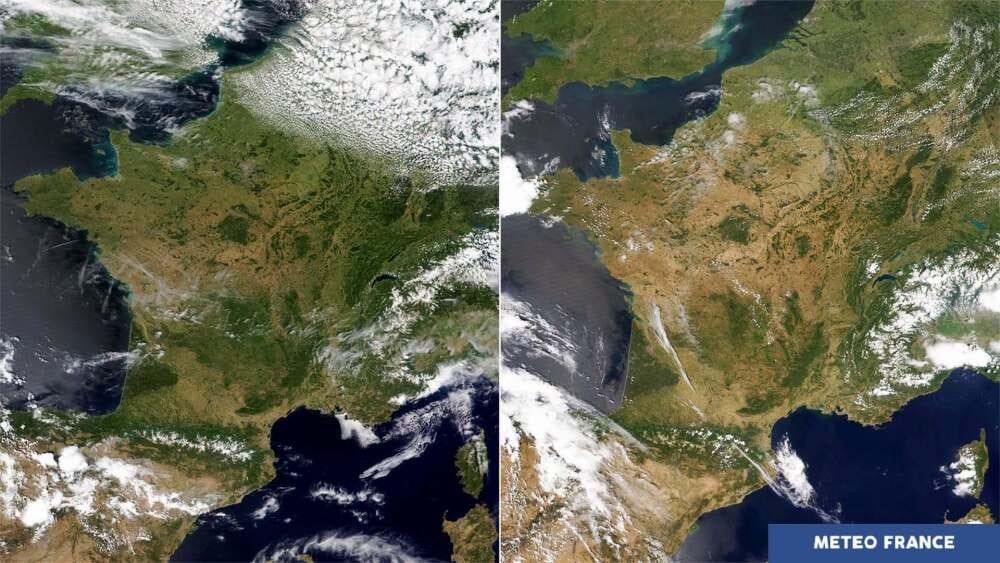
The historic heat wave of 2026—which, according to Météo-France, surpassed the 2003 catastrophe in both intensity and speed—has ushered in a new ideological phase of capitalism: adaptive denialism. No one seems to deny anymore that the planet is burning. Political disagreement is increasingly centered on the causes, the degree of urgency, and the necessary responses—and, in that sense, on the possibility of halting global warming. Generally speaking, the debate on television talk shows boils down to a technical, market-based solution, such as the unregulated proliferation of air conditioning and the installation of fans.
This view fosters the dangerous illusion that business owners can continue to produce and accumulate profits under extreme ecosystem conditions. It is a kind of programmed defeatism. Treating adaptation as the central focus rather than as an emergency afterthought amounts to a capitulation to ecological collapse that wipes the only urgent discussion off the table: halting the accelerated destruction caused by the capitalist mode of production.
The hypocrisy is total. While the government feigns concern by slowly purchasing 30,000 emergency air conditioners for overwhelmed and ill-equipped hospitals, behind the scenes it is dismantling the state. In the midst of a heat wave, the executive branch dissolved GIP Epau, the public agency that funded strategic research with municipalities to adapt urban architecture to climate change. At the same time, they cut more than a third of the Fonds vert (Green Fund), the tool municipalities used to finance the removal of human-made structures from vacant lots and the planting of vegetation. Concrete is prioritized because it generates quick property taxes and real estate revenue; living soil, which regulates temperature, is not traded on the corporate stock market.
Class-Based Crime: Workers Have Nowhere to Turn
Those who die in French apartments are not the executives at the Paris Stock Exchange who work from home in air-conditioned offices. The victims of the heat wave are members of the working class, the working poor, those in precarious employment, women in the inner cities, and racialized communities.
The Santé publique France bulletin provides a key statistic that spokespeople for the bourgeoisie are trying to downplay: deaths at home skyrocketed by a staggering 91% in one week. This highlights the consequences of the gradual defunding of healthcare, which has led to limited hospital capacity, and lays bare the housing crisis. Thousands of working-class families are spending the summer confined to veritable “passoires thermiques” (homes that function like ovens due to deplorable insulation). Living in a studio apartment in northern Paris in 40 °C heat in the shade while paying exorbitant rents to private landlords is a form of housing violence.
But this barbarity finds its most intolerable expression in the workplace. During the first heat wave in May, in the Drôme region, a young worker, barely 19 years old, lost his life to extreme heatstroke (hyperthermia) after spending his workday laboring on a rooftop in direct sunlight. His employer failed to implement any protective measures. In education, classrooms reached temperatures of over 45 degrees; in the hospitality industry (bars, restaurants, etc.), measures were minimal—such as allowing workers to forgo their full uniform to “stay cooler”; in hospitals, workers were overwhelmed just as they were during the critical moments of the pandemic; not to mention the most precarious sectors, such as delivery workers and construction, among many others. For employers and the government, we workers are disposable units of production. The imperative to maintain profit margins takes precedence over the most basic right of human biology: not to be boiling up inside while you’re earning a living.
Repression and criminalization are the order of the day
In this situation, the government is cracking down on those trying to survive and criminalizing working-class people. In the working-class neighborhood of La Gauthière (Clermont-Ferrand), a police operation cordoned off the area to force the removal of a plastic pool that young people had set up on a side street to cool off the neighborhood’s children. Not to mention the cancellation of Pride, Ivry en Fête, or the ban on drinking alcohol during the Fête de la Musique in the streets (you had to drink in a bar, no exceptions). The message is clear: coercive individual measures (banning alcohol, banning people from going out on the streets, confiscating neighborhood pools) are used to criminalize poverty, while real estate capital destroys the neighborhood, business owners rake in profits, and our right to protest is restricted. But take note: everyone has to go to work.
Every year in France, 20,000 hectares of natural and forested land are sacrificed to real estate speculation (the equivalent of twice the area of Paris). This urban ecocide is shielded by the right-wing and far-right lobby led by Marine Le Pen—who introduced hundreds of legislative amendments to block the “Net Zero Land-Take” (ZAN) targets—with the complicity and retreat of Macron’s centrist bloc. They are paving over the “heat islands” that today act as death traps for working-class communities.
An Eco-Socialist Program to Keep Us from Dying of Heat
It is clear that we cannot expect any solutions from those who are part of the problem. The fight against the heat wave is the fight to wrest control of factories, cities, and nature from the hands of the capitalist market. To respond to the immediate crisis and plan for the future, the working class must organize under an eco-socialist transitional program:
- No one should die on the job because of the heat! Workers’ control of production: We demand the mandatory establishment of Health and Safety Committees in all workplaces, led in a binding manner by the workers themselves. Every worker must have the legal right to halt production or refuse to work if heat stress exceeds safe thresholds, without loss of pay. Guaranteed mandatory breaks, reduced work hours during orange/red alerts, and full access to drinking water and shade.
- Rent Strike Against Inadequate Housing: Immediate suspension of rent payments for all tenants living in homes classified as thermally inadequate during the hottest months of the year. Landlords and large investment funds must be legally required to finance the renovation and eco-friendly insulation of homes, under penalty of confiscation.
- The Right to Coolness is a Human Right: Unconditional 24-hour access to public, climate-controlled shelters powered by carbon-free energy, a ban on water shutoffs for nonpayment, and free access to swimming pools and hydration facilities in all working-class neighborhoods, as well as the cleanup of waterways for public use under the supervision of lifeguards.
- Emergency Plan to Combat Real Estate Speculation: A complete ban on new land development. Expropriation of speculative construction companies to launch a massive national plan for urban renaturalization, financed by extraordinary taxes on oil companies (such as TotalEnergies), the ultra-wealthy, and the elimination of the war budget. We must tear up unnecessary asphalt and plant urban forests with large-canopy trees to cool down working-class neighborhoods.
- Ecological planning in the face of climate change. It is necessary to implement ecological planning at the infrastructure standards level that takes future weather variations into account (and thus prevents tram tracks from melting in the middle of a heat wave), carried out by workers under the guidance of a scientific council.
The climate crisis is already here, but its outcome is not determined by the laws of physics, but by the laws of class struggle. Capitalism is burning us alive; let’s channel our anger to destroy it and build an eco-socialist society where our lives are worth more than their profits.
Note: This article draws on epidemiological and media data from Santé publique France’s reports dated July 3, 2026, and Mediapart’s investigations from June 2026.