European Commission President Ursula von der Leyen proposes strengthening the alliance with Canada, creating a European Security Council, and establishing a new security mechanism of its own. Under the guise of a stronger and more independent Europe, rearmament, militarization, and the tightening of border controls are advancing. Workers and the people must answer united action, with mobilizations and strikes. The International Socialist League (ISL) raises the banner: “No to austerity for imperialist wars; for workers’ governments; and for a Socialist Europe.”
By Rubén Tzanoff
Canada, security, Ceuta, and Ukraine
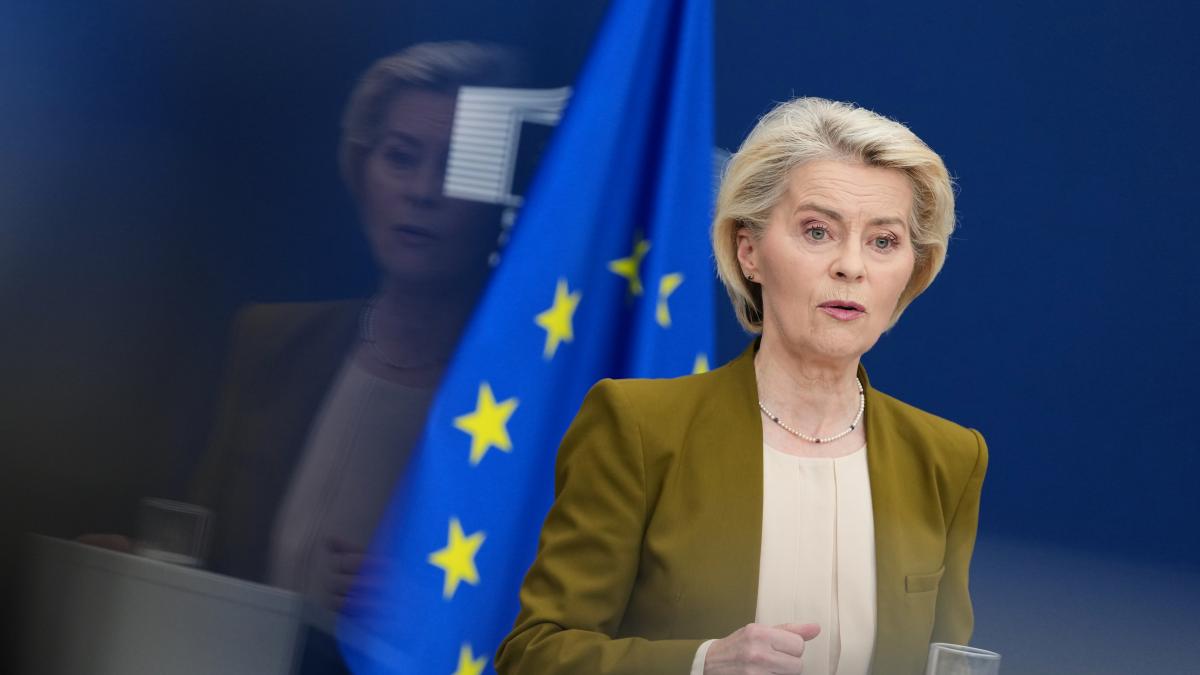
In her annual address to the European Parliament on September 16, Ursula von der Leyen outlined the European Union’s (EU) main priorities. She proposed taking the relationship with Canada to a new level. Building on the current CETA (Comprehensive Economic and Trade Agreement), the EU is seeking a “Partnership for the Future.” This includes defense, technology, artificial intelligence, energy, raw materials, batteries, quantum computing, and cybersecurity. She also proposed opening the door for Canada to become the EU’s first “associated member.”
She also announced a future European Security Council, with participation from EU countries and partners such as Canada, the United Kingdom, Norway, and Ukraine. In addition, she proposed a “European Security Protocol” modeled after Article 4 of the NATO Charter. Its goal would be to coordinate responses to specific threats, seeking to move toward new European military and security structures with a sort of “mini-NATO” that would operate in coordination with the existing NATO.
Ceuta also featured in this concept of security. Von der Leyen stated that “Ceuta is Spain. Ceuta is Europe” and described its borders as European. She linked the migration crisis to human trafficking, external threats, and the need for a common European response.
Ukraine was another key focus. Von der Leyen announced increased defense support through new investments in European military capabilities. The issue of strategic raw materials was also a major topic. The EU seeks to secure supplies for sectors such as batteries, semiconductors, energy, and defense. Thus, so-called “European independence” appears to be closely linked to industry, strategic resources, and the military.
Friction with Trump and the Inter-Imperialist Dispute
These initiatives are unfolding amid a growing dispute among the major powers. European imperialist powers are at odds with one another and with the U.S. At the same time, they seek to increase their room to maneuver vis-à-vis the United States, China, and Russia. The rapprochement with Canada is part of that strategy. Prime Minister Mark Carney is also calling for closer ties with Europe amid heightened tensions with the United States.
But this does not mean a break with U.S. imperialism. Von der Leyen herself called for greater cooperation with NATO. The new European strategic capabilities instrument will, as she announced, be fully aligned with the Atlantic Alliance. We are not witnessing a Europe that is breaking away from the U.S. Rather, we are seeing powers vying for influence, markets, resources, technology, and military capability. They also negotiate and maintain alliances when their interests align.
The last efforts of European imperialist powers
The European bourgeoisies are attempting to address their economic and strategic setbacks through greater coordination. They seek to reduce certain external dependencies. But this so-called “strategic autonomy” does not meet the needs of workers or the people.
It is the ruling classes’ response to the crisis and to international competition. That is why the European project, presented as a defense of peace, is accompanied by rearmament. Industry, technology, raw materials, and security are all subordinated to inter-imperialist competition.
“Fortress Europe” is racist and inhumane
Another aspect of this militarized Europe is its immigration policy. Borders are increasingly being incorporated into a security framework. Drones, cyberattacks, acts of sabotage, and external threats are linked to border control.
Ceuta is one example of it. The border is transformed into a space of control and militarization. Migrants are portrayed as part of a security problem. But they are victims of inequality, war, and the policies of the ruling classes.
Rearmament is the central focus
Rearmament is the common denominator. Europe seeks to increase its military capacity, secure strategic supplies, and develop new security structures. This is a war-oriented approach. More military spending means greater competition for resources that are also needed for wages, housing, education, healthcare, and public services. Austerity and rearmament go hand in hand: while social rights are being cut, resources allocated to military preparedness are increasing. We refuse to accept that workers should pay for the capitalists’ wars.
No NATO, and no new scaled-down versions of it
The solution is not to build new European military alliances either. A European Security Council or a mechanism modeled on Article 4 of the NATO Charter does not eliminate the logic of war but rather reinforces it. NATO and all military blocs—including the CSTO (Collective Security Treaty Organization), the political-military alliance in which Russia plays the leading role—must be dissolved.
Russia is complicit in the aggression against Ukraine. We support the Ukrainian people’s right to defend themselves against the Russian invasion, in defense of their sovereignty, territorial integrity, and self-determination. We do so completely independently of the Zelenskyy government and by denouncing both Putin and the various manifestations of Western imperialism. We do not want a European NATO. Nor do we want new, scaled-down versions of the same expansionist mechanisms. We want to put an end to military blocs and to the imperialist system that sustains them.
Immediate actions and a long-term solution
Faced with this reality, we are promoting the broadest possible unity of action among workers, students, unions, social movements, and grassroots organizations under one banner: “No to austerity for imperialist wars.” Against rearmament and militarization. Against “Fortress Europe” and its anti-immigrant policies. For international solidarity among workers and peoples. The student strike called for November 20 by various youth groups is part of this struggle.
And alongside these struggles, we are proposing a fundamental solution: “For workers’ governments and a Socialist Europe.” A Europe built on cooperation among workers and peoples, not on competition among imperialist powers. A Europe without austerity, without exploiters or oppressors, without military blocs, and without borders that turn migrants into enemies.