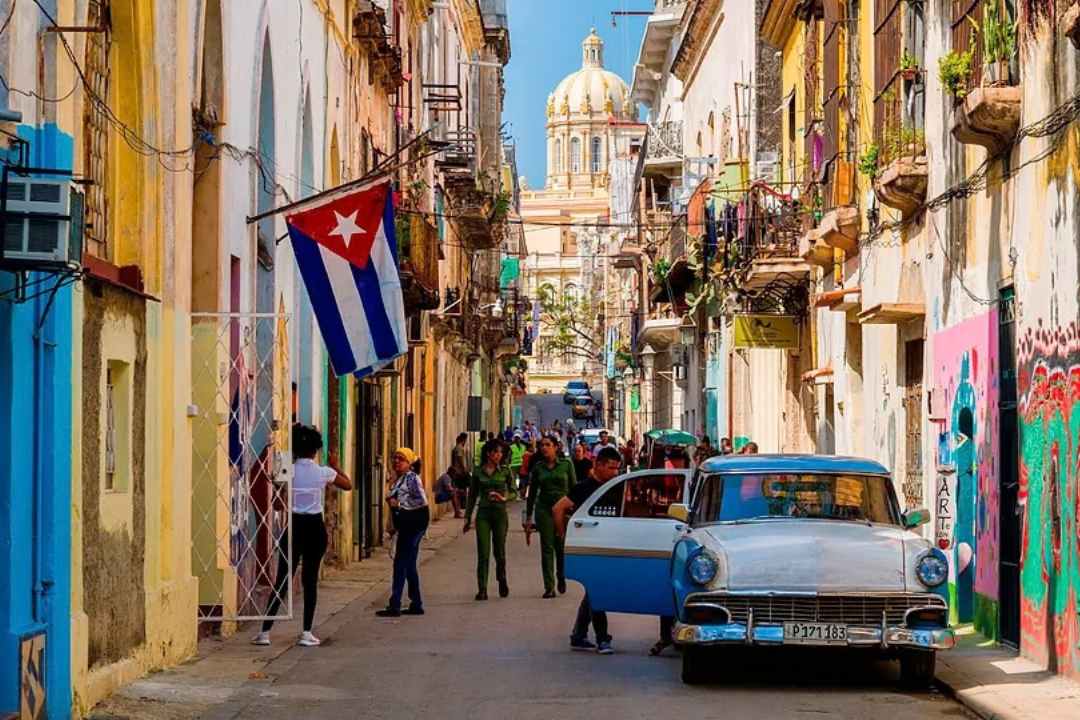
The Cuba of the Revolution and its social achievements—which once inspired the sympathy of millions of people across the world—is ceasing to exist. Decades of imperialist blockade and a repressive, bureaucratic, single-party regime have exacerbated the economic crisis, destroyed said achievements, and deepened, to an unbearable degree, the hardships faced by the Cuban masses.
A pro-market course has been advancing for a long time, but the enactment of a package of measures in June of this year has marked a qualitative leap. We are witnessing an accelerated transition toward capitalist restoration. The bureaucratized workers’ state is practically unrecognizable. We stand before a Workers’ state in dissolution.
The US imperialist blockade has undoubtedly been a constant source of pressure on the Cuban economy. However, the blockade on its own cannot explain the current situation—contrary to the claims of those who blindly defend the regime (“campists”). Cuba is suffering the consequences of failing to envision the socialist revolution beyond the country’s borders; of failing to advance in Nicaragua and El Salvador when it was on the agenda, or in Venezuela more recently. It is the result of handling matters bureaucratically—without genuine participation from workers and the people—and, instead, repressing any expression of discontent. Ultimately, it stems from doing everything possible to preserve the privileges of the ruling caste at the expense of the working population.
Against this backdrop, Miguel Díaz-Canel’s government announced a package of 176 pro-market measures in June 2026, surpassing all economic reforms implemented in recent years.
A deepening crisis
To understand the scope of the new measures, we must start by analyzing Cuba’s current situation.
Cuba is undergoing a deep economic and social crisis. Shortages, inflation, fuel scarcity, and energy issues are part of daily life. Blackouts have multiplied, and sectors of the population have endured prolonged periods without electricity several times.
Compounding this is the erosion of income. State wages have lost a significant portion of their purchasing power in the face of rising prices and the expansion of a market increasingly dominated by foreign currency transactions and the private sector.
The crisis also has a political dimension. State bureaucratization, restrictions on democratic freedoms, and the persecution of opposition and protesters have generated growing discontent, particularly among the youth.
A segment of the younger generation questions the regime and rejects the notion that the current situation represents the only possible model of socialism.
Two simultaneous processes are at play against this backdrop.
On one hand, the United States maintains and intensifies its blockade and sanctions against Cuba, alongside political pressure on the government. Along with the precedent of Venezuela, this pressure has yielded results.
On the other hand, the Cuban economic model is showing increasingly evident signs of exhaustion. The crisis cannot be explained solely by the blockade; it also reflects the limitations resulting from decades of bureaucratic management, low productivity, external dependency[1], refusal to expand the revolution, and an absence of mechanisms for workers’ democracy.
The result is an extremely complex situation: the Cuban people face an ever-deepening crisis, while the government responds by expanding market mechanisms and opportunities for private capital, all while negotiating a consensual solution with imperialism.
The 176 measures: a leap toward restoration
The package deepens reforms that have been advancing for a long time. The 2011 Economic Guidelines and the so-called “Ordering Task” of 2021 are a part of this process. Now they are pushing an expansion of the private sector, greater enterprise autonomy, the opening of the economy to foreign capitals, and a greater decentralization of economic decision-making.
The state monopoly on foreign trade is ending, and the economy is opening up to private banking.
Non-state management of activities and means of production—which formally remain state property—is being expanded. This allows a growing portion of the economy to be managed through private mechanisms.
The autonomy of state-owned enterprises and OSDEs (Superior Organizations of Business Management)[2] is also being deepened; they will be able to make decisions regarding wages, reorganizations, mergers, liquidations, and other matters that were previously more directly subordinate to centralized state planning—a system that has begun to be dismantled.
Another significant change is the possibility of transforming state-owned enterprises into commercial companies based on shares or equity participation. This paves the way for the progressive transformation of sectors within the state economy.
More room for private capital
The measures also considerably expand growth opportunities for private SMEs.
Conditions allowing a single individual to participate in multiple businesses are being made more flexible, while opportunities for hiring and diversifying activities are expanding. The 100-employee cap for private enterprises has been eliminated, fostering the creation of larger-scale private businesses.
Simultaneously, opportunities for foreign capital participation across multiple economic sectors—and for partnerships with domestic private companies—are being broadened.
The financial system is also affected by this shift, seeing greater openness to private mechanisms, foreign currency operations, and new transaction methods.
Overall, these are not merely isolated measures designed to address a specific economic situation. The package deepens a long-standing trend: the growth of the market and the private sector within the Cuban economy, alongside the dismantling of the centralized economic model.
Alongside these changes, the government reaffirmed the legal ban on independent trade unionism via Decree 160 of 2026, cementing the monopoly of the state-aligned Workers’ Central of Cuba (CTC). Its goal is to guarantee investors a supply of cheap, controlled labor.
The people bear the cost
The flip side of this opening is the burden of austerity placed on workers and popular sectors.
The gradual replacement of universal subsidies with targeted mechanisms, the elimination of product subsidies, the introduction of new taxes, and cutbacks in healthcare and education—along with other economic restructuring measures—shift a significant portion of the crisis’s cost onto those who live off their wages.
The problem is that these transformations are taking place in a society where incomes are already insufficient to cover the cost of living.
The government affirms that these reforms are necessary to tackle the crisis and preserve the socialist system in the face of the embargo. However, the growth of the private sector, the opening to foreign capital, and the progressive dismantling of state planning and ownership mechanisms point in the opposite direction.
Whither Cuba?
Unless a revolutionary process intervenes—one that confronts the bureaucratic caste, restores and deepens the Revolution’s achievements, and calls upon the rest of Latin America to confront imperialism and spread the revolution—the most likely outcome is a more or less rapid restoration of capitalism.
Both imperialism and the bureaucracy are working toward this restorationist scenario, and at present, there are no social or political forces with sufficient weight to halt this trajectory.
Will the regime attempt to transform Cuba into a state-capitalist system—with the bureaucracy itself becoming a new bourgeoisie—while maintaining control through a repressive, one-party regime, as in China? Or will it be forcibly overthrown? Faced with this prospect, will it cede control of the economy to imperialism, as Venezuela has done?
Imperialism is currently intensifying pressure to force the regime to negotiate, and is beginning to succeed. This does not mean the threat of intervention has been entirely ruled out, although it does not appear to be the most likely scenario.
The social crisis in Cuba will not be resolved by the restoration of capitalism. That would only set the island back to the era when U.S. corporations had a field day, ruthlessly exploiting the population.
Yet, defending the existing model offers no way forward either. The social gains of the Revolution—now lost or on the verge of being lost—could only be recovered and deepened by confronting both imperialism and the ruling bureaucracy.
From a revolutionary socialist perspective, the solution lies in a deep political transformation: ousting the ruling bureaucracy and establishing a regime of workers’ democracy—characterized by political freedoms, the right to organize and protest, and effective worker participation in economic and political decision-making.
A true workers’ state requires the direct rule of the working class through democratically elected and recallable workers’ councils, a workers’ militia, and a democratically planned economy under workers’ control. These institutions cannot simply be proclaimed from above: they must be developed through the struggle of the workers and the oppressed against the bureaucracy and its drive toward capitalist restoration, becoming the organs of a new revolutionary power.
However, achieving this would require a new revolution—one that changes the regime without altering the class character of the State—as well as a revolutionary alternative to spearhead that process.
Recent experience shows there is discontent and mobilization capacity. The 2021 protests reflected part of this process; since then, new forms of activism and leftist sectors have emerged, seeking to contest the meaning of the revolution from both within and outside Cuba.
For many Cubans, a “socialist path” represents the reality they currently live in—and naturally reject—due to its limitations. Therefore, building an alternative requires not only confronting imperialist propaganda but also redefining revolution, distinguishing it from the existing regime, which bears no relation to the revolutionary socialism that must be built.
It is in this context that organizations have emerged that identify as Marxist, anti-capitalist, internationalist, and anti-authoritarian, advocating for the defense of social gains alongside democratic rights, freedom of organization and protest, and political independence from the Cuban government. This and other such organizations remain very small.
At the same time, we must bear in mind that imperialism and its accomplices are working within Cuba to steer social protest toward a capitalist scenario.
This is a huge challenge and its solution cannot be reduced to choosing between the blockade and capitalist restoration. It is necessary to reclaim the emancipatory essence of the Revolution, put an end to bureaucratic privileges, and place the Cuban workers and people back at the center of decision-making.
From this perspective, a political, democratic, and internationalist revolution is the only way to defend social gains and forge a revolutionary path out of the Cuban crisis.
In this regard, reclaiming an internationalist vision is crucial, as no revolution can sustain itself indefinitely while confined to a single location. Solidarity among the workers and peoples of Latin America and the world—along with extending the struggle for socialist transformation beyond national borders—are fundamental conditions for confronting imperialism and opening the way to a genuine emancipatory solution.
All our solidarity with the Cuban people!
Down with the imperialist blockade!
For the defeat of any foreign intervention!
Full freedoms to organize in trade unions, socially, and politically!
Down with the privileges of the ruling class!
For workers’ and people’s councils!
For a socialist Cuba with full workers’ democracy!
The alternative to imperialist barbarism is continental socialism!
International Executive Committee – International Socialist League
September 27, 2026
[1] For decades, it relied on the Soviet Union, and in recent years, on Venezuela. Today, without that support, its economy has been withering away.
[2] The Superior Organization of Business Management (OSDE) is an entity that groups and coordinates state-owned enterprises.