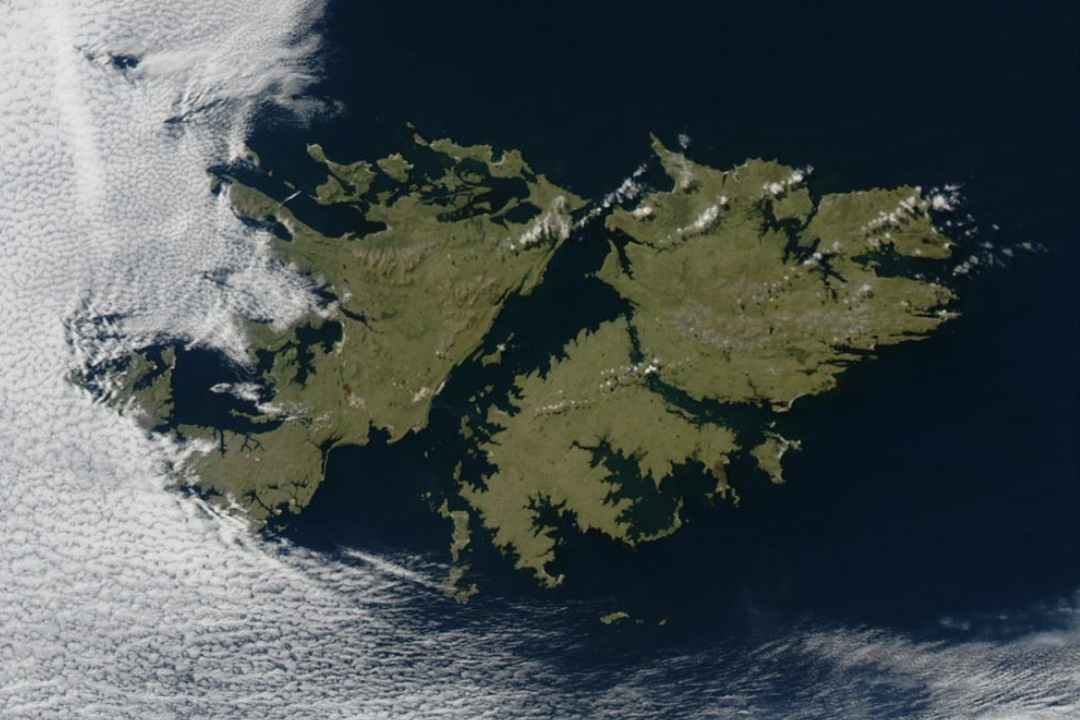
A few weeks ago, U.S. President Donald Trump once again shook up the global political stage with another of his flamboyant statements, asserting that he did not rule out changing the United States’ position regarding Malvinas Islands. “I always review every position. That’s just one of many.” he said, hinting that he might alter the formal position of supposed “neutrality” regarding the sovereignty dispute over the territory—which is legitimately claimed by Argentina, usurped by British imperialism, and deemed “disputed” by the UN.
Immediately following this, Argentina’s far-right president, Milei—a self-professed admirer of Margaret Thatcher— took a turn and triumphantly embraced the Malvinas cause; he set expectations regarding a potential mediating role for Trump and announced, in a nationwide broadcast, a bill for the “defense of national sovereignty,” promising sanctions against companies linked to oil extraction operations.
Although Trump downplayed his statements—calling a potential conflict between Argentina and the UK a “disaster” and acting friendly with the British Prime Minister at the UN General Assembly—he nonetheless opened up new fronts of conflict and raised questions that fueled commentary in the international press. What reasons led Trump to stir the waters by reigniting such a sensitive dispute? How far might this go? What changes does this bring to relations with British imperialism?
The reasons behind Trump’s turn
Beyond mere speculation, there is a combination of several factors that encourage Trump’s political decision. He needs to reposition himself following the defeat suffered in the confrontation with Iran—and the quagmire of his interventions in the Middle East and the Russia-Ukraine conflict—. This is undoubtedly a powerful reason. Trump’s administration also wishes to pressure Great Britain, whom it accused of failing to support its aggressive stance against Iran, and to call out Prime Minister Andy Burnham’s government for not increasing defense spending. Trump’s threat to alter his position on Malvinas seems to be part of a series of measures being considered by the Pentagon to pressure NATO members into raising their defense investment within the alliance to 5% of their GDP.
However, there are two other reasons. One of them is economic: the lucrative oil business currently being exploited by the British—who are, for the moment, partnered with Israeli corporations. Trump is using a historic claim of the Argentine people as a bargaining chip to blackmail England.
The other factor is geopolitical, coinciding—precisely right now—with the revival of the military base project in Tierra del Fuego. This move aims to increase military presence in a zone that is strategic for the South Atlantic and serves as a prized interoceanic passage for the oil business.
Only Trump’s own crisis and his hegemonic ambitions can explain this opportunistic turn—a move that should fool no one. The US was never truly neutral regarding the Malvinas issue; that stance is merely an official cover to mask its historic support (as England’s “eternal” ally, in Trump’s own words) and its regional interests, which have consistently aligned with those of British imperialism. During the 1982 Malvinas War, the United States also played an “arbitrator” role—through the infamous then-Secretary of State Alexander Haig—only to ultimately clearly side with Great Britain, alongside then-President Reagan. Furthermore, any friction or contradictions with the British government in no way imply a stance that would support Argentina’s legitimate sovereignty claims. Malvinas are an imperialist enclave—territory usurped by the British empire—and must be returned to Argentina.
Milei and his double standard on Malvinas
President Milei—Trump’s most loyal follower—was quick to capitalize on the initiative, staging a media show in which he used a nationwide broadcast to spin a hard-to-believe narrative of sovereignty. This is the same man who declared himself an admirer of Margaret Thatcher, yet had previously reacted with outrage when the national football team—during the last World Cup—championed and revived this deeply felt national cause, reigniting the debate internationally.
Undoubtedly, the critical situation his administration is facing has been the primary driver behind his deceitful and hypocritical shift. Milei faces a sharp decline in political capital, a growing opposition fueled by public anger and discontent, dire economic indicators, and an outlook that jeopardizes his reelection plans. Consequently, acting in tandem with Trump, Milei has jumped on the demagoguery bandwagon and announced a series of measures—submitted to Congress under the so-called “National Sovereignty Defense Law.” Behind the “sovereigntist” facade—which mandates tougher sanctions against companies “illegally” extracting oil in Malvinas—lies submission to the Trump doctrine regarding national “defense.” This involves creating a National Security Council with sweeping powers, in which the president, select ministers, and the Intelligence Secretariat define security policy, thereby expanding the scope of military intervention. Furthermore, through an emergency decree (DNU), he has ordered the construction of a naval base in Tierra del Fuego—a move that serves as a pretext masking a clear attempt to militarize the south of the country.
This sudden jingoistic spectacle is not just a smokescreen to mask the political and economic crisis of the government. Milei appeals to the deeply rooted anti-imperialist sentiment etched in collective memory, all while continuing to act as a subordinate and a conduit for Trump’s strategy. This goes beyond his position against the British; it also involves facilitating Yankee imperialism’s predatory ambitions regarding the region’s hydrocarbon resources—specifically, challenging British oil companies for offshore extraction rights in favor of U.S. corporations. It is the very same type of shady deal that Milei hypocritically denounces today.
Currently, the Sea Lion oil project is operated by Navitas (Israel, 65%) and Rockhopper (UK, 35%). The deposit is estimated to hold over 500 million barrels of recoverable oil. If we consider the entire northern basin, it could potentially exceed 1 billion barrels of crude. The Sea Lion project is designed for 100% offshore operations, eliminating the need for fixed onshore logistics infrastructure due to the harsh weather conditions of the South Atlantic.
The unconditional international “alignment” that Milei celebrates entails greater submission to the dictates of the White House. Far from defending Argentine sovereignty, the announced sanctions and naval bases are actually subservient to the Trumpist strategy. Milei is a serial sell-out of Argentina’s national assets—opening the floodgates to imports and destroying domestic industry, championing the RIGI and “Super RIGI” schemes that mortgage the nation’s common resources and hand over land to foreign interests, and acting as a doormat for the IMF by complying with usurious debt demands—he is hardly in any position to seriously speak about sovereignty. He praises Margaret Thatcher—the leader of the 1982 “pirate” offensive and responsible for the sinking of the cruiser General Belgrano. Milei, Netanyahu’s Ally and friend of Peter Thiel. He has traveled to Chile to back Kast while vindicating Augusto Pinochet—the dictator whose regime provided logistical support to the British during the bloody 1982 war.
Cynicism at its best: Zionism talking about sovereignty
In this series of opportunistic turns, Zionism was the latest to jump on the sovereignty-advocacy bandwagon. Displaying utter cynicism, Israel’s Minister of National Security, Itamar Ben Gvir, publicly called on Prime Minister Benjamin Netanyahu to have his government recognize Argentine sovereignty over the Malvinas Islands. Although Israel’s official stance of “neutrality” did not change, Netanyahu’s son echoed that position on social media, while the Finance Minister called for measures against Great Britain. This statement takes place amidst severe diplomatic friction and an open clash with the British, stemming from the latter’s critical stance regarding the aggression against the Palestinian people.
It is sheer opportunism and brazenness for those who occupy and govern an enclave similar to Malvinas to speak of sovereignty—having usurped Palestinian lands at gunpoint and perpetrating an ongoing genocide that, since October 2023 alone, has killed over 73,700 Palestinians and wounded nearly 175,000, alongside hundreds of thousands of internally displaced people living in extremely precarious conditions. The Zionist hypocrisy is compounded by the fact that, while crafting this narrative, they are profiting from oil wealth.
Executives from the Israeli oil company Navitas have justified their act of piracy by claiming that the investment decision-making process was completed with the approval of the British and the “self-determination” of the islanders. Therefore, a comprehensive anti-imperialist policy must include the rejection of Israeli/Zionist interests in the region.
We also repudiate the politics of the British Labour Party, which—without a hint of shame—came out in defense of imperialist interests and the British Crown, threatening to use its military might to defend them; this shows a degeneration that has been decades in the making, as well as the need to move beyond it by building a new instrument for the working class.
A revolutionary politics
We denounce and reject the hypocrisy of Trump and his maneuvers in the service of his hegemonic interests, as well as the double standard of his lackey, Milei. No project for sovereignty can be built by subordinating a country to another imperialist power. Milei crudely exploits the tragic delusion of the dictator Galtieri—the military leadership responsible for the defeat in the 1982 war—who urged reliance on supposed U.S. support that never materialized.
We also reaffirm our long-standing policy of defending Argentine sovereignty over the Malvinas Islands. This is the orientation courageously defended by our comrades in Workers Power in Great Britain, and a banner of anti-imperialist struggle for the MST in Argentina and in all countries where the International Socialist League exists.
Malvinas are Argentine, and we must demand an end to the British colonial occupation and the immediate return of the territory. Malvinas are a British colonial enclave, seized through the use of force. They are not a colony; therefore, while respecting the islanders’ democratic right to decide their own course, we do not recognize any claim to a right of self-determination—a tired excuse used by the Crown and British governments to justify this act of piratical usurpation. It is a pseudo-democratic façade designed to uphold imperialist interests, including the exploitation of offshore resources. Great Britain has no right to unilaterally exploit the resources of a usurped territory that the United Nations itself considers to be in dispute.
For this reason, we have opposed and rejected any politics aimed at “de-Malvinizing” the issue or dragging legitimate claims into a diplomatic quagmire, all while usurpation persists and imperialist business interests expand. Diplomatic appeals over the years have amounted to a bureaucratic process that leads nowhere but the halls of the UN. Although every year a majority votes for the decolonization of this Argentine territory, it never translates into specific action.
Therefore, we demand:
- The immediate and unconditional return of the Malvinas Islands to Argentina, with full sovereignty and without military bases of any kind. Unwavering defense of Argentine sovereignty over the islands and the entire continental shelf.
- We reject the appropriation of oil exploration and extraction—not only by current foreign corporations but by any other private monopoly. All oil operations in the region must be nationalized and placed under social control.
- No non-aggression agreements with the British pirates. Sovereign confiscation of all British companies and landholdings in Argentine territory. Repudiation and non-payment of any debt owed to British imperialism.
- Break from all political, economic, and military pacts that subordinate the nation to Yankee and British imperialism—including the Rio Pact, the Inter-American Defense Board, the OAS, the TIAR, and other semi-colonial bodies. No to joint military exercises.
- The struggle to reclaim Malvinas is inseparable from the struggle for national liberation and the path to socialism. Therefore, these measures must be part of a workers’ and socialist program that—among others—breaks with the IMF, nationalizes the banking system and foreign trade, and redirects resources currently used for foreign debt payments and the profits of the wealthy to serve the working people.
- British out of Malvinas. Yankees out of Latin America.
International Exacutive Committee – International Socialists League
September 27, 2026