By: David Morera Herrera
Automatic translation made by AI.
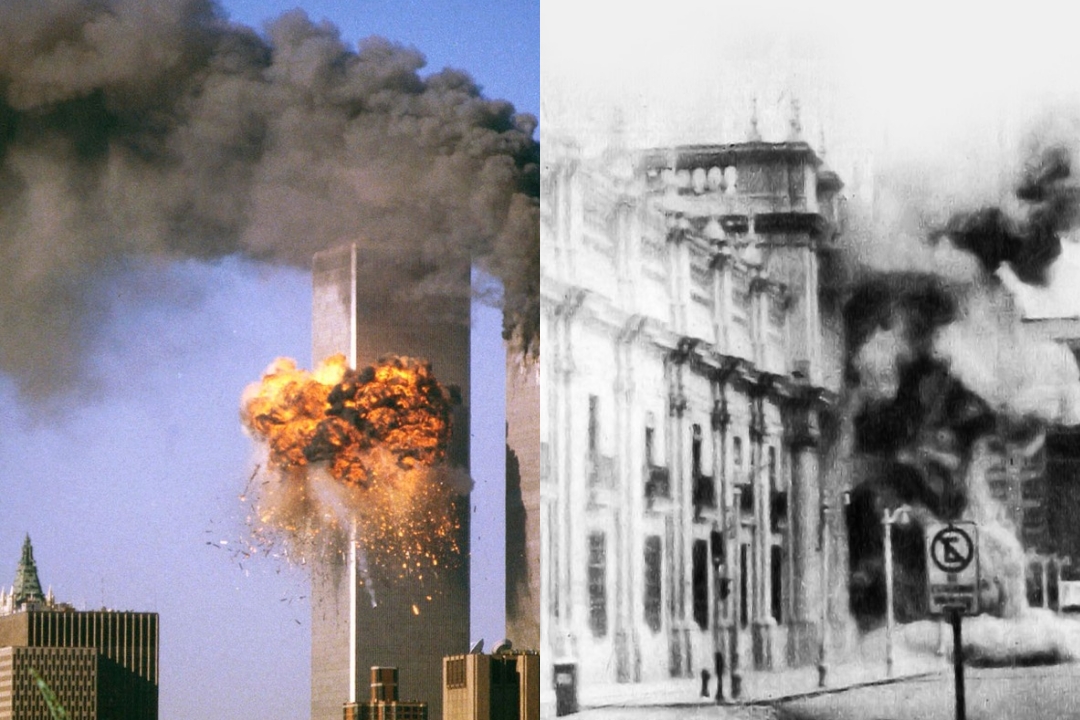
Much has been written about September 11. In particular, about the horror of the attack in which kamikaze planes destroyed the Twin Towers of the World Trade Center in New York. It occurred on September 11, 2011.
This barbaric act was attributed to the alleged Saudi Islamist Osama bin Laden (who is supposedly dead, although his body has not been found) and his organization, al-Qaeda. This shadowy organization, linked to the Afghan Taliban, was originally fabricated by the ultra-wealthy Saudi oligarchy, the CIA, and the Mossad, who exploited the resistance to the Soviet occupation of Afghanistan in the 1980s. It was promoted and heavily funded by fundamentalist madrasas [1] as centers for recruitment and indoctrination.
Regardless of what one might infer or speculate, the fact is that the attacks on the World Trade Center played right into the hands of the former Texas governor (and oil tycoon), Bush Jr., allowing him to launch the offensive led by the Pentagon hawks (“blood for oil”).
Well, today it is only right to remember another September 11—one just as tragic, if not more so, than that of 2001. At the southern tip of our America, Chile never forgets.
On another September 11, in 1973, a military coup took place against the elected government of the Popular Unity coalition, led by Salvador Allende. The coup was led by General Augusto Pinochet, a supposed constitutionalist military officer whom Allende trusted. The coup was orchestrated by the CIA as part of its counterinsurgency strategy in the Southern Cone (Operation Condor), which led to the establishment of national security dictatorships in Chile, Argentina, Brazil, and Uruguay. The coup was designed by the Zionist Henry Kissinger, U.S. Secretary of State and right-hand man to President Richard Nixon, and was fully supported by mining corporations such as the Anaconda Mining Company and ITT Corporation, in retaliation for the nationalizations of the copper and telecommunications sectors implemented by the UP government. It also enjoyed the complicity of the National Party oligarchy, and, of course, the participation of the far-right fascist paramilitary group “Patria y Libertad,” as well as the tacit approval or complicity by omission—albeit more concealed and circumspect—of the Christian Democratic Party led by Eduardo Frei Sr.
The tragic toll: more than 30,000 detained and disappeared; the cream of the crop of the labor, student, and popular movements, the Mapuche movement, the arts, and the leftist intelligentsia perished. Among them was the great singer-songwriter Víctor Jara, whose disfigured body was found on a property near the Mapocho River on September 15.
On the morning of September 11, Víctor Jara dutifully answered the Communist Party’s call to defend the University of Chile campus in Santiago. Like Víctor, thousands of workers, women, and young people—unarmed or carrying only light weapons—took a stand against the fascist beast.Víctor was horrifically tortured, and when he refused to betray his comrades, he was executed in some dark corner of the Estadio de Chile, which was used as a concentration camp, a place of torture, and a death camp.
There was much debate, and the Latin American and global left mobilized during those dark times. The Chilean Communist Party’s project—articulated by Luis Corvalán as “the peaceful path to socialism”—was shattered by fascist barbarism.
Once the coup took place, the Guevarist organization was also unable to hold out for long, due to its weak roots among the working class and its far-leftist methods. I am referring to the Revolutionary Left Movement (MIR), which rightly criticized Allende’s and the UP government’s trust in bourgeois institutions and the army. In response to the UP’s slogan immortalized by Quilapayún—“the people united will never be defeated”—the most radical left put forward another slogan: “the armed people will never be crushed.”
Many of the founders of Costa Rican Trotskyism in the mid-1970s—including comrades Edwin (“Martín”) and Consuelo Badilla, Manuel Sandoval, Olga Carrillo, Pablo Hernández, Héctor Monestel, and Allen Cordero—who were very young at the time, faced with that terrible lesson of the class struggle, came to the conclusion that they must take a different path than the dead end of Stalinism. In fact, it was no coincidence that the Internationalist Communist League (LCI), the predecessor of the PRT, was founded on September 11, 1976, at a rally at the UCR on the third anniversary of Pinochet’s coup.
As for me, I finished learning to read and write in Santiago. My mother and father, who were Costa Rican communist activists at the time, took us to live in Santiago, where we stayed from 1970 to 1973.
One of my most vivid childhood memories is the scene of an afternoon stroll, during which, suddenly, police officers mounted on imposing guanacos [2] violently dispersed a demonstration. My mother, Rosalila—her belly bulging with my younger sister, Margarita— and my father, Oscar, firmly took Gabriel (age 5), Oscar (age 3), and me (age 7) by the hand to flee the tear gas and the jets of water being sprayed at people on the pavement. I can still see myself, with our entire immediate family, running at the top of our lungs through unfamiliar alleys.
I also remember the first “tankazo” (the coup rehearsal) and the fear in the eyes of my classmates as they watched the soldiers search the school buses we were riding home in with their bayonets, while Santiago was in a constant state of alarm. I also remember the signs of shortages in the pantry, caused by employers’ hoarding.
But what I remember most vividly and powerfully is the first time I saw my father cry, through my child’s eyes. It was just an ordinary night at our house in Ñuñoa, on Augustín Vigorena Street. On the black-and-white TV screen in the living room, Allende was delivering one of his final speeches—of course, this was months before the desperate defense of La Moneda Palace, which was being furiously attacked from the ground and the air with bombs and a barrage of shrapnel.
Allende, as far as I can remember, was pleading with the army and the conspiring oligarchy to respect the Constitution. There was an atmosphere of imminent defeat. The chronicle of a death foretold. And then my father, a little embarrassed by my inquisitive gaze, wiped away the big tears streaming down his olive-skinned cheeks.
Then I myself understand—and he was still crying—for the same reasons and for no reason at all.
These were the final moments of the Popular Unity, as its tragic end drew near. Fortunately, my father had the survival instinct to finish the academic requirements for his endocrinology residency, and we returned to San José, Costa Rica, exactly one month before the infamous coup, with my sister Margarita, who was less than a year old.
Finally, I would like to add that, despite my early childhood, my life has been marked by the tragedy of Chile. But not to lament it like a litany, but rather to prepare for the people’s and the working class’s revenge against an increasingly degraded and degrading capitalism. Because the color of blood is never forgotten; Chile and Latin America will, sooner or later, vindicate the many anonymous heroes of the brave people of Caupolicán, Angelita Huenuman, and O’Higgins.
Terror and death have not been able to break us. I’m sure of it.
[1] Schools of Islamic fundamentalism—from which the Taliban emerged—that follow the ultra-reactionary, patriarchal, and homophobic Saudi Salafism.
[2]A Chilean term referring to an armored police vehicle that shoots high-pressure water jets.