The Great Potential of Radical Change. Will the Working Class Take Center Stage? Analysis and Proposals from Revolutionary Marxists in the New Phase: In France and Italy.
By the Communist Workers’ Party (PCL)
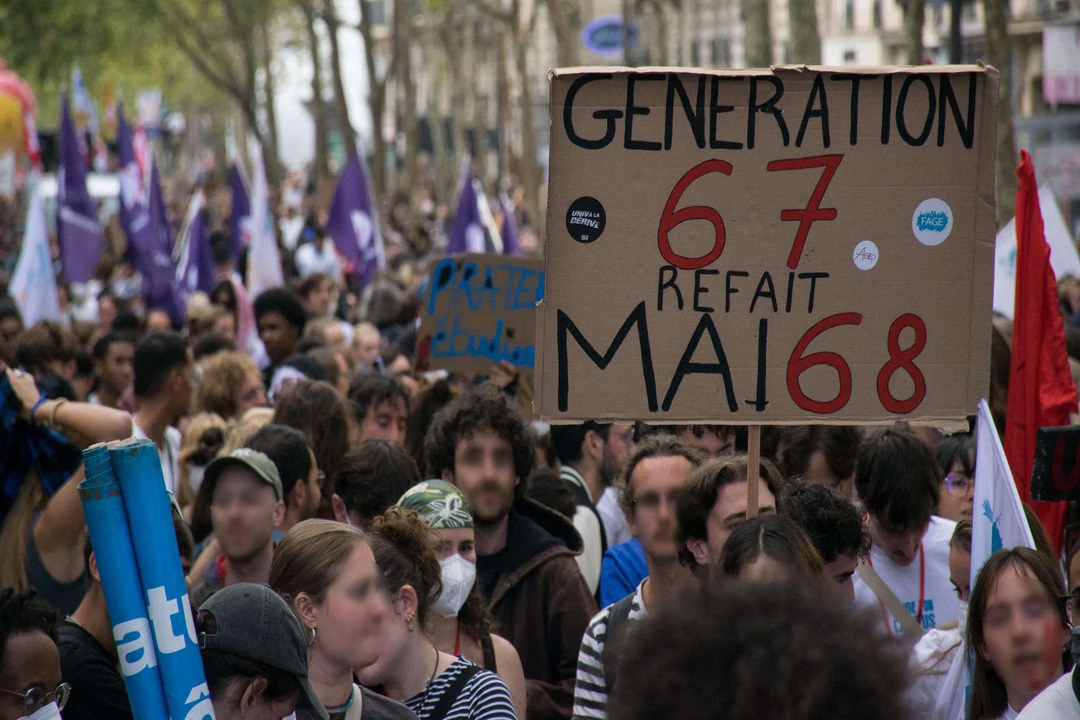
The massive student movement in France—the largest since May 1968— the demonstrations in the streets of Spain demanding the right to housing, the beginning of its potential spread to Portugal, and the prolonged popular uprising in Albania with the explicit demand for the ouster of the Rama government, are ushering in a new chapter in Europe.
We are witnessing the rise of the student and youth movement, which has the potential to spread. We cannot predict its future today, but it is essential to understand its characteristics.
Palestine led the way
Over the past two years, the pro-Palestinian movement has also seen a broad segment of the younger generation in Europe come to the forefront. Amid the barbarity of the Zionist genocide, millions of young people saw more than just the oppression of a people. They saw in it a sign of global injustice: the hypocrisy and complicity of international diplomacy, of all bourgeois governments, and of all their propaganda about the values of “civilization,” “equality,” “democracy,” and so-called “international law.” The ruling classes were suddenly revealed to millions of young people for what they really are: a temple of lies and oppression.
Hence the gradual emergence of a collective youth movement that transcended the borders of Palestine and began to evolve into a broader rebellion—a rebellion, above all, against their own circumstances. The plight of a generation that is better educated than previous ones, more globally interconnected, and, at the same time, condemned to a worse life—worse than that of their parents, which in many cases was already worse than that of their grandparents.
Schools in ruins in the suburbs, job insecurity, poverty wages, a lack of affordable housing, an out-of-control climate crisis, and the proliferation of military spending and wars. And all of this amid an unprecedented stock market boom and a profit-driven frenzy that has enriched corporations, banks, hedge funds, energy and food giants, and the world’s largest military-industrial complex—precisely those most responsible for the overall decline.
The Ripple Effect of the Student Movement
This overall picture has left an indelible mark. Now, these marks have begun to burn. The continental connection between the various mass movements does not come from above; it cannot be traced back to any international organization or coordination. Rather, it comes from below, through a ripple effect.
The French student mass movement undoubtedly paved the way for its dynamic spread and its hold on the public imagination—partly due to its enormous scale, and partly due to France’s historical prestige in terms of revolutions and uprisings. This does not imply homogeneity among the movements, much less in their triggers, which are always diverse and specific (schools in France, housing in Spain, environmental exploitation and corruption in Albania, as well as in Serbia). It does mean, however, that the new generation in Europe tends to recognize itself as such, to identify with its own motivations beyond national borders. Hence the call to emulate. At the student demonstrations on October 16 in Italy, “Do as in France” was not only the title of our pamphlet but also a call for a widespread sense of solidarity. This was true regardless of specific knowledge of the French movement, and in particular of its forms of organization.
The November 20 deadline for the first European student strike against militarism preceded the outbreak of the current student movement in France. Rather, it was spurred by the experience of German students’ struggle against their country’s massive increase in military spending and related conscription plans. Undoubtedly, the possible coincidence between November 20 and the ongoing mass movements in several countries may lend that date greater significance. The fact that the general strike called by the Italian General Confederation of Labor (CGIL) will take place on that day in Italy is indirect evidence of this.
The Issue of the “Casseurs”
The presence and sudden appearance of the “Casseurs” (rioters) on the fringes of mass demonstrations—or alongside them—represents an unexpected weapon of reactionary propaganda against the movement for the bourgeoisie. It is the only one at their disposal. But this does not justify the labor movement succumbing to such propaganda. The Phenomenon: Riots, especially in metropolitan areas, often exhibit different characteristics depending on the national context and the presence or absence of a connection to mass dynamics. History is also replete with primitive rebellions against the high cost of living, which were outside the bounds of social norms.
Certainly, looting stores in the city center, smashing storefronts, and stealing private property are not part of the arsenal that can be proposed to the movement, nor can they even be justified. This is even more true for revolutionaries, who, by the very nature of their anti-capitalist project, must always invest in promoting mass action, its organization, its political consciousness, and even its right to collective self-defense against any aggression by the state or fascist forces.
And yet, as revolutionaries, we cannot in any way endorse the hypocrisy of the bourgeois condemnation of “violence,” not even the disorganized violence represented by the casseurs.
The main forms of violence are exploitation, the inability of millions of precarious workers to obtain a mortgage, exorbitant rents, the investment of billions in instruments of death, cuts to public healthcare to boost the private sector, air and water pollution, retirement at age 70 or older, if all goes well—with the sole purpose of paying off 100,000 million euros in public debt to banks and insurance companies, and military and economic support for genocidal regimes such as the Zionist state… The entire bourgeois society is sustained, even more so today, by this organized, everyday violence designed to protect capital. Against this backdrop, the broken windows in the city center on a weekend at the hands of young people from the suburbs—often second- or third-generation residents, harassed in a thousand ways in their own neighborhoods by police patrols employing racist methods and attitudes—are simply a consequence of bourgeois violence. A distorted form of revenge for the violence they have suffered. A way to escape everyday invisibility in order to display and proclaim their own presence. Bourgeois governments seek to exploit these phenomena—ultimately driven by their own policies—to further tighten repressive legislation (even against minors), undermine the rights of mass movements, and organize a reactionary social bloc in defense of the status quo.
Revolutionary Marxists work in the opposite direction: by fostering the self-organization of mass movements against the ruling classes and their governments, and by building an anti-capitalist social bloc. This is, moreover, the only possible way to reduce the impact and scope of the marginal actions of the casseurs.
For the unified self-organization of the student movement. The real lesson from France
For us, “Doing it the French way” isn’t just about calling for mass mobilization. It also means adopting the French movement’s organizational model, which is so traditionally different from the Italian one.
In Italy, we have a loosely organized network of student groups that compete with one another over the timing of mobilizations, forms of action, and the goals of the struggle, often claiming ownership of and representation for the movement. This is detrimental to the movement itself, its growth, and its strength. In France, the situation is different.
In France, the movement is based on joint assemblies of schools and colleges, their democratically elected representatives, and their joint coordination at the municipal, departmental, and, ultimately, national levels.
Within this joint movement, the various labor and political organizations that comprise it confront one another with their differing positions and disagreements. However, they do so within a unified framework in which the assemblies and their coordinators make the decisions—not the organizations that support them (when such assemblies are held). The definition of each individual option is not left to the supposedly manipulative “synthesis” of this or that leader, but is entrusted to the free vote of the assemblies and their coordinators. This is the tradition of workers’ and popular democracy. It is best suited to the movement’s development, its stability, the election of its leadership, collective control over it, and the promotion of a democratic platform of unifying demands as the basis for the national struggle against the government.
Of course, this does not mean that there are no problems or conflicts within the movement itself. The larger the movement, the greater the number of individuals involved, leading to an inevitable plurality of competing positions and, consequently, an open struggle for hegemony.
But this struggle can unfold within a unified and organized movement, not on the periphery of the movement. And when, for example, the French high school students’ union—controlled by a reformist leadership—claims to speak for the movement by demanding its own alternative seats and a monopoly on negotiations with the government, the united movement rejects it with all the authority conferred by its democratic form of organization.
The strong Trotskyist tradition in France has played a decisive role in the formation of movements for workers’ democracy. This is the battle that the PCL and its student members want to wage within the Italian student movement.
So that the working class can take center stage
The rise of a mass student movement is shaking bourgeois society to its core. In France, it has forced the government to hold emergency meetings to address the movement. Although Prime Minister Lecornu was forced to grudgingly acknowledge “the legitimacy of the movement and its demands, ” he did so in an attempt to calm tempers and bring the movement to its senses (in vain). This is an indirect measure of the movement’s political weight, a byproduct of its strength.
The French movement has presented its own list of demands regarding the budget bill. These are the people’s demands: a significant increase in spending on public education, the large-scale hiring of new teachers, the immediate regularization of temporary staff, smaller class sizes, and the renovation of school buildings, starting with suburban schools… In short, a program of essential goals that requires at least 10,000 million euros.
This figure is incompatible with France’s growing public debt crisis, the increase in annual interest payments to financial capital, and France’s plans to acquire new weapons to counter German military competition. This is already forcing the Lecornu administration to adopt a budget of sacrifices and cuts that is particularly provocative in a country marked by social inequality even greater than that of Italy.
The French students’ protest movement, therefore, has the government backed into a corner. This is even more true in a political and institutional context in which the government lacks a parliamentary majority, the old two-party system is disintegrating, and political polarization is intensifying on the eve of presidential elections that could prove decisive for the future of the Fifth Republic and the very balance of power in Europe.
This impasse cannot be overcome by the strength of the student movement alone. The labor movement must step in. Some sectors of the workforce have already mobilized for their own sector-specific demands (firefighters) and/or in active solidarity with the students, starting with the teachers’ union, which is traditionally left-wing in France. Some former “Yellow Vests” groups resurfaced on October 17, demonstrating against the high cost of living and in solidarity with the students. But the major union bureaucracies are hesitant. On the one hand, they support the movement against the government and its budget; on the other, they fear being swept up in a dynamic of uncontrolled radicalization and do not want to jeopardize their bargaining leverage with employers and the executive branch. Hence their rejection of a general strike based on a unifying platform of struggle, in favor of fragmented and sporadic actions. This is the same bureaucratic method the apparatuses have used to crush the major movements for workers’ rights (the El Khomri Law) and pensions over the past ten years. The truth is that in France, not only the ruling classes but all bourgeois political forces suffer from the “May ’68” syndrome: the specter of a revolutionary crisis. Even Mélenchon’s “France Insoumise,” the left wing of a popular front now in disarray, is careful not to call for a general strike or criticize the union bureaucracies. The solidarity shown and proclaimed toward the student and youth movement goes no further than electoral maneuvering in the presidential elections. In fact, Mélenchon denounces “the adventurism of a government that risks dragging society into a disastrous conflict.”
For the same reason, the struggle of revolutionary Marxists in France can and must be directed toward unifying the student movement with the working class, and vice versa. This convergence cannot be achieved through mutual solidarity alone. It requires a unifying platform of struggle for all workers in the public and private sectors, and a radical and united shift in their struggle. This is precisely what the union bureaucracies reject today, with the support of the entire reformist political left.
These considerations are even more relevant in the case of Italy
A year ago, in late September and early October 2025, we witnessed a sudden and dramatic increase in the number of workers in Italy, coinciding with the rise of the Palestinian movement. The youth mobilization. The beginning of a potentially abrupt turning point, the potential for a social explosion. The general strike for Palestine, called jointly by all the grassroots unions under pressure from the masses—a unique event in Europe—was, in a sense, the seismic event itself. But that potential was quickly squandered by those who should have capitalized on it. First and foremost, the CGIL apparatus, but also the leadership of the Union Sindical de Base (USB) (and, therefore, of Potere al Popolo), both embarrassed by the united front imposed by the movement and eager to break free and return to their own confines and rituals.
But a year later, the movement in France seems to be signaling a possible new resurgence of the student movement in Italy. This means that, despite everything, the legacy of the pro-Palestinian movement has remained latent. But now, the movement’s own development raises the crucial question of its forms of organization, its platform, and its relationship with the labor movement (and vice versa).
The form of organization we propose must be unitary and democratic, as in France. No student organization can claim to “do as they do in France” while at the same time ignoring that experience. Every position and organization (Link, UDU, OSA, Cambiare Rotta, Fronte della Gioventù Comunista, etc.) must be fully respected. But each entity must accept the democratic sovereignty of the unified assemblies and their coordinating bodies. Democratic voting in each forum will determine the degree of representativeness of the various student organizations, whether they are labor or political.
At the same time, we need a unified set of demands that the student movement can make its own, launching a genuine struggle against the government during the upcoming budget bill. Just as in France, so too here. Starting, for example, with the demand for significant investment in public schools—not in weapons—and a comprehensive overhaul of school buildings, free education, school cafeterias, transportation, and student housing, funded by a 10% tax on the wealth of the richest 10%; the abolition of public funding for private schools in favor of fully public and secular schools…
The platform must be defined and approved democratically by the student assemblies and their coordinating bodies, establishing a clear mandate for the leadership appointed by the movement itself. The mobilization supporting it must be sustained and open-ended, as in France, until the established goals are achieved. It will be up to the assemblies and their coordinating bodies to choose the forms and methods of struggle.
In France, the occupation of universities has been and continues to be not only the main form of struggle, but also the cornerstone of the movement’s democratic self-organization. The public authorities have ordered the closure of numerous affected schools and colleges precisely to hinder the organization of assemblies, forcing students to seek out other spaces to meet, debate, and make decisions.
Why November 20 Marks a Unified and Radical Turning Point
But even in Italy—and all the more so in Italy—the united front between the student movement and the labor movement is crucial. The CGIL’s decision to join the European student strike on November 20, following its own general strike, represents an important opportunity. All class-based labor organizations must come together on this date, free from any sectarianism or minority self-interest, which in this case would be truly grotesque.
At the same time, it is necessary to clarify the nature of the strike, the platform on which it is based, and, above all, its perspective. Every year, Maurizio Landini calls for a “social revolt,” only to betray that call in practice. For example, following the riots in Milan, the CGIL (Italian General Confederation of Labor) called for a demonstration in the city “for social cohesion.” Cohesion between whom and whom? In reality, this means presenting the union as the safety net for the Republic’s “democratic” order. This is not exactly a call to revolt.
Instead, for once, the slogan of the social revolt must be taken seriously, as an alternative to the traditional logic of the bureaucracy. The November 20 strike must be prepared through assemblies in the workplaces, based on a defined platform that must be subject to review. This platform cannot be reduced to a list of grievances or problems. It must translate into precise, quantifiable, and enforceable demands, launching a general and unifying struggle against employers and the government.
A significant pay raise of at least €500 net and the introduction of a progressive pay scale must be the main demands. Otherwise, the fight against the high cost of living will become a farce. a. Second, we must demand that investment in healthcare and education be doubled, financed by reducing military spending and implementing a genuine wealth tax (10% on the wealthiest 10%). This goes beyond a simple cut to so-called windfall profits, in a country where banks made $50 billion in net profits in a single year, and ENI alone made a whopping $5 billion.
But this is not the place to analyze each individual demand. What matters is the overall sense of radical change: we need to give millions of workers—often demoralized by the repeated betrayals they have suffered—a strong, recognizable, and unequivocal motivation to finally wage a real battle. A battle not just to participate in, but to win. To achieve results. To change their situation. And, above all, to hold their heads high after years of resignation and retreat.
For the same reason, a change is needed in the forms of struggle that accompany the dispute
If the November 20 strike is reduced to a one-off, essentially symbolic action—before and after which everything continues as before—much of its potential will have been wasted. We need to turn the page. For example, there are hundreds of ongoing labor disputes against companies that have received public funds for years and decades, that have accumulated enormous profits in recent years, and that wish to relocate or restructure to reduce production costs. Each of these disputes is resolved on its own, without even a hint of a unifying slogan—neither in terms of objectives nor methods of struggle. The result is that, time and again—company by company, plant by plant—negotiations take place on the employer’s slippery slope, guided by the eternal logic of damage control, yet inevitably ending in defeat. This adds to the previous defeat in an endless retreat.
We cannot go on like this. We must, therefore, turn November 20 and the widespread preparations leading up to it into a moment of unity for this workers’ front, issuing a general call to occupy companies that lay off workers and to nationalize them without compensation and under workers’ control. We must also create a national resistance fund to support the struggle, just as the GKN workers did in their own factory.
Of course, it would be absurd to present these proposals for a platform and struggle as a precondition for the strike. It would also be presumptuous, given that we are a small party. But we will fight once again for this general approach—so that the Italian labor movement can set its sails to the wind blowing from France and Spain, to the wind of the new generation.
We will fight within every grassroots organization—from the CGIL to the grassroots unions—to advance the demand for this great, unified, and radical change. So that November 20 is not reduced to a symbolic action or, worse still, a mere bureaucratic facade for the student movement, but rather marks the beginning of a united mass front, capable of enduring and subverting the balance of power between the classes. To overthrow the Meloni government and lay the foundations for a real alternative. This is not the same old formula of yet another “broad coalition” with bourgeois parties. It is a systemic alternative: a government of the working people.
A Crossroads of Perspectives: Revolution or Reaction?
This is not just a labor issue, but a political one. Years of decline in the European labor movement—particularly acute in Italy—have paved the way not only for the passivity of broad sectors of the working class, but also for the rise of reactionary populism and its ability to influence millions of workers. The left’s repeated political complicity in anti-worker and anti-grassroots policies has been a catalyst for this dynamic. The rise of the far right in key European countries is a significant result of this.
Now, the emergence of student and youth rebellion in Europe could open up a new scenario. But this will only be possible if the labor movement aligns itself with this new momentum and focuses its strength on the class struggle. Otherwise, the decline or defeat of existing movements could provoke an even sharper and more radical reaction, in the name of “restoring order.” Fratelli d’Italia, Rassemblement National, Vox, and others have already geared their propaganda in this direction.
In this regard, the dilemma of choosing between socialism and barbarism takes on greater significance today. Raising awareness among young people and the labor movement about this issue is fundamental to the political work of the International Socialist League (ISL) and all its sections and members.