By Bill Mullen
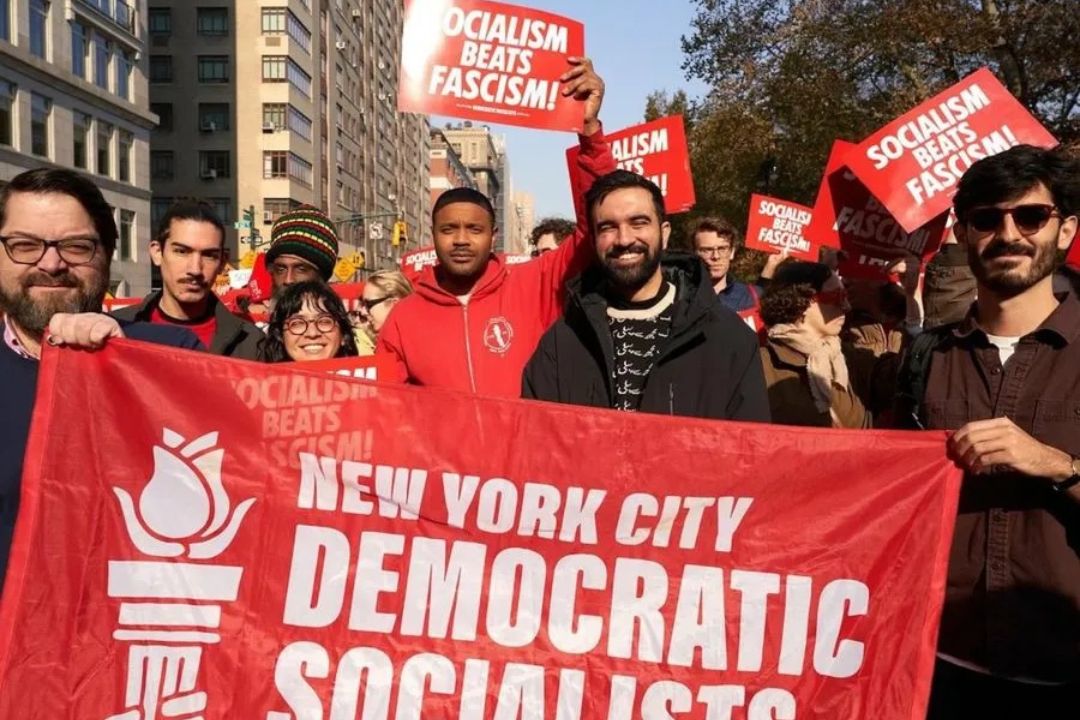
The rise of the Democratic Socialists of America from some 5,000 to 125,000 members in the past decade is one of the most significant signs of the long crisis of U.S. capitalism, the continued appeal of anti-capitalist politics, and the perpetual possibility of a larger working-class challenge to U.S. imperial hegemony.
At the same time, the DSA’s persistent push to reform the Democratic Party from within, its contradictory and inchoate internal political orientation, and the historical drag of socialist reformism are predictable ceilings on its future ability to reshape American politics.
To date, DSA’s two most significant political impacts have been kindling the spectre of socialist politics for a new generation of radicalizing youth, while both clouding and propelling the project for a revolutionary socialist left of creating its own pole of attraction.
The Democratic Socialists of America explosion into current American politics was created not by a widespread social movement but by an electoral wave. Bernie Sanders’s campaign for the presidency in 2016 was most responsible for the massive leap in DSA membership towards 100,000.
But Sanders’s campaign foretold much: running as a Democrat, he ultimately stepped aside to endorse Hillary Clinton after being squashed by the Democratic Party establishment consolidating its centrist flank.
That pattern has repeated perpetually over the past decade: DSA or DSA-backed candidates running within the party sometimes win while drawing backlash from the Democratic establishment.
This contradictory push and pull is the defining one of the DSA’s “inside out” strategy of reform, a tried and failed method used in years back by the progressive Left (Henry Wallace’s “Progressive Party” in the 1940s), the Civil Rights Movement (the Mississippi Freedom Democratic Party in the 1960s) and now the DSA.
Mamdani
What it has yielded is a distinctively weak brand of social democracy that reached its apotheosis in Zohran Mamdani’s victory as Mayor of New York City. Mamdani is without question the best, most skilful and in many ways most politically advanced of any DSA candidate to come along.
Unlike Bernie Sanders and Alexandria Ocasio-Cortez, for example, Mamdani has tried to remain loyal to the DSA “base” in New York that elected him by mobilizing policies on housing, childcare, and taxation that forward a politics of redistribution.
Most significantly, Mamdani has generally not retreated on his relentless criticism of Zionism, Israel’s genocide in Gaza, and his support for Palestinian self-determination. Yet even these politics have been entrapped by the tentacles of the Democratic Party he ultimately must answer to.
He has endorsed and appeased mainstream Democrats including the reactionary, anti-labour Governor Kathy Hochul, invited big business into his “big tent,” and avoided confrontation with the New York City Police Department – which he technically oversees – on questions of defunding the police. His appearance at a recent “vigil” sponsored by Jewish groups to commemorate October 7th produced optical nightmares as Palestinian protesters accused him of selling out.
Yet that moment was a predictable outcome of the DSA’s ongoing deal with the devil that is the Democratic Party. The U.S. duopoly, mutual admirers of the capitalist system, remains impermeable to wholesale change from forces as relatively tiny as the DSA.
The Mamdani “vigil” moment was a stark reminder that the challenge of American politics remains creating an independent socialist movement – and a party – from the revolutionary socialist Left that can stand clear as a tribune of the working-class and the oppressed.
The Revolutionary Left
Today, the revolutionary left in the U.S. is managing better through cooperation. For example, the United Left Platform, formed at the 2025 Socialism conference, has brought together six revolutionary socialist groups (Workers Voice, Tempest, Speak Out Socialists, Solidarity, Socialist Horizon, International Marxist Humanist Organization) to advance a revolutionary socialist perspective.
The group has sponsored important public meetings on the U.S. wars against Venezuela and Iran, expressed organizing solidarity in the anti-ICE upsurge, and is currently working on building a national defense network for victims of political repression in the United States, from the Prairieland defendants to the Minneapolis 15 to the Michigan 8. These are cases where protesters against ICE raids and Occupation, or the genocide in Palestine, have faced criminalization, incarceration and harassment by the state.
The ULP is endeavouring to build out a wider base of social struggle and maintain a tradition of political independence from the Democratic Party, while advancing discussion on the need for a revolutionary alternative to the DSA. It is combining a United Front approach to political work with a commitment to discussion about the potential of building a large-scale independent socialist Left.
At the Socialism Conference in Chicago in September, the ULP hosted a meeting on the topic “Standing Up to the National Security State.” The panel featured speakers from the Prairieland defence committee, a defendant in the Minneapolis 15 repression case, and a representative of the Michigan 8 charged with “conspiracy” for advocating for Palestine and BDS.
The room for the event was packed and featured animated discussion about the potential growth of a larger revolutionary Left out of the current crisis.
Socialism
The discussion is urgent. A Gallup poll released shortly after the conference found that 43 per cent of Americans now view socialism positively, the highest figure since Gallup began asking the question in 2010. And a majority of 18-to-34-year-olds, 57 per cent, view socialism positively against 43 per cent who still favour capitalism.
That number represents literally hundreds of thousands of people who have not found a political home in the DSA – or on the revolutionary Left. Some of them are now finding it.
These signs of resurgence of the revolutionary left should not be counterposed with the growth of the DSA, but seen as a part of a wider social turn to anti-capitalist politics in the U.S.
Indeed, in some cases – as in the defense of Socialist Horizon professor Tom Alter, fired from his tenured position for speaking as a private citizen at a Socialism conference – the DSA and revolutionary socialist groups have worked in mutual campaigns. This is a positive development that is bound to surface and elevate the role of socialism – and socialists – in the United States.
The November elections will also be a litmus test of the DSA strategy. Candidates backed by the organization are running across the country. A string of victories will likely further panic the Democratic establishment and foster intensified internal debate about how to contain the party’s Left flank as it considers its options for the 2028 election.
There is aspiration in some DSA quarters that Alexandria Ocasio-Cortez could stand as a presidential candidate. Yet her recent critical comments denigrating “Woke” culture in the U.S. already portend a likely move to the centre for her or any DSA-backed candidates in 2028.
For the revolutionary socialist left, the elections will serve primarily to gauge strategies and tactics for organizing in what one Socialist group has called the “age of Mamdani.” What can be affirmed without hesitation is that the opportunities for socialist groups to organize have rarely been as great in recent times. Working in collaboration, as the ULP is doing, can be an important step to paving the road forward.