By Jeremy Dewar, Workers Power
The largest international strike by dockworkers in history took place on 30 October. There was workers’ action in at least 113 ports across 22 countries on five continents – from Australia to Ireland, from India the USA. Many completely halted all shipping for 24 hours, especially in Italy and France, others downed tools for two hours. In the Mediterranean, 40% of all freight, worth £1.5 billion, was held up.
The International Dock and Transport Workers Against War and Genocide launched the strike call in May, based on their Istanbul Declaration. Though the coalition only had six unions at the time, the forces multiplied, particularly in the last month.
The workers are demanding an end to the genocide of Palestinians, solidarity with Cuba and the people of Venezuela and Sudan, and for ports not to be used to transport arms or military components. Their Declaration also demanded wage increases, secure contracts and shorter hours, as well as control over all automation.
By combining anti-militarism with economic demands, the unions showed dockers they were not supporting job losses, but demanding shorter hours, safer conditions and decent pay.
The Unione Sindacale di Base, which started the initiative, combined the strike with a call for a general strike, which was supported by five other rank and file unions, including Cobas… and tens of thousands of pupils and students. Genoa was shut down.
In France, too, the youth rallied to the dockers. The cause of Palestine is dear to their hearts, and their actions over the past month clearly increased the militancy of workers. All 22 ports were closed by the mainstream CGT union. An effigy of President Emmanuel Macron was burned in Le Havre.
UK: first contact made
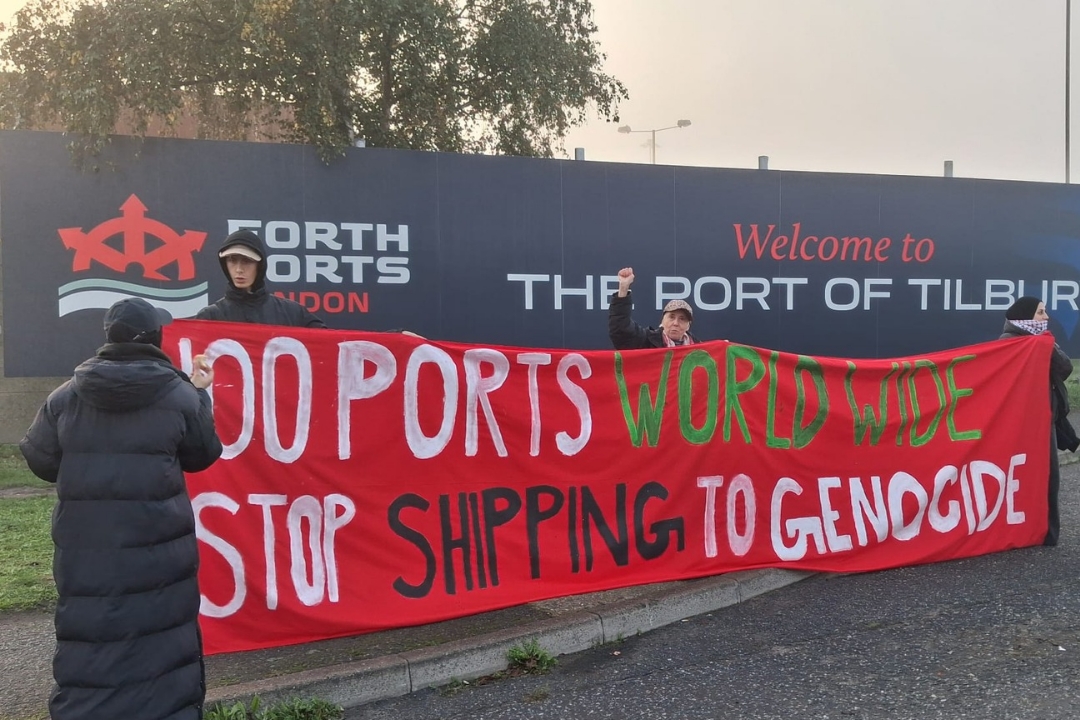
At 5.30am on 30th, 30 rank and file trade unionists, Palestinians and their supporters emerged from our coach into the deep mist shrouding the Thames estuary to take up position at the entrance to Tilbury Port. Police were taken completely by surprise, our posters and leaflets having advertised a 9am start. They took no action beyond maintaining a clear distance between us and the constant stream of HGVs entering the dock.
Within minutes, banners reading ‘Dockers Don’t Work for War’ and ‘100 Ports Worldwide Stop Shipping Genocide’ were unfurled, leaflets were being given out and megaphones and drums were beating out chants. This was the first time British antiwar activists had approached British dockers and asked them, not their union bosses, for solidarity action.
Between 6.00 and 9.00, over 3,000 port workers start their shifts, most of the manual workers, our main target audience, in the first hour. Despite the difficulties in approaching cars and vans, we handed out hundreds of leaflets, talked to dozens of dockers and provided the main talking point for the day among teams and in the canteen.
Our immediate ask was modest by international standards. Wear a Palestine pin. Talk to your workmates about the genocide and the strikes. Ask for a branch meeting with an international docker present to discuss joining the coalition next time.
Our leaflet pointed out the ‘intensification, exhausting schedules, insecure jobs, unsafe conditions and low wages’ dockers suffer, and the need for workers to ‘organise independently to take action’ against war and over the rising cost of living.
Workers Power members were prominent throughout the morning, handing out leaflets, chanting and holding up banners, and giving three well-received speeches to the demo. This was the culmination of our work in the build-up, making banners, writing leaflets, sending out press releases and model motions to union branches and trades councils.
Having grown in size to over 100 protesters and with fewer and fewer workers coming in, we decided to wrap up the action at the port at about 10.30 and held a short demo and final rally in Tilbury Town, where previous leafleting and postering had met with a good reception. Most of the shops and cafes are run by migrant workers, who were already antiwar.
Despite the right-wing reputation that the area has – 50 Reform councillors out of 54 voted in only last May – a number of other residents also applauded our efforts. In particular, we had the support of the local Irish social association. This shows it is the failure of the reformist leaders to reach out, inspire and organise workers in Britain’s industrial regions that has aided Nigel Farage’s rise, not some inherent backwardness of the workers.
Build-up and follow-up
Workers Power was not only prominent on the day, but part of the central organising team. The campaign started with a south London public meeting on 13 October hosted by Southwark Trades Council (the association of local trade union branches), where Mick Flynn from CGT Marseilles spoke. Mick inspired us and a similar meeting in Liverpool to approach the dockers and their union, Unite, to support the call and join the coalition.
Easier said than done. Unite has a notoriously pro-rearmament and anti-Palestinian leader, Sharon Graham. In Liverpool, the Unite convenor (senior shop steward) convinced the campaign to shift its protest to the city centre, away from the docks. In London we were having none of that.
For three years, we have leafleted town centres. For three years the Palestine Youth Movement had held talks with Unite at Tilbury – but not met a single docker. This time we were going to approach them in person. We wrote to the convenor (who is effectively a fulltime official) to this effect, but received no reply as of yet, though we do know he has been talking to the UBS in Italy, so things may be shifting.
We had more luck with the antiwar and Palestine solidarity movements, four trades councils and several union branches. But the big breakthrough came with the unanimous support of the London regional council of the Rail, Maritime and Transport union (RMT). Unfortunately, this came on the very eve of the strike, but could prove a powerful ally in the future, as the union organises some key workers inside the ports.
Going forwards, we intend to deepen the campaign. In that, we have the generous and important assistance of Mick from Marseilles, and the kudos from having already organised the biggest day of worker solidarity action in three years of genocide. We must not only try to win over the Tilbury dockers, but also encourage Liverpool to take a more direct approach, as well as approaching other important ports, like Felixstowe, Southampton and in Scotland.
We are facing an inflationary crisis that is hitting basics like fuel and food the hardest, coupled with a Labour government committed to rearmament. Prime Minister Andy Burnham deceitfully suggests that more arms factories (including one in Southwark!) will reindustrialise Britain, and urges citizens to stock up on tinned food and powerpacks in case of a Russian attack. Dockers laughed when we mentioned this.
By linking the fight for higher wages and shorter hours to the struggle to stop war, we can mobilise British workers and encourage them to learn French, Italian and Spanish, i.e. to link up with the youth and raise the level of resistance. We have no doubt that this will involve a battle with the bureaucracy, who have thrown all their weight behind Labour and guard their members in their jealous grip.
For our part Workers Power, the British section of the International Socialist League, will raise also the need for a new working class International. As Mick said at Tiilbury, ‘Some people call the French school students rioters. I call them revolutionaries!’ Indeed, the new International must, like the previous four, be a revolutionary communist one.