Report on the rally in front of the UN and interview with Alfons Bech, a leader of the mission: “We are rebuilding internationalism in concrete terms: from Palestine to Ukraine, occupation is a crime.”
By Flor Salgueiro Carral
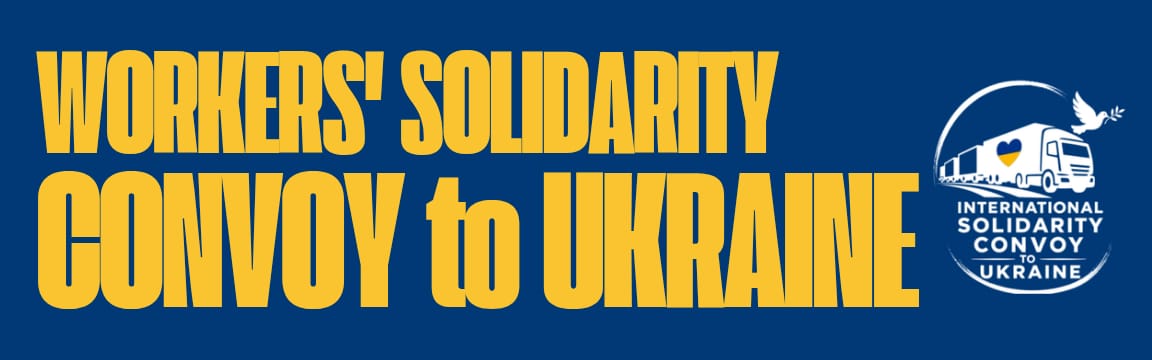
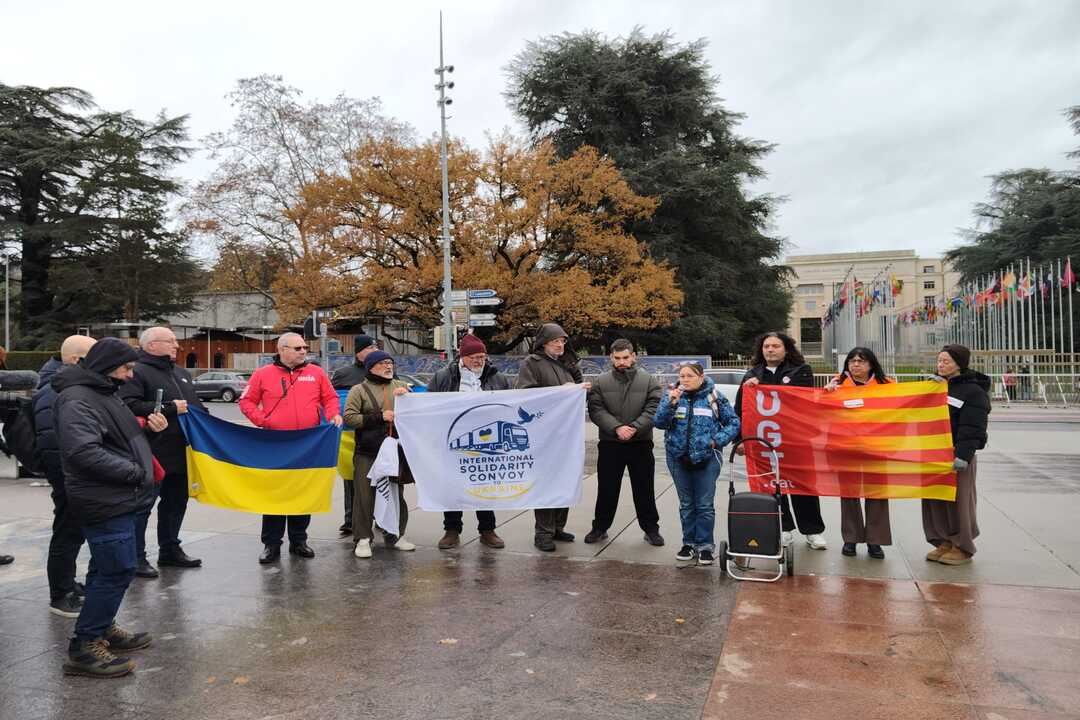
On Monday, the 23rd, the International Solidarity Convoy with Ukraine held a rally in front of the United Nations headquarters in Geneva. Speakers included David Acosta (spokesperson for the Convoy), Cati Llibre (International Relations for UGT-Catalunya), and leaders from the Swiss Trade Union Federation and the UNIA union, among other prominent figures.
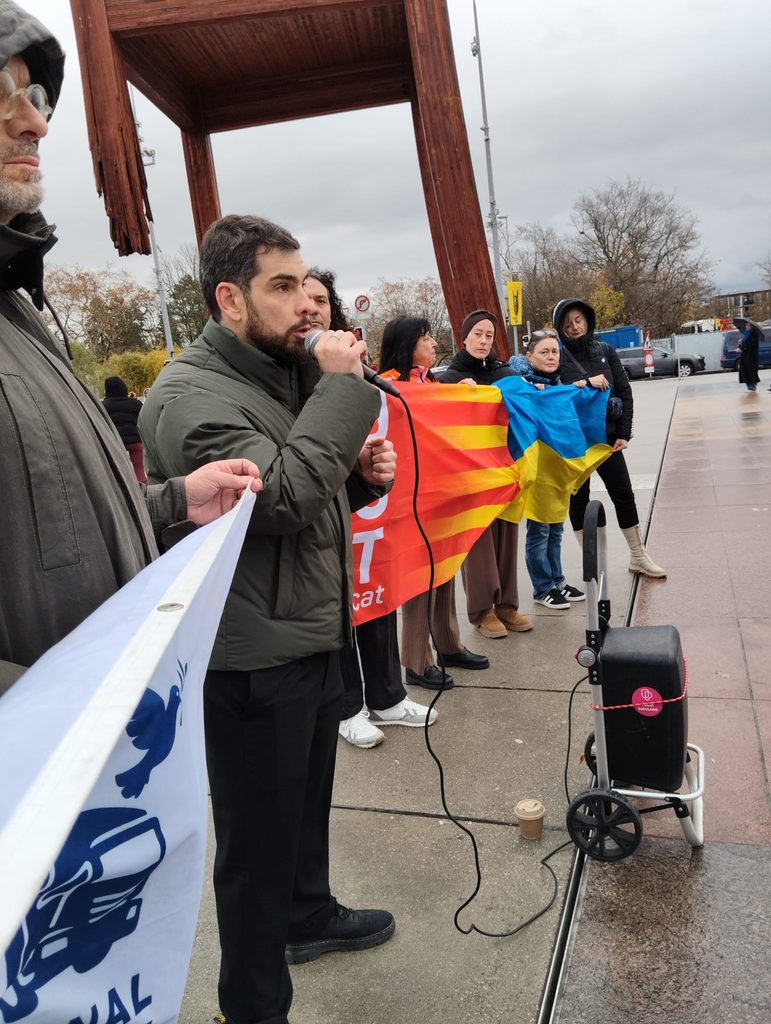
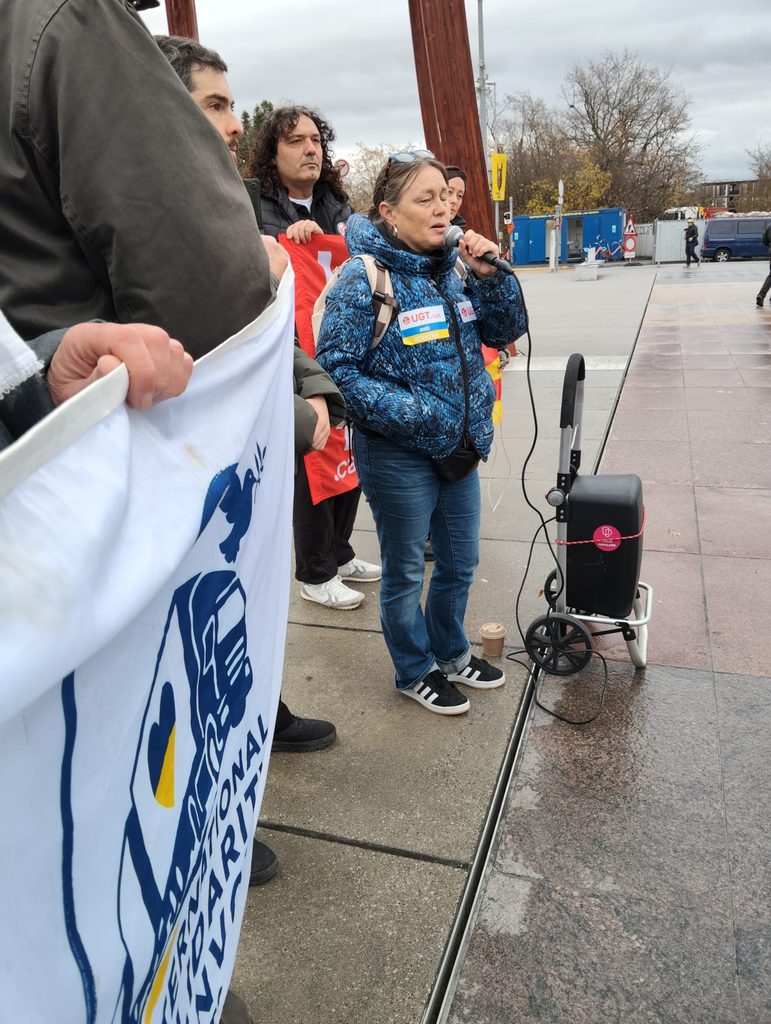
Afterward, the mission’s vehicles parked in front of the UN headquarters to pick up the participants and resume their journey to Strasbourg, with the plan to arrive that evening.
Voices of the Convoy:
Alfons Bech, a retired railroad worker, member of La Aurora—Marxist Organization, and one of the main driving forces behind the initiative. We spoke with him about the organizational details, union support, and the political objectives of the trip.
A construction project against the clock, starting from the ground up
—Tell us about the activities leading up to the trip, both in terms of solidarity and the organization of the convoy.
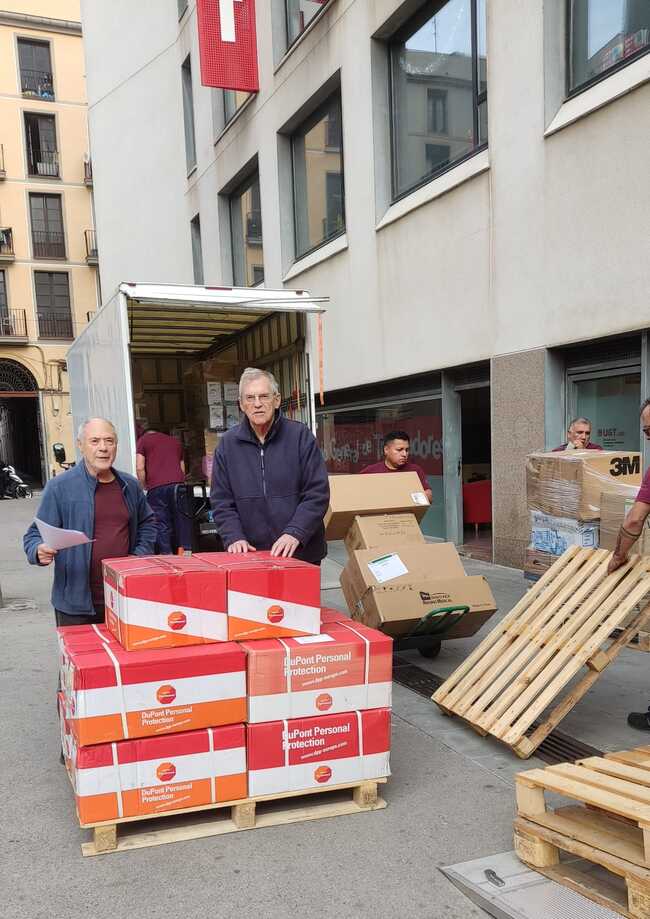
—It’s been very intense. A small team of us began the planning shortly before the holidays, but most of the work started in September—in just under three months. It’s something almost unimaginable.
Why did we start so late? This is the first time we’ve organized a convoy of this scale in Catalonia that’s both international and open to all. It was risky, yes, but we had the opportunity to secure a grant from the Catalan government to launch a project we’d already proposed two years ago through ENSU (European Network of Solidarity with Ukraine), of which we’re members. Furthermore, it was urgent to act before the arrival of the harsh Ukrainian winter. That determined everything, including the joint appeal with other organizations, setting aside issues that could spark debate—such as sending weapons—to prioritize concrete aid. We’re pleased to have reached that consensus.
We launched the campaign by drawing on ENSU’s experience, which allowed us to quickly put together a broad coordinating committee. We made mistakes and ran out of time; some activists were under a lot of stress and got very little sleep. But the important thing is that we managed to inspire many organizations and new activists—several of whom were very young—to take on responsibilities. It’s a clear step forward compared to everything we’ve done before.
Winter as a weapon, and independence in the face of governments
—“What are the mission’s objectives, and what are your expectations?”
—The first objective is necessarily humanitarian. Since Putin cannot defeat the Ukrainian people’s resistance militarily, he is resorting to siege and genocide, using the cold and power outages to try to break their spirit. But he won’t succeed. The entire nation—and on the front lines, the workers who day after day repair the bombed-out power plants, trains, and stations, as well as bridges, water systems, and heating infrastructure—is standing up to him, knowing they may never return home.
That is why we are raising 100,000 euros to purchase generators and heaters. We are confident that we will exceed that goal thanks to individual and union donations: the European Federation of Public Service Workers contributed 25,000 euros, and we have also received contributions from unions in Belgium, Switzerland, Norway, Sweden, the United Kingdom, Scotland, and Italy.
“Institutions are no guarantee; the guarantee is activism and organization independent of any government.”
In addition to this dedicated group of volunteers, we have the institutional support of the Generalitat and a statement from the Parliament of Catalonia. But beware: institutions are no guarantee—activism is the guarantee. Despite having a 250,000-euro grant approved, we haven’t received a single euro yet—it will arrive at the end of the month, with the Convoy already underway—and four vehicles promised by the Mossos fell through at the last minute, so we had to replace them by buying used cars. Nevertheless, we left Barcelona on schedule thanks to the money we’d already raised through grassroots efforts.
Class Solidarity and the Struggle Against All Forms of Imperialism and the Far Right
—The political dimension of the Convoy is just as important as the humanitarian one,” Bech continues. “We want to show that Ukraine is not alone and that a mobilized society is demanding that its governments provide real support for its legitimate defense against imperialist aggression.” This has nothing to do with widespread military rearmament, to which I am categorically opposed: it is about stopping a neo-fascist imperialism that seeks to rebuild an empire and threatens to spread the war across Europe.
Furthermore, we seek to strengthen trade unions and left-wing and grassroots organizations in Ukraine, because the country’s reconstruction requires a strong social fabric to stand up to the local oligarchy. That is why we will meet with the FPU trade union federation, left-wing organizations such as Sotsyalnyi Rukh and Solidarity Collectives, Be Like We Are, and the Civic Center for Freedoms (Nobel Peace Prize laureate), among other feminist and social groups.
—The Convoy is moving forward along its three routes. What are the main stops in the European Union?
—We’re like a “flotilla” of solidarity, but on land. Three caravans—North, Central, and South—are traveling through capitals such as Brussels, Berlin, and Warsaw, and institutional headquarters such as the UN and the ILO in Geneva or the European Parliament in Strasbourg. At each stop, we coordinate with the Ukrainian diaspora, labor unions, and left-wing parties to demand political support and raise specific causes, such as the release of the 15 workers at the Zaporizhzhia nuclear power plant who were kidnapped by Russia, and solidarity with former student leader Denys Matsola and social-democratic historian Vlad Staroudev, who have been persecuted and attacked by far-right groups in Lviv. Although the far right is a very small minority—it does not have a single member of parliament in the Ukrainian Parliament—our Convoy fights the far right both outside and inside Ukraine.
Final destination: Lviv and Kyiv
—What activities are planned in Lviv and Kyiv? —In Lviv, we will hold sector-specific meetings with feminist groups such as Bilkis, Solidarity Collectives, Be Like We Are, Sotsyalnyi Rukh, and the FPU union.
—In Kyiv, in addition to these meetings, we will hold two major events. One will take place at the historic House of Trade Unions on Maidan Square, organized in collaboration with the FPU, featuring speeches by union members from the three branches of the Convoy and various Ukrainian workers’ organizations. The second will be an open forum featuring panel discussions between Ukrainian associations and international delegations to draw conclusions and plan new joint steps to be taken this winter. In the fifth year of the war, it is vital that we come together to consider what vision of a just peace we are defending.
How to Join and Organize New Caravans
—“How can those who aren’t participating in the trip continue to contribute?”
—We’ve already had to tell several comrades who decided too late that there were no spots left, but we’re asking them to get ready for the next one—just like our comrades from RESU in Lyon, who’ve already announced they’ll be adding a car for the next edition.” The Convoy has sparked enormous enthusiasm and is sparking debates even within left-wing parties whose leaders have been reluctant to support Ukraine—such as La France Insoumise, Die Linke, and The Commons—where younger members are pushing for solidarity, just as rank-and-file members of CCOO have made individual donations.
Everyone can contribute to the fund—which we’ll use to purchase generators and stoves directly in Ukraine, thereby creating jobs there as well—organize talks after the delegation returns, or screen the documentary we’ll bring back from the trip at their unions.
“Do you want to add anything else?”
—This Convoy isn’t perfect, but it’s necessary. The next ones will require even more hands on deck and a deeper political understanding of what’s at stake. We’re rebuilding internationalism in concrete terms. As our banner says: ‘From Palestine to Ukraine, occupation is a crime.’” It is not consistent internationalism to fight only one form of imperialism; the future of humanity depends on defeating all forms of imperialism, because the working class has the greatest stake in free, sovereign, and fraternal nations.