The latest issue of Permanent Revolution, the ISL journal, is now available. Don’t miss it. Here’s the editorial.
Trump’s historic defeat in the US midterm elections and Bolsonaro’s in Brazil dealt major blows to the far right that has been growing bolder around the world. Meanwhile, young people across Europe surged into action on a mass scale. Their radicalization has terrified the ruling classes and drew workers into struggle. This is beginning to dispel some of the skepticism that had existed in the mass movement.
By Alejandro Bodart
There is something new in the air and healthy optimism across broad sectors of society. No bourgeois project looks invincible to the new generation of young people who embraced the Palestinian cause from the outset and are now challenging capitalist barbarism in the streets. To them, storming heaven is no utopia.
We are witnessing a new global conjuncture. Social and political polarization continues to divide societies, and the far right remains a present and significant danger. Over the past couple of months, however, the most dynamic development has been mobilization against those perceived as neo-fascists and in defense of a better life.
Electoral Defeats with Far-Reaching Repercussions
Trump’s electoral collapse deepens the decline of US imperialism and calls into question the new world order he has dreamed of since taking office for his second term. It weakens Zionism and the complicit Arab bourgeoisies in the Middle East, and further isolates the genocidal State of Israel internationally. It raises further questions about whether a weakened Trump can bring the war between Ukraine and Russia to an end, and limits his ability to provide political and economic support to governments willing to sell out their countries, like Milei’s and others in the empire’s backyard. It eases the pressure on a weakened European imperialism to fall submissively into line. And it gives Chinese imperialism more room to pursue its ambition of becoming the hegemonic power, which will deepen the current Cold War between the two and strengthen the tendencies towards a future confrontation with unpredictable consequences for humanity.
The Republican Party’s defeat had been on the cards for some time. Rejection of complicity in the genocide of the Palestinian people and of the aggression against Iran, with its consequences for living standards, grew until it became the majority position. Mass mobilizations and coordination among neighbors against the fascist forces of ICE showed the enormous extent of this radicalization and inflicted major defeats on ICE, as in Minneapolis.
For years, young people and sections of the working class in the United States have been shifting to the left. This has found contradictory expression in the growth of the DSA within the Democratic Party, as well as in a radicalized vanguard active in struggles and in the early stages of a reorganization of the workers’ movement. Looking ahead, the dynamics of class struggle will pose ever more sharply the need for a third party, a workers’ party independent of the Democrats.
In Brazil, Latin America’s leading country, millions of young people and workers spontaneously took to the streets after the far right won the first round of voting. Their mobilization reversed the result in a runoff that everyone had written off for Lula. To win over an electorate disillusioned with his neoliberal governments, Lula was forced to repeal part of Bolsonaro’s labor reform, which he had left untouched during his presidency, and to promise changes he is unlikely to deliver. Beyond its implications for the entire continent, the entry of young people and the working class into the struggle brought about a qualitative shift in Brazil’s political situation, opening up more space to the left of the PT.

Gen Z Shakes Up Europe
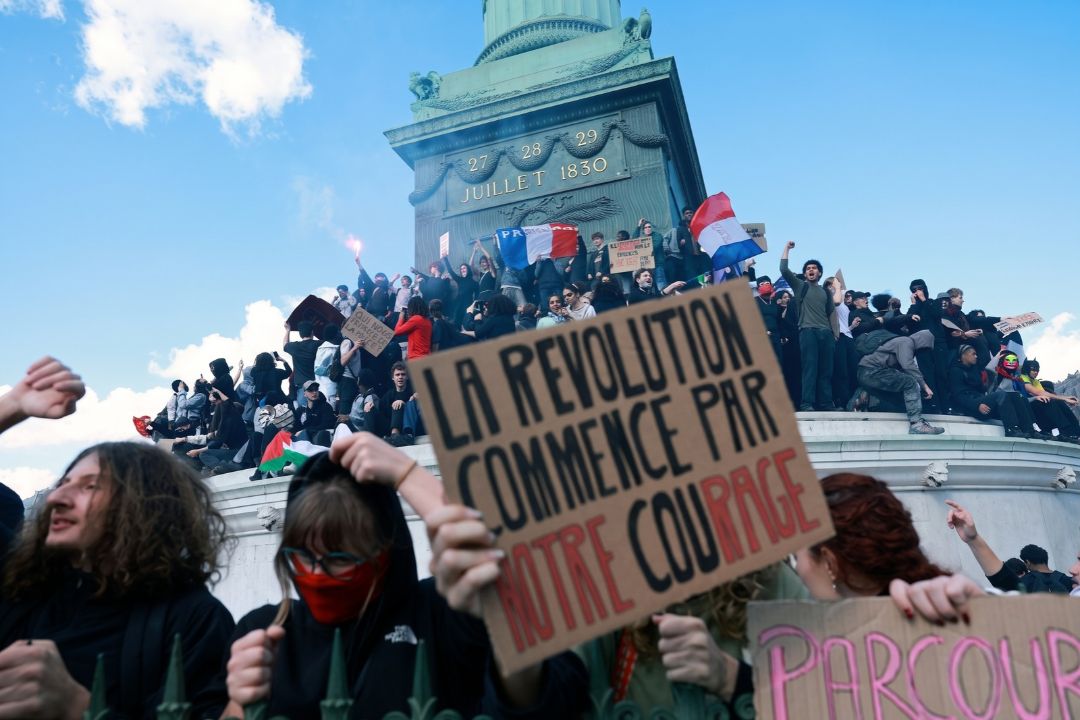
The youth rebellion we are witnessing has spread like wildfire across the old continent. The most far-reaching developments are unfolding in France and Spain, but the rebellion has also made itself strongly felt in Italy, Germany, Portugal, Belgium, Serbia, Albania and other European Union countries. The first continent-wide action took place on Friday, 20 November. Memories of France’s May ’68 are in the air.
The immediate triggers vary from country to country, but what is driving this generation into revolt is that a declining European capitalism offers it neither a present nor a future. Its members are between 13 and 29 years old and tend to organize and coordinate online. This is a global trend that has erupted in explosive forms on every continent(1).
High school students are at the forefront, drawing university students in and making an impact among workers. Young women play a very important role. They are fed up with misogyny and with the attacks on their rights that come with the right’s medieval rhetoric. Alongside its support for Palestine, this generation is deeply responsive to environmental struggles and the feminist movement, and it despises authoritarianism, fascism, racism and homophobia.
Anger at a system that condemns them to a life of hardship, without the opportunities their parents had, drives them to rebel against the existing order as a whole. Politically, they tend to look to broad left organizations. This has given fresh momentum to groups such as Mélenchon’s La France Insoumise and Die Linke in Germany (2). The growing political consciousness of this young layer of activists also opens up major opportunities for the revolutionary left. We need to seize them to build strong organizations that can challenge the reformists for the support of young people.
The Tasks of Revolutionaries
First of all, it is important to understand this new political situation. In some countries, class struggle has intensified sharply. In France, a key debate is whether the situation is already pre-revolutionary or heading in that direction. Similar dynamics could develop in other European countries. The imperialist bourgeoisie will try to divert these developments into the electoral field. But the causes of this new wave of struggles will persist, and any victories by the far right in France or Spain will ultimately deepen polarization and add fuel to the fire. This poses new challenges that will put all revolutionary organizations to the test.
As well as being on the front lines against austerity plans, militarization and every manifestation of reaction, we must boldly promote the united front, coordination among those in struggle, and self-organization to confront repression. We must also support the development of a democratic and consistent leadership in every country where we are active.
One danger we face in building the united front is the sectarianism of various currents, including some on the left. They refuse to engage with and make demands on the reformist or bureaucratic leaders who head the most representative organizations and have responsibilities in these struggles. This weakens struggles in which the left has influence. It also makes things easier for leaders who betray those struggles, since their conduct goes unexposed before the mass movement when they refuse to intervene or end up collaborating openly or indirectly with governments and employers.
The other danger is the opportunism of tailing the leaderships with which we act in unity, letting their inconsistencies go unchallenged. Our politics must combine unity in action with ongoing political confrontation, pushing the mobilization forward until we displace the leaderships integrated into the bourgeois regime.
The other major task is to popularize proposals on programme and methods that help give these struggles an anti-capitalist direction. We must organize meetings, seminars and all kinds of activities to organize the most committed activists who agree with our proposals and make every effort to regroup with revolutionaries with whom we are reaching a common understanding of the situation and the work that needs to be done.
(1) Between 2024 and 2026, there were major youth mobilizations in India, Indonesia, Bangladesh, Nepal, the Philippines, Kenya, Morocco, Macedonia, Sri Lanka, Iran, Peru, Paraguay, Mexico and elsewhere. In previous years, there were mobilizations in Lebanon, Chile and Colombia, among other countries.
(2) In the United States, for example, it is the DSA that is capitalizing on this trend.