France is experiencing an unprecedented social and political crisis:
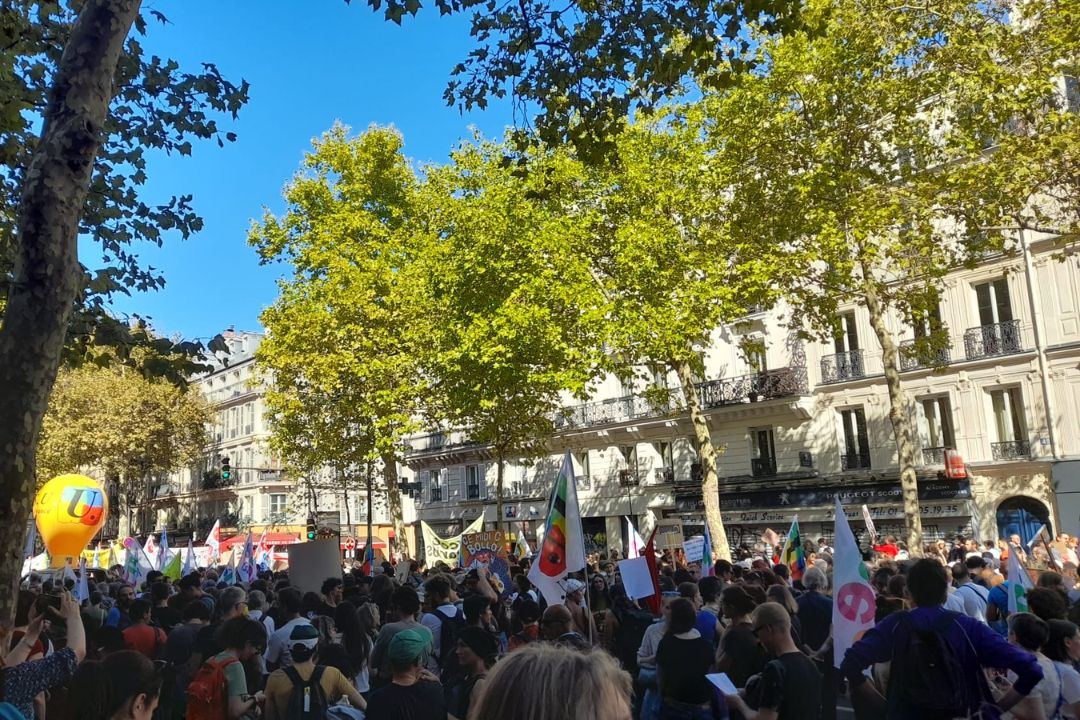
it’s not just the fall of the governments of François Bayrou and Sébastien Lecornu over the past month (the latter having returned to office five days after resigning), bringing to five the number of prime ministers in three years, but above all the entry onto the political scene of hundreds of thousands of workers and young people who went on strike and demonstrated on September 10, September 18 and also on October 2. They clearly expressed their anger at the austerity budget prepared at the time by Bayrou, warning the government not to continue in the same direction. Two years after the movement against pension reform, the working class and young people have regained their confidence and want to play a leading political role.
The days of mobilization on September 10 on the one hand, and those on September 18 and October 2 on the other, are very different in character. Launched by an anonymous call on social networks, the one on the 10th raised the hopes of many for a rebirth of the Gilets jaunes. Its success can be attributed to the fact that it attracted large numbers of young people and workers, often behind the banners of their grassroots union organizations, that it clearly identified Bayrou’s draft budget as a flagrant social injustice, and that it sought to attack the state and the capitalist system through radical methods of struggle.
It has to be said, however, that while the aim was to “block everything”, this call had its limits. The 800 or so blockades were quickly countered by a massive police presence – 80,000 police officers and gendarmes. But who could doubt it? The lack of coordination and direction, logical in actions organized by the grassroots, gave rise to confused, not to say chaotic, situations. In Paris, for example, a gathering of unionized workers, a massive general assembly of railway workers, an open-air general assembly/happening and, no doubt, other minor mobilizations took place simultaneously, albeit in three different locations.
The only effect of all this was to divide forces and weaken the political scope of the mobilization. This lack of program and direction has made it easier for the populists of LFI and their allies, on the one hand, and the anarchists and autonomists, on the other. The former do not want a large-scale movement to last and succeed in satisfying their demands.
Instead, they want a nationwide media coup to pave the way for the arrival of LFI and its “solutions”: new elections for Jean-Luc Mélenchon to take power at the head of the bourgeois state. The aim is to channel popular anger towards a solution based on bourgeois democracy.
The anarchists, as usual, wanted to make a political point by smashing a few windows or bus shelters. September 18 was the date chosen by the major unions for the usual back-to-work demonstration. Initially chosen to oppose September 10, and rather to divide the movement, the proximity of the two dates was a happy coincidence that reinforced the impact of both mobilizations. 250,000 workers demonstrated across the country on the 10th and around 1 million on the 18th, in dynamic and demanding processions, with strikes in transport, public services and education in particular. Despite this, the unions quickly decided to put the movement “on pause”, issuing an “ultimatum” to the government to meet with them and discuss the new budget. However, in the face of Mr. Lecornu’s obstinacy – what else could we expect from this ultra-faithful Macronist? -they called for a day of strike action and mobilization on October 2, where, for a variety of reasons, the movement, though significant, was less well attended (around 500,000 people nationwide), the main cause being the difficulty of striking on a single day without following through with a plan of struggle to win, not to mention the loss of pay for the day not worked.
The French bourgeoisie is facing a serious political crisis, which is turning into a crisis of the Fifth Republic and its institutions. With the National Assembly divided into three blocs – the Rassemblement National, Macron’s center-right Les Républicains, and the institutional left – it will no doubt be difficult to form a government again after Lecornu’s untimely resignation.
The irruption of workers and young people on the political scene can upset the plans of the bourgeoisie, and a mass movement can win important victories in social demands. However, neither the spontaneity of the masses alone, nor the reformism of the central trade unions, can lead to such victories. Time and again in the past, the big trade union centers have monopolized the leadership of the movement and channelled it into a series of dead-end mobilization days. The only result has been to exhaust workers’ fighting spirit, sow despair and, paradoxically, strengthen the Rassemblement National.
The task of revolutionaries is to promote the self-organization of the working class, to build a program of action based on transitional demands, and to organize a mass movement ready to go all the way to an unlimited general strike.
The task is a difficult one, but the current situation and its contradictions are a source of support.
Discontent is massive, and Lecornu’s resignation, followed by his return to office less than a week after his resignation, is a further blow to Macron’s discredited government. The mobilizations of recent weeks have been a first step in building new mobilizations. The large number of general assemblies, some of which brought together hundreds or even thousands of people, held to prepare for September 10, but also for September 18 and the days that followed, have provided so many forums to generalize this program of struggle and advance the movement’s self-organization.
Unambiguous criticism of the central trade unions must be combined with a tactic of making demands on the union leadership. This battle must be waged relentlessly at general assemblies, but also in rank-and-file unions, which often bring together sincere, combative militants. This means building a democratically elected leadership for the struggle, and fighting to ensure that the union belongs to the union members. We need to demand that union leaders call for new days of mobilization leading to a general strike to win the struggle, the only weapon capable of breaking the back of employers and the government. To crown this perspective, revolutionaries must put forward the slogan of a workers’ government, based on workers’ democracy and its fighting organizations.