By Edwin Paz and Rodrigo Avalos from La Paz
There is not only a change of government in Bolivia now that Rodrigo Paz Pereira took office. It is the end of a nearly 20-year cycle of MAS -a party that is now fragmented- and the beginning of a shift to the right that translates into a rapprochement with Washington and a political framework that seems to move away from the moderate continuity it promised. This shift has an impact on a region marked by the rise of conservative governments and international alignments that once again place the United States as a central actor in South America and, also, on the popular movements, which from the territories have already declared that “the second round is in the streets”.
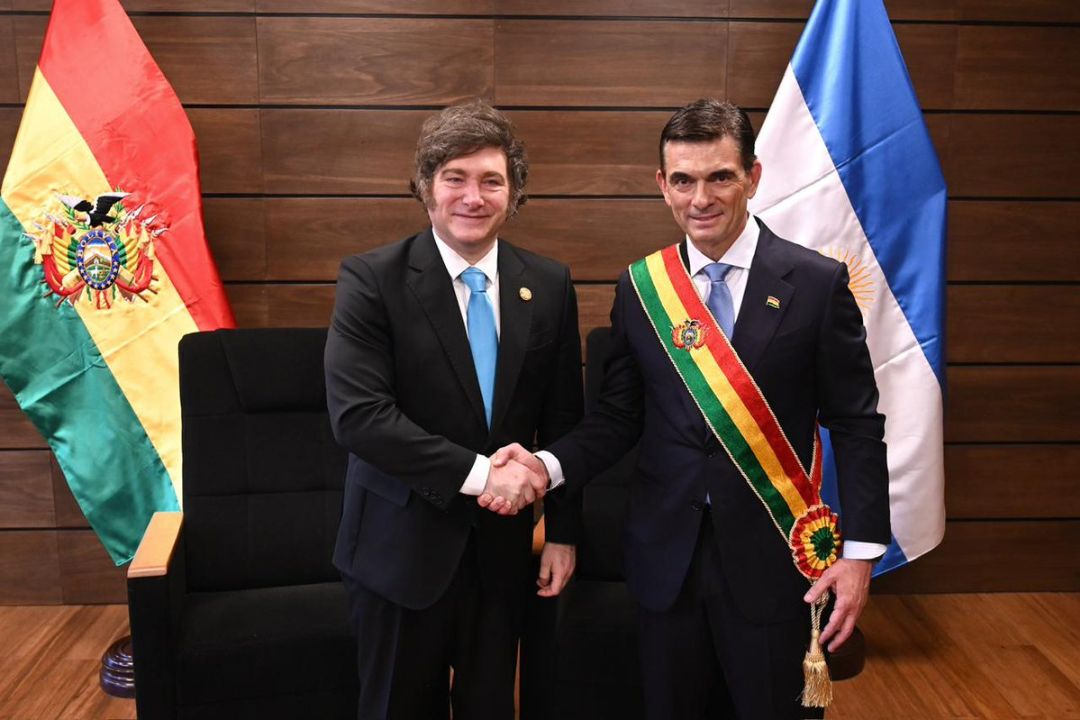
The President took office last Saturday in Sucre and presented his cabinet this Sunday. The ceremony was attended by more than 50 international delegations, including that of the United States, headed by the U.S. Undersecretary of State, Christopher Landau; and four presidents: Javier Milei, from Argentina; Santiago Peña, from Paraguay; Yamandú Orsi, from Uruguay; and Gabriel Boric, from Chile, also a historic presence between countries whose relationship is marked by the 1978 Bolivian maritime claim.
Elections and promises
Paz Pereira is the son of former president Jaime Paz Zamora (1983-1993), senator for Tarija, former national deputy (2002-2010), former councilman (2010-2015) and former mayor of the municipality of Tarija (2015-2020). He was born during his parents’ exile in Compostela, Spain. When he entered the runoff in the second round, he surprised: the polls had not had on the radar the one who in his campaign raised a particular slogan: “Capitalism for all” with which, finally, he won by 54% of the votes last October 19 when the historic runoff took place.
In that race, Paz Pereira beat former president Jorge “Tuto” Quiroga (2001-2002), of the Libertad y Democracia (Libre) alliance. Evo Morales’ historic rival is a conservative who proposed “liberalizing Bolivia” and was nicknamed in the press as “the Argentinean (Javier) Milei”. Despite having lost, he already plays a key role in the new scenario of the South American country because his alliance Libre won 50 seats in the first round, out of the 175 available in the Chamber of Deputies, crucial for the PDC to get through Congress the reforms it has planned. Before the transfer of power, the commitment to accompany him had already arrived.
Paz Pereira, who in an interview with the BBC after her victory called herself a “national, popular and democratic” center.
With this position “in the center”, he committed himself with the classic neoliberal promises, to face the economic crisis affecting the country, which combines: a foreign debt of 13,806 billion dollars, inflation of 25%, fuel shortage and scarcity of reserves in the Central Bank. To achieve this, he proposed incentives for private and foreign investment, the reduction of taxes and tariffs, greater access to credit and the reform of the exchange system.
In this sense, he also committed himself to the decentralization of the police forces to fight insecurity, where his vice president, the former police officer Edman Lara, will concentrate the prominence he already has in his social networks. However, within hours of his inauguration, Lara already denounced the new president for trying to marginalize him from the meetings of Ministers, which anticipates new quarrels and confrontations between the president and the most popular figure of his own government.
A third point is what is glimpsed as a reform of the State with a focus on public companies “with operating deficits” to freeze their activities and a judicial reform to go back to the popular election of judges.
The challenge for the new government
By the time he took office, Paz Pereira had already received his credentials as president and had set in motion a local and international agenda. He met in the United States with leaders of different financing organizations and, finally, he obtained a loan of 3.1 billion dollars from the Andean Development Corporation (CAF) -currently Development Bank of Latin America-, which will have a first disbursement next month “with the purpose of alleviating fiscal liquidity and dynamizing the national economy, for the benefit of around 3 million Bolivians”, informed the Office of the President Elect.
The arrival of Paz Pereira is going to be a 180 degree turn, which should not have been, judging by the offers he made to give continuity to certain aspects of the MAS model. This allowed him to conquer the popular vote that previously belonged to MAS. However, with the moves made so far, Paz “ignores the rural vote and the vote of the most impoverished sectors that brought him to the presidency”. In this sense, it is relevant to highlight some of the people who accompanied him to the meetings in Washington, who are seen as members of the government whose destiny will be known only this Sunday: Samuel Doria Medina, former presidential candidate and recognized for being one of the architects of the privatization process of the 1990s; José Luis Lupo, vice presidential candidate with Doria Medina, economist and politician; and Gabriel Espinoza, self-styled “liberal economist”.
These movements anticipate a program of economic adjustment and the certain possibility of rejection and social protest. Accordingly, the religious and racist components that will accompany the new economic model after 20 years of an administration that proposed to integrate an indigenist and good living vision whose reactions we have already seen during the coup of 2019, where pollera women and members of community movements were persecuted and criminalized, are added to the new government’s perspectives.
The impact of internal MAS disputes
For the first round, MAS was divided into three fractions and lost the hegemony it had held for two decades. The three remaining fractions are: one led by former president Morales, self-exiled in the Chapare and forced to form another party called Evo Pueblo; another by his successor and now fervent opponent Luis Arce, who kept the MAS acronym and, finally, Andrónico Rodríguez, a young cocacolero leader, who expressed the renewal of the space until Morales vetoed him. In this scenario, the former president -politically disqualified to dispute the presidency- called for the null vote, which conquered 19.9% against a historical average of 3.7%.
Among them, the only one to achieve a small representation in Congress was Rodriguez, with eight deputies.
The path towards this “radical break”, has antecedents since 2016, when Morales lost the referendum he proposed to be reelected president and deepened in 2019 with the racist and ecclesiastical coup d’état. The internal problems of the party and the last presidencies of Morales and Arce did not result in what society wanted or asked for economically, socially and politically.
But the impact of the defeat is not only local. “It is a great defeat for the false Latin American progressivism”. The fact is that the leadership of Morales and his party was not circumscribed to the local order, but was erected as an emblem of Latin American progressivism, which promoted indigenous recognition through the creation of the Plurinational State with apparently democratic processes and which had achieved a conjunctural growth of the national economy and of the internal demand with its own exploitation of natural resources with the implementation of statist and protectionist measures that translated into relative improvements in the living conditions of the population. Simultaneously, the entire era of Masismo demonstrated the limitations of all those who want to improve the living conditions of the population without questioning the issue of ownership of the means of production and without overthrowing the foundations of the Bolivian capitalist system on which the entire economy is based.
The impact on the region and on relations with the United States
The arrival of Paz Pereira to the government also means the restitution of international relations with the United States, damaged since 2008, when Morales expelled the then ambassador Philip Goldberg and the link was reduced to chargés d’affaires. With him, the presence of the U.S. Anti-Narcotics Department had also ended, and the U.S. Department of Homeland Security will once again disembark.
With this decision under his arm, the new president traveled to Washington to meet with the U.S. Secretary of State, Marco Rubio, with whom they discussed measures to “broaden and deepen” the relationship between both nations. However, the redefinition of foreign policy goes further: it includes having left out of the invitations for the change of office the presidents of Venezuela, Nicaragua and Cuba -the latter with whom they have maintained a relationship that went through neoliberal governments-, having called the anti-Chávez referent of the Venezuelan ultra-right María Corina Machado the day after winning the elections to express his support in the “struggle to recover democracy in Venezuela” and the consequent suspension of the Bolivarian Alliance of Our America (ALBA).
In addition to these gestures, there was the rapprochement with Israel after several years of broken relations due to the accusations against Benjamin Netanyahu, accused of committing war crimes and genocide in the Gaza Strip.
Thus, Paz Pereira joins the concert of presidents who embody the global rise of the right wing and the most conservative parties, which in the region are in Ecuador, Argentina, Paraguay and El Salvador, just to mention a few.
“The second round is in the streets”
From the territories and grassroots organizations they articulate a deeply critical reading of this new political cycle. They interpret that the election itself was a false dilemma between two rightists, and the victory of Paz Pereira is the direct consequence of the “betrayal of the MAS” to the project of decolonization and depatriarchalization.
All the options were linked to the right, to the conservative parties, the governments of Morales and Arce as they have expressed themselves as a colonial, racist and irresponsible left without self-criticism that, with its corruption and repression, fragmented the social organizations and “destroyed the political project of the peoples of decolonization and indigenous peasant autonomy”, paving the way for the triumph of the right.
Faced with this scenario, the arrival of Paz is not experienced as just another electoral defeat, but as a historical lesson. It is a learning to understand that the State is not useful for the organizations. Power does not take, it takes the organizations, it eats dreams, it eats the anti-patriarchal and anti-colonial transformation proposals. This learning redefines the struggle: “Colonial, racist and bourgeois democracy is of no use to us. We never have a choice.
The initial gestures of the new government – such as the withdrawal of the wiphala and the imposition of the Bible and the crucifix – confirm this shift, as well as the release of the coup leader Jeannine Áñez, who won in this week the annulment of the conviction for the 2019 coup d’état. But the plan goes beyond symbols. We must alert about a concrete attack on legal conquests: “This government is attacking the Education Law, which proposes decolonization and depatriarchalization, and they are going to repeal Law 348 against violence against women and the legal interruption of pregnancy (established by causalities)”.
Faced with this panorama of conservative offensive, the answer lies in the autonomous reorganization of all the Bolivian anti-capitalist sectors. That is why we repeat that the second round is in the streets. We do not believe in this democracy, that is why we call to rearm ourselves, to recover the memory of more than 500 years of resistance and to define in the streets what we want to live, without handing over our dreams to the State”. Paz Pereira’s victory is only a temporary victory in the face of the strength of a resistance that will seek to recompose itself by drawing conclusions from the mistakes made.