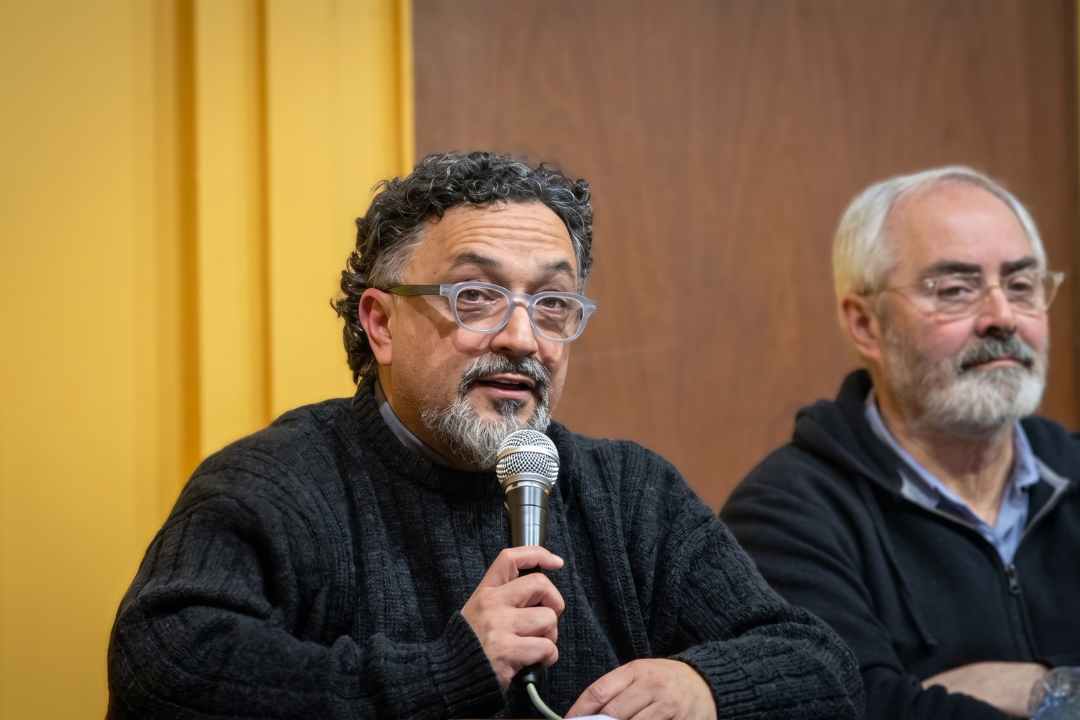
On Monday, June 29, the first meeting in a series of forums organized by the Left Front—Unity was held in the auditorium of the UBA’s Faculty of Social Sciences to publicly debate the opportunities and challenges facing the left in Argentina. This first debate addressed the strategies, methods, and program for building a tool for the working class in Argentina, as well as the role of the left. The panel included leaders from the four political forces that make up the Front. Below, we share Sergio García’s remarks, and you can watch and read Alejandro Bodart’s remarks here.
Good afternoon and good evening to all my fellow members. I’d like to extend my greetings, of course, to this forum, because it’s very important that all our members are able to discuss issues with everyone here in person or connected virtually.
As has already been said here, we are experiencing an unprecedented situation in our country—what we call a historic challenge. Because it’s an opportunity, but it’s also a challenge—we’ll have to see if we’re capable of overcoming it—since we’re witnessing a moment when leftist ideas are gaining significant ground, and people everywhere are asking, “What would the left do if it were in power?” The support that Myriam, in particular, is garnering is a victory for the entire left, and we must view it very positively. And we must view this process, we believe, not merely as a snapshot of this moment, but from the perspective of a film showing just how far it can go. Because if we do not see it this way, we also run the risk of making proposals that lag slightly behind the situation as it may unfold. And the revolutionary left in our country must begin by understanding and internalizing the current moment and seeking out all possible paths and all possible strategic and political alliances in order to achieve the best possible outcome in the context of a revolutionary political struggle for power in this country. Because if levels of sympathy and support remain as they are today, and if the class struggle were to develop much more deeply in the medium and long term, it will be necessary for that process to combine political sympathy with struggle in the streets, and for the possibility of a political leap forward—of political influence, militant organization, and the struggle for something we have not yet been able to achieve in our country—to be greatly strengthened.
I’ll start there, because if we only see a slight increase in a poll—a little more potential support or a little more favorability—and then we have to discuss more or less the same things but a little better, we won’t be addressing that situation. To put it another way, if the situation we’re experiencing is extraordinary, we can’t respond to it with the policies and approaches of a previous situation, because that’s political conservatism that fails to address the political challenges posed by a situation that has, in fact, become extraordinary. And in that sense, it seems to me that discussing—as part of the title of this panel taking place today at this first forum—the role of the Left Front must also be situated within that framework. Because if the Left Front as such fails to grasp the full magnitude of the situation we are facing, it will continue to operate with its strengths and limitations, but will fall short of the potential that lies before us. Because for us, the Left Front is not the issue here; we are part of the Left Front–Unity, we value it, we defend it, we want it to continue, but we also have to situate it precisely within the context of this situation. And in the context of this extraordinary situation, defending the Left Front means fighting to transform it, fighting to change it, fighting for it to evolve. It means fighting so that it can overcome its current electoral limitations. Because otherwise—whether with Open Committees, semi-open committees, or parallel committees—the Left Front will still act in a disunited manner in the class struggle and on union slates, since the underlying problem remains unresolved.
The Left Front has the potential to change that, if we all dare to discuss how to be much more than we are now, to work toward a common strategy. And within that strategy—which includes politics and tactics as well, of course—it must continue to be an electoral tool that fights on that front when it’s necessary to do so. And we must also view it this way, because we cannot separate what we are experiencing from what several of you here have raised regarding the crisis within Peronism. Because the crisis within Peronism is neither an abstract problem nor a permanent one. It’s clear that the political shift we’re witnessing—which is what’s making this Forum possible and allowing us to debate here—is linked to the crisis within Peronism and to the fact that a sector of its social base is beginning to move further to the left and view our ideas and our leaders with sympathy.
But for that process to unfold, the Left Front and those of us here need to discuss ways to deepen the crisis within Peronism’s leadership structure and to help bring more rank-and-file workers and young people over to our side. And if they’re abandoning their historic home, we can’t just offer them four or five different alternatives. We have to find a way to politically inspire ourselves to build a great revolutionary party together, one that competes on all fronts. Because if we don’t do that, we’ll also be giving Peronism the chance to regroup and allow them to tell their own base , “See, the left has this opportunity, yet they can’t even agree among themselves.”
So, comrades, we have to take on that challenge. Alejandro said it—he’s already explained our proposal. We’re patient, and we’re going to be persistent because we believe we have a common strategy. That’s why we can discuss forming a great united party—because we have a common program, because there are many points that unite us. And yes, there are nuances and there are differences. Where aren’t there any, comrades? All of us here defend the Russian Revolution. Was the Russian Revolution carried out without differences? Was the Bolshevik Party built without differences? Who believes the fairy tale that it was built without differences? Read another story, because the Bolshevik Party was forged through political struggle; it was forged through agreements and differences; it was forged through mergers; it was forged through unity with Trotsky—who had come almost to the brink of seizing power, since he had not previously been a member of the Bolshevik Party—and an agreement was reached between the Bolshevik Party and the Socialist Revolutionaries. It was forged through public, fervent, and passionate debate—before, during, and after the seizure of power. There was never 100% complete unity on everything. What there was, however, was a common strategy and the will of the leadership to build a party together. If you have the will, you can fight for that party and dare to win or lose amid whatever internal differences may exist.