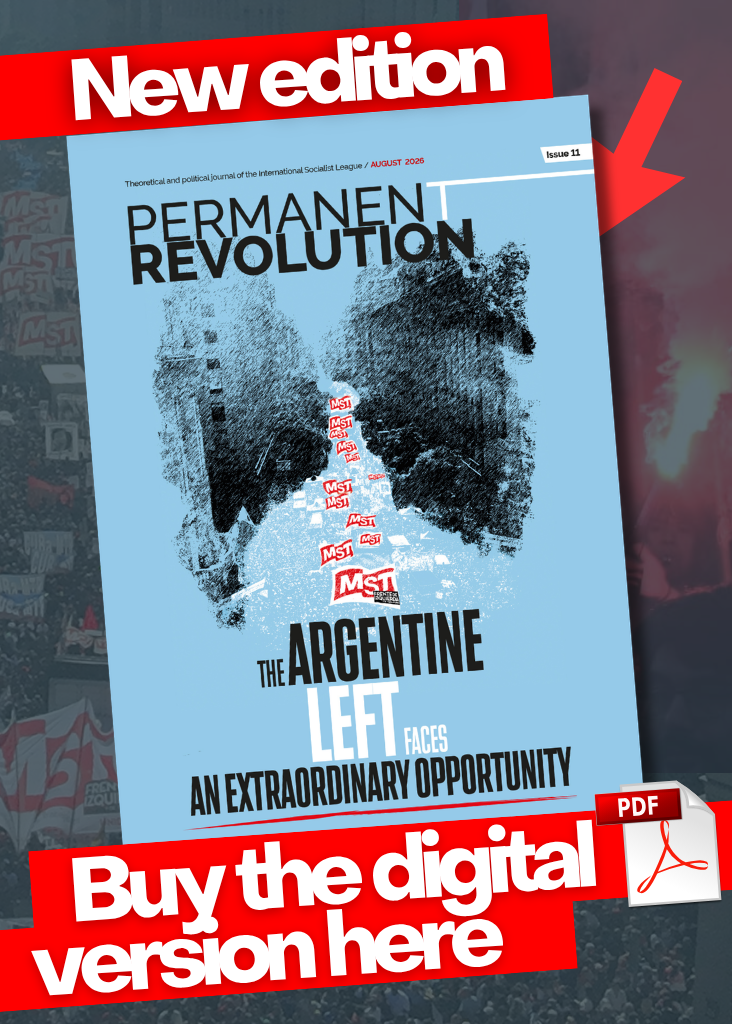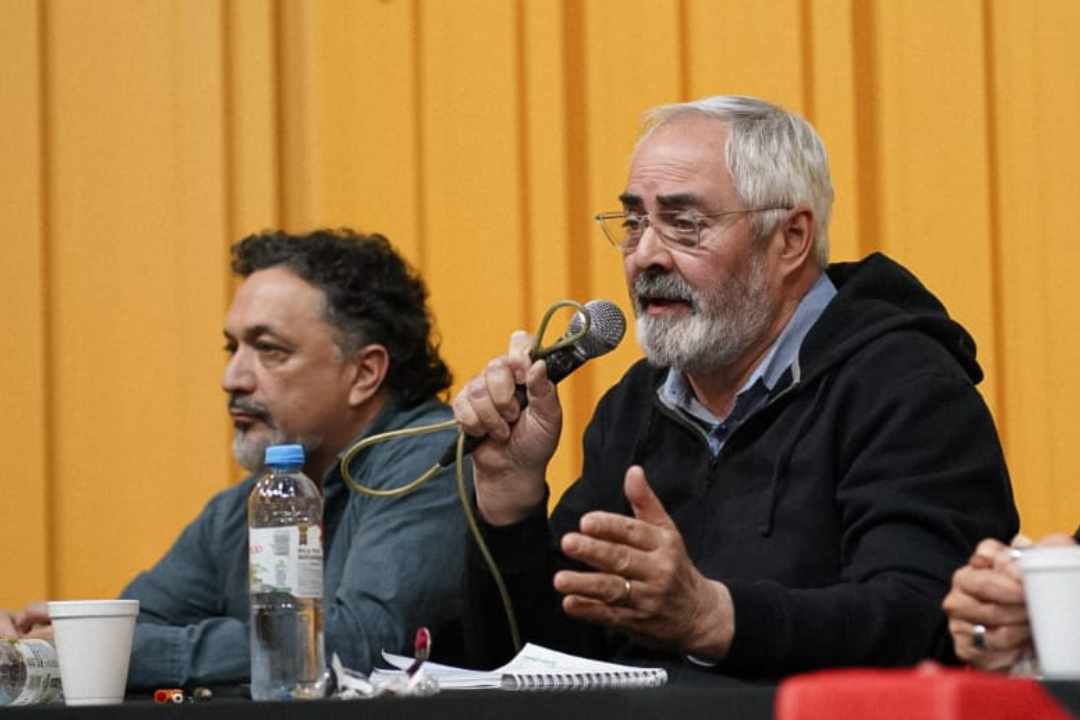
On Monday, June 29, the first meeting in a series of forums organized by the Left Front-Unity (Frente de Izquierda Unidad) was held in the auditorium of the UBA’s Faculty of Social Sciences to publicly debate the opportunities and challenges facing the left in Argentina. This first debate addressed the strategies, methods, and program for building a tool for the working class in Argentina, as well as the role of the left. The panel included leaders from the four political forces that make up the Front. Below, we share the remarks by Alejandro Bodart.
Time is of the essence, so we’re going to have to move very quickly on this. I believe the essence of this debate is that we’re facing a historic opportunity for the left, and therefore we need to discuss the ways to take full advantage of that opportunity. It’s clear that Milei isn’t at his best right now, though we can’t downplay the role of the right—because the right, as a global phenomenon, is here to stay. And even if Milei is struggling, they have other figures they can use to keep fighting to set back our rights. I believe that when we talk about an opportunity for the left, the fundamental factor is the crisis within the PJ. Because it is the PJ that is paving the way for the left to become a force capable of competing on equal footing with the old parties. This is the third major opportunity we’ve had on the left since the fall of the dictatorship. The first was in the 1980s with the rise of the MAS. A second one came in 2001 with Zamora, which was Izquierda Unida. Both of these ended in complete failure due to theoretical, political, and methodological errors. This is the third opportunity—the great opportunity that has presented itself to us—and we cannot let it slip away. Because, as we can see, it’s not as if there’s an opportunity every year. Rather, opportunities generally arise only every few years, and when an opportunity is not seized, we generally end up taking a step backward rather than moving forward. We believe that the political influence Myriam is gaining as a leading figure in the Left Front—and the Left Front itself—presents us with the opportunity to fight to win organic mass influence.
What does this mean? First and foremost, the possibility of organizing tens of thousands of people behind the Left Front’s revolutionary program. Because we’re talking about a shift toward the revolutionary left in our country, and this is an unprecedented development even on a global scale, where we often see such shifts end up as center-left or progressive variants. Here, we’re talking about the revolutionary left. If we manage to organize tens of thousands—and we believe we have that potential, provided we do our homework right—we would have the opportunity to lead struggles, to lead struggles against Milei’s government, because we must not believe that Milei or the right will fall solely through elections. We have to push forward by advancing our organization more and more to confront them in the struggles. This would open up the possibility of contesting unions, contesting internal committees, and emerging strong in the face of a potential revolutionary crisis—or an “Argentinazo,” or whatever we choose to call it. Because we believe that sooner rather than later, the dynamics of the country—the shift in public consciousness that is taking place—will eventually spill over into the streets and the mass movement. Therefore, we believe we are talking about a tremendous, extraordinary opportunity, if we know how to take full advantage of it. We don’t know whether a possible revolutionary crisis will occur before, during, or after the elections. We don’t have a crystal ball. It may be that the struggles that have begun today in the interior of the country will spread, leading to a powerful outbreak of the mass movement throughout the country. It may be a strong electoral result for the left that creates the possibility of a revolutionary crisis, because we do not believe that a strong electoral result will be viewed favorably by the bourgeoisie or by the ruling sectors. Or it may happen afterward. What matters is how we, as revolutionary socialists, position ourselves so as not to miss an opportunity as we did in previous revolutionary crises, where for one reason or another we were unable to capitalize on the moment and play a role. We believe, comrades, that the opportunity lies in the left preparing to contest for power in the country. That is what we are talking about. We’re not talking about recruiting 500 or 1,000 more members—which every organization can do; they can grow during this period. We’re talking about the fact that we have the possibility, if we do things right, to organize tens of thousands of comrades so that we emerge strong at the end of this process. Of course, our view is that no single party within the Left Front can, on its own, capitalize on this opportunity to its full extent. And this is an important point. There is no single dominant party within the structures of the working class, in the neighborhoods, or among the youth, capable of capitalizing on this. The possibility of capitalizing on this depends on a unified political strategy, the details of which we need to discuss. We believe that the Left Front has been a great tool, but it is not enough for the period ahead. It must evolve; it must change because it must cease to be merely an electoral front and transform itself, in our view, into a common organization—whatever we choose to call it: a great Workers’ Party, a great Unitary Party of the Left, a New Historical Movement, or whatever name we wish to give it. But if we do not have a common strategy to build a shared organization among the various forces of the Left Front—or among those who accept this challenge—it will be very difficult to take full advantage of this opportunity.
I’ll say it again: all parties can grow a little at the expense of the Left Front because there’s a shift toward us. But we’re talking about tens of thousands, and for that, we need a unified political strategy. Of course, a unified party raises the question of what to do with the existing parties. We’ve put forward a proposal: that the parties transform themselves into internal currents, tendencies, or whatever name we choose to give them. But if we don’t take on this challenge, it will be very difficult, because it’s very difficult to envision a Single Party through the dissolution of existing parties—which would even be a mistake—since there are nuances and differences that don’t prevent us from working together toward a common strategy, because we have a program: the program of the Left Front Unity. We have a strategy, which is workers’ government. We have nuances that can be evaluated and discussed within a common framework. And we must discuss a method—the method of the working class—where, if differences arise regarding action, decisions are made by majority vote, as happens and as we want it to happen in the labor movement.
Specifically, if a disagreement arises over which rally or event to attend on March 24, we can certainly discuss it among the members of that new party and vote by majority to go, not to go, or to discuss later what we will do. We cannot use these differences—which are often tactical, though there are also more fundamental ones—as an excuse for failing to organize a party, a movement, or a common organization of revolutionaries in Argentina. Mind you, we’re not talking about a “Broad Party” like those that have emerged since 2001—since the turn of the century—because those parties have been organized essentially around reformist forces, they have not had an insurrectionary program to resolve the question of power, but have instead been mere electoral variables that, when they entered an electoral crisis, ended up retreating—and they lacked a revolutionary method as well. We are talking about something new, because it is unprecedented in this country for the revolutionary left to be the one making headway. Therefore, it has the potential to organize a great force with a revolutionary program, a revolutionary method, and an insurrectionary strategy—the strategy of workers’ government—something that is unprecedented worldwide and could be a tremendous blow, not only for the Argentine ruling classes, but also a beacon of hope for other movements worldwide if we were to succeed.
If we don’t succeed, there will be a significant setback, and unfortunately, yet another opportunity will be lost. We are convinced that what we are discussing in Argentina is the possibility of the left becoming an alternative not only for government, but for power. That is what this is all about. That is why we must not treat this debate as just another one of the many we have had on the left. We need to move forward in our discussions with one another, shaking off what so often causes us to fall into petty squabbling, into cheap debates, into trying to outdo one another—one activist more, one activist less. What we’re talking about here is the possibility of the revolutionary left becoming an alternative capable of contending for power—of contending, if we act together, for the possibility of overcoming the barrier of bureaucracy in many places and winning over unions and steward committees. What we’re talking about is what all of us here—all the activists and the leaderships of the parties that make up the Left Front—have aimed for since we first became activists: to defeat Argentine capitalism within the framework of an internationalist policy and pave the way for a working-class solution. Therefore, we in the MST believe that every effort made and yet to be made is worthwhile, the patience to discuss—to discuss among ourselves—that there is no possibility of building a great party with mass influence without learning to coexist with certain nuances and differences, knowing that many debates will not be resolved immediately, but will be resolved through our joint action. We need to build trust by acting together; we have made progress within the Left Front on the electoral front, but we often do not act in the same way in the class struggle or in union disputes—we struggle to maintain a common orientation. Well, the time has come for us, in light of what has been raised, to make an effort to move forward in that direction. And this is the proposal we are bringing up for discussion.
We have a revolutionary program—that of the Left Front—which, of course, needs to be improved, expanded, and advanced. What we need most today is a strategy to organize tens of thousands, to take action, and to bring over the millions of workers who could come from Peronism but who are in complete crisis with that leadership. We need to attract intellectuals, human rights leaders, and union leaders who fight for these causes every day. Because there are many people who won’t join political parties directly, but who might be willing to campaign for the project of a Unified Party—a party with democratic structures that, through our program and sound methods, can give the Argentine working class the chance to challenge for power. Let’s not miss this opportunity we have. Let’s open a frank debate among ourselves. Let’s listen to one another, because often we engage in debates without really connecting—we focus on how to respond to our comrades rather than on listening first—so that we can develop a collective strategy. That is the challenge we face, and I believe that if we approach it correctly, we will all be able to advance toward meeting the Argentine working class’s need for a revolutionary leadership that will lead its struggles to victory, comrades.
As has been said here, this is the first of five debates. Let’s all commit to holding all five and not letting this end any sooner. Because we need to continue delving deeper into all the issues under discussion. Every time the left has had a huge opportunity, it has been linked to a crisis within the PJ. In ’83, it lost the election, and that was linked to the subsequent rise of, for example, the MAS in Argentina. In 2001, people were chanting, “Without Peronists or Radicals, we’ll live better,” and that was also linked to the experience of Zamora, and so on. Now it’s linked to the new crisis. But be careful: in ’83, since the left couldn’t capitalize on it, Menem returned. And in 2001, Kirchner ended up in power, and there were several more PJ governments. Why am I bringing this up? If we don’t seize this opportunity quickly—because we don’t have a lifetime to debate this—Peronism could regroup and end up once again acting as a brake on workers’ progress toward class independence. That’s why this debate is so important, and we have to engage in it thoroughly, because nothing is predetermined. There’s a huge opportunity, but be careful. I believe that, obviously, if we’re talking about the opportunity we have, we can’t be foolish. And it’s clear that Myriam has qualities that have allowed her to become the leader she is today. We can’t deny that; we have to acknowledge it. Now, I also believe that the Left Front has played a part in making Myriam who she is and in creating this opportunity for us. And in recent times, it has been the struggles in general that have taken place that have brought the left into the spotlight. Because we’ve been the only ones standing with the Garrahan Hospital, the only ones standing with the retirees, the only ones present in every struggle. And all of that social movement has contributed to the opportunity we face today. Now the problem is how we move forward with the more substantive debates.
We are in favor of united committees. We’ve said so, and we’ve written it down. But be careful: if we have a united committee but no agreement on where we want to take it, those committees—far from bringing in tens of thousands of people—could end up scaring them away because of the crisis and the debates within the left, leaving us with only the activists. That’s why it’s important to discuss more substantive agreements, in addition to the committees, which are important in their own right. What program, what strategy, and what discussions are we going to bring to these unifying committees that we need to build? But first, we have to discuss whether we can actually agree. If we’re going to tear each other apart over this or that proposal—be careful—because we’ve already had bad experiences in 2001 regarding this, where there were calls for unity but it ended in a bad experience because we were tearing each other apart; it was a forum for the left to tear each other apart.
We want to have a clear discussion. We need to start discussing whether we can agree to build together a party, a movement, or some kind of organization that can bring together tens of thousands of people. For us, it would be essential for the FITU to evolve into that, or at least for those of us who agree on this to start working toward that goal. Of course, this is an enormous, enormous challenge. Because everyone is used to their own party, where, more or less in general, there is so much agreement that there aren’t many problems. But today, that’s just a comfortable way of dealing with reality. In that sense, the problem is conservative, because we have to set the bar higher if we want to make the most of this opportunity. Because does anyone believe that without a revolutionary party of tens of thousands, we can challenge for power? No, comrades, no. We need a party that brings together tens of thousands—call it whatever you like. That is the debate: how we build it and whether it’s possible among us. We’ll tell you this: if we’re not capable of—and if it’s not possible to build—a unified organization capable of truly challenging for power, we’re going to miss our chance. We’re saying this clearly. We want to—and we’re going to—fight to ensure we don’t miss that opportunity.
Is it possible for political parties to coexist as distinct currents? Well, it’s a tremendous challenge, but if we aren’t able to sit down and discuss how we can turn those challenges into reality, then let’s just focus on something else, comrades, because the revolution constantly presents us revolutionaries with challenges.