A political critique of LC’s positions from the perspective of revolutionary Marxism.
By Marco Ferrando
Lotta Comunista is a “sui generis” organization on the Italian left, founded way back in 1965. Various organizations from other countries, largely of a Trotskyist tradition, have become acquainted with LC through the annual international meetings (2023–2026), organized primarily by LC and the NPA-R in Milan and Paris. Undoubtedly, the special relationship that the French NPA-R has chosen to establish with LC has contributed to its international recognition.
We therefore believe it is important and useful to clarify the political nature of Lotta Comunista. And, above all, to compare the organization’s self-image with reality.
LC is a relatively large organization, with several thousand members. It is likely the largest organization on the Italian far left, with a presence in factories and among students (both colleges and high schools); it also has a fairly broad territorial reach, although distributed (very) unevenly, and has numerous local branches and a solid cadre of permanent leadership. The subtitle that appears in its eponymous newspaper (“Leninist Groups of the Communist Left”), along with some of the organization’s positions that we will analyze later, has often led to LC being associated with the Bordigist tradition (of Amedeo Bordiga, founder and first secretary of the Communist Party of Italy, whose initial extremism was the subject of Lenin’s critique in “Left-Wing Communism: An Infantile Disorder”). In reality, this is a misattribution. LC does not stem from Bordigism nor has it ever claimed such an affiliation. Its founding group, on the contrary, came from the ranks of anarchism, specifically the GAAP (Anarchist Groups of Proletarian Action), which emerged in 1951 under the banner of libertarian communism. During the 1950s, this group participated in the brief “Azione Comunista” movement, a current of internal and external opposition to the PCI (Italian Communist Party) surrounding its 8th Congress (1956). Subsequently, the group led by Cervetto and Parodi underwent a gradual ideological evolution: it broke definitively with anarchism and gave rise to LC on the basis of a formal embrace of “Leninism.”
However, nothing could be further from the ABCs of Leninism than LC’s theoretical positions, political orientations, and forms of organization. On the other hand, some features of early anarchism remain as a residual substrate—discreet but persistent.
LC AND DEMOCRATIC CENTRALISM
Let’s start with the forms of organization. LC disregards democratic centralism. It has not held a single genuine congress in 60 years, neither at the national level nor within the various regional circles (the basic structure of LC). Its leaders are not elected, but rather appointed or self-appointed by the “center.” Even their names are formally unknown to the vast majority of members and are generally deduced from the bylines that appear at the bottom of articles in the monthly newspaper. The organization’s political positions are determined without any form of internal voting. Political discussion and the exchange of differing viewpoints have always been absent from LC at all levels. The only space for discussion arises when a new contact participates in a public initiative organized by a territorial circle and, eventually, raises doubts or asks questions. But such a space does not exist within the organization’s membership.
Throughout LC’s long history, anyone who has raised questions about the party line or even simple tactical differences regarding specific decisions has been systematically expelled from the party. LC boasts that, unlike other organizations, it has never suffered splits, thanks to the supposed rock-solid strength of its line. In reality, it has experienced several splits, of varying importance and, for the most part, of a local nature (in Lombardy, Liguria, Turin, Naples…). Undoubtedly, this “granite-like” unity constitutes a disciplinary duty, both individual and collective. Anyone who fails to fulfill this duty by expressing any kind of disagreement “excludes themselves,” whether as an individual or as a group. Those who “exclude themselves” have at times been subjected to treatment befitting a “pariah”: “lice” was the public epithet reserved for a group of comrades who split off in Genoa in the early 1970s. Other comrades were expelled from LC in 1972 following a trial-assembly without the possibility of defense, convened specifically at the Genoa Sampierdarena headquarters, after they had been forced to walk between two rows of security personnel who were shouting and making threats. These are just a few examples.
It is, of course, difficult to compare Leninist democratic centralism with this organizational practice.
ARRIGO CERVETTO’S THOUGHT AND THE LC ORGANIZATIONAL RITUAL
Like any cult, the organization has its own guru. This is Arrigo Cervetto, founder of LC alongside Lorenzo Parodi; both had roots in anarchism in the immediate postwar years and have long since passed away. Cervetto’s ideology is the be-all and end-all of LC, just as—to put it plainly—Ocalan’s ideology is the be-all and end-all of the PKK. He is quoted, exalted, and held up as the object of a veritable cult. Every issue of LC’s monthly newspaper evokes him, in one way or another, to pay homage to the dogma. Just as Bordiga’s “organic” centralism positioned the “Communist Program” as a substitute for Leninist democratic centralism, LC does the same with the thought of Arrigo Cervetto, placing it above the party hierarchy as a kind of creed. This is the theory of the “scientific party.” The “scientific” method is that of Arrigo Cervetto. It is not debated; at most, it is interpreted.
Like any cult, the organization also has its own ritual. The jacket-and-tie attire of its members serves as a public sign of recognition for LC. And, above all, it is intended to be just that. The organization’s “seriousness” is reflected in the “seriousness” of its members. And the seriousness of its members is reflected in a strictly austere and traditional dress code. It is a distinguishing feature set against the supposed “petty-bourgeois, sloppy, and disheveled decadence” that is said to characterize most left-wing activists. The same applies to hairstyles. Wearing short hair is a general guideline for LC members. In the early 1970s, the rejection of the so-called “long-haired” crowd was the subject of meetings convened specifically for that purpose, accompanied by the corresponding collective political mandate—in stark contrast, as one can imagine, to the customs of the rebellious youth of that era. Many LC members were forced, much to their chagrin, to comply with this rule.
Lotta Comunista’s main activity consists, above all, of selling its monthly newspaper. The newspaper (“Lotta Comunista, organ of the Leninist groups of the Communist Left”) has a distinctive profile. The opening editorial always aims to be highly “theoretical,” while the political summary of current events is reserved for the last page. The entire publication is in black and white, strictly without images. The theory of the “scientific party” permeates all the articles in the monthly. The topics covered range from the history of the labor movement to the analysis of the world economy and inter-imperialist relations, using a generally very economistic method of interpretation, in which every superstructural phenomenon is reduced to an underlying economic factor. A sort of vulgar, non-dialectical materialism. Issues specific to the day-to-day political struggle—whether a referendum, a reactionary law, or a current political controversy, especially in the realm of domestic politics—are often sidelined because they fall outside LC’s sphere of political intervention. The newspaper’s language is deliberately convoluted, at times cryptic, reserved for the initiated. Its ability to communicate—both to the vanguard and to broad sectors of the masses—is inversely proportional to the scope of its militant circulation. LC acknowledges the“difficulty encountered in reading our newspaper,”attributing itto “the Marxist method by which the newspaper observes and judges events.” But that is not the case. Among other reasons, this is because it is often precisely “the events” of real politics that are conspicuously absent from LC’s press.
In reality, the primary function of the LC newspaper is not to popularize the party’s position, explain it, develop it, or make it accessible to readers in order to raise their political consciousness. Rather, its function is to highlight the elitist superiority of the “science party” over any other publication or organization. The less understandable the newspaper is to the majority, the more the superiority of the “science party” appears to be demonstrated. And the more that superiority appears to be demonstrated, the more the organization’s prestige increases. The newspaper ends up becoming a somewhat narcissistic reflection of the organization that produces it. At best, it is the “collective organizer” of a sect—certainly not of a Leninist party.
THE REJECTION OF ANY FORM OF UNITY OF ACTION AND OF THE SINGLE FRONT POLICY
LC has always rejected any unity of action with other political and labor union groups on the left in the arena of political struggle—both in the context of the mass united front and in that of unity of action within the vanguard. Ordinary united political demonstrations opposing the bourgeois government—whichever it may be—have been systematically ignored by LC throughout its history. From the united demonstrations of the far left in the early 1970s for the release of comrades unjustly accused (notably the case of the anarchist Valpreda, accused of the Piazza Fontana bombings in Milan, which were in fact carried out by extremist fascists), to the united demonstrations in defense of occupied factories (for example, most recently the GKN metalworks in Florence), and the united demonstrations against police and/or anti-immigrant laws—to cite just a few examples among many possible ones. The same applies to the mass anti-war movements themselves, which typically see the united convergence of various organizations on the political left and/or within the labor movement, with the sole exception of Lotta Comunista.
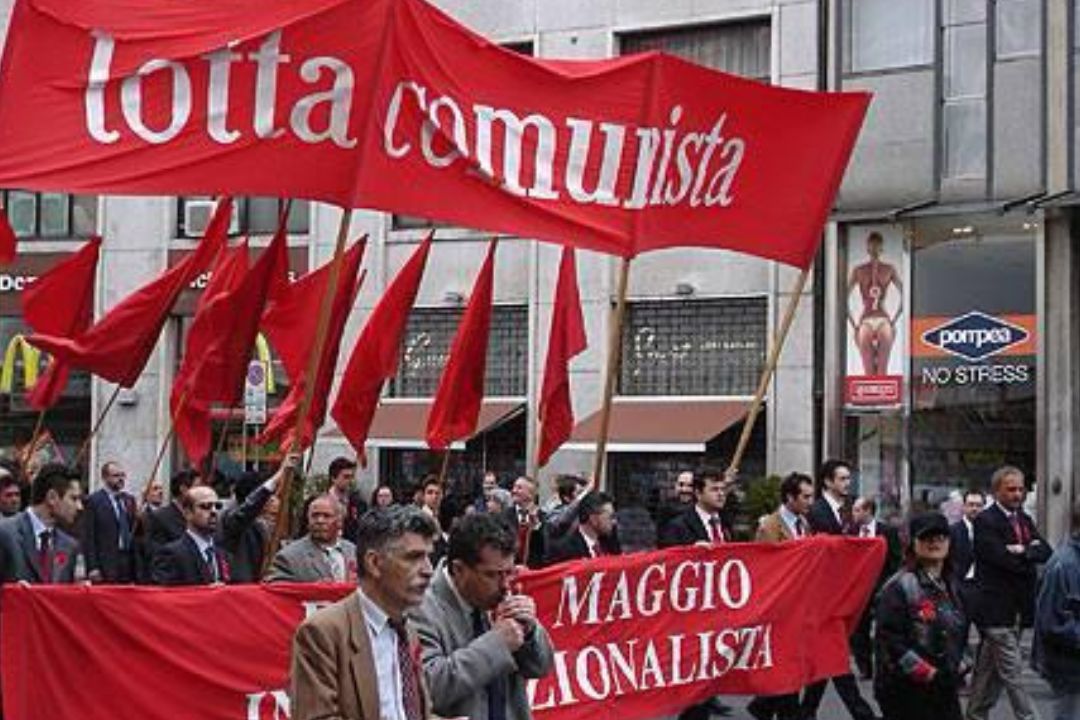
LC’s presence at each of these events is limited to selling its own newspaper—with members dressed in suits and ties—on the sidelines of the demonstrations. Even in the case of the annual mass demonstrations on April 25 (the anniversary of Italy’s liberation from the fascist regime), LC is notable for its absence. The only exception is May Day. Every year on May 1, in the major cities of the North, at the end of the united demonstration, the often substantial bloc of Lotta Comunista can be seen. LC dedicates months of propaganda efforts by its own local circles to preparing this bloc, mobilizing all its contacts. May 1st is the moment when LC showcases its party. It is a sort of “annual mass” designed to satisfy the organization’s sense of patriotism.
LC’S “HARD-LINE” APPROACHES IN ITS RELATIONS WITH THE LEFT
LC’s relations with other far-left groups have at times involved the use of violent methods. This was particularly true in the 1970s, though not exclusively. One incident marked the very beginning of these relations: the despicable and extremely violent attack suffered by LC in 1972 in Milan at the hands of the security forces of a Stalinist group (Mario Capanna’s so-called “Student Movement”), combined with the infamous slander of portraying LC as a “fascist” organization.
Instead of politically denouncing what had happened in the name of workers’ democracy, LC reacted with a speculative “militarist” turn against all far-left organizations, such as Lotta Continua and even Avanguardia Operaia (which, however, had defended LC against the Stalinists). More generally, starting in Genoa (its historic stronghold), LC adopted a policy of “military” closure of its own spaces—that is, the spaces it controlled—against any possibility of political intervention by rival organizations. For example, in May 1975, in Genoa, its security detail attacked activists from a university collective who had dared to publicly criticize the indiscriminate use of expensive university lecture notes by professors close to LC. In particular, the Trotskyists who were part of that collective were attacked; they were forced to launch a united front of the city’s far left against LC’s methods, in defense of workers’ democracy.
A lot has happened since then. LC has undoubtedly toned down the most radical forms of its own intolerance. But not always. In 2017, members of the Partito Comunista dei Lavoratori were subjected, in Genoa, were shoved, kicked, and had their flags torn up, simply for having distributed leaflets at the entrance to the Ilva steel mill—which was “controlled” by LC—expressing some criticism of the union’s line. LC employed “military”-style tactics against groups and comrades who had left its organization in Lombardy, through actions aimed at physically preventing them from holding their publicly announced assemblies. It is no coincidence that the issue of workers’ democracy and the methods used by LC toward other groups was, years ago, the subject of a public exchange of criticisms between LC and the French Lutte Ouvrière.
In recent years, we have witnessed a positive shift in LC’s attitude, particularly toward the Trotskyists. This has taken the form of more peaceful and respectful relations, and even some collaboration and editorial openness. However, this change in attitude has occurred empirically, without a self-critical reassessment of past methods. This exposes LC to the risk of new acts of reaction (or “excesses of self-defense,” to use a euphemism), as occurred during the clashes in Milan and Rome with pro-Palestinian activists during the “occupations” of their respective universities. In short, LC lacks a Leninist culture grounded in principles when it comes to relations with other organizations in the labor movement. This reflects the organization’s sectarian self-centeredness.
LC’S PERPLEXITY REGARDING MOVEMENTS THAT ARE NOT DIRECTLY PROLETARIAN
LC ignores the reasons and demands of mass movements that are not directly proletarian. This includes youth mass movements, the large anti-globalization movement of the early 2000s, women’s liberation movements and those of other particularly oppressed minorities (LGBT), as well as, more generally, movements for democracy, environmentalism, peace, or anti-fascism. Any issue of a democratic nature—one not directly class-based—meets with indifference and disinterest from LC. The Leninist conception of *What Is to Be Done?*, which emphasizes the need to combat all forms of oppression in order to build an anti-capitalist class hegemony over all demands for liberation, is completely ignored by LC. For LC, these are fundamentally issues and areas specific to the intellectual petty bourgeoisie, not the working class. In 1974, even on the issue of the referendum on divorce, LC remained undecided for a long time, finally coming out with a carefully crafted “YES” in order to avoid tensions within its own ranks. In reality, on the issue of civil rights, LC endorses regressive prejudices present among workers, hindering the development of their consciousness and effectively providing cover for positions of Stalinist origin.
LC’s work on immigration is an exception, albeit only partially. In this area, particularly since the pandemic, LC has carried out specific solidarity and assistance efforts (food and clothing drives, language classes, etc.), involving several of its local chapters. But even in this area, where it expresses a “progressive” stance, LC has never committed itself to opposing the xenophobic and reactionary legislation of bourgeois governments or to expanding citizenship rights. Not because LC holds positions favorable to such reactionary legislation, but because, in general, it does not intervene in the arena of democratic political struggle—neither as a party nor, much less, in a united front with other organizations. The arena it truly abandons is that of politics.
LC’S CAPITULATION TO THE CGIL’S UNION BUREAUCRACY
LC’s involvement in the realm of class struggle has a strongly economistic character. In the 1970s, LC fostered a vulgar “workerist” view that, in essence, reduced the working class to the factory. Proletarian sectors employed in the service sector were considered consumers of surplus value and, therefore, outside the class. Famous was its denunciation of the “privileges” enjoyed by street sweepers compared to metalworkers employed in production (while LC’s denunciation of “shopkeepers”—treated on the same level as the bosses—intensified). Subsequently, this view changed for the better, coming to include the entire class within the proletariat. However, a fundamentally wage-oriented approach to union intervention remained unchanged, to the detriment, for example, of the demand for a drastic reduction in the workday without a reduction in wages. Moreover, LC completely lacks any Leninist conception of a transitional stage that would serve as a bridge between minimum objectives and the revolutionary perspective.
However, this is not the most negative aspect of LC’s approach in the classroom. The most negative aspect lies in LC’s subordination to the CGIL’s leadership bureaucracy. With a few brief and partial exceptions, LC systematically supports the leadership bureaucracy of Italy’s main union against the internal left-wing and/or class-conscious opposition. This is a profoundly opportunist line. All the more so given that the CGIL bureaucracy today, in fact, also constitutes the political leadership of the labor movement in Italy. As such, it bears primary responsibility not only for the serious setbacks suffered by the working class in its social condition (starting with the collapse of wages), but also for the profound decline in its levels of mobilization and the widespread penetration, reactionary and populist ideas within its ranks. Not only does LC fail to denounce these responsibilities, and not only does it fail to fight for a unified and radical shift in platforms and struggles, but it directly supports the bureaucracy in all instances of confrontation, starting with confederal and federation congresses, negotiating in exchange for its own space and role in national and local leaderships. This is exactly the opposite of a Leninist line: a line of collaboration with “the agents of the bourgeoisie” within the labor movement.
Not only that. LC’s approach to the day-to-day management of labor disputes has, on more than one occasion, subordinated the interests of the working class to its own organizational interests (whether real or perceived). Here is just one recent example. Ilva is the leading steel company in Italy and Europe, with 12,000 employees. It has been in crisis for a long time. Now a new anti-worker restructuring has been announced—possibly linked to a new change in ownership—which aims to further reduce the workforce, exploiting a potential divide between the workers at the Taranto plant (the largest and most controversial plant) and the workers at the other two plants (Genoa and Novi Ligure). In Genoa, Lotta Comunista leads the FIOM (the CGIL’s metalworkers’ union) at the city level and at the Ilva plant. Its main union leader at the factory publicly declared that“the Genoa plant does not want to be dragged down into ruin by the Taranto plant.” This is a declared willingness to endorse the division between workers in the North and the South in order to protect the Genoa plant and, with it, its own role as an organization. An organization even willing to engage in a “tough fight” when it comes to defending its own role, but at the expense of the working class’s unity against the government and the bosses. A defense of the party placed above the united defense of the class.
LC’S ANTI-LENINIST POSITION ON THE “NATIONAL QUESTION”
LC completely ignores the national liberation struggles against imperialism. This is a central aspect of LC’s character, the one best known following the experience of the international meetings in recent years.
We must be clear about the particular gravity of LC’s position. This is not a matter of differing analyses of Russian imperialism’s war of invasion in Ukraine (for example, regarding the greater or lesser role of the inter-imperialist element in this war), nor is it a matter of differing views on the nature of the Palestinian resistance leaderships, except indirectly. Rather, it is, in general, indiscriminately and deliberately, a denial of the very existence of oppressed nationalities and of the very principle of their defense against imperialism.
According to Lotta Comunista, the last progressive national liberation war was the one in Vietnam. In the half-century that followed, the global expansion of imperialism (the so-called “unitary imperialism” theorized by Cervetto, which, according to him, also included the USSR) is said to have dissolved and absorbed all residual national issues. As an LC leader authoritatively put it at the last meeting in Paris:“There are no peoples, there areonlyclasses.” Everywhere, there is only capital and labor, proletarians and bourgeoisie, capitalists and wage earners. Period. Any basic distinction between imperialist countries and colonial or semicolonial states is explicitly rejected in the name of proletarian internationalism—an internationalism indifferent to national liberation struggles and, indeed, opposed to them.
In much cruder terms, this is exactly the position that Lenin denounced as “imperialist economism” in his seminal writings on the self-determination of nations between 1915 and 1916, in his polemic with Luxemburg, Radek, and Piatakov. With one difference. Lenin argued for the need to fight for the right to self-determination even for semi-colonial countries that were relatively developed from a capitalist standpoint—as was the case with Poland—precisely because he did not reduce imperialist national oppression to its economic aspect alone. LC goes so far as to reject the concept of self-determination for an oppressed nationality even in the face of a fully colonial state such as the Zionist state. It thus goes far beyond, both in content and method, the erroneous positions of Rosa Luxemburg. LC’s refusal to support the Palestinian national cause in the name of indiscriminate support for both Palestinian and Israeli proletarians reveals the extent of LC’s anti-Leninism. And it lies at the root of the fundamental contradiction between LC and the very dynamics of the pro-Palestinian movement. Both in Italy and on the international stage.
In fact, on the issue of oppressed nationalities, LC seems to be effectively echoing the ideological denialism of the anarchist Proudhon—the very man whom Marx lambasted in relation to Poland and Ireland.
LC’S “STRATEGIC ABSTENTIONISM” IN THE ELECTORAL ARENA
LC advocates what it calls “strategic abstention” in the electoral arena. In other words, it rejects the Leninist use of the electoral platform as such, under any circumstances and at all times.
This is the aspect that has often led to LC being identified as a Bordigist group. In reality, Bordiga’s abstentionist position regarding participation in bourgeois elections was quite flexible. It was the position of the Bordigist faction (“Soviet”) within the PSI, as a reaction—albeit an “infantile” one—to the opportunist parliamentarism of the Party leadership. That position was in fact set aside when the “Soviet” faction merged with Gramsci’s “Ordine Nuovo” at the founding of the Communist Party of Italy. In fact, the PCI, still under Bordiga’s leadership, ran in the 1921 general election, partly as a result of Lenin’s campaign in favor of the revolutionary use of Parliament against electoral abstentionism, which he argued at length in “Left-Wing Communism” (1920).
Lotta Comunista’s “strategic abstentionism” is, at its core, the very position against which Lenin waged his battle. Naturally, LC is very careful not to engage in polemics with Lenin; it simply brushes him aside. LC’s fundamental thesis is that parliamentarism has“already”been objectively superseded by the dynamics of capital, which uses it to deceive the workers and divert them from the class struggle. As if that had not always been the nature of bourgeois parliamentarism and the bourgeois use of that institution. For Lenin, the point is to use the bourgeois electoral platform not to ignore or gloss over its nature, but precisely for the opposite reason: to expand revolutionary propaganda and agitation as much as possible for a workers’ government and, therefore, for the revolutionary destruction of parliamentarism. Moreover: the more deeply entrenched bourgeois parliamentarism is, the more valuable the revolutionary use of the electoral platform (and, if elected, the parliamentary platform) becomes—precisely to develop class consciousness starting with its vanguard. Here, too, we are faced with the ABCs of the Leninist method—the very method that LC “strategically” rejects. Here, too, the regressive legacy of Arrigo Cervetto’s original anarchism rears its head.
IN CONCLUSION: A “SECTARIAN CENTRIST” ORGANIZATION
What, then, is Lotta Comunista’s program, in short? Formally, communism and the dictatorship of the proletariat, revolutionary internationalism, and the condemnation of imperialism and imperialist war. But the gap between the organization’s proclaimed program and its actual line is very wide. On the one hand, the maximum program; on the other, economistic minimalism and subordination to the union bureaucracy. In between lies a doctrine grounded in Cervetto’s theory of the “scientific party,” as a set of doctrinal precepts: whether on the analytical level (“unitary imperialism,” the “USSR as state capitalism”…), whether at the level of political behavior (electoral abstentionism, denial of national liberation struggles, rejection of any unity of action), or at the level of historical assessments (Trotsky’s “strategic inadequacy,” which Cervetto claims to have remedied). All of this is seasoned with a great deal of intellectual smugness and organizational arrogance.
Overall, from a revolutionary Marxist perspective, LC can therefore be characterized as a sectarian centrist organization, strongly self-centered, which makes the self-preservation of LC the be-all and end-all of its entire political agenda. In short, Lotta Comunista’s real program is and remains solely Lotta Comunista.
You may also be interested in: “Lotta Comunista: A Caricature of Leninism”