By Imran Kamyana
This document was originally written in Urdu in December 2023, against the backdrop of the events described in the opening paragraph. Although it was prompted by those immediate circumstances, its primary purpose was to present Lenin’s position on the national question as clearly and concisely as possible.
It was submitted to the Third Congress of the ISL as a reference document. Since Lenin’s quotations had been translated from Urdu back into English, there were inevitably some minor variations from the standard English translations. In the present version, published during another upsurge of the People’s Rights Movement in Kashmir, all of Lenin’s quotations have been replaced with the standard English translations to eliminate any such discrepancies.
This edition also contains a few additions that remain fully consistent with the original framework of the document. In particular, several of Lenin’s quotations have been expanded to provide greater clarity. On this delicate question, Lenin—and, where relevant, Trotsky—is deliberately quoted at length in order to avoid any confusion, preclude accusations of cherry-picking or distorting their position, and allow their arguments to speak for themselves.
It hardly needs to be pointed out that, in these quotations, Lenin uses the term Social-Democracy to refer to the revolutionary Marxist movement, as this was the name by which Marxists were generally known at the time.
The long march and ongoing sit-in in Islamabad by the Baloch Solidarity Committee (BYC)—organized against extra-judicial killings, enforced disappearances, and general state repression in Balochistan—has once again brought the smoldering national question in this country to the forefront. This protest is part of a series of movements that have arisen in recent years among the oppressed nationalities in Pakistan. Whether it is the rise of Pashtun Protection Movement (PTM) in Khyber Pakhtunkhwa (particularly in the tribal districts), the powerful and widespread movement in Kashmir against expensive electricity, the ongoing agitation in Gilgit-Baltistan against the withdrawal of the wheat subsidy, or the sit-ins in Sindh against killings in fake police encounters… these movements and protests reflect the deep deprivation felt in the peripheral or backward regions of this crisis-ridden capitalist state and the continuous oppression inflicted upon the subjugated nationalities.
Ruling-class politics and state repression have tried relentlessly to suppress these voices, but despite this, they have gained strong support among the deprived and toiling masses, and they have now become crucial in shaping the country’s current political and social landscape. This situation again highlights the fact that even after more than seven decades, the belated and crisis-ridden capitalist system here remains utterly incapable of resolving the national question; in fact, the intensity of the national question has only increased over time.
Moreover, this condition is not limited to Pakistan alone; the national question remains unresolved in most South Asian states, including India. Although the forms in which it appears—its intensity, scale, and composition—may differ, the class character of these states, born out of colonial rule, is not fundamentally different from one another. The history of imperialist occupation by these states begins as early as 1947: on the one hand, military operations were carried out to occupy Balochistan and Kashmir, and on the other hand, even “progressive” rulers like Nehru wasted no time in attacking Hyderabad to forcibly integrate it into India and in occupying the remaining parts of Kashmir.
In general, the character of institutions and classes shaped by specific historical factors does not change even after decades or centuries. In this broader historical context, the South Asian states of today are simply a continuation of the colonial state—designed to keep the people of this region politically, socially, and psychologically subdued and wounded, and to enable the deep and extensive plunder of its resources. The same situation is visible in other backward regions such as Africa and Latin America. For hundreds of years, these continents were violently devastated—economically and culturally—through direct colonial robbery, and the development and glitter of Western capitalism arose, at least in part, from the ruin of a large part of the world.
Due to the specific conditions that emerged after the Second World War, even though the Western colonizers departed, the “independent” states that took shape were merely components of a new imperialist system. The purpose of this system was to ensure the continuous flow of wealth and resources from these regions to the imperialist centers. As a result, the ruling classes of these states retained the same comprador character—based on servility and commission-agent politics—that they had before their so-called independence. These include not only the ruling elites of the dominant nations but also those of the oppressed nations.
Despite differences in nationhood, religion, language, resource distribution, and political influence, the relationship between these ruling classes must be understood within an overarching imperialist framework that maintains class and national oppression and exploitation. Moreover, these backward states—while serving as tools and subordinates of global imperialism—also adopt an imperialist role within the regions under their own control. In these states, the ruling classes of oppressed nations often hold a relationship to the ruling classes of dominant nations analogous to the relationship between dominant nations’ ruling classes and global imperialism. In this way, a full hierarchy of shared exploitation and plunder is established from the bottom to the top.
In countries like Pakistan, the overwhelming political and economic control exercised by state institutions—especially the military—makes the bourgeois-military elite an important part of this hierarchy, which also includes personnel belonging to oppressed nations. Yet despite the comprador role of the ruling elites or dominant strata within the oppressed nations, the existence of national deprivation, oppression, and exploitation cannot be denied in any way. At the same time, however, Marxism cannot reconcile or compromise with nationalism.
In the advanced West, nations—or nation-states with a relatively uniform national composition—were the product of a specific stage of capitalist development, in which revolutions, wars, and industrialization played a decisive role. This was essentially the period of bourgeois-democratic revolutions. Regarding the formation of nation-states, Vladimir Lenin identified the era between 1789 and 1871 as “precisely the period of national movements and the creation of national states. When this period drew to a close, Western Europe had been transformed into a settled system of bourgeois states, which, as a general rule, were nationally uniform states.” (The Right of Nations to Self-Determination, 1914)
But, like its other historic tasks, capitalism succeeded in resolving the national question only in a relatively small part of the world. Today, not only have national-democratic revolutions become a thing of the distant past, but capitalism long ago transcended national boundaries and entered its imperialist stage. As a result, in Lenin’s words,
[N]ational oppression has been extended and heightened on a new historical foundation. Hence, it follows that… we must link the revolutionary struggle for socialism with a revolutionary program on the national question. (The Revolutionary Proletariat and the Right of Nations to Self-Determination, 1915)
Today, most backward regions of the world consist not of nationally unified or homogeneous states but of multi-national states where the national question exists in varying degrees of intensity. The fundamental reason for this is again the historical backwardness of these states. On the one hand, their bureaucracies and ruling classes possess the imperialist psychology and ambitions described earlier; on the other hand, they are economically so weak and impoverished that they are incapable of providing balanced, even development to the nations and regions under their control. Nor do they possess the historical space, economic comfort, or capacity required to integrate different nationalities in a healthy manner to form a unified nation.
The national question arising from these conditions is inherently complex—sometimes extremely intricate—and no ready-made formula can be proposed in advance that could simply be applied everywhere. Nevertheless, the extensive work of the principal Marxist theorists does provide some invaluable general principles. Keeping these in mind is crucial for revolutionaries, because in such regions no revolutionary socialist program can be formulated without addressing the national question in an appropriate manner.
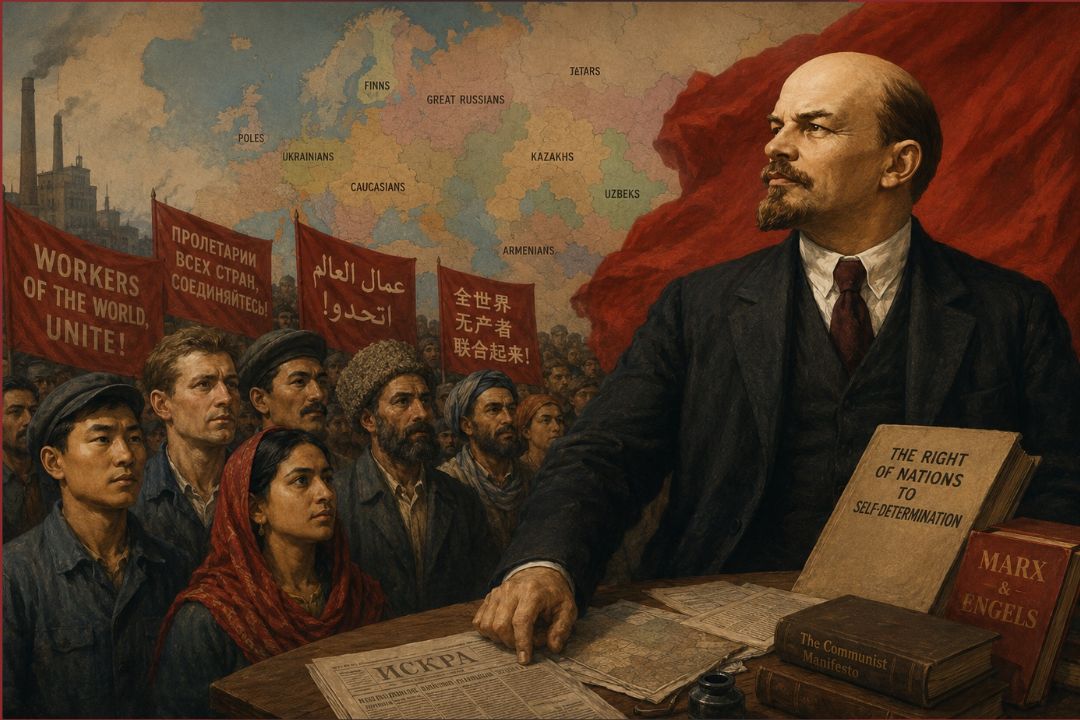
Lenin understood this reality clearly. Building upon the position of Marx and Engels, the Bolshevik Party presented a program of national liberation to the oppressed nationalities that became a decisive factor in the success of the Bolshevik Revolution. In The History of the Russian Revolution, Leon Trotsky offers a summary of the national question in Russia and Lenin’s policy toward it—one that still deserves to be read and understood today:
Russia was formed not as a national state, but as a state made up of nationalities. This corresponded to its belated character… Thus was created an empire of whose population the ruling nationality constituted only 43 percent. The remaining 57 percent, were nationalities of various degrees of culture and subjection… Lenin early learned the inevitability of this development of centrifugal national movements in Russia, and for many years stubbornly fought—most particularly against Rosa Luxemburg – for that famous paragraph 9 of the old party program which formulated the right of nations to self-determination—that is, to complete separation as states. In this the Bolshevik Party did not by any means undertake an evangel of separation. It merely assumed an obligation to struggle implacably against every form of national oppression, including the forcible retention of this or that nationality within the boundaries of the general state. Only in this way could the Russian proletariat gradually win the confidence of the oppressed nationalities. But that was only one side of the matter. The policy of Bolshevism in the national sphere had also another side, apparently contradictory to the first but in reality supplementing it. Within the framework of the party, and of the workers’ organizations in general, Bolshevism insisted upon a rigid centralism, implacably warring against every taint of nationalism which might set the workers one against the other or disunite them. While flatly refusing to the bourgeois states the right to impose compulsory citizenship, or even a state language, upon a national minority, Bolshevism at the same time made it a verily sacred task to unite as closely as possible, by means of voluntary class discipline, the workers of different nationalities. Thus it flatly rejected the national-federation principle in building the party. A revolutionary organization is not the prototype of the future state, but merely the instrument for its creation. An instrument ought to be adapted to fashioning the product; it ought not to include the product. Thus a centralized organization can guarantee the success of revolutionary struggle—even where the task is to destroy the centralized oppression of nationalities.
These few lines effectively summarize the foundation of Lenin’s policy on the national question, whose central point is the recognition of the existence of oppressing and oppressed nations—and thus of oppression and exploitation on national grounds. Lenin considered the distinction between oppressor and oppressed nations to be “extremely important” from the standpoint of the analysis of imperialism’s essence and from the perspective of revolutionary struggle against imperialism. It is a tragedy that many self-styled Marxist analyses today ignore these fundamental facts.
A recent example of this is the question of the Russia-Ukraine war, where many Marxist organizations attempted to forcibly impose the policy of revolutionary defeatism. Some among them never tire of quoting Lenin and Trotsky on every matter, yet here—under the cover of opposing Western imperialism—they have effectively become unofficial spokespersons for Putin. Lenin did not describe imperialism as a single imperialist power or bloc, but as a struggle among various large and small imperialist powers or blocs.
Similarly, in his analyses of wars and revolutions, Lenin always kept in view the relations of subjugation and exploitation among nations. On this basis, he not only vigorously advocated including the right of oppressed nations to self-determination—which he considered fundamentally a democratic right—into the party program; he also repeatedly emphasized that without the right to secession, the right to self-determination becomes meaningless jargon and hypocrisy. Furthermore, he declared that opposition to all forms of national oppression (cultural, linguistic, political, etc.) was essential for the proletariat and its party. For example, he firmly opposed giving official status to a single language—usually that of the dominant nation—and imposing it upon other nationalities, as well as opposing similar national privileges.
For Lenin, the right of nations to self-determination was one of the fundamental tasks of the socialist revolution, and he regarded its denial as a betrayal of socialism. But the aim of the socialist revolution is not merely to resolve the national question; rather, it is to annihilate the very foundations of all forms of oppression and exploitation. Therefore, like Marx and Engels, Lenin viewed every democratic question—including the national question—within its historical context, and adopted a position based on the historical interests of the working class. For in any society where all wealth is produced through class exploitation, the class contradiction becomes the most fundamental of all contradictions.
Thus Lenin repeatedly stressed that, for revolutionary socialists, the national question is not an abstract matter but can only be understood within concrete context and conditions:
The categorical requirement of Marxist theory in investigating any social question is that it be examined within definite historical limits, and, if it refers to a particular country (e.g., the national program for a given country), that account be taken of the specific features distinguishing that country from others in the same historical epoch… There can be no question of the Marxists of any country drawing up their national program without taking into account all these general historical and concrete state conditions. (The Right of Nations to Self-Determination, 1914)
This is an extremely important warning from Lenin. For, just as democratic centralism and revolutionary defeatism have been misused—and indeed abused—so too has Lenin’s position on the national question. Those responsible are by no means confined to nationalists masquerading as Marxists. Equally prominent are Marxists afflicted with pedantry and doctrinarism, whose rigid formalism has often led them to distort Lenin’s method no less than the nationalists.
In any case, Lenin made clear—without hesitation or hypocrisy—that in the epoch of imperialist capitalism, the national question is subordinate to the historical mission of the working class. For example, in a debate with the Polish Socialist Party (PSP), Lenin explained this point as follows:
We shall go straight to the root of the matter: is Social-Democracy in duty bound to demand national independence always and unreservedly, or only under certain circumstances; if the latter is the case then under what circumstances? To this question the PSP has always replied in favor of unreserved recognition… Unfortunately, this is nothing more than one of those bourgeois-democratic phrases… By falling for the bait presented by these phrases and yielding to the allurement of this clamor, the PSP in its turn proves how weak in theoretical background and political activities is its link with the class struggle of the proletariat. But it is to the interests of this struggle that we must subordinate the demand for national self-determination. It is this that makes all the difference between our approach to the national question and the bourgeois-democratic approach. The bourgeois democrat (and the present-day socialist opportunist who follows in his footsteps) imagines that democracy eliminates the class struggle, and that is why he presents all his political demands in an abstract way, lumped together, “without reservations,” from the standpoint of the interests of the “whole people,” or even from that of an eternal and absolute moral principle. Always and everywhere the Social-Democrat ruthlessly exposes this bourgeois illusion, whether it finds expression in an abstract idealist philosophy or in an absolute demand for national independence. (The National Question in Our Program, 1903)
In the same work, Lenin goes on to show—through examples—that Marx and Engels approached the national question in the same manner. For instance, while they supported Poland’s right to self-determination, in the case of southern France being oppressed by northern France they took the position that national oppression does not always give rise to aspirations for freedom that correspond with the interests of democracy and the proletariat. There are countless other examples where Marx and Engels analyzed national wars and struggles from the standpoint of proletarian internationalism, and put forward their program and demands on that basis.
Thus, even when supporting bourgeois-democratic demands, it becomes essential for the proletariat to maintain its independent political and organizational identity. Lenin clarifies this point:
In contrast to the petty-bourgeois democrats, Marx regarded all democratic demands without exception not as an absolute, but as a historical expression of the struggle of the masses of the people, led by the bourgeoisie, against feudalism. There is not a single democratic demand which could not serve, and has not served, under certain conditions, as an instrument of the bourgeoisie for deceiving the workers. To single out one of the demands of political democracy, namely, the self determination of nations, and to oppose it to all the rest, is fundamentally wrong in theory. In practice, the proletariat will be able to retain its independence only if it subordinates its struggle for all the democratic demands, not excluding the demand for a republic, to its revolutionary struggle for the overthrow of the bourgeoisie. (The Socialist Revolution and the Right of Nations to Self-Determination, 1916)
Lenin elaborated this basic Marxist method in many of his other writings as well. For instance, in his debate with Rosa Luxemburg he criticized the mechanical approach to the national question in the following words:
The demand for a “yes” or “no” reply to the question of secession in the case of every nation may seem a very “practical” one. In reality it is absurd; it is metaphysical in theory, while in practice it leads to subordinating the proletariat to the bourgeoisie’s policy. The bourgeoisie always places its national demands in the forefront, and does so in categorical fashion. With the proletariat, however, these demands are subordinated to the interests of the class struggle…
[T]he important thing for the proletariat is to ensure the development of its class. For the bourgeoisie it is important to hamper this development by pushing the aims of its “own” nation before those of the proletariat. That is why the proletariat confines itself, so to speak, to the negative demand for recognition of the right to self-determination, without giving guarantees to any nation, and without undertaking to give anything at the expense of another nation…
On the plea that its demands are “practical”, the bourgeoisie of the oppressed nations will call upon the proletariat to support its aspirations unconditionally. The most practical procedure is to say a plain “yes” in favor of the secession of a particular nation rather than in favor of all nations having the right to secede!
The proletariat is opposed to such practicality. While recognizing equality and equal rights to a national state, it values above all and places foremost the alliance of the proletarians of all nations, and assesses any national demand, any national separation, from the angle of the workers’ class struggle. This call for practicality is in fact merely a call for uncritical acceptance of bourgeois aspirations. (The Right of Nations to Self-Determination, 1914)
Even apart from the national question, Lenin’s line of argument here has a great deal to teach those “Marxists” who, in the name of practicality, insist on reducing every issue to a binary choice—yes or no, support or condemnation, etc. The result is invariably a series of abstract pronouncements devoid of logic, common sense, and “practicality.”
In this same framework, Lenin—while giving top priority to the unity of the workers of all nations—formulated the fundamental principle that revolutionaries must vigorously support every demand raised against national oppression, even when such demands come from bourgeois circles of an oppressed nation. But at the same time, bourgeois nationalism must always be condemned and opposed. Furthermore, Lenin described the refusal to support the right of secession as tantamount to playing directly into the hands of the bourgeoisie of the dominant nation and other reactionary classes.
Thus, the solidarity of workers of all nations has always been the central objective of the revolutionary Marxists like Lenin and Trotsky, and it becomes the duty of revolutionaries to reject nationalism as well as every tendency that creates divisions within the working class. In his debates with Rosa Luxemburg, Lenin also clarified that supporting equality of nations and the right of oppressed nations to self-determination is in no way “nationalism,” but opposing nationalism by denying the right to self-determination is equally unreasonable. For example, describing the Marxist approach to nationalism, Lenin writes:
The bourgeois nationalism of any oppressed nation has a general democratic content that is directed against oppression, and it is this content that we unconditionally support. At the same time, we strictly distinguish it from the tendency towards national exclusiveness… (The Right of Nations to Self-Determination, 1914)
He expresses the same point elsewhere in these words:
The awakening of the masses from feudal lethargy, and their struggle against all national oppression, for the sovereignty of the people, of the nation, are progressive. Hence, it is the Marxist’s bounden duty to stand for the most resolute and consistent democratism on all aspects of the national question. This task is largely a negative one. But this is the limit the proletariat can go to in supporting nationalism, for beyond that begins the “positive” activity of the bourgeoisie striving to fortify nationalism. (Critical Remarks on the National Question, 1913)
The issue of “national culture” also requires clarification. It is often raised in the most reactionary manner by nationalist tendencies that lack any serious political or economic program. In this approach, “culture”—mostly reduced merely to things like attire and music—is superficially displayed to assert some imagined national superiority. In periods of temporary retreat of the class struggle, this phenomenon also reflects a crisis of identity, in which people seek refuge in religious sects, caste identities, or linguistic affiliation. But if culture is understood in its real and broader sense—with the totality of human relations, living standard, social behavior, etc.—then the societies of this region, like those of all nations, are so deeply mired in degradation and crisis that life itself has become a constant torment.
In this context Lenin also analyzed culture on a class basis, emphasizing the need to distinguish between progressive and reactionary tendencies within every national culture. Yet overall, he believed that the culture of any given nation bears the imprint of the prejudices and interests of its ruling class—just as in normal circumstances, the ruling ideas in society are those of the ruling classes.
[A]ll liberal-bourgeois nationalism sows the greatest corruption among the workers and does immense harm to the cause of freedom and the proletarian class struggle. This bourgeois (and bourgeois-feudalist) tendency is all the more dangerous for its being concealed behind the slogan of “national culture”. It is under the guise of national culture—Great-Russian, Polish, Jewish, Ukrainian, and so forth—that the Black-Hundreds and the clericals, and also the bourgeoisie of all nations, are doing their dirty and reactionary work.…
The slogan of national culture is a bourgeois (and often also a Black-Hundred, and clerical) fraud. Our slogan is: the international culture of democracy and of the world working-class movement. (Ibid.)
Going deeper into the analysis of culture, he writes:
The elements of democratic and socialist culture are present, if only in rudimentary form, in every national culture, since in every nation there are toiling and exploited masses, whose conditions of life inevitably give rise to the ideology of democracy and socialism. But every nation also possesses a bourgeois culture (and most nations a reactionary and clerical culture as well) in the form, not merely of “elements”, but of the dominant culture. Therefore, the general “national culture” is the culture of the landlords, the clergy and the bourgeoisie…
In advancing the slogan of “the international culture of democracy and of the world working-class movement”, we take from each national culture only its democratic and socialist elements; we take them only and absolutely in opposition to the bourgeois culture and the bourgeois nationalism of each nation…
Those who seek to serve the proletariat must unite the workers of all nations, and unswervingly fight bourgeois nationalism, domestic and foreign. The place of those who advocate the slogan of national culture is among the nationalist petty bourgeois, not among the Marxists. (Ibid.)
Lenin judges the national cultures of both oppressor and oppressed nations by the same criteria. In the end, he draws a sharp line between these contradictory tendencies:
Bourgeois nationalism and proletarian internationalism—these are the two irreconcilably hostile slogans that correspond to the two great class camps throughout the capitalist world, and express the two policies (nay, the two world outlooks) in the national question. (Ibid.)
In the same text he once again openly declares that no matter how “civilized” nationalism becomes, it cannot be reconciled with Marxism. Similarly, while explaining the material foundations of proletarian internationalism and workers’ unity, he writes:
Marxism cannot be reconciled with nationalism, be it even of the “most just”, “purest”, most refined and civilized brand. In place of all forms of nationalism Marxism advances internationalism, the amalgamation of all nations in the higher unity, a unity that is growing before our eyes with every mile of railway line that is built, with every international trust, and every workers’ association that is formed (an association that is international in its economic activities as well as in its ideas and aims).
Furthermore, denouncing the hypocrisy of bourgeois nationalism and highlighting the dominance of class contradiction over the national question, he writes:
On the boards of joint-stock companies we find capitalists of different nations sitting together in complete harmony. At the factories workers of different nations work side by side. In any really serious and profound political issue sides are taken according to classes, not nations. (Ibid.)
He reiterates this point elsewhere:
The capitalists and landowners want, at all costs, to keep the workers of different nations apart while the powers that be live splendidly together as shareholders in profitable concerns involving millions…
The class-conscious workers demand complete unity of workers of all nations in every educational, political, and trade-union organization. (The Working Class and the National Question, 1913)
And again:
Social-Democracy, therefore, must give most emphatic warning to the proletariat and other working people of all nationalities against direct deception by the nationalistic slogans of “their own” bourgeoisie who with their saccharine or fiery speeches about “our native land” try to divide the proletariat and divert its attention from their bourgeois intrigues while they enter into an economic and political alliance with the bourgeoisie of other nations and with the Tsarist monarchy. (Theses on the National Question, 1913)
Trotsky, too, when he described the nationalism of oppressed nations in the context of the Russian Revolution as “the outer shell of immature Bolshevism,” meant that certain revolutionary tendencies could emerge from national movements that would rapidly adopt the Marxist program. However, this in no way implies that nationalism as such is inherently a progressive or revolutionary ideology. As he also illustrates with concrete examples:
This subordination of the national movements to the fundamental process of the revolution, the struggle of the proletariat for power, was not accomplished at once, but in several stages—and moreover differently in different regions. The Ukrainian, White Russian and Tartar workers, peasants, and soldiers who were hostile to Kerensky, the war and the Russification, became thereby, in spite of their compromisist leadership, allies of the proletarian insurrection. From being an objective support of the Bolsheviks, they became obliged at a further stage to go over consciously also to the Bolshevik road. In Finland, Latvia and Estonia, and more weakly in the Ukraine, the stratification of the national movement had taken such sharp forms by October, that only the interference of foreign troops could prevent the success of the proletarian revolution. In the Asiatic East, where the national awakening was taking place in more primitive forms, it could only by degrees and with a considerable lag come under the leadership of the proletariat—only, indeed, after the proletariat had conquered the power. If you take this complicated and contradictory process as a whole the conclusion is obvious: the national current, like the agrarian, was pouring into the channel of the October revolution. (The History of the Russia Revolution)
In the context of societies like Pakistan, it is also noteworthy that the progressive aspects of national cultures, which Lenin referred to, are crushed under the weight of the country’s belated and backward capitalism, particularly in its acute crises. At the same time, the reactionary and backward elements of these same cultures are made more virulent and allowed to dominate. Historically, just as this system has carried the banner of secularism, today it seeks to impose all forms of religious sectarianism and fundamentalism upon humanity.
Thus, according to Lenin, the aim of Marxist internationalism and the socialist revolution was not only to erase national borders and bring nations closer together but to integrate them into one another. This was not a utopian dream; capitalist globalization itself has laid the foundations that make such integration possible. Yet capitalist “internationalism” is not only incomplete and fraught with contradictions, it is also built on oppression and exploitation. While globalization exists in capitalism, the system is equally compelled to divide humanity and keep people in conflict with one another. Especially in times of crisis, it brings forth the most extreme nationalist and fascist tendencies—one manifestation of which we see today in the rise of various far-right parties and leaders. It is no accident that, after 2008, capitalist globalization in trade and investment began to recede, and the international movement of people—which is already limited compared to capital—became even more restricted. In such circumstances, proletarian internationalism is the only theory and strategy capable of uprooting every form of reactionary and poisonous prejudice of the past.
For Lenin, recognizing the right of nations to self-determination was one aspect of the global struggle for socialist revolution, aimed at paving the way for a voluntary socialist federation of nations in the future (as Marx had argued that the British working class should support Ireland’s separation from Britain, so that both nations could form a democratic and voluntary federation). However, a more important aspect of Lenin’s revolutionary policy was the class and organizational unity of the working class across all nations, under which he subordinated the right to self-determination and secession (as we have already seen). History is replete with examples where ruling classes, in order to preserve their power or advance their class interests, can champion the cause of secession in ways that contradict the broader interests of the working class. In such cases, the working class must retain the right to agitate against secession in accordance with their class interests and historical mission.
For example, during the Bolshevik Revolution, ruling classes of many oppressed nations—historically loyal to the Tsarist regime and complicit in national oppression—suddenly became champions of national freedom and independence as the revolution spread into their territories. Yet, Lenin continually emphasized that the unity of workers across nations is only possible when the proletariat of the dominant or oppressing nation opposes all forms of national oppression and privileges, embraces national equality in its agenda, and recognizes the right of oppressed nations to self-determination. On this basis, it can gain the trust of workers in oppressed nations and forge genuine class solidarity. Without this, “internationalism will remain a meaningless term.”
Conversely, it is the duty of the working class in oppressed nations not to tolerate bourgeois nationalism, which divides their class on national lines, and to actively promote class solidarity with the workers of the dominant nation, thereby laying the groundwork for an independent proletarian struggle. On the foundation of this class unity and struggle, when the working class rises within a revolutionary movement and takes the lead of nations, it can resolve the national question without any bitterness or separation—by eliminating the very foundations of national oppression and exploitation.
Once again, it is important to note that Lenin was strongly opposed to the division or separation of workers’ organizations or parties on national grounds. He applied the same principle to the revolutionary party itself:
The Party should not be federative in structure and should not form national Social-Democratic groups but should unite the proletarians of all nations in the given locality, conduct propaganda and agitation in all the languages of the local proletariat, promote the common struggle of the workers of all nations against every kind of national privilege and should recognize the autonomy of local and regional Party organizations. (Thesis on the National Question, 1913)
Moreover, as Trotsky highlighted in his writings, Marxists do not recognize the right to secession as an endorsement of separation; rather, it is meant to foster unity and solidarity among nations. Lenin clarified this point with a vivid analogy:
Let us take the question of divorce… The reactionaries are opposed to freedom of divorce; they say that it must be “handled carefully”, and loudly declare that it means the “disintegration of the family”. The democrats, however, believe that the reactionaries are hypocrites, and that they are actually defending the omnipotence of the police and the bureaucracy, the privileges of one of the sexes, and the worst kind of oppression of women. They believe that in actual fact freedom of divorce will not cause the “disintegration” of family ties, but, on the contrary, will strengthen them on a democratic basis, which is the only possible and durable basis in civilized society…
To accuse those who support freedom of self-determination, i.e., freedom to secede, of encouraging separatism, is as foolish and hypocritical as accusing those who advocate freedom of divorce of encouraging the destruction of family ties. (The Right of Nations to Self-Determination, 1914)
In the notes to the same work, Lenin goes on to make another point that may come as quite a shock to those nationalists who mistake him for a nationalist, as well as to those “Marxists” who bend over backwards to appease and accommodate nationalism:
It is not difficult to understand that the recognition by the Marxists of the whole of Russia, and first and foremost by the Great Russians, of the right of nations to secede in no way precludes agitation against secession by Marxists of a particular oppressed nation, just as the recognition of the right to divorce does not preclude agitation against divorce in a particular case.
Except in exceptional cases, neither Marx and Engels nor Lenin and Trotsky considered the creation of new national borders or the division of humanity into small states as a progressive or positive development. Lenin’s position was unambiguous: the vanguard of the proletariat should always strive to create the broadest possible state grounded in democracy and national equality.
We do not advocate preserving small nations at all costs; other conditions being equal, we are decidedly for centralization and are opposed to the petty-bourgeois ideal of federal relationships. (On the National Pride of the Great Russians, 1914)
In later years, Lenin elaborated:
We demand freedom of self-determination, i.e., independence, i.e., freedom of secession for the oppressed nations, not because we have dreamt of splitting up the country economically, or of the ideal of small states, but, on the contrary, because we want large states and the closer unity and even fusion of nations, only on a truly democratic, truly internationalist basis, which is inconceivable without the freedom to secede. Just as Marx, in 1869, demanded the separation of Ireland, not for a split between Ireland and Britain, but for a subsequent free union between them, not so as to secure “justice for Ireland”, but in the interests of the revolutionary struggle of the British proletariat, we in the same way consider the refusal of Russian socialists to demand freedom of self-determination for nations, in the sense we have indicated above, to be a direct betrayal of democracy, internationalism and socialism. (The Revolutionary Proletariat and the Right of Nations to Self-Determination, 1915)
Approximately a year later, he clarified further:
The right of nations to self-determination means only the right to independence in a political sense, the right to free, political secession from the oppressing nation. Concretely, this political, democratic demand implies complete freedom to carry on agitation in favor of secession, and freedom to settle the question of secession by means of a referendum of the nation that desires to secede. Consequently, this demand is by no means identical with the demand for secession, for partition, for the formation of small states. It is merely the logical expression of the struggle against national oppression in every form. The more closely the democratic system of state approximates to complete freedom of secession, the rarer and weaker will the striving for secession be in practice; for the advantages of large states, both from the point of view of economic progress and from the point of view of the interests of the masses, are beyond doubt… The recognition of self-determination is not the same as making federation a principle. One may be a determined opponent of this principle and a partisan of democratic centralism and yet prefer federation to national inequality as the only path towards complete democratic centralism. It was precisely from this point of view that Marx, although a centralist, preferred even the federation of Ireland with England to the forcible subjection of Ireland to the English. (Socialist Revolution and the Right of Nations to Self-Determination, 1916)
Trotsky counted Lenin’s invaluable work on the national question among the “eternal treasures of mankind.” Lenin’s policy toward oppressed nations not only ensured the success of the Bolshevik Revolution but also guaranteed the victory of the Red Army in the subsequent extremely destructive and bloody civil war. The Bolsheviks proved through their actions that the right of nations to self-determination was not a hollow slogan for them. Immediately after assuming power, the Soviet government recognized Finland’s right to independence in less than a week, and subsequently supported the independence of Ukraine, Moldova, Lithuania, Estonia, Belarus, Poland, and Latvia, among others.
Although this was an extremely complex and challenging task during the conditions of the First World War, revolutionary crisis and the looming civil war, Lenin had to struggle intensively to prepare the Bolshevik Party theoretically on the national question. As Trotsky explains:
The Bolshevik Party did not by any means immediately after the February revolution adopt that attitude on the national question which in the long run guaranteed its victory. This was true not only in the borderlands, with their weak and inexperienced party organizations, but also in the Petrograd center. During the war the party had so weakened, the theoretical and political level of its cadres had become so lowered, that on the national question too its official leaders took an extremely confused and half-way position until the arrival of Lenin. (The History of the Russia Revolution)
This shows that nationalist and conciliatory misconceptions, prejudices, and hesitation regarding the national question can infiltrate not only the working class but also even the most revolutionary parties and organizations of the era, necessitating constant ideological and political struggle—something Lenin continued until his death. For him, the struggle against national oppression, nationalist narrow-mindedness—especially the chauvinism of the oppressor or dominant nation—was an ongoing process, inseparably linked to the struggle for the socialist revolution and the building of socialism.
[I]t is impossible, in the twentieth century and in Europe (even in the far east of Europe), to “defend the fatherland” otherwise than by using every revolutionary means to combat the monarchy, the landowners and the capitalists of one’s own fatherland, i.e., the worst enemies of our country…
[T]he socialist role of the Great-Russian proletariat, as the principal driving force of the communist revolution engendered by capitalism, will be all the greater. The proletarian revolution calls for a prolonged education of the workers in the spirit of the fullest national equality and brotherhood. Consequently, the interests of the Great-Russian proletariat require that the masses be systematically educated to champion—most resolutely, consistently, boldly and in a revolutionary manner—complete equality and the right to self-determination for all the nations oppressed by the Great Russians. (On the National Pride of the Great Russians, 1914)
His struggle to develop and defend a revolutionary socialist policy on the national question continued even after the Bolshevik Revolution. For example, when Stalin, as Commissar of Nationalities, proposed including the independent Soviet republics of Ukraine, Belarus, Georgia, Azerbaijan, and Armenia into the Russian Republic as autonomous regions, Lenin, despite severe illness, expressed strong disapproval and insisted on establishing the Soviet Union as a federation of equal republics, forcing Stalin to yield. Over time, Lenin’s national policy remained a closed book for Stalin and Stalinism. Consequently, after Lenin’s death and Trotsky’s exile, the reactionary Stalinist bureaucracy imposed Russian dominance and coercion over smaller nations inside and outside the Soviet Union—a policy with no connection to Marxism. Nevertheless, Lenin’s work on the national question remains as relevant and important today as it was during the Russian Revolution.
In the present context of our part of the world, extreme class oppression and exploitation have reached their peak, and the national question is burning with equal intensity. It is the deep-seated feelings of national deprivation and subjugation that fuel not only movements for national rights but also aspirations for secession. In recent years, these movements have witnessed the emergence of new leadership, including youth and women in key roles. While progressive trends and class demands exist within these movements, reactionary prejudices linked to nationalism and illusions in liberal capitalism are also visible and, at times, dominant! One reason for this is the temporary retreat of class struggle and the lack of mobilization of the working class in Pakistan. Consequently, the national question is often viewed through a nationalist lens or people place hope in duplicitous institutions like the United Nations or in foreign imperialist powers.
Nevertheless, these movements cannot be overlooked or dismissed. The deprivation and subjugation of Balochistan, for instance, cannot be brushed aside by blaming the killing of non-local (mostly Punjabi) workers, which is undoubtedly a highly reactionary and condemnable act in itself. On the one hand, blaming an entire nation for the acts of its ruling class or state, or for incidents of individual terrorism, is unjust; on the other, equating the oppressor and the oppressed obscures the long historical background of domination and exploitation, allowing the imperialist powers responsible to go unaccountable. Moreover, the current situation highlights the limitations of armed struggle and individual terrorism, especially when conducted outside objective conditions, devoid of revolutionary theory, and isolated from the broader working masses, driven instead by narrow nationalism, haste, or adventurism, ultimately leading the entire movement into a dead end.
Similarly, the so called mainstream political elite of oppressed nations that relies on the state apparatus, patronage, and bureaucratic sycophancy cannot be overlooked. In these circumstances, it is the duty of revolutionaries, following Lenin’s strategic framework, to wage war against all forms of national subjugation and oppression, striving to unite workers of all nations and present a revolutionary socialist program to the masses for resolving every burning issue in society, including the national question, through transitional demands. Materializing this historic objective requires intervention in every national and class movement—not to appease leaderships but to win over the most conscious and vanguard elements to the program.
Given the complexity of the national question in Pakistan today, and the large-scale settlement and migration of different national groups across regions, it is no exaggeration to say that if these societies are fractured along national lines in a reactionary manner, as in an ethnic civil war, the resulting devastation could eclipse the massacres that occurred in Yugoslavia. However, belief in the scientific theory of Marxism and the struggle for socialist revolution makes it possible to replace this gloomy, exploitative world with a new one based on Lenin’s principle of unity among the working class of all nations—a world in which no special privileges exist, no human is oppressed by another, and workers everywhere begin building a genuine human and international culture on higher historical and material foundations.