By: Alternativa Socialista – Peru
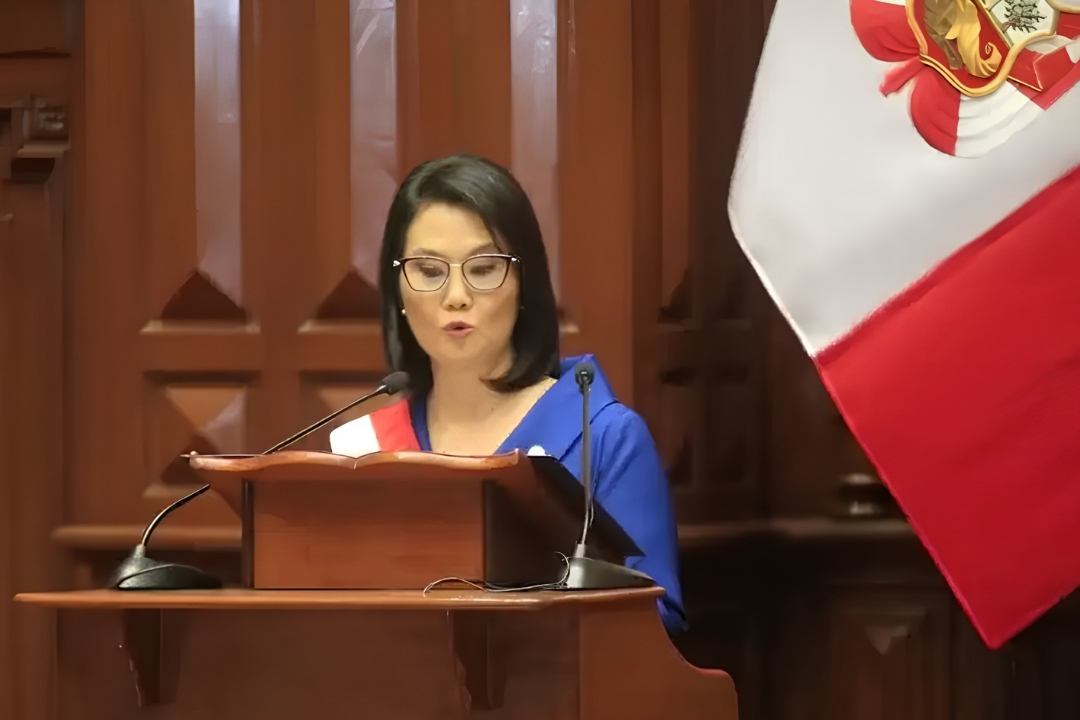
Keiko Fujimori’s new administration as head of the Peruvian government cannot be viewed as an isolated event, but rather as part of a broader trend in Latin America: a shift in power toward the right that does not necessarily reflect a uniform shift in society, but rather the ability of certain groups to concentrate control over the state. In the case of Peru, this process takes on a particular dimension: it is not merely a change in government, but the return to power of the direct heir to an authoritarian project—Keiko Fujimori, daughter of former dictator Alberto Fujimori—which reignites historical tensions surrounding democracy, institutional frameworks, and the concentration of power.
The political landscape in Congress reflects this tension. The election of the leadership bodies revealed a fragmented balance of power: while the ruling party managed to prevail in the Senate by a narrow margin of one vote, the opposition secured the presidency in the Chamber of Deputies. This unstable balance could have served as an institutional counterweight; however, in practice, it has been the starting point for the executive branch to push for mechanisms that allow it to expand its scope of action outside the parliamentary debate.
In this context, the request to delegate legislative powers becomes a central element of the new administration’s start. Under the pretext of addressing public safety concerns and reviving the economy, the executive branch seeks to enact legislation over a 120-day period across a broad range of issues, including public safety, labor regulations, tax policy, productive development, government reorganization, and the promotion of private investment. This scope is no small matter: in practice, it opens the door to governing by decree in structural areas. Furthermore, the document itself stipulates that the regulations issued will be exempt from mechanisms such as public consultation or regulatory impact analysis, significantly weakening standards of transparency and citizen oversight. Thus, what is presented as an efficiency measure translates into an accelerated concentration of power in the executive branch.
This governing logic is also reflected in the content and contradictions of the president’s rhetoric. Although Fujimori addressed sensitive issues such as teenage pregnancy, her own congressional caucus sponsored and passed Law No. 32535, which eliminates the guidelines for Comprehensive Sex Education (ESI) and replaces them with a model centered on biological, scientific, and ethical foundations, without a gender perspective. This new framework promotes a strictly biological view of men and women, prioritizes traditional family values, and reinforces parental rights over school education—all of which directly conflict with the evidence on effective public policies to prevent teenage pregnancy. The contradiction between the assessment of the problem and the concrete measures taken reveals not only inconsistency but also a clear ideological orientation.
Something similar is happening in the areas of education and youth. In her speech, the president stated that she would “expand Beca 18 so that more young people can access higher education, ” without specifying goals or timelines. However, this announcement comes at a time when her party has backed changes to the National Scholarship and Educational Credit Program (Pronabec) that, according to organized student groups, could restrict access to and continued participation in the scholarship system. Among the contested changes are the possibility of losing the benefit for failing courses and the inclusion of ambiguous disciplinary criteria that could affect recipients. Added to this is the complete lack of mention of the Bicentennial Scholarship, which is currently at the center of public debate.
Tensions surrounding these policies have already begun to spill out onto the streets. For days now, students organized under the National Front of Scholarship Recipients, Former Recipients, and Applicants (FRENABEP) have been staging protests in front of the Ministry of Education, demanding that the proposed changes be shelved and that a dialogue be initiated. Their demands aim not only to halt the cuts but also to guarantee a real increase in the budget allocated to higher education and scholarship programs. In this regard, the announcement of the expansion of Scholarship 18 appears more like a rhetorical gesture than a policy backed by specific decisions.
Finally, the government’s economic and environmental approach reinforces the idea of a structural shift toward an extractivist and deregulated model. The package of delegated powers includes the ability to modify environmental regulatory frameworks with the aim of “harmonizing” environmental protection with the promotion of productive activities, as well as simplifying and accelerating project approval processes. In practice, this opens the door to a relaxation of environmental standards in favor of private investment. Organizations such as Red Muqui have warned that these measures are not isolated but are part of a deeper trend: the consolidation of a model that prioritizes the expansion of extractive activities (especially mining) over the rights of communities and environmental sustainability, thereby weakening oversight mechanisms and citizen participation. From this perspective, the problem is not merely regulatory but structural: it involves the reaffirmation of a development model based on the intensive exploitation of resources, historically linked to social conflicts and regional inequalities.
Taken together, these factors suggest that the beginning of Keiko Fujimori’s administration can be viewed as part of a process of democratic regression in Peru. The combination of a rhetoric that appeals to urgent social demands, public policies that move in the opposite direction, and institutional mechanisms that concentrate power in the executive branch creates a scenario in which democracy is being hollowed out while structures of control are reinforced. Rather than an ideological shift in society, what we are witnessing is a reconfiguration of power from above, in line with a regional trend that is redefining the rules of the political situation in Latin America.