Ukrainian trade unionists describe life and resistance under war and occupation.
By Jeremy Dewar
The Ukraine Solidarity Campaign hosted a meeting in August with two Ukrainian trade unionists at Unison’s London HQ.
Khrystyna Levchenko, a youth workplace rep of the Atomprofspilka union at Zaporizhzhia nuclear power plant (ZNPP), and Ivanna Khrapko, an official in the State Employees’ Union of Ukraine and Youth President in the Federation of Trade Unions of Ukraine, spoke of the terrible conditions faced by workers and their families in the war-torn country.
Ivanna Khrapko reminded us that in July alone Russian drones and ballistic missiles killed 437 civilians. Nowadays the reassuring sound of interceptor missiles is silent, giving people typically 30–40 seconds’ warning of incoming attacks.
Going to work, ending shifts and attending school are all daily nightmares. Ballistic missiles hit Kyiv every day, in Kherson it is impossible to move around the city freely, and ‘unbreakable’ Kharkiv is completely without air defences. ‘Double tap’ airstrikes, pioneered by Israel, routinely target health workers and firefighters coming to assist the injured.
Zaporizhzhia
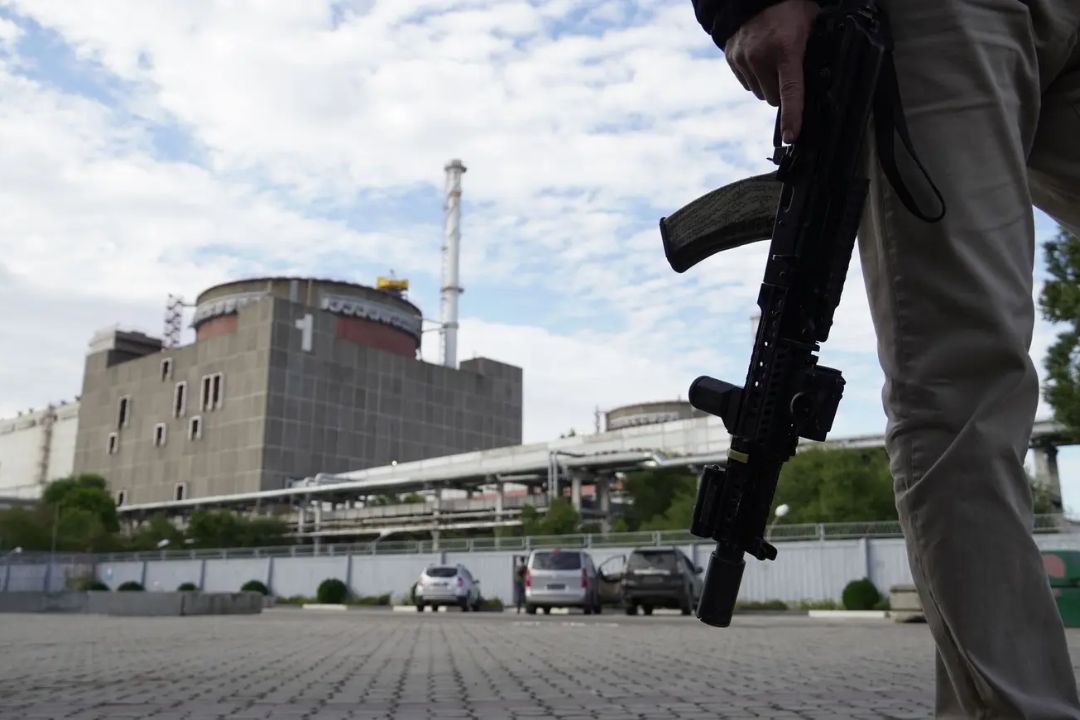
Levchenko gave recounted the Russian takeover of the largest nuclear power plant in Europe in March 2022. Khrystyna worked as an engineer at ZNPP for over 10 years, the last 18 months under occupation. Four days after Russia’s full-scale invasion, on 28 February 2022, residents of the nearby town of Enerhodar erected barricades and formed a 10,000-strong human shield around the plant to prevent Russia’s military advancing.
The National Guard only had light weapons, though, no contest for the Russian artillery, which opened fire on the peaceful protesters on 3 March. By the following day, the training centre, gatehouse and administrative building were destroyed; ZNPP was under Russian control.
Before the war around 11,000 workers were employed at ZNPP, of whom 5,000 were on site at any one time. At the time of the attack, only 2,200 were at work, and most of them were sent home by management. But 14 lab assistants, all women, bravely volunteered to work a 24-hour shift—their usual shift is eight hours—to keep the plant running. If a nuclear plant stops running, an uncontrolled nuclear chain reaction could have devastating consequences.
The workers were forbidden to use their mobiles, even to phone their children, or to talk, which was in itself a highly dangerous condition. Eventually all workers were forced to take Russian passports and sign contracts with Russian conglomerate Rosatom to continue their essential work. Meanwhile, Russian troops broke all safety regulations as they encamped in the plant, washing their laundry, erecting sleeping quarters, installing electric heaters and cooking food.
Levchenko recalled the first blackout three months later in June, when the electricity supply to her unit, number five, fell from 500MW to zero in seconds; a quick phone call revealed that neighbouring Unit 6 had witnessed the same sudden drop. The workers, without help from the Russian military or Rosatom, managed to stabilise the situation at around 120MW, but further electricity supply failures have followed.
As have disappearances of key workers. At least 45 workers have been kidnapped. Twenty have been sentenced, four await ‘trial’, and 13 are being held incommunicado. Charges include espionage, terrorism, and treason to the Russian Federation. Sentences range from 11 to 25 years.
Atomprofspilka is campaigning for the immediate release of 15 workers, the Zaporizhzhia 15, the most prominent of whom is Serhii Potynh, who has suffered torture and is serving a 20-year sentence for terrorism and ‘subversive activities’. The Russians even detained and mistreated Serhii’s wife for a week.
Khrystyna also revealed some of the details of her escape, traversing countless checkpoints, encountering dead ends, and finally getting into Russia, Latvia and Poland. She made a point of mentioning the help she received from ordinary Russian workers, including a taxi driver, along her way. Although even the smallest display of solidarity with Ukraine and disapproval of the war is harshly punished, anti-war sentiment in Russia is growing.
Trade union rights in Ukraine
Nevertheless, the Ukrainian government is itself accused of a series of attacks on trade union rights and free speech for socialists. In 2022, the government, as part of the imposition of martial law, passed draconian labour laws that invalidated collective bargaining, legalised zero-hours contracts, increased the maximum working day to 12 hours, and allowed employers to fire workers without giving justification.
On 5 June 2025, the trade union headquarters of FPU, the country’s largest union federation, which before the war had over 4.8 million members, was seized by the police and union staff were expelled. This came after the arrest of Grigoriy Osovyi, President of the FPU and a member of the ETUC Executive Committee.
Yarema Zhuhaievych, chairman of the Trade Union of Aircraft and Machine Building Workers of Ukraine (TUAMBWU), affiliated to the FPU, has been in pre-trial detention since 1 May this year.
On 10 August, a Ukrainian court sentenced the 27-year-old Ukrainian socialist Bogdan Syrotiuk to 15 years in prison for ‘high treason’ under martial law. He had been under arrest since 25 April 2024 for opposing the war in Ukraine. He is now appealing the verdict.
Answering a question about President Zelenskyy’s anti-strike laws, Ivanna Khrapko could only say that the union has negotiated that once martial law is lifted the right to strike will be restored and indeed extended to council workers and civil servants. Their right to strike did not exist before the war.
As for the ban on demonstrations, she observed that these can be breached if ‘the cause is a popular one’, like the anti-corruption demos last summer and the recent ones supporting sacked defence minister Mykhailo Fedorov.
But trade unions continue to operate, albeit under difficult conditions. Khrapko told us that they regularly bring workers together and train up workplace reps and negotiators. Firefighters, railway drivers and paramedics are among the most dangerous professions, suffering many deaths and injuries. The Federation has managed to negotiate a three-hour period of grace for workers unable to reach their workplace due to missile and drone attacks.
She made a special point about the unions’ work establishing women’s councils, where women face an increased ‘double burden’ while their husbands and sons are on the frontline. In contrast to the situation before the war, 60% of union members are now women. The union has won more state benefits for women.
The union is also working closely with disability rights campaigns to establish safe and appropriate conditions for the increasing number of disabled workers due to war casualties. Close ties to the social movements, more necessary than ever due to the war, have been strengthened.
Solidarity convoy
These reports give some indication of the conditions that the Ukraine Solidarity Convoy will encounter this autumn. The convoy, carrying medical supplies to Ukraine, has three legs, from the Spanish state, the UK and Norway. Trade unionists and socialists will speak to labour movement activists in cities along the way, before converging in Poland and entering Ukraine.
The convoy has already departed from Barcelona and will leave London in November. We encourage all our readers to call for the return of the disappeared Zaporizhzhia workers, support Ukraine Solidarity Campaign initiatives and donate to the International Solidarity Convoy to Ukraine.