The Responsibility of Revolutionaries in the Face of the Elections and The Future
Automatically translated by AI.
By Gérard Florenson
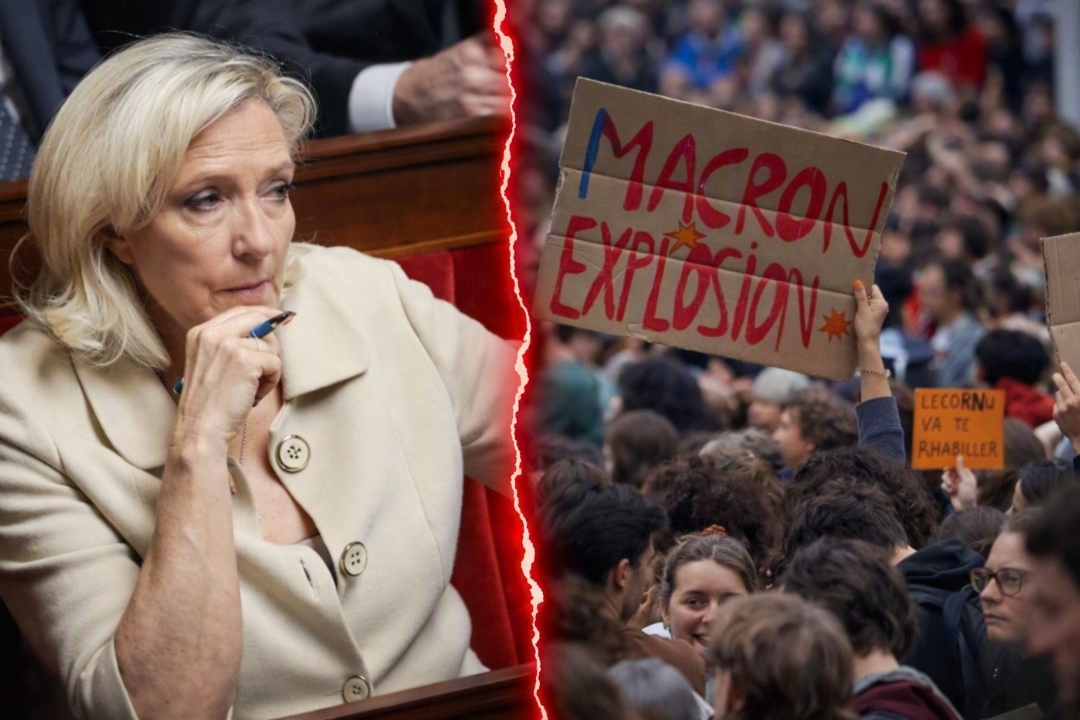
The challenge of the 2027 presidential election seems to boil down to the possible election of Marine Le Pen, the National Rally (RN) candidate. Riding the wave sweeping through most countries, including those in Europe, the far right appears to be on the verge of power, and the only question is whether this can be prevented—and, if so, by what means.
All commentators—at least those who fear such an outcome—agree that, unlike in previous elections, in which opposition to the RN paved the way for Macron’s victory, the “cordon sanitaire” isolating the RN is unlikely to be replicated. Both the legislative and municipal elections have shown the permeability between the right-wing and far-right electorates. Calls from the institutional left for a “republican cordon” have been one-sided. If its clear lead in the polls is confirmed at the polls, it can count on Zemmour and other far-right candidates withdrawing in the runoff, giving it strong potential.
A solution that the employers’ association no longer rules out
But if Marine Le Pen has any chance of moving into the Élysée Palace next May, it is not so much because of a supposed irreversible shift toward fascism in public opinion as it is due to a change in attitude among a significant portion of the business community. The candidate has made an effort to reassure the public and “de-demonize” the National Rally (RN); she no longer speaks of leaving the European Union or even abandoning the common currency. She simply presents herself as the true modern right, breaking with the “soft right” that supports Macron. Her rhetoric on “national preference” does not bother capitalists who need immigrants but want to keep them in precarious conditions.
The capitalists are impatient: France must catch up as soon as possible in the dismantling of public services and the destruction of social gains. It must reclaim its place among the leading imperialist powers and regain the ground it has lost in Africa. Successive governments have tried in vain; they have dismantled social laws and imposed setbacks on a labor movement that often remained passive, but all this is not moving fast enough to guarantee “our competitiveness.” Macron and his rapidly rotating prime ministers have failed to push through the pension “reform” that employers’ groups consider a priority. The French Business Movement (MEDEF) wants to break this deadlock.
Capitalists are looking to Italy. Meloni has so far managed to stabilize her government—without any open crisis—and to push through policies favorable to Italian employers. So why not Marine Le Pen as president, with a government that brings together a significant portion of the so-called “classical” right? It would not be the “iron fist” of fascism, but rather an authoritarian power willing to impose its measures by force; the institutions of the Fifth Republic provide the means to do so, and using them is a matter of political determination.
The crisis facing all the old bourgeois parties paves the way for Le Pen
On the right, there is a cacophony that cannot be explained solely by clashing egos, although, of course, personal ambitions play a role.
But the right—in all its various forms, some centrist and others more clearly reactionary—is desperate. The crisis of the regime is the crisis of their regime—the political system that has always been theirs and that the “interlude” of Mitterrand’s two seven-year terms ultimately respected: that “republic of friends and scoundrels” that has been the foundation of their prosperity.
There are numerous potential candidates, and for the moment, there is no indication that an agreement will ultimately be reached on a single candidate—which, however, would be their only chance to make it to the runoff and hope to win, even by a narrow margin, by banking on voters’ reluctance to entrust power to the RN. To win, to hold on to power a little longer by counting on the collaboration—at least passive—of a segment of the bourgeois left…
But this bourgeois left isn’t in any better shape either. The Socialist Party, which for a long time was its mainstay, is completely fragmented. This began with Benoît Hamon’s electoral debacle and the move by some of its elected officials toward Macron, and has since worsened with the proliferation of small factions vying for the party’s legacy. One faction, led by Glucksmann and Hollande, is openly seeking a governing agreement with the “civilized” right—excluding the extremes, namely the National Rally (RN) and La France Insoumise (LFI); this could take the form of supporting a right-wing candidate if one makes it to the runoff. Another faction, led by Faure, still hopes to revive the New Popular Front—at least for the duration of an election—without completely ruling out a “national unity” government afterward. And then there are the spoilsports like Ruffin and some environmentalists… all in all, a lot of people for very few chances of success.
This political breakdown among the parties that have taken turns in power—and are responsible for the deterioration of living conditions for the vast majority—paves the way for Marine Le Pen, despite her electronic ankle monitor and the verbal gaffes of some of her elected officials.
Is Jean-Luc Mélenchon the answer to the far right?
This is how the leader of La France Insoumise presents himself. De Gaulle once said, “There is nothing between the communists and me.” Mélenchon takes up and updates this line of reasoning: he is locked in a head-to-head race with Marine Le Pen, and all the other parties—along with their potential candidates—are insignificant. It will be either her or him, and to prevent a victory by the National Rally (RN), there would be no other solution than to throw one’s support behind his candidacy.
Despite his grandstanding, Jean-Luc Mélenchon will not be the next president of the Republic; he will be defeated in the runoff—if he even makes it that far—by the predictable alliance between the National Rally (RN) and a majority of the right, coupled with the refusal of the centrists and a significant portion of the bourgeois left to “choose between the extremes.”
This is the result of the demonization of LFI, which has been accused of the worst possible crimes, including anti-Semitism and seeking to establish a “Bolivarian” communist dictatorship. Not only LFI, but also its leaders and elected officials, are the targets of slander—often with racist undertones—which reflects the bourgeoisie’s hatred toward the “dangerous classes.” The goal of these campaigns is to trap Mélenchon and LFI within the “cordon sanitaire” and to rally support against them by appealing for a “republican vote” at a time when Marine Le Pen appears to have moderated her stance and become more acceptable.
We understand the hopes that workers, students, and other sectors of the people—who are concerned and desperate to stop the far right—place in Mélenchon, but we do not share them. Beyond our differences with both the political positions and the functioning of LFI, we emphasize that these hopes, in the hands of the reformist left, will be used to channel anger into bourgeois institutions, completely preventing us from preparing for the intensification of the inevitable class struggles that will arrive very soon after the elections. The bureaucratic apparatuses and the reformists will try to postpone these confrontations, to divert them once again by raising expectations in parliament and then at the polls during legislative elections.
Preparing for the Class Struggle
We can formulate hypotheses and consider various future possibilities without spending our time discussing the polls—though we should keep them in mind. But we will not be responsible for the election results. Even if we pursue the best policies, reality is far more complex than anything we can do or speculate about in terms of the election. What we are responsible for, however, is how we prepare for what comes next.
The two likely scenarios are not exactly encouraging. If Marine Le Pen is elected and, immediately afterward, the RN increases its number of deputies, we will have a government that attacks workers and young people, bringing together the right and the far right. The few demagogic promises made for electoral gain will quickly be forgotten. Immigrants will be the first target, condemned to insecurity and precarious living conditions for the greater benefit of the exploiters. It won’t be fascism of the Hitler or Mussolini variety, but fascist gangs will feel emboldened and will step up racist, sexist, and homophobic attacks, without fear of a police force already infiltrated by fascists.
The other possibility is a narrow victory by a single candidate from the “Republican right,” made possible by a strategic vote from part of the “left,” with the likelihood that a dissolution of the National Assembly would result in yet another lack of a majority. But the resulting government would have to rely on the support of the RN to pass its measures, which would undoubtedly involve a more decisive implementation of the policies that Macron was unable to see through to the end.
What we must prepare for in both cases is to confront a government that is hostile to workers and young people—one that is even more determined and brutal, and openly serves the MEDEF.
In previous decades, powerful mobilizations by workers, the general public, and school-age youth sometimes succeeded in forcing governments to back down and temporarily halt their attacks on social protections and labor rights. At the time, the “Yellow Vests”—despite their contradictions and limitations—shook Macron to his core with their street protests and highly progressive demands. We must not, therefore, give up the fight. We must combine strikes, blockades, and demonstrations—which requires our capacity—the capacity of “those at the bottom”—to force union leaderships to reject any dialogue with the reactionary forces and to advance a plan of struggle to halt social destruction and win our demands.
Revolutionaries Facing Up to Their Responsibilities
The organized forces of the revolutionaries are too few in number to meet this challenge, but it is possible to win over new generations of activists to the struggle and also to win back the older ones—the thousands who have grown weary but who continue to participate in unions and associations. There is one condition: we must break with all forms of sectarianism and self-assertion, prioritize what unites us, and understand that our differences must not be an obstacle to joint action.
In the struggles and in the elections? Yes. One cannot exist without the other. For many workers and young people who view us favorably—and whose numbers are greater than our election results suggest—our divisions are incomprehensible and discourage them. It is time to correct our course. Contrary to the claims of the leaders of Lutte Ouvrière, the proliferation of candidacies is not inevitable, and the election results do matter. A strong election result boosts the morale of activists and supporters and spurs them on to prepare for battle on another front—that of the class struggle. In elections where it is possible to win elected office, these positions serve as a foothold—our spokespeople within the assemblies. Joint slates in the municipal elections would have yielded better results.
This is even more true for presidential elections. If revolutionaries go into the election divided, it means they are giving up, that they are leaving political polarization at the level of a confrontation between the RN and the LFI. It means settling for token candidates, crushed by the so-called “tactical vote,” with the resulting discouragement of seeing so few of us there.
The Unity of Revolutionaries in Struggles and Elections
We can do things differently, and it’s within our reach. The presidential election campaign—despite the objective challenges, the difficulties, and the maneuvers aimed at sidelining the “minor candidates”—remains an opportunity to be seized. It offers the chance to widely publicize a program of urgent social and democratic reforms, while explaining that it will not come from the ballot box and that, as always, we will have to win these advances through our struggles.
A unified campaign by the revolutionaries would resonate more strongly than scattered campaigns; it would give hundreds of thousands of people the confidence to prepare for confrontations with the bosses and the government. Unfortunately, this is not the current choice of the revolutionary left organizations. Some, torn between despair and hope, are throwing their support behind Mélenchon’s candidacy. The rest are presenting a divided front to the electorate, whether due to an inability to reach agreements, factional interests, or the petty hope of gaining a few dozen members.
In another article, we have outlined Lutte Ouvrière’s position and its defeatist motivations, but its predictable rejection of any united campaign should not lead the other organizations to resign themselves to doing the same.
We regret that, after having approached LO in vain, the leaderships of the NPA-R and Permanent Revolution were unable to reach an agreement. The candidacies they are putting forward are positive, reflecting the struggles and sectors of organized workers, and—at the cost of considerable effort—they can hope to obtain the 500 endorsements needed to see them through to the end. Despite all the obstacles, there have been, in most cases, two and sometimes three revolutionary candidates. But we simply ask: and then what? How can this division help prepare for what is to come, which will unfold on an entirely different terrain?
We urge our comrades to revisit the issue and make the necessary efforts to put forward a united far-left candidacy. Various historical and current examples show us that we can achieve this, such as the recent unified rallies and actions in Argentina against the far-right government, which is propped up by the passivity and complicity of Peronism and the treacherous union bureaucracy.