By Peter Main
Note: This is transcript of an introduction by Peter Main at the summer school of the German speaking sections of the ISL (Arbeiter:innenmacht from Germany, Arbeiter*innenstandpunkt from Austria and Marxistische Aktion Schweiz). We reprint the speech here.
Having looked at US policy towards Europe, we now turn our attention towards the Western Hemisphere. As an egotistical property speculator, Donald Trump sees no reason why Canada, the property next door, shouldn’t simply be amalgamated with his existing property portfolio. However, although this is further evidence of his under-estimation of the concept of national identity, Canada is an imperialist power and we have no particular concern with its defence. What we will discuss today is Washington’s policy towards Latin America, often described as “America’s backyard” – at least by other imperialist powers.
In their coverage of this subject, journalists often refer, jokingly, to the new “Donroe Doctrine” or, if they are better educated, as the “Donroe Corollary” so, we will begin with this – and, as we shall see, once you do look into it, it is anything but a joke.
Some Historic Background
The reference, of course, is to the 1823 assertion by James Monroe, the fifth President of the USA, that there should be no “interference” in the “Americas” from other powers. He meant the European powers that had been expelled by nationalist movements and were thought likely to try to return. This was the “Monroe Doctrine” interestingly, although not formally adopted by the UK, it was agreed between London and Washington that only the Royal Navy had the capacity to enforce the Doctrine and, of course, the shared desire to keep the Europeans out. Characteristically, “perfidious Albion” almost immediately transgressed the Doctrine by proclaiming its own sovereignty over Argentina’s Islas Malvinas, which it renamed the Falkland Islands.
That aside, the Doctrine was held to justify US intervention across Latin America whenever its interests were threatened, or its advantage could be gained – for example in the war against Spain to take effective control of Cuba in 1896. Shortly after that, and perhaps to justify it in retrospect, President Theodore Roosevelt declared that the US had the right to act as an “international police power” in the Americas and, consequently the right to intervene to stop “chronic wrongdoing” or “instability”. This was dubbed the “Roosevelt Corollary” to Monroe’s Doctrine.
Such an explicit assertion of US suzerainty over the whole hemisphere was supposed to have been replaced by Franklin Delano Roosevelt’s “Good Neighbour” policy by which he pledged that the USA would not interfere in the domestic or foreign affairs of Latin American nations. That was, at least theoretically, still in force in the 1960s but did not prevent Kennedy’s Bay of Pigs assault on Cuba or Johnson’s sending troops into the Dominican Republic when he feared “another Cuba”.
Trump Doctrine
In reality, then, the US has always believed itself entitled to impose its will on Latin America. In general, the “Trump Corollary” or Donroe Doctrine, as expressed in the US National Security Strategy, merely reformulates this for the 21st century. However, there is a significant change of emphasis. As well as introducing the idea of preventing drug smuggling as sufficient justification for intervention, it specifies that the aim is to block all “outsiders” from sending in forces or controlling strategic resources such as minerals. This does, indeed, echo Monroe’s fear of “foreign powers” muscling in on US interests – but the threat now is not from across the Atlantic, but across the Pacific.
Before we deal with that, however, we should review the current balance of forces. Despite the two waves of the so-called “pink tide” that began with Hugo Chavez in Venezuela and Luiz Inácio Lula da Silva in Brazil and then the likes of Nestor Kirchner in Argentina, Evo Morales in Bolivia and Rafael Correa in Ecuador, followed, more recently by, for example, Andrés Manuel López Obrador in Mexico, Gustavo Petro in Colombia and, once again, Lula da Silva, it was pro-US figures who won the last seven Presidential elections in the region.
The most recent of these, Abelardo de la Espriella in Colombia and Keiko Fujimori in Peru have no doubt benefitted from the arrival of Trump in the White House. Like them, José Antonio Kast in Chile, Daniel Noboa of Ecuador and others campaigned on very “Trumpian” issues such as internal security, illegal migration and the “war on crime”, to justify increasingly repressive laws and barbaric prison regimes such as Bukele’s mega-prison in El Salvador. Similarly, de la Espriella refers to the United Nations as an “instrument of the left” while Kast is against abortion in any circumstances and has even opposed his own wife taking the contraceptive pill.
At first sight, Trump’s approach toward Latin America is not a complete break from long-established US practice. His explicit support for Flavio Bolsonaro as a candidate for the Presidential election in Brazil next year or the $20billion to boost Javier Milei in Argentina, are not dramatically out of keeping with the actions of his predecessors. In some respects, such as 10% tariffs across the board, it is even counter-productive to US interests since it has encouraged governments to look for other markets and trade links.
It is certainly true that he shows a cavalier disregard for diplomatic norms as, for example, when he intervened in the Honduran election by pardoning Juan Orlando Hernández, the former Honduran president convicted of drug trafficking in the US. Even before taking office, in November 2024, Trump was threatening Panama, asserting that higher rates were being charged for US ships to pass through the canal and claiming that, “China is running the Panama Canal that was not given to China, that was given to Panama foolishly, but they violated the agreement, and we’re going to take it back…” Both claims were untrue but Trump may feel that his bluster was effective; Panama agreed to re-open Fort Sherman and allow deployment of US troops, by agreement.
Venezuela, however, showed Trump was prepared to go further than bluster. On the basis of unsubstantiated claims of government sponsoring of criminal drug smuggling, small boats plying the Caribbean Sea were blown to smithereens by US warplanes and, of course, on January 3rd this year Caracas was bombed as US troops broke into the Miraflores Palace and seized Nicolas Maduro and his wife.
Against that background, Trump’s statement, “I do believe I will have the honor of taking Cuba” has a seriously ominous implications.
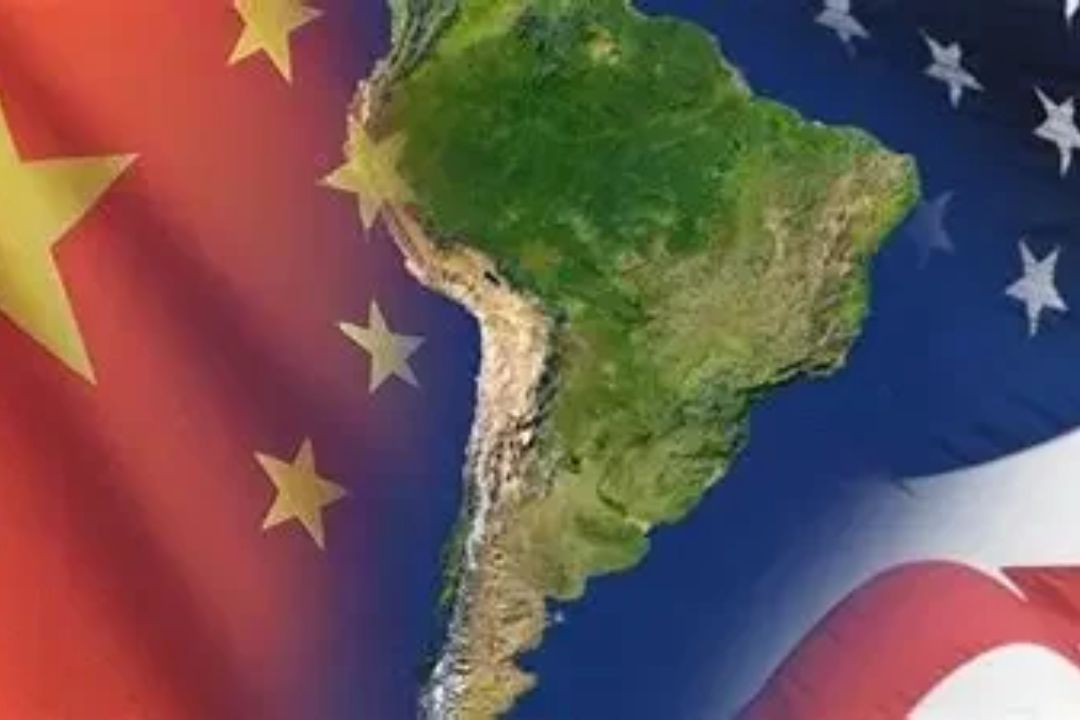
Trump’s actions are far from unique in the history of US relations with Latin America but it is true that his perceived threat of a challenge to US dominance is new. Where previous interventions, equally brutal, were aimed at quelling hostile movements and regimes within the continent, today the threat is external, dynamic and already a force to be reckoned with: China.
China
As far back as Barack Obama in 2011, Washington has been aware of Beijing’s global strategy of financing infrastructure and extractive industry projects to support its own dramatic economic growth. While the well-known Belt and Road Initiative maps show projects across Eurasia and down into Africa, China has not ignored Latin America. As early as 2010, $25 billion was being invested annually, usually in major projects. This resulted, for example, in the construction of ports in Ecuador, Venezuela, Colombia and Mexico, and three in both Cuba and Brazil .
The most recent of these, Chancay in Peru, illustrates the long term and integrated strategy pursued by China. The port itself cost $1 billion to build, it is the largest port on the whole Western seaboard of the continent and is situated near to copper, tin and zinc mines that are already owned by Chinese companies. Goods shipping from the coast of Southern China now take 23 days to reach Peru, as opposed to 43 before it was built. Obviously, Chancay serves as a doorway to other countries, particularly the Andean republics, but there are also plans for a railway to connect this Pacific port to another on the Atlantic coast of Brazil, opening an entire region to development. There is no date for this huge project but it serves to show what is thought possible.
It was such super projects that alerted the US to China’s potential, a threat on a completely different scale from either European links or domestic insurgencies. However, as the US journal Foreign Affairs recently reported, China has now adopted a rather different approach. As the report explained, China is now, “embedding itself in the region by fostering smaller, quieter endeavours, often at the municipal or provincial level”.
This new approach is in keeping with President Xi Jinping’s domestic strategy of pouring resources into advanced technologies and information systems, together with commercial, financial and legal services. One particular application is provision of municipal and security surveillance equipment. There now 35 Latin American cities using Chinese equipment and, therefore, reliant on Chinese corporations for programming, updating, maintenance and integration of such systems.
Another example of the new approach comes from the province of Jujuy in Argentina. A geological survey undertaken as a collaboration between Argentinian and Chinese geological agencies, became a state partnership to survey a region of salt flats, when this revealed a rich source of lithium, a Chinese company invested in its development for commercial use. Lithium, of course, is a vital element in the production of modern batteries for electric vehicles, which are produced in China.
Latin America has also figured in China’s more general trading development and this has actually been strengthened by some of Trump’s measures, such as the general 10% tariff on all goods imported into the USA. Predictably, countries look for alternative markets and China’s huge population and dynamic economy is an obvious option.
Beijing is also in a position to make use of Latin America in its trade war with the US. After Trump’s “Liberation Day” imposition of tariffs on Chinese imports, which eventually reached over 150%, China did not back down but cancelled contracts to buy millions of tons of soya beans from US farmers, transferring the purchases to Brazil, not exactly Trump’s favourite Latin American country.
Subsequently, there was a relative climbdown by both sides but it remains to be seen what will happen next, Xi and Trump will be meeting on September 24th – we can imagine they will be discussing much the same topics as we have been discussing at this summer school!
To conclude this brief introduction, it is important to remember that we are here discussing the plans and strategies of two imperialist powers, one in relative decline the other still rising. While it might be quite satisfying to see the USA’s grip on Latin America, or anywhere else for that matter, beginning to slip, we should not make the mistake of seeing China as some kind of benevolent power. What Beijing is doing in Latin America, and elsewhere, is no different from what the British empire builders did in the 19th Century and the USA in the 20th.
Capital is being exported and invested in order to extract wealth and create markets for China’s own production. As internationalist socialists, our programme is counterposed to all imperialists and our strategy is the political development of the working class and oppressed peoples and their mobilisation to take control of all the resources of their countries, including those of the imperialist powers, to develop them in the interests of humanity, not capital – and that will no doubt be strengthened by collaboration with the workers of all countries, including the imperialists.