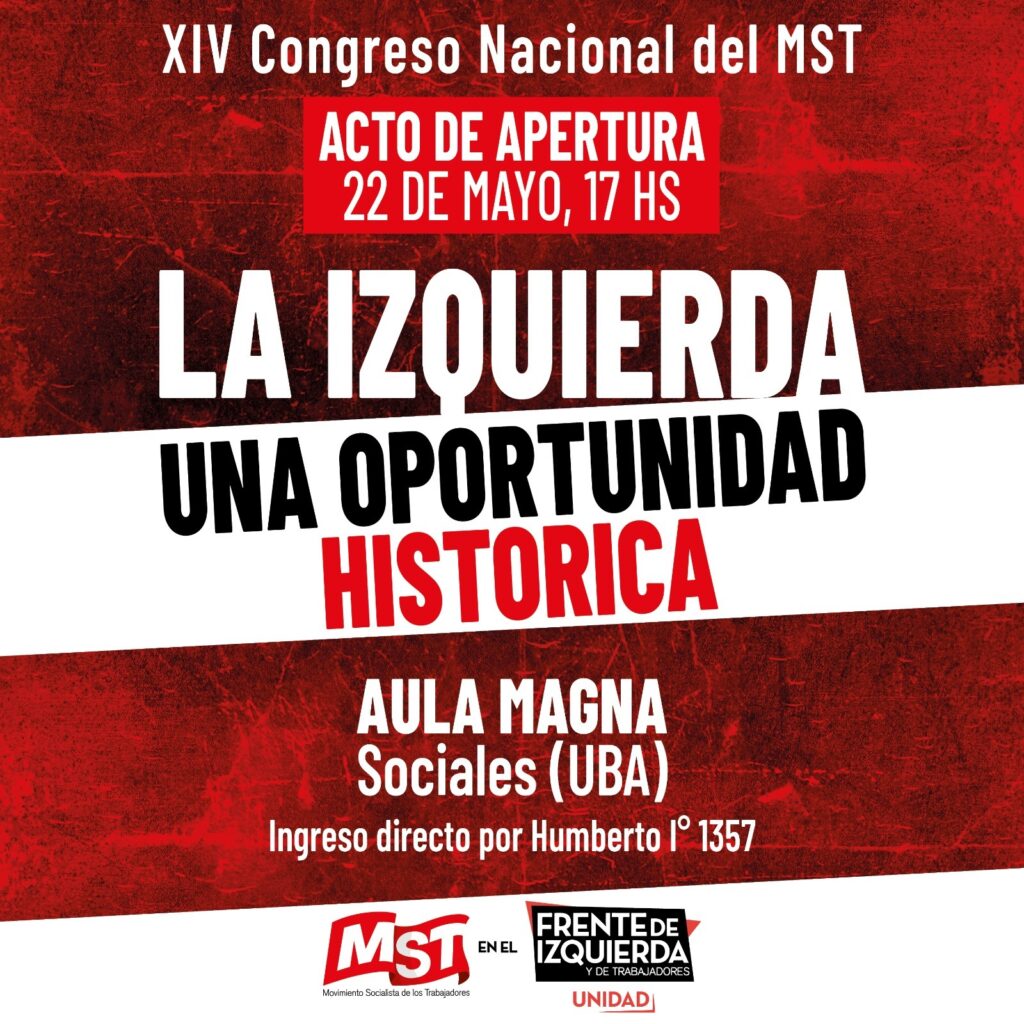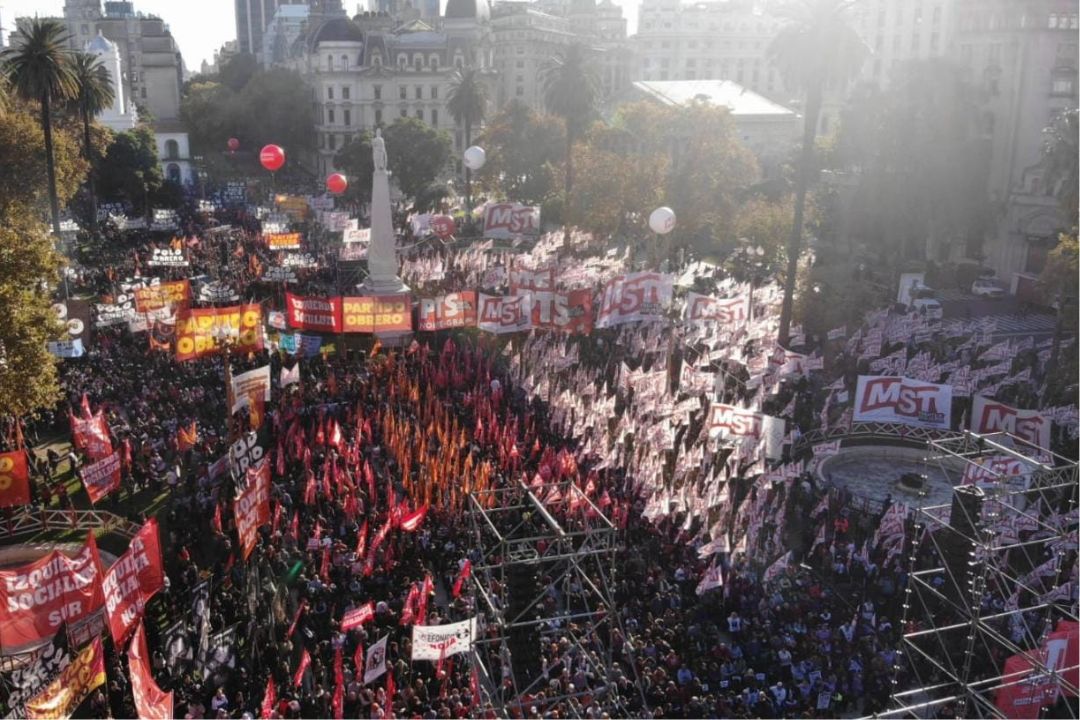
Between May 22 and 25 the XIV Congress of the MST will be held in Buenos Aires. It will be marked by a series of international political discussions, in a context of global polarization and inter-imperialist conflict, with processes that we are intervening in as the dynamic of development and growth of the International Socialist League advances. This is a priority among our internationalist tasks. Our Congress will also have profound debates about the national situation and perspectives. We will discuss a comprehensive assessment of everything we have done in recent years. On that basis, we will debate proposals for our political orientation and party building in the next period. After the Congress, we will socialize its debates and resolutions as a whole. As a preview, this article takes up one of the debates that will be central in our Congress: the historic opportunity that the anti-capitalist and socialist left has before it.
By Sergio García
The current moment deserves special attention, a deep and perspective analysis and, logically, a policy and orientation to intervene in it. We refer to the development that has emerged as the main political novelty: the prominent political advance, as a result of a left shift of an significant part of the population, which anticipates in surveys and opinion polls a political and electoral support for Myriam Bregman and the left that is identified with the Left Front Unity. In relation to this development, we will debate a series of political, theoretical and strategic questions that we raise here for the consideration of the militants of the left, the thousands of sympathizers who support us and all the workers and young activists who want to be part of these transcendental debates.
The profound crisis of Milei’s government
The country is in a new moment, a new conjuncture marked by a series of characteristics that, as a whole, strongly impacted on Milei’s project. There is a combination of an advancing economic and political crisis and greater social responses. In the economic area, it is evident that the failure to control inflation, with forecasts of around 30% annual, leads to the government losing on two fronts: one of its main rhetoric pillars collapses, and rising prices fuels social unrest. At the same time, production, consumption and tax collection are falling. In addition, there ir more instability and criticism from the establishment, towards a government that does not transmit any certainty of being reelected.
The economic crisis combines with the political crisis, mainly around the Adorni case, which is the flagship of a series of corruption cases that have come to light, like the Banco Nación loans, the officials with houses in Miami, the $LIBRA case, among others. But the Adorni case is central in the conjuncture because it destroys the libertarians’ other rhetorical pillar: their supposed crusade against the political caste. Milei appears as a central figure in the defense of a corrupt official and this is what millions of people perceive. The government will be weakened whether Adorni resignes or stays, because it has already lost in the public opinion.
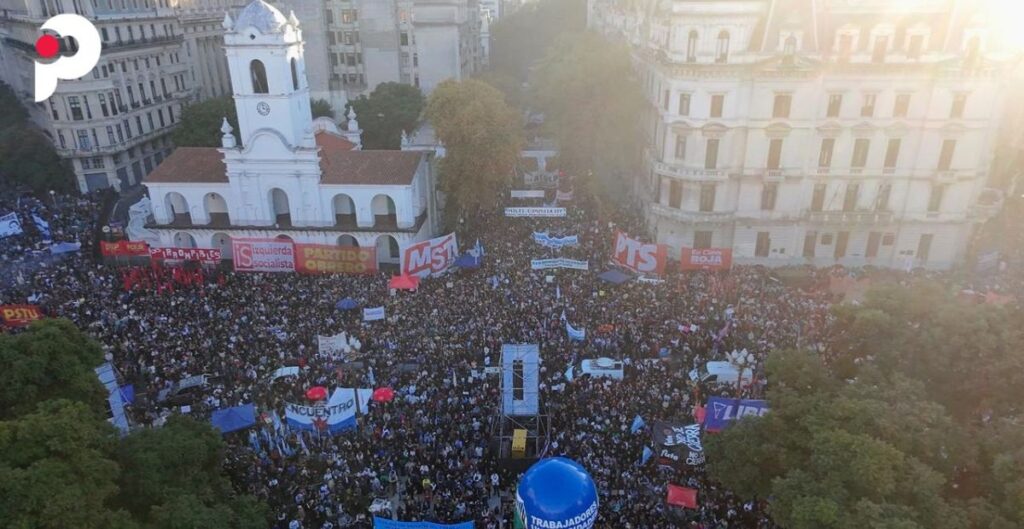
Additionally, there is an advance in the process of struggles, still centered in the provinces, not the country’s political center. This is the beginning of something that could become much bigger. We saw elements of provincial rebellion in Catamarca, teachers’ protests that were massive in Córdoba, self-organized in Santa Fe, and saw a radicalized rank and file overtaking the trade union bureaucracy in Chubut, among other examples. A massive Federal University March has just taken place. What comes next? Most likely an advance of this process, which, were it to talke a leap in the Buenos Aires Metropolitan Area at some point, could begin to change the underlying situation and open unprecedented and very positive perspectives.
The crisis of Peronism, as an essential factor of the present
The other central element that crosses the situation of the country in recent years and that today acquires new symptoms is the deep crisis of Peronism. In a sense, we could not speak of a political advance of the left if this deep crisis of the PJ did not exist. Because if something is part of the reality of millions is the anger that is growing against the government of Milei, and at the same time a deep disappointment that still persists caused by previous Peronist governments, of which the last one of Alberto Fernandez, CFK and Massa, was a qualitative leap.
This has notoriously weakened the relationship of Peronism with its social base, as it is expressed on a daily basis in workplaces, places of study and popular neighborhoods. It is not only an electoral problem, where even in the midst of this crisis, Peronism can capitalize on the growing anger against Milei. It is about something more profound that evidences the rupture from below of important sectors that do not want to support more of the same, driving the most positive phenomenon which is the search for something new from the left.
A left turn has begun
As we said at the beginning of this article, everything described above is causing a shift to the left of a segment of the population. It is the most important fact of the new conjuncture we are living, the most dynamic factor that we have to interpret in all its magnitude as a necessary condition to respond correctly to it. Because we are not talking about just any shift, nor is it comparable to others in previous stages. This turn has an unprecedented and very positive character, finding as a political attraction directly to the revolutionary left and not to reformist or possibilist variants. For the first time this search for the left is linked with the figure of Myriam Bregman and with the left identified with the FIT-U, with anti-capitalist and socialist political positions. Knowing that is why an important sector is choosing her, when faced with the question of who they would vote for or support in the country. That is to say that there is a decision, expressed in about 10% or more of the population, to elect for the government a figure that represents a defined program. This is not a legislative election or a parliamentary debate. All polls are framed in a debate and questions about the future of the country and the possible presidential candidates. And in this context, for the first time, a figure of our front appears very well positioned. It is an unusual and at the same time very positive phenomenon.
At the same time, although the measurement has electoral characteristics, we would make a mistake if we reduce its analysis only to this aspect. Because the transit of a shift to the left in the country is and will always be combined with the development of the class struggle and a possible social ascent. In a sense, the positive change that is materializing in the consciousness of several millions is part and at the same time a foretaste of possible abrupt changes in the future of the country. We cannot separate this political advance from the possibility of a major social crisis in the medium term. Just to take the last historical example of our country, let us remember that the Argentinazo of 2001 was also preceded by an advance of the left in the two previous years, at the time both electorally and in the leadership of union and student sectors. That is why we have to see the situation as a whole and have an integral policy for this phenomenon, which, as we were saying, has as a new and historical element that the turn finds our front and its main political figure in the front line to capitalize it.

Change the reality, change the Left Front
In general it is said that we cannot expect different results by always doing the same thing. This, which is evidently so, is today an even deeper political problem for our Frente de Izquierda Unidad. Already in the previous conjunctures a change was imposed, since the Front could not continue to be marked by a limited electoral format, routine and distant from an in-depth strategy to intervene. Now, in the new situation of advance and turn to the left, the urgency of a change of quality is total. No policy is revolutionary if a profound change in the situation is not accompanied by political and organizational changes of the same magnitude, which materialize in a qualitative improvement of the political tools we have. This is the central and urgent debate that we have to carry out in the Frente de Izquierda Unidad.
From the MST we have been stating that we have a proposal in this regard and we put it at the disposal of a collective debate. In our opinion, a positive leap would be if we form a common party, unified among the members of the FIT-U, with our program and incorporating intellectuals, social referents and related sectors. A party of ours, which at the same time has a democratic functioning that allows the free organization of internal currents, and allows the construction of agreements, as well as the public debate of positions when there are nuances or differences.
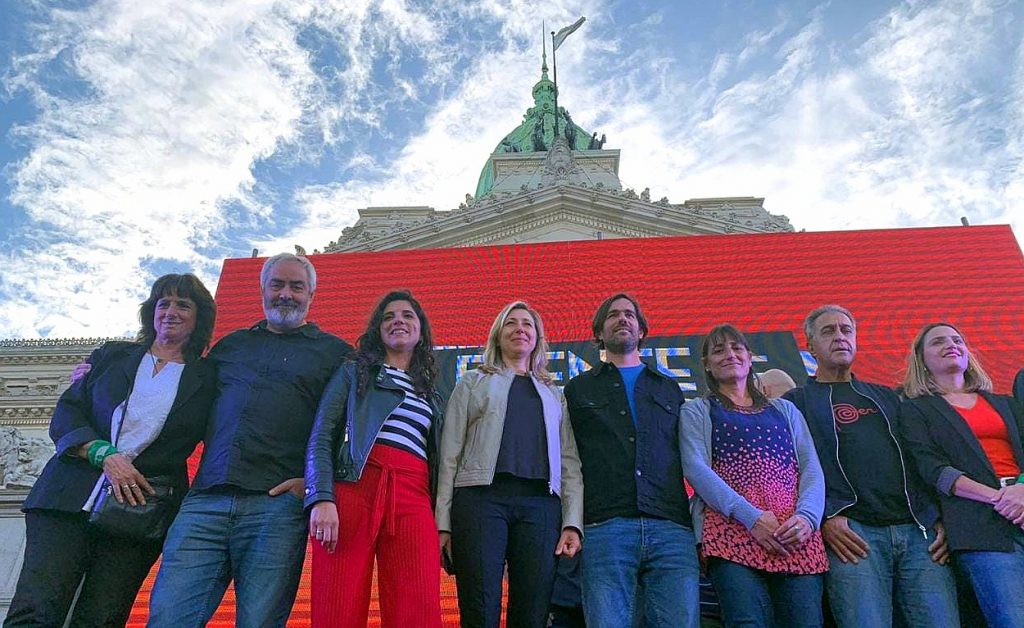
As we have stated through our comrade Alejandro Bodart in the closing speech at the Plaza de Mayo, we are very open to discuss other proposals and possibilities. It is important to us that there be a real advance, we do not make schemes nor do we tie ourselves to only one possibility. For example, if the comrades of the PTS propose to create a PT, a new workers’ party, we are in favor of doing so. In any case we have to debate how it would be, what steps we take in common, how we organize its impulse, to whom we propose it and with what program. It would be very positive that they express a proposal in this respect, in order to be able to initiate an in-depth debate, if this is the possibility of progress. In Plaza de Mayo, Gabriel Solano of PO denied this possibility of debating about a Workers Party, saying that we already have the Frente de Izquierda (Left Front). Thus reflecting that he does not understand either the magnitude of the process and opportunity that is being experienced, or the obvious fact that the FIT-U has many limits that must be overcome.
In a note in response to an article by PO, Guillo Pistonesi of the PTS leadership, says that there is working class strength and that “The task is not to contemplate it from the outside nor to enclose it in the current limits of the FIT-U, but to give it a common political tool. The opportunity is not for the FIT-U to look at itself preserving its current proportions“. We share that we should not close ourselves in and that the FIT-U cannot remain the same. We have then to advance in debating in depth and in unity, how we offer and how we build that common political tool, of which we have to be protagonists and promoters. Because it is a task that in order to do it thoroughly and positively, has to be done in unity, without being driven or built by a single party, which would make it impossible for it to play the leading role it should play.
We can and we want to govern. Take advantage of the situation now
The advance of the left is so notorious in the national political scene that all kinds of TV programs, streaming and social networks debate about the left or invite Myriam Bregman to tell her proposals. Also different national media covered our important act in Plaza de Mayo looking for statements and proposals there as well. What is under debate is not minor. As we were saying, it is not a matter of journalists giving their opinion on whether the left will win a few more deputies. The debate is about the fact that the candidate of the Frente de Izquierda is among the possible most voted candidates in the next electoral contest. And that enables a debate on whether the left can govern, whether it is prepared to do so. We believe that our task is to assume that debate with all audacity. Not focusing on hypothesizing about the possibility of winning an election or not. But rather focusing on what it implies that several millions support us, and how that will have repercussions on thousands of workers, young people, professional intellectuals who would make themselves available to be part of the struggle for fundamental changes. If we on the left consolidate this support in the midst of this turn, and if at some point along the way it coincides with a generalized rise and a social crisis of magnitude, unique conditions will be opened for this relationship of political location with the mobilization of millions to open the floodgates to the dispute for power. This is what we are debating, behind polls that refer only to the next electoral process.
That is why we consider the approach taken by the comrades of PO in this debate, reflected in an article by Néstor Pitrola, to be mistaken. There they take away all transcendence from the political advance that is developing, criticize the PTS for electoralism and the MST for saying in Plaza de Mayo that in a hundred years we have not had an opportunity like this one. PO’s definitions reflect a profound lack of understanding of the phenomenon underway and of the background of revolutionary possibilities that are opening up, if we know how to act correctly, with audacity and seeking the highest levels of unity. Instead of positioning ourselves, as PO, searching for arguments at the service of a fratricidal dispute very out of place and alien to the political tasks of the moment.
We believe that if everywhere there is a debate about who can govern, and Myriam Bregman and the Frente de Izquierda Unidad are placed as the main actors of that future dispute, we have to go out now with more strength, run politically, travel around the country, organize public events, say with force that we do want and can govern. We must call more than ever to organize thousands with us, starting this task collectively around the figure of Myriam and adding from there all the main referents of the parties of the front. And we have to do it, logically, while we promote with force and in the street all the processes of struggle that are underway today. This priority task, which is to fight now and with force to defeat Milei, does not negate the political task of running and taking advantage of the political rise and turn to the left that we are experiencing. PO repeatedly commits the strategic error of separating the social-union struggle from the political struggle. And this gross and permanent error that it commits acquires worse magnitudes in a moment like this, of historic opportunity for the revolutionary left.
Party, parties and revolutionary strategy
Another fundamental debate, theoretical and strategic, generated by the current situation and above all the perspectives that could open up, is how we act from the anti-capitalist and socialist left if at some point a greater growth of political support for the left than is expressed today is combined with a qualitative leap in the struggle in the streets, until opening a revolutionary crisis that puts into question the problem of power, and that gives rise to self-convened formations or organizations of dual power. Because of the weight of Trotskyism and of our front, that combination would open an unprecedented situation of political opportunities. And we want to debate in our Congress and also with the rest of the parties of the front on all these questions.
If at some point we are in front of a revolutionary process and in a very prominent political position, we must start from the reality that there are different parties with different degrees of development and influence, with inequalities in sectors and regions and no one is hegemonic, nor is it planned to be so. And therefore it will be necessary to count on all the strength we have to fight for fundamental changes. In this sense, it is decisive for us to look for mechanisms to try to build common strategies, and we believe that it would be very wrong for any force to believe that it can solve the problem by itself, because this could lead to limited closed or self-proclaimed orientations.
There is a necessary unity to be built and a necessary loyalty to try to achieve it. In our case, we recognize that if comrade Myriam and her organization lead this political process, we want to debate in depth and with political loyalty how we help in everything possible for the process to develop and advance much more. Because those of us who want and believe in the revolution, when historic opportunities open up, we have to act according to those revolutionary objectives, proposing and debating, far from the method of polemicizing for the sake of polemicizing that is used by those who only want to win an argument. This is not the revolutionary method, but the one that places the profound debate in function of the advancement of the revolutionary process. Even the main historical revolutionary experience, the Russian Revolution, demonstrated in reality that at the time it was necessary to reach agreements between parties and different forces. First the Bolsheviks had to make an agreement and incorporate the whole Trotsky current, which was very important. And then all together they made an agreement with the revolutionary socialists because of their weight in the peasantry. This is how those who want to make the revolution act, putting that political necessity ahead of past or even partial differences of the present. Because there will always be agreements, struggle of ideas or in some issues differences. The issue is whether all this is placed within a common strategic framework or not. And we believe that it is possible to do so.
Our XIV Congress will debate on all these political, theoretical and strategic issues. And we will debate our conclusions with other organizations, intellectuals, social referents and allies in this struggle. We will propose the organization of forums, panels and events for the exchange of ideas, special spaces dedicated to these issues within our digital, audiovisual and printed communication tools, to encourage thousands to participate in different ways. In particular with the comrades of the PTS we want to address this whole strategic question in depth, exchanging on their visions of the revolutionary process and to know how they see these political problems, which at some point along the way can become decisive. Do we have the will to try strategic agreements? Do we open an in-depth and loyal debate to explore them? Do we assume that it is possible to coexist on the basis of strong agreements of substance and in that framework respecting divergences that may logically arise? Our Congress will surely respond positively to these questions. We hope that the political location that the comrades of the PTS have today will lead them to pose similar political and theoretical problems, without mistakenly locking themselves in. Exciting times are coming and of enormous political opportunities. The challenge is to resolve well and in unity how to respond to them. To try to avoid that by not doing it or trying to do it, at some point we lose a political opportunity that, we insist, is historic. Let us make this and all the debates in depth. The XIV Congress of the MST will take up this challenge and will try to contribute positively to the tasks set forth in the revolutionary left.
(Sergio García, author of this article, is director of Periodismo de Izquierda and is a member of the MST’s National Board of the Frente de Izquierda. His article is part of the monthly printed edition of Alternativa Socialista, which you can buy in all MST stores or digitally through periodismodeizquierda.com).